Update: Fire at Vietnam karaoke bar kills 23

UPDATE: The death toll from a fire at a karaoke bar in southern Vietnam on Wednesday had risen to 23, a police official said, warning that the number of victims could rise further as search efforts continued at the site of the blaze.

Initial reports put the death toll at 12 with 40 others injured in the fire at a karaoke bar in southern Vietnam, according to reports from state media.

According to Reuters, official reports said the fire broke out on Tuesday night at the bar in Binh Duong province, an industrial production hub near Ho Chi Minh City. Of the 40 who were injured, 11 were said to be in a serious condition.

A witness, who identified herself as Quynh, was quoted as saying in the report: “When the fire broke out, I was so panicked and ran for safety and can’t remember how it happened.”

Prime Minister Pham Minh Chinh on Wednesday ordered the Ministry of Public Security and provincial authorities to investigate the cause of the fire. Chinh also ordered cities and provinces across the Southeast Asian country to step safety standards at facilities prone to fire, including at karaoke bars.

The fire marks Vietnam’s worst incident since 2018 when 13 people died in a blaze in an apartment complex in Ho Chi Minh City. In 2016, a blaze in a karaoke bar in the capital Hanoi left 13 people dead, causing a country-wide assessment of fire prevention measures at bars and clubs. And last month, three firefighters died after trying to extinguish a fire at another karaoke bar in Hanoi. 

Updated EN system standard for alarm systems for Europe is important says Euralarm

The CENELEC TC79 committee on alarm systems is looking at a revision of the EN50131-1, the European system standard for intrusion and holdup systems. Euralarm, who was involved in the revision of the standard, has released a statement explaining why this standard important for Europe and what the benefits of the revision for European citizens, alarm responders, policy makers, insurance companies and for the professional security industry.

Euralarm’s statement:

In order to keep Europe a safe place to live, work and travel we need to protect ourselves and our resources against burglary and robbery. Therefore, many homes and buildings are equipped with an intrusion or hold-up alarm system. The requirements for the design of these systems are laid down in the European standard EN 50131-1. While the number of buildings that are equipped with such a system increased every year, the digitization of our private and business world exploded. Technology evolved and smart homes and smart building became part of our connected world where each and every device is able to communicate with each other. Remote access, remote services, connected devices, cloud-based systems and interaction with automation system are just a few examples of today’s possibilities.

Just like fire safety systems, all security systems have one thing in common: we install them while hoping we will never need to use them. But if the system is needed ‘we only have one chance’ to detect an incident. No matter if it is a panic, holdup, fire, or intrusion we cannot afford ourselves to miss an event. Missing an event can be the difference between no incident or a major incident. The same counts for tamper or technical problems which could lead to malfunctioning of a system. Because there is only one chance in case of an event, our industry wants to ensure that the equipment used in these systems have a maximum reliability. That is why the professional security industry already for a long time manufactures and delivers products and services that comply with the EN standards. For intrusion or hold-up alarm system this is the EN 50131-1 standard.

The EN 50131 has a long history. The first version of the system standard was published in 1997 and was updated several times since then. Other standards in the EN 50131 range followed soon. Today the standard covers all aspects of intrusion and hold-up systems: from the system requirements to power supplies, intrusion detectors and pyrotechnic obscuration security devices. The advantage of a European standard is that it unifies the view on what an electronic intrusion and hold-up system is, as well as defines its functionalities and performance. The standard has helped end users, insurance companies, risk managers, installation and service companies, alarm responders and local authorities across Europe to understand what a system should do.

Since the introduction in 1997 the standard has defined the difference in requirements for low, medium and high risks. This differentiation is meant to ensure that there is a balance between measures and risks. Over the past decades, more parts were added and updated to keep the standards in line with the available technologies. To ensure a correct installation of a security system application guidelines were provided and, in most countries, professional security installers need to proof that they have the knowledge to classify the risks, choose the correct product and install the system in the proper way. Only with these requirements the security system will offer the desired reliability and will be accepted by end users, insurance companies and police response is provided.

In order to proof that security systems and components meet the European standards, the products are tested by independent accredited laboratories. After being tested successfully the systems and components get their official EN compliant certificate. In most countries these certificates are needed to show compliance and get the product locally accepted. Some countries have additional requirements, like the PP6662 – ACPO policy in the UK or the ‘blockschloß’ functionality in Germany to meet the requirements from the local market. The confirmed compliance with the standards and technical specifications is a passport for the professional security industry in Europe and the base for the confidence in our products and services.

Times are changing and technology moves forwards at high speed. More and more different types of sensors and systems become available mainly in the Do It Yourself (DIY) and IoT area. They combine home automation and energy management with intrusion, safety and security functionality. The combined functionalities are added to the ‘home hub’ to provide the end user intrusion and hold up functionality. Reporting of events is done via IP or GSM to the building owner which can cause challenges to get events transmitted on time to responders.  In general, these products and services do not comply with the standards for intrusion and hold-up systems.

Meanwhile, the number of buildings that are secured in this way increases every year, while the digitization of our private and business world explodes. Technology evolves and smart homes and smart building are becoming part of our connected world where each and every device is able to communicate with each other. Remote access, remote services, connected devices, cloud-based systems and interaction with automation system are just a few examples of today’s possibilities. This trend towards digitization is inevitably accompanied by a risk of cyber-attacks. This evolution requires a revision of the EN 50131-1.

Therefore, Euralarm took the initiative in 2020 to organize an open round-table to describe its vision on the future of the security standard. The outcome of the round-table discussion was that the standard should address a set of components complemented by a proposal bringing some nuance to the original 2 options. These outcomes have been presented to the working group in charge of this revision. Another significant contribution has been the proposal for the structure of the revised standard based on the 5 essential functions of an intruder and hold-up alarm system (detection, control and indication, notification, power supply and interaction with other systems) and considering the 4 performance aspects: effectiveness, reliability, robustness and resilience. Very recently, Euralarm fed the standardisation working group with substantial proposals for drawings depicting the boundaries of the system and a style for writing the content of the new standard.

Going forwards Euralarm wants to ensure that the updated standards on one side include the use of new technologies and on the other side continue to ensure that the product, installation and services meet a set of functionalities and qualities and perform as expected in case of an event. This will give users the best insurance that their system works as they expect and that it does not miss any events. Euralarm also believes that the revision will have significant impact on the other standards and therefore suggest to establish, when achievable, a roadmap for the corresponding revision of these other standards. In particular, the revision of the EN 50131 product standards should be refrained until the content of the revised EN 50131-1 is stabilised.

Euralarm calls upon all stakeholders – insurance companies, risk managers, installation and service companies, alarm responders and local authorities – to join the work from Euralarm and its members and participate in the different working groups from TC79. Together with stakeholders on European or on national level we can keep Europe a safe and secure place to live, work and travel.

Arista Aviation wins Portuguese Air Force aerial firefighting contract

Arista Aviation Services, a provider of rotary wing aircraft repair, overhaul, and modernisation with specialisation in the Sikorsky UH-60 Black Hawk helicopter, has announced that is has been been awarded a contract to provide six firefighting-capable Black Hawks to the Portuguese Air Force (Força Aérea Portuguesa), besting Industry OEMs Leonardo and Bell Helicopter.

The contract includes the delivery of six aircraft over the next three years, training for six pilots and 21 mechanics, and five years of onsite maintenance and logistical support. With the addition of these helicopters, Portuguese Air Force aerial firefighting capabilities will be enhanced as each Arista-modified Black Hawk will have the ability to quickly transport 12 firefighters and over 750 gallons of water to rural areas when needed.

Arista President Rich Enderle said, “The Black Hawk has proven itself around the world as an extremely versatile airframe, and we are proud to offer our customers a wide variety of options to help ensure their mission success.

“Our aerial firefighting configuration is highly successful in fighting U.S. wildfires in California and other western states, and we are thrilled to be able to internationally introduce these lifesaving platforms to Portugal.”

Arista is an FAA Part 145 Repair Station and provider of MRO services with facilities strategically located in Alabama and California. Arista specializes in depot level repairs, custom painting, custom avionics upgrades, structural enhancements and repairs as needed to extend the useful life of legacy helicopter platforms.

Mann McGowan expand Middle East distribution network with Emirates Technotrade LLC

Mann McGowan has announced an agreement with Emirates Technotrade LLC to further expand the distribution of Mann McGowan intumescent fire, acoustic and smoke seals to the construction and passive fire protection industries in the United Arab Emirates and throughout the Middle East.

Mann McGowan already has a successful existing distribution and customer network in the region and the agreement further strengthens the company’s ambition to become the leading fire seal manufacturer throughout the Middle East.

The deal also extends Mann McGowan’s partnerships within the Emirates group of companies, with Falcon Acoustics & Passive Fire Solutions Pvt. Ltd distributor of Mann McGowan products in the Indian sub-continent.

Jamie Scott, Managing Director of Mann McGowan, commented: “We are excited to strengthen our position in the Middle East with this agreement with Emirates Technotrade. Their wealth of commercial and technical knowledge perfectly complements the existing distribution network for our high quality, third-party tested and certified seal solutions. This is another important step in Mann McGowan’s global business development strategy.”

Emirates Technotrade and its group of companies has been supplying Passive Fire Protection solutions to the construction industry in both the GCC and Indian sub-continent for more than 15 years and service the Middle East region through their sales office and warehouse in Dubai. Their Managing Director, Varghese Joseph Parackal, said: “Having worked closely with Mann McGowan in India and knowing full well their product testing regime, production capabilities and fast track delivery performance, it was the optimal choice for us to partner with Mann McGowan for the UAE and Middle East markets.”

Mann McGowan design, manufacture and supply a comprehensive range of fire, smoke and acoustic seals to meet industry requirements and customers’ needs and specifications. To ensure the safe compliance on all fire doors and to develop their product range, they work closely with door, glass and hardware manufacturers. Every product is subjected to rigorous quality control and most importantly independent third-party evaluation and testing to various national and international standards.

For further information, please contact Tim Foster on +44 (0)783 3052920 or tim@mannmcgowan.co.uk

www.mannmcgowan.co.uk

Evac+Chair gives the Last Word on the Fire Safety Act

Gerard Wallace, Managing Director at Evac+Chair International tells us why the Fire Safety Act was a missed opportunity

What is your response to the Fire Safety Act, FSA?

We are hopeful that the FSA is just the start of creating legislation and laws pertaining to fire safety, but we do see it as an opportunity missed for the disabled, due to the lack of commitment to PEEPS (Personal Emergency Escape Plan) in high-rise residential blocks.

We have copious amounts of rules, legislation, approvals and controls around Fire Safety, but very little concerning safe evacuation particularly for the disabled. Many lives have been lost due to lack of thought, legislation and planning around safe evacuation. Every building is different, specifically in reference to the means of escape.

There are a wide range of products available to ensure everyone, including the mobility impaired can be evacuated in an emergency but the lack of legislation means they are rarely implemented. Equipment should be mandatorily available to ensure that everyone can escape in an emergency, including the mobility impaired.

The “Stay Put Policy” has been hugely controversial for many years amongst fire safety professionals. My thoughts on this are, who makes the call on “Stay Put” or “Evacuate Now”, what sort of skills and experience must you have to make this judgement? There is a little more clarity around the legal responsibility of “The Responsible Person” but the revised legislation falls far short of considering the needs of the mobility impaired. At the very least, a PEEP should be mandatory for every building as it provides reassurance to those with mobility impairments that there is a plan in place for their safe evacuation.

Why do you feel evacuation chairs should be legislated?

They have been proven to save lives and there are many examples of this, everyone should have the right and means to evacuate in an emergency, if it is appropriate to do so. Whether the plan is to evacuate or stay put, without the proper equipment in place, evacuating the mobility impaired will be at the very least challenging but could lead to life threatening consequences. In the case of Grenfell, deaths of disabled residents was far greater than any other group. 41% of disabled residents lost their life as they were not able to evacuate themselves and equipment that could have helped them was not available.

What options can Evac+Chair offer building owners looking to improve their evacuation equipment?

We manufacture a wide range of evacuation chairs, specifically designed for stairway evacuation, to suit any type of personnel requirement and staircase; providing everyone with the means to escape, whether disabled, injured or mobility impaired. We offer free on-site evacuation assessments, carried out by our team of specialist nationwide consultants, which we recommend prior to purchase, this ensures the most suitable Evac+Chair is selected. We also offer training courses to ensure that our equipment is deployed and operated in the correct and safe manner, in the event of an emergency. Every building should be equipped with the means to evacuate anyone who cannot quickly and safely evacuate themselves.

This article was originally published in the August edition of IFSJ. To read your FREE digital copy, click here.
Exclusive Interview: David Brown, Event Director for the Emergency Services Show

IFSJ caught up with David Brown, Event Director for the Emergency Services Show (ESS) which is set to take place at the NEC in Birmingham, UK from 21/22 September.

What is on the agenda for firefighters at ESS this year?

It’s quite simple this year: the weather. This is an issue that is not going to go away. With what has happened over the last few weeks there is going to be a focus on wildland fires and lessons learned. The industry will be re-evaluating the kit that they have been using and looking for suitable new gear for the future.

When you have sustained weather patterns like the dryness that we’ve had, it is inevitable that we are going to have potential flooding following soon. There’s a lot happening in the industry keeping fire services busy and sustainability and the environment are among the big issues affecting the sector.

What key speakers and sessions should attendees from the fire industry look out for?

There are three main seminar theatre which are all CPD accredited – Health and Wellbeing, Emerging Technologies and Lessons Learnt.

The big one that is always popular is Health and Wellbeing – Mental Health is an ongoing problem for the sector and for all the emergency services, so we’ve got a strong seminar theatre focused to support all staff.

We’re also the new main sponsor for the Control Room Awards who are hosting their awards at the show on the evening of 21 September. Control rooms are the first people who receive that 999 call and some of the work they do listening to people is very challenging and it is so important to give this area the recognition they deserve.

Other new areas of focus for the fire sector are electric vehicles and emerging technology. There are a number of electric vehicle suppliers displaying a great range of vehicles this September including ambulances and fire appliances such as Emergency One will be introducing their newest E1 EV0 fire appliance to visitors at the show.

What’s interesting with new technology is when it goes wrong. There has been a spate of lithium batteries causing fires such as those started by scooters and phones, and of course electric vehicles themselves. That’s something we’re looking at in the Lessons Learnt and Emerging Technologies seminar theatres by exploring the problems it gives the sector as well as looking at solutions to overcome them.

Ukraine has been a big area in terms of the great work Fire Aid have done in delivering vehicles and kit to Ukraine, so we’ve got a few sessions on how they dealt with logistics and how they have worked with equipment suppliers. We’re flying over a paramedic from the front line who is going to be talking about what it is like out there and the type of equipment they are desperate for.

Can you tell us about the range of exhibitors from the fire industry at the show this year?

It’s huge: it’s vehicles, clothing, IT, communications, medical, training, facilities – in fact any type of kit that is used in prevention and responding to incidents – the show has grown considerably. Our show last year was successful, but this year it’s going to be our biggest and best yet. My message to the industry is that we organised last year’s show at short notice, but the last full show was really in 2019. That’s three years ago – imagine how much technology has changed in this time and how many new companies are now in the market. If you missed last year’s show and you are serious about looking at the latest kit then make sure you come to the NEC this September because you have got so much to see.

What networking opportunities will be available at this year’s event?

The show is a great networking arena. New for this year is a health and wellbeing cafĂ© which will hopefully include yoga sessions and drop in massages. There’s a networking cafĂ© that we haven’t had before, we’ve introduced a VIP lounge and we’ve got the drinks reception on the Wednesday night.

We have the National Fire Chiefs Council (NFCC) National Procurement Hub who will be hosting their September procurement meetings, and they are really interested in engaging with our exhibitors. NILO, the National Interagency Liaison Officers group will also be in attendance, and the Airport Fire Officers Association are having their AGM at the show.

We will once again have the Collaboration Zone featuring organisations from the voluntary sector who attend the scenes of major incidents, such as the Salvation Army and British Red Cross. They will be looking to discuss the capabilities they have and what they are able to assist with.

What are you most excited for as the event draws closer?

I’m genuinely excited about bringing everyone together again not only in the fire and rescue service but ambulance and police. Future Policing has grown incredibly and has a show itself within the hall so I’m excited about the way that’s going. We’ve just got a new exhibitor on board: BT Emergency Response Team who are coming to the show for the first time. They have their own firefighters and flood teams who protect their own assets as well as their own mobile communication vehicles and are offering their services to the emergency services, so they will be looking to engage with visitors.

The West Midlands Fire Service are once again running their popular regional extrication competition in the hall, which interestingly is currently being used as a competitors venue for the Commonwealth Games.

When you’re so involved in organising the event, you take everything for granted and when you take a step back like now and are asked what’s there – it’s the best and biggest show we’ve ever put on since we launched in 2006 and I believe the show now truly reflects what a fantastic sector the fire and rescue services is and the brilliant work that they do along with the other emergency services. It is truly collaboration at its best!

I know we had the show last year but we had two months’ notice to actually organise it. This time we’re back to the full year. There’s just so much hunger from equipment suppliers to get involved with this sector – the response has been phenomenal. Firefighters, decision makers, fleet managers, whoever has a say in what kit you use and buy, there has never been a better time to come to the show.

To find out more about the Emergency Service Show and register to attend, visit https://www.emergencyuk.com/

Four trends to propel Europe’s Passive Fire Proofing System market

According to a recent study from market research firm Graphical Research, the Europe Passive Fire Proofing System Market size is projected to reach a valuation USD $7 billion by 2027.

According to Graphical Research, governments are laying down stringent laws and policies to encourage fire safety drills across organizations and residential complexes and so people are also becoming aware of the significance of using fireproof systems, further boosting their installation.

Large-scale public infrastructure projects, such as hospitals and airports are rising at a notable rate in Luton, Brighton, Manchester, and Birmingham which will offer growth opportunities for the region’s construction sector and for the industry participants.

Graphical Research identified four trends that will propel industry demand and expanding the regional industry size:

  • Strong use of passive fireproofing in structural steel protection:

Europe passive fire proofing system market share from the structural steel protection segment will be valued at over USD $1.5 billion by 2027. Steel is considered as an ideal raw material to prepare the basic structure of any establishment. The structures are still prone to fire accidents which is why fireproofing systems are being installed across residential and industrial buildings.

  • Institutional construction activities to gather considerable momentum:

Europe passive fire proofing systems market size from institutional construction will record 4% CAGR through 2027 as this type of construction is one of the largest consumers of passive fireproofing solutions. Fireproofing measures must be taken to ensure that a building’s structure can withstand fire and prevent it from reaching the maximum temperature at which it will completely collapse. These systems are popularly used across high-rise buildings, sports stadiums, and other developments.

  • Fireproof glasses will offer long-term protection:

Fire-resistant glasses took around 14.5% of Europe passive fire proofing system market share in 2020. This type of glass can provide long-term protection against all kinds of fires, with one of the most important properties being its ability to stop the fire from spreading to other areas. Fireproof glass is widely used in building entrances, glass partitions, and doors. Features, such as low maintenance, efficient temperature radiation, durability, and high safety quality will contribute to product adoption.

  • Commercial end-users will increase reliance on passive fireproofing solutions:

Europe passive fire proofing system market from commercial end-users will generate USD 5 billion revenue by 2027. The construction sector of the region is showing incredible expansion, thanks to rising income levels, urbanization, and continual economic development. Regulatory bodies are introducing a tight framework and guidelines to prevent fire mishaps from taking place in the future, one of them being the deployment of passive fire proofing systems.

Graphical Research said: “Europe passive fire proofing system industry value will grow at an appreciable rate in the future due to the favorable policies introduced by governments. UK Performance Doorsets Ltd., Rapp Bomek AS, Chase Industries, Inc., Saint-Gobain S.A., Assa Abloy AB, and Promat are a few renowned providers of passive fireproofing solutions. These include fire dampers, doors, stops, fire-proof walls & floors, glasses, and structural steel protection. These products will find notable use in residential, institutional, and commercial sectors.”

How do you solve a problem like high rise building safety?

IFSJ looks at the UK government’s changes to the 2005 Fire Safety Order affecting high-rise buildings across England

Last month marked five years since the devastating fire that destroyed Grenfell Tower and claimed the lives of 72 of its residents. Following the disaster, the UK government launched the Grenfell Tower Inquiry Phase 1 in a bid to safeguard against history repeating itself.  Soon to be introduced under article 24 of the Regulatory Reform (Fire Safety) Order 2005 (Fire Safety Order), the government is implementing the majority of those recommendations triggering a change in the law set to come into force on 23 January 2023.

What happened

Following the Grenfell Tower Fire, the Government established in August 2017 the Independent Grenfell Tower Inquiry. The Inquiry published its first Phase report in October 2019. This report made several recommendations which the Government, in principle, accepted.

Following a call for evidence from the Home Office’s in response to the Independent Review of Building Regulations and Fire Safety, the Home Office launched the Fire Safety Consultation which ran from 20 July to 12 October 2020. Section 2 of the Consultation outlined the intention to lay regulations under article 24 of the Fire Safety Order to implement the Inquiry’s recommendations which required a change in the law. It also included proposals to implement the recommendations in a practical way.

The Government’s response to the Fire Safety Consultation was published on the 17 March 2021 and demonstrated broad support for these proposals. Following the commencement of the Fire Safety Act 2021, it was clarified that the Fire Safety Order applies to a buildings structure, external walls and any common parts of premises including all flat entrance doors for buildings containing two or more sets of domestic premises.

The regulations sit alongside the Building Safety Act amendments to the Fire Safety Order. The Government’s overhaul of supporting guidance issued under the Fire Safety Order aims to improve fire safety outcomes designed to protect the public from the risk of fire by better supporting compliance and effective enforcement in all regulated premises.

The new regulations

The Fire Safety Regulations 2022, which apply only to England will make it a requirement in law for responsible persons of high-rise blocks of flats to provide information to Fire and Rescue Services to assist them to plan and, where needed, provide an effective operational response.

In all multi-occupied residential buildings, the regulations require responsible persons to provide residents with fire safety instructions and information on the importance of fire doors. The regulations apply to existing buildings, and requirements for new buildings may be different.

On of the foremost requirements regards a premises’ secure information box which will become a legal requirement for all buildings that fall under the high-rise category. The regulations will require the responsible person to install a suitably secure information box in or on their high-rise building. They will also be required to provide in the box: their UK contact details, the UK contact details of any other person who has the facilities to and is permitted to access the building as the responsible person considers appropriate, copies of the building’s floor plans which identify specified key fire-fighting equipment. Their contents will be required to be kept up to date in line with the duties imposed by the regulations and the Fire Safety Order.

Responsible persons will also have to provide to their local Fire and Rescue Service information about the design and materials of a high-rise building’s external wall system and to inform them of any material changes to these walls. They will also be required to provide information in relation to the level of risk that the design and materials of the external wall structure gives rise to and any mitigating steps taken.

They must also legally provide their local Fire and Rescue Service with up-to-date electronic building floor plans and to place a hard copy of these plans, alongside a single page building plan which identifies key firefighting equipment, in a secure information box on site.

Monthly checks on the operation of lifts intended for use by firefighters and evacuation lifts in their building and check the functionality of other key pieces of firefighting equipment must be carried out. Any defective lifts or equipment must be reported to local Fire and Rescue Service as soon as possible after detection if the fault cannot be fixed within 24 hours. Records of the outcome of checks are to be made available to residents.

Whilst not a legal requirement under the new legislation, installing wayfinding signage has been recommended in all high-rise buildings to assist the Fire and Rescue Service in navigating their way round a building even when visibility is low.

Multi-occupied residential buildings in with two or more sets of domestic premises which have common parts must provide residents with fire safety instructions. Responsible persons should make sure that these instructions are shared with their residents in a form that residents can reasonably be expected to understand with instructions on: how to report a fire, a reminder of what the evacuation strategy is for that building, information on the importance of fire doors to a building’s fire safety and any other instruction that tells residents what they must do once a fire has occurred, based on the building’s evacuation strategy

In residential buildings with storeys over 11 metres in height, responsible persons will be required to undertake quarterly checks of all fire doors (including self-closing devices) in the common parts and undertake annual checks of all flat entrance doors, including self-closing devices, that lead onto a building’s common parts.

Personal Emergency Evacuation Plans

The Personal Emergency Evacuation Plans (PEEPs) in high-rise residential buildings consultation set out how the Government proposed to implement the two relevant Grenfell Tower Inquiry Phase 1 Report recommendations: that responsible persons of every high-rise residential building be required by law to prepare personal emergency evacuation plans (PEEPs) for all residents whose ability to self-evacuate may be compromised, and be required by law to include up-to-date information about persons with reduced mobility and their associated PEEPs in the premises information box.

The PEEPs consultation response revealed that a large majority of respondents supported the proposal to require the Responsible Person to prepare a PEEP for every resident who self-identifies to them as unable to self-evacuate and do so in consultation with the residents.

However, the consultation responses highlighted significant concerns over the proportionality, the practicality, and the fire safety case for PEEPs in all high-rise residential buildings. They found that whilst respondents were strongly in favour of any measures that improve the fire safety of residents who are unable to self-evacuate, there were serious concerns over increasing the risk of harm to those being evacuated.

There was also the issue of execution: If the PEEPs requirement were extended to all multi-occupied buildings, as advocated by some responses to the consultation, it would increase the number of buildings covered from around 12,000 buildings, to approximately 1.7 million in England.

The Government has since launched a new consultation, including a proposal on Emergency Evacuation Information Sharing (EEIS). The new proposal focuses on residential blocks of flats with a simultaneous evacuation strategy in place. In these buildings, responsible persons would be required to ask residents to make themselves known if they feel they might need support to evacuate in the event of a fire. The consultation will close on 10 August.

Who is liable?

The High Court in London delivered a landmark judgment that establishes legal liability for remedial safety work on buildings in a ruling that could help resolve one of the biggest unanswered questions from the Grenfell Tower fire. In the recent ruling, Essex-based contractor Mulalley & Co was ordered to pay damages towards the cost of removing cladding it had fitted to four residential tower blocks in Gosport on the south coast of England which had been deemed unsafe after the Grenfell blaze.

The ruling marks is the first time financial liability for remediation work on unsafe cladding has been established in court. It is thought that the outcome could have far-reaching ramifications for leaseholders, building owners and contractors in England.

Andy Hulme, chief executive of housing association Hyde Group which brought the claim via its subsidiary Martlet Homes against Mulalley, said the case had â€˜massive implications for the market’. He said it should help unblock disputes between leaseholders living in blocks fitted with flammable cladding and the buildings’ owners over who should pay to have it removed.

“It’s the first time a contractor has been held accountable for the quality of work and the materials they have used,” he said. “Based on this case we now know where the lines of accountability lie.”

The court has yet to decide what the extent of the damages will be. According to reports Hyde is looking to recoup as much as much as possible of the ÂŁ8 million it spent fixing the blocks. Criminal proceedings are expected to follow. Ahead of the inquiry laying out its conclusions, the High Court’s ruling could provide a legal precedent and a new path for leaseholders and property owners to recoup the costs of fixing blocks found to be unsafe in the aftermath of Grenfell.

Mary-Anne Bowring, a fire safety expert and group managing director at property consultant Ringley Group, said of the ruling is: â€œA landmark that gives hope to millions of residents living in unsafe buildings by opening the potential for legal action against other construction contractors who installed unsafe cladding”. She added, however, that: “It is not enough to simply expect developers and housing associations to launch further legal action off the back of today’s judgment in order to recover the money spent on fixing unsafe buildings.”

High-rise fires are not an issue confined to the UK – just look at the Bronx apartment Fire in January which claimed the lives of 17 people or Taiwan’s Kaohsiung tower fire last October which killed 46. Whilst the new Building Safety Act will hopefully resolve some of the issues in the UK, there is still a way to go before residents around the world can sleep easy knowing their homes are safe.

This article was originally published in the August edition of IFSJ. To read your FREE digital copy, click here.

Revolutionising rapid cleaning of firefighter protective gear

While much of the fire service is mitigating the risk of exposure from gear for carcinogens encountered in fires, firefighters also face a multitude of risks from non-enveloped viruses and bacteria. Because firefighters, first responders, and police respond to frequent medical calls, often over 80% of their requests for service put them in contact with bacteria and viruses, in addition to unseen hazards such as MRSA, bedbugs and Coronavirus. 

Covid has certainly brought laser-focused attention to biohazards. Prior to Covid, firefighters were cleaning their gear from fires, but not necessarily after biohazard exposure on an ambulance or car accident calls. If they did use traditional chemical and extraction cleaning methods their gear was out of service for over 24 hours due to drying time – which considering many firefighters are not fortunate enough to have a second set of gear can be a major setback.

Until recently, firefighters did not have a fast, chemical-free solution for decontamination. The regulations for cleaning requirements are dictated in NFPA 1851. NFPA 1851 previously required fire departments to conduct advanced cleaning of firefighter PPE at least once a year and indicated that clothing should actually be cleaned whenever it is soiled or contaminated. Since 2020, two advanced cleanings are now required each year, and protective clothing should be subject to advanced cleaning whenever it is exposed to products of combustion.

15 minute decontamination

To be able to decontaminate gear in as little as 15 minutes is a game-changer. “The saying ‘necessity is the mother of invention’ was never truer than during the Covid 19 pandemic,” says Cliff Baggott, Chairman of Cres Cor, Cres Guard’s parent company. Cres Cor has served as a premier brand in the commercial food service industry since 1936. In the early days of the pandemic, much focus was on first responders and the very limited access to N95 masks, the standard for protection against Covid for firefighters and medical personnel.

Due to this unexpected rise in demand, the idea to use Cres Cor’s stainless steel heating cabinets and their proven heat and humidity, chemical-free units to decontaminate used N95 masks was born. Cres Cor worked with the innovation and strategy division of a prominent Cleveland-area hospital system, which was looking into options to extend the life of PPE.

The hospital studied the efficacy of using the cabinet system to disinfect masks. Not wanting to become a medical device regulated company, Cres Cor looked at other service segments that depended on decontamination. Firefighters and first responders were the most obvious and were stretched as thin as those in the medical profession.

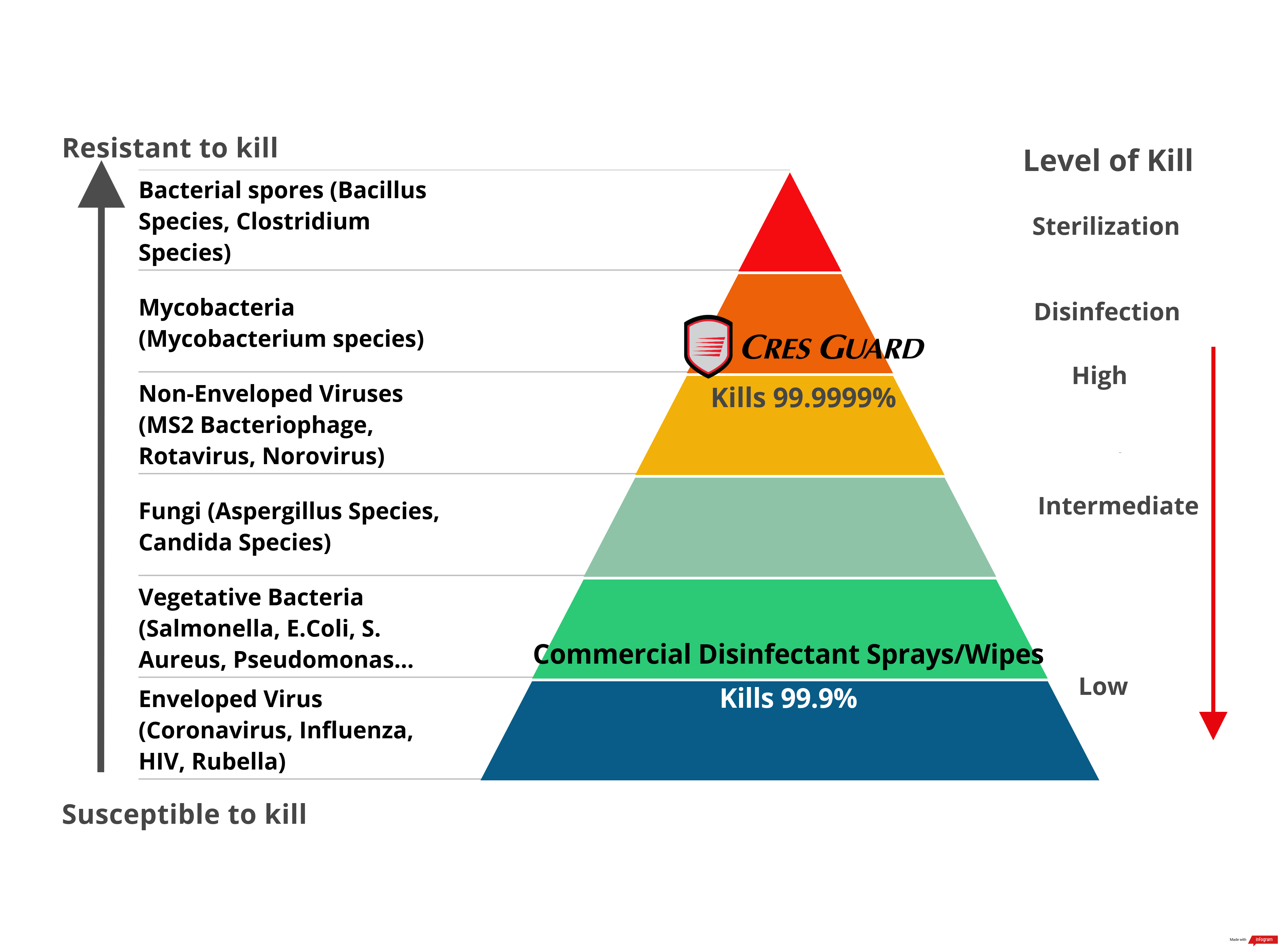
Cres Guard and the Health and Safety Division was then established. The company hired a large independent lab to conduct a study on the efficacy of the decontamination unit. The studies concluded that the Cres Guard decontaminated at a 6-log reduction (99.9999%) of difficult-to-kill viruses and bacteria. Examples include influenza, HIV, Salmonella, E.Coli, fungi and mycobacteria.

All-purpose cleaning

The Cres Guard can be used for all gear, helmets, backpacks, and personal protection items except electronics. Firefighters and police have even said they are using it for their personal items so as not to bring unknown bacteria into station quarters or their personal vehicles and homes, Baggott tells.

Using just heat and humidity provided by a four-gallon easily refillable reservoir, the stainless-steel cabinet effectively decontaminates items in just 15 minutes. Gear is dry and ready to use immediately and no chemicals are used that can impact gear integrity or off gas to personnel. The portable cabinet features optional arrangements for varying-sized gear, with a standard model including five racks and three hanger supports. 

The Cres Guard unit has been designed for use by firefighters, police, first responders, and military personnel are finding the Cres Guard easy and safe to use, sometimes multiple times in a single shift. Several fire departments in the county where Cres Guard is built were early adopters. Concord Fire Department in New Hampshire participated in initial product trials and much of their feedback was incorporated into the final product.

First responders have said the items they typically place in the Cres Guard cabinets for decontamination include firefighter gear, boots, hoods, gloves, goggles, bulletproof vests, SCBA masks, and medical/personal jump bags. “We heard that several crews were also placing personal items, such as bedding and backpacks in the Cres Guard,” adds Cliff Baggott. “This feature adds to the firefighters’ personal and families safety.”

In addition to being a chemical-free process, the heavy-duty cabinets are sturdily built with stainless steel and heavy-duty casters to make the entire unit mobile. Using a standard 110V 20A outlet, the Cres Guard is designed to be one of the hardest-working pieces of equipment employed to keep first responders safe from “invisible” dangers. The added bonus is that it is relatively small, requiring very little space in even smaller stations.

Cres Cor, the parent company of Cres Guard’s Health & Safety Division has supplied the food service industry with high-quality premier food warming cabinets worldwide for 86 years. Cres Cor cabinets are in use in high-end hotels, restaurants, schools and resorts in countless countries.

Cres Guard mobile decontamination cabinet using moist heat is patent-pending and Cres Cor Health and Safety is developing another innovative and chemical-free decontamination cabinet to eradicate viruses and bacteria effectively and safely for electronic items and other PPE sensitive to higher heat.

This article was originally published in the August edition of IFSJ. To read your FREE digital copy, click here.

All UAE University buildings now linked to Hassantuk Safety System

UAEU University has announced that all the buildings on all campuses are now connected to the Hassantuk safety system. The system is integrated with Civil Defense Command Centre in the UAE in line with an agreement with Injazat, the UAE’s leader in digital transformation. 

Hassantuk is a strategic public-private initiative between the UAE Ministry of Interior and Injazat designed to increase the efficiency of emergency services’ responses to all fire and life safety emergency alarms through a state-of-the-art smart system, helping to cut down response times and increase efficiency in all emergency events across the UAE, reducing the danger to life and damage to property. 

For the University, the Hassantuk system will send the alarm in real-time to the Command-and-Control Center, if smoke or fire is detected. The Center will then contact the UAEU Facilities Management (FM) team to check whether it is a real or a false alarm. The FM service provider will verify and repair the false alarm, but in case of a real fire, the Civil Defense team will arrive immediately. 

Prof. Ghaleb Al Hadrami Al Breiki, Acting Vice Chancellor, said: “The United Arab Emirates University adopts the latest technical solutions and standards to enhance occupational security, safety, and health. In addition, it uses the best technologies to protect university facilities and buildings, enhance the response to emergency situations, and reduce or prevent the loss of lives and property.

“The UAEU higher management considers the safe environment of the university community as a top priority.  We seek to link the UAEU facilities to the “Hassantak” safety system, the Ministry of Interior, and “Injazat” initiative to protect lives and property from fires and emergency situations. We are pleased to relate to it to protect lives and property and ensure the safety of the UAEU buildings using the latest innovative technological solutions.

Ayman Alsebeyi, General Manager at Hassantuk, commented: “Hassantuk is one of the world’s first federal fire and life safety services that is designed not only to help save lives and property but also to assist educational institutes to ensure the safety of its buildings and visitors.”

Eng. Mohammed Al Owain, Director of the Facilities Management Department, said the university continuously seeking to keep pace with the latest security services to improve the level of safety and readiness and response to accidents and fires.

He said: “The Facilities Management Department is responsible for the university’s quality of life for students, academic and administrative staff, partners, and visitors. Therefore, it has developed a system that meets all the requirements of international safety standards in general and the standards applicable in Abu Dhabi in particular.”

He also said that it provides a positive and effective environment that contributes to promoting creativity, ensuring the health and safety of students and academic and administrative staff, and improving the conservation and management of natural resources.

Owain added: “Hassantuk will continue to provide round-the-clock protection for connected buildings, creating a safer, smarter community.”

From schools and hospitals, residential and commercial buildings, warehouses, and workshops, Hassantuk monitors connected buildings’ fire alarm systems 24/7 from a central control room, liaising with Civil Defense Operators and emergency services to transmit fire and life safety events with greater detail and speed.

Its advanced AI engines generate regular operational and business intelligence reports for Civil Defense and the Ministry of Interior, while its dedicated online dashboards and real-time messaging enable building owners to constantly monitor their properties, adding an additional layer of information and actionable intelligence.