Firms refusing to contribute to the fund set up to fix dangerous cladding will be warned they could be blocked from selling new homes, the Guardian has reported.
Michael Gove, the UKs levelling up secretary, will explicitly threaten retaliation, citing powers in the building safety bill that would stop uncooperative developers getting planning permission.
It is understood that Galliard Homes will be one of the major developers singled out as a potential target for the punitive measures, although other companies are also expected to be named by Gove.
Earlier this month Gove, who was tasked with addressing the cladding scandal – which has involved thousands of leaseholders facing crippling bills for the removal of dangerous cladding – signed an agreement with 35 developers, which collectively agreed to contribute £2bn towards fixing buildings they had a role in constructing.
Some developers did not sign up to this supposedly voluntary agreement, and Gove will this week ratchet up the pressure by reminding them that if they continue to refuse, they risk harsh sanctions under legislation about to become law.
The Building Safety Bill was introduced to create a new regulatory framework for building safety after the Grenfell Tower fire. But as it was going through its final stages in the House of Lords Gove introduced amendments that would give him the power to stop firms that have failed to sign his cladding pledge from selling homes.
Under the bill, these firms could be blocked from obtaining planning permission, or prevented from getting building control signoff.
Ministers believe that even the threat of these sanctions could be enough to deter investors. According to an internal document about the strategy seen by the Sunday Times, officials are arguing that it would be “irresponsible” not to warn prospective consumers of the potential risks.
Galliard is one of at least nine large developers that has yet to sign the Gove pledge. They are expected to be given just a few weeks more to comply. Galliard said at the weekend that it had acted quickly on cladding but that, before signing the pledge, it required “certainty” from the government and “a clear and succinct plan for developers, the government, the supply chain and insurers to all work together to find an equitable solution”.
Under the Gove plan, in addition to the £2bn from developers to fix their own buildings, the industry will commit a further £3bn for the removal of unsafe cladding through an expansion of the building safety levy, a charge on new residential buildings.
Under the current system, local authorities can impose section 106 agreements on developers telling them that, as a condition of getting permission, they must construct a certain number of affordable homes.
Gove wants to abandon these arrangements and instead force developers to contribute to an infrastructure fund that could be used by councils. In a recent white paper, the Department for Levelling Up, Housing & Communities argued that a new approach was needed because the current system “enables some developers to benefit disproportionately and unfairly from the land they develop”.
Super Vac, one of the leading manufacturers in fire ventilation equipment, will showcase an unmanned misting turbine by EmiControls in its booth at FDIC International 2022 (Booth #3417).
The robotic fan features a water mist system that atomizes water and extinguishing foam into a fine mist before propelling it up to 300 feet with Quadrijet nozzles and turbine propeller. The fan can be maneuvered an additional 1,000 feet toward the hazard thanks to advance remote controls, making these turbines the ultimate unmanned firefighting fans for chemical operations, tunnel systems, subway shafts, recycling plants and urban areas.
The fan’s water misting system includes 40 turbine-ring Quadrijet nozzles, which provides up to 400 gpm of water, and a powerful turbine propeller, which combines 25kW power with a polymer blade to deliver 35,000 cfm. An integrated Akron nozzle (or brand of choice) produces up to 1,200 gpm that can be propelled up to 300 ft. with remote adjustable pattern. In addition to its misting capabilities, the turbine is also highly maneuverable. The robot can tilt
19-degrees down and 43-degrees up, while the turntable features 362 degrees of rotation. The design can also fit into parking garages as low as 80” while having the ability to raise an additional 67”. This large industrial fan can be mounted on tracks, trailer or truck.
When mounted to the crawler tracks, the robotic fan can navigate harsh terrain, 30-degree inclines and 15-degree traverses with the mobile unit’s 71HP Kubota diesel engine. A number of optional features can be added to the firefighting robot, including forklift, railway wheels, camera kit, remote winch, air duct hose, ground-sweep nozzles and web-based GPS.
“We’re excited to partner with EmiControls so that we could bring this firefighting robot to the United States market,” Super Vac President Roger Weinmeister said. “This fan is a great addition to our large-scale PPV lineup, which includes 30”, 48” and 80” industrial fans, all designed for ventilating large structures. At Super Vac, we know every ventilation scenario is different, so we pride ourselves in this addition because we know it’s important to offer a wide variety of tools to get the job done.”
Martin Joosen, Managing Director EMEA, Lion EMEA sheds light on the company’s roots, and the latest trends in fire training.
Tell us a bit of Lion, and how you’ll got to where you are in the market as a fire training specialist.
Lion EMEA was a Dutch company formed 30 years ago, we were founded by firefighter for firefighters. The mission was to offer better products and training scenarios. The desire was born out of the fact that the founder, Jac Haagen, was not happy with the quality of the smoke generators that were being using used, which were like the ones used in theatres / night clubs. He created his own products, small generators to begin with.
We then progressed, sold our products to other fire brigades in the Netherlands, followed by Belgium, France, UK, Germany. Eventually, we got into the Middle East and into the USA. In 2012, we were bought by the Lion Group, which gave them the opportunity to broaden their portfolio beyond PPE. The benefits of the takeover were mutual, giving us the opportunity to expand as well. Lion also bought one of our competitors in America, that continues to provide training products in the USA.
How did the takeover benefit Lion’s operations?
The takeover allowed us to grow our footprint, we were able to attract larger projects. Along with our purpose-built firehouses and containers, we were able to build complete fire training skyscrapers in Shanghai and Melbourne. These are fully functional buildings, residential / office blocks whose sole purpose is to be set on fire.
The facility in Melbourne includes scenarios that replicate everything that can catch fire such as a boat, car, helicopter, building, and a house. We are the biggest company in the market in our sector. We offer everything from the smallest training products, such as smoke generators and fire trainers, to delivering training centres.
Since our centres involve burning gas, wood, and other components it requires the highest standard of maintenance. Ultimately, the training we impart is lifesaving in critical situations, which is paramount to firefighters and the industry. Well imparted training makes all the difference in critical situations where lives and property are at risk.
The EMEA is a massive region, what are a few complexities of the different regions?
Absolutely, the Europe Midde East and Africa is a broad region. The European market is different from the Middle East or Asia for that matter. Meanwhile the African market is still developing, and we are not there yet in terms of competition. We have an appetite to increase our market share in all these regions, but it needs to be done strategically, without loss of quality or standards.
When we talk about our competition in the market, there aren’t too many companies that offer what we do. Some of our peers, for instance, cater to a specific market segment.
Ultimately, in the fire training business it all comes down to the expertise of a company. The trainers you employ, methods and techniques they use, and standards we follow. For example, our competitors might focus on smoke generators in sewage extraction or night clubs, which is their remit. On the other hand, we are one of the only companies that’s looks at it from a firefighter’s point of view, and not from a product perspective.
To what extent are Lion’s training regiments customisable?
We always start with a blank canvas and paint the picture with our clients. We have more than 30 years expertise in the field, we are able to offer insight at different points throughout the journey. We want to be in a position, where we handover the keys to a client and they can get started straight away.
Tell us about your other training facilities.
Fire departments have a different thinking process across different regions. Each country tends to have its own set of training requirements. We don’t have many projects (in Europe) the size of our China or Australia facilities. We have several smaller purpose-built training facilities based on container systems, or a firehouse, kitted out to the requirements of the client. The most recent one was a facility we set up in Cardiff, Wales. A firehouse can be purpose built to any fire technology required by the client, wood, or gas fires, and so forth.
What costs are involved in building training facilities?
A fire training facility is resource intensive, after all we are burning critical components and resources, then you need to consider rising costs of natural gas and other non-renewable materials. You also need to go through the props that will catch fire for a period of 45 minutes. The costs tend to stack up a fair bit.
Before training, we need to decide whether we are going to train in the defence or attack of firefighting or tracking fire dynamics. In Western Europe, clients are extremely precise about each training facility, geared to tackle each vertical within the industry. In France, there are approximately 95 to 99 fire departments, and we are present in 80 of them. Each region tends to have its own training facilities, which are based on the budget of their councils.
Martin Joosen.
How receptive is the market in general towards making new investments?
Budgets constraints usually impact negatively on training-related spends. Clients tend to invest more in PPE protection, which is critical because you need to have good tools for intervention and rescue. However, if firefighters are better trained, which also means better techniques to equipment, it would lead to saving a lot more lives. Compromising on training can be fatal.
For instance, with the tragic Thailand bus disaster in 2018; there was a lack of training to rescue people from that situation. In the aftermath, within six months of the incident, authorities set up a bus simulator to help stay prepared.
It’s a paradox when there are no catastrophes it’s hard to justify expenses towards training. On the flip side, without adequate training the results of an accident could be a lot worse. Slashing training budgets could also lead to more expenses in the form of compensations, use of hospital resources, and so forth.
What new techniques are being introduced in firefighting?
We are incorporating digital technology in our training centres. We have introduced screens within the training centres, along with sensory devices such as heat and smoke generators to replicate an emergency scenario. Having said that, these additions are nothing more than training aides for firefighters, which will never replace traditional techniques. That’s something we want to assure your readers. We are cautious when adding new technology to our facilities. It does have its benefits, they go a long way in helping firefighters drill repeat scenarios, helping them create muscle memory to specific situations.
On one hand veteran firefighters love to deal with the actual fire, replicating the stress and tension of an emergency. This is also extremely important for newly qualified fire fighters as they need to experience 1,000 degrees Celsius environments where it’s nearly impossible to humanly function. It’s a fine balancing act to get the best training, in the most effective way.
What new products are you’ll working on to meet different requirements?
We will launch a range of seven fully customisable container systems, which can be easily transported on site, and ready for use. Due to the high costs, it’s also important that our client’s get maximum ROI. Our containers and fire houses usually last for about 10 years, which is industry benchmark, which is a tried and tested tenure from our side. A few of our customers train in a London facility that has been in operation non-stop, day-after-day for more than 10 years. That’s testament to the quality and ingenuity of our products.
Tell us about your initiatives to make your offerings more environment friendly.
Burning non-renewable resources such as natural gas and wood are not the best for the environment, and we are extremely conscious about that. We try our best and use eco-friendly materials wherever we can. The inherent nature of fire means it’s always going to be a challenge to cut down on the pollution created by burning different components. That’s where our digital and technological offerings play a huge part.
The global passive fire protection market is expected to grow from $3.99 billion in 2021 to $4.42 billion in 2022 at a compound annual growth rate (CAGR) of 10.9%. The market is expected to reach $5.73 billion in 2026 at a CAGR of 6.7%.
The main types of products in passive fire protection are cementitious materials, intumescent coating, fireproofing cladding, and others. Cementitious materials have properties of cement, and are used to protect steel elements within a building’s construction. The different applications include structural, compartmentation, opening protection, firestopping material and is used by various sectors such as oil and gas, construction, industrial, warehousing, and others.
North America was the largest region in the passive fire protection market in 2021. The regions covered in this report are Asia-Pacific, Western Europe, Eastern Europe, North America, South America, Middle East and Africa.
Technological advancement is a key trend gaining popularity in the passive fire protection market. Major companies operating in the passive fire protection sector are focused on developing technological solutions for passive fire protection to strengthen their position. For instance, in November 2020, Honeywell, a US-based company that mainly operates in building technologies launched new suite of Connected Life Safety Services (CLSS), a cloud platform for fire safety systems. The platform is intended to help fire professionals avoid downtime, demonstrate compliance, and shorten the time it takes to design, install, commission, inspect, maintain, and report life safety equipment.
The growing construction sector is driving the growth of the passive fire protection market. Construction is a sector that deals with the building, maintenance, and repair of structures and buildings, as well as the construction of roadways and service facilities. Fireproof materials are used in the construction sector for fire safety in the building as they are non-combustible with low thermal conductivity and take a long time for the fire to affect the structures, and also protects the spread of fire.
The report covers market characteristics, size and growth, segmentation, regional and country breakdowns, competitive landscape, market shares, trends and strategies for this market. It traces the market’s historic and forecast market growth by geography. It places the market within the context of the wider passive fire protection market, and compares it with other markets.
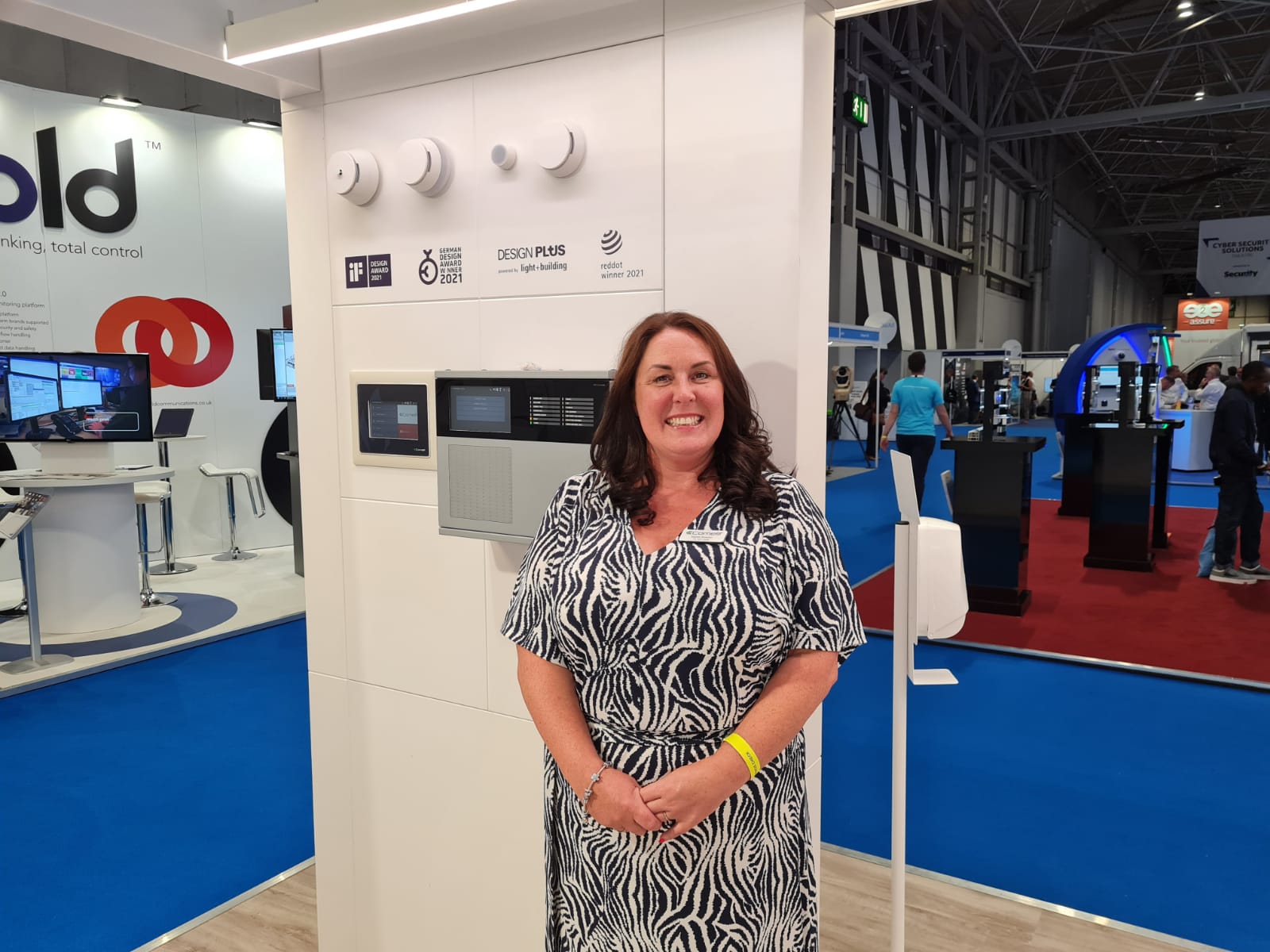
Mandy Bowden, fire manager, Comelit-PAC highlights how legislation and fire detection and alarm systems have evolved to enable tailor made solutions to meet individual smart building requirements
Fire safety is vital to consider in new buildings, construction, or refurbishment projects as early in the specification process as possible, to ensure systems can be designed in compliance with latest legislation and still blend with their surroundings, without losing their function.
Historically, fire safety design of buildings has been seen as a constraint to innovative design, but this needn’t be the case.
The future of fire detection and alarm systems is changing. From predictive advancements to sustainable technologies, there is now an opportunity to specify preventative protection systems tailored to each individual property together with their owners and users.
Setting the Scene
Successful fire systems design requires an understanding of a wide range of issues and components, and the interactions between them such as, fire source, smoke movement, heat transfer to the building structure, detection, human behaviour and toxicity.
Mandy Bowden.
Finding the right fire detection system and design is the most difficult task. And currently, this is set against time, budget and resource stretched personnel, who especially during the pandemic, had essential Government guidelines to comply, and fire safety found itself slipping down the agenda.
Yet the findings of the Grenfell Tower tragedy and Fire Safety Act 2021 (alongside the forthcoming Building Safety Bill) as part of the ‘biggest changes to building safety in a generation,’ demonstrate the importance of fire safety.
With its significant ramifications for those organisations considered “responsible persons” it highlights the need for compliance and the risk of enforcement powers and sanctions for those that do not prioritise fire safety.
Today’s global environment requires the fire and life safety industry to innovate with solutions, installing systems that can adapt to its environment and support and understand the specific needs of a building’s purpose.
It is down to consideration of these elements and all who occupy the facilities early in the specification process of any works programme, to determine the best technology and installation of compliant fire detection.
Fire systems by design
Above all else, fire detection is there to save lives; but the way in which systems are presented, will depend on their surroundings. Fire systems specification can begin as early as during the briefing and continue into the handover and close out stages.
Even then the need for risk assessments are essential to maintain on a regular basis, again, especially in line with new expectations of the Fire Safety Act 2021.
If fire safety is outlined in the initial design process, it can contribute to the smooth and efficient running of the building construction, which together with identifying design and consultancy services early on, can deliver on even the most demanding fire safety and security specification requirements, of today and the future.
The same is true for refurbishment projects, and change-of-use schemes. When you alter how a building is used, you also change the measures required to make it safe.
It’s not a case of one size fits all as different buildings need different approaches. Areas within those buildings also need to be treated differently – for instance, escape routes in a residential block (like public corridors and staircases), need greater fire protection than individual flats to allow people time to evacuate.
The best fire protection strategies consider the design of individual buildings and how they are used by occupiers, using both active and passive measures in a holistic approach.
Fire systems in education
Comelit-PAC was involved in an award-winning eight-form entry secondary school and sixth form academy, designed as part of a £100m development in Broxbourne, Hertfordshire.
Designed by architects Bond Bryan and built by Chase Homes, Broxbourne School offers multiple educational buildings, including a new indoor sports hall, 3G football pitch, a multi-use games area for sports such as netball and tennis, together with The Broxbourne Music Centre.
Winner of the School Building Awards, presented by the Education Business Awards, the new campus, completed five months ahead of schedule, will cater to the 1,500 students aged 11 to 18, as well as the wider community.
By integrating fire safety into the specification detail, systems could be installed that
have the flexibility to expand with a facility or building requirement, to enable more to benefit from this ambitious new college.
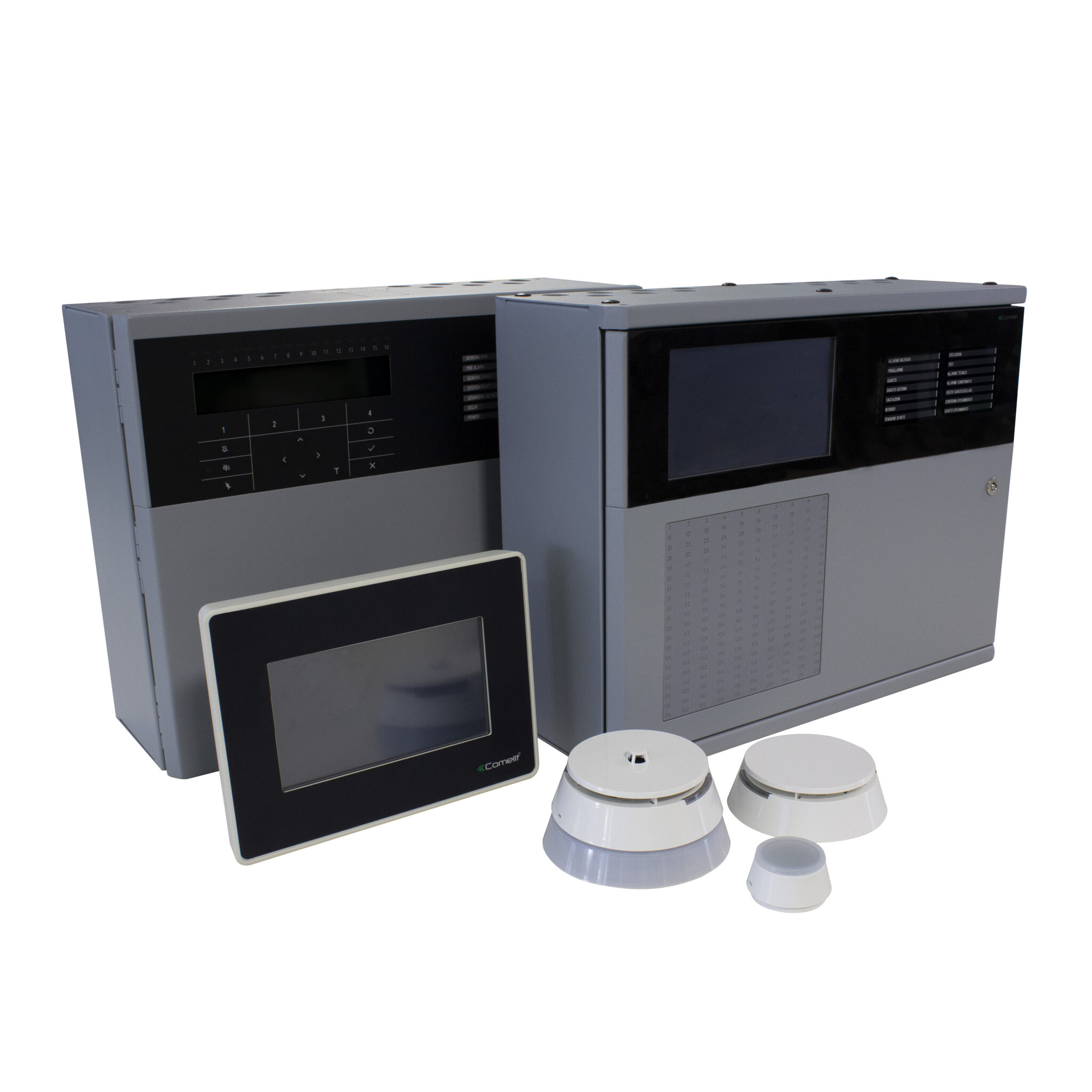
The LogFire system.
Says Ben Lewis, of Matrix Fire & Security: “We knew instantly that Atena would accommodate the requirements of the school and blend seamlessly with the fabulous teaching and learning environment that has been created.”
What this demonstrates is when creating school buildings fit for 21st Century learning, holistic design principles must be adopted. While the Comelit-PAC Atena addressable panels represented just one component of this amazing new build, by being so easy to use, they provide an effective way to keep the school community, and the broader range of buildings’ users, safe and protected.
Fire systems in healthcare
Any fire detection technology must be strategically placed, unobtrusive and not affect the aesthetics or daily busy operations of the staff on site. And risk assessments were essential to maintain a safe environment.
This is also particularly essential in new hospitals and mental health facilities, where the focus is the use of natural light and bright, airy spaces, to positively impact both workforce well-being and where every part of the site is seen as potentially having therapeutic value.
Comelit fire specification
Comelit-PAC is evolving with the specification requirements of discerning end users, providing the products and services necessary for installers to meet burgeoning expectations.
Most recently, it has upgraded its entire fire system range with the launch of LogiFire, which represents a complete technical and aesthetic evolution of its innovative addressable platforms.
LogiFire is guaranteed by a new range of control panels. The systems can be expanded from 1 to 8 loops and support up to 2000 devices on an 8-loop system and have a greater loop capacity of 700mAh. The panels are feature rich and have many onboard fault-finding diagnostics.
The stylish product design is a unique feature of the range, with carefully constructed lines and a neutral appearance to ensure fire safety has a natural blending with surroundings, without affecting the experience for visitors or staff on any site development.
Most of all, LogiFire prioritises reliability and performance levels. Its development has taken consideration of increasing reliance on integrated systems with security through the internet of things, leaving room for LogiFire to evolve to meet changing fire safety requirements.
In summary, many innovative building designs now utilise fire safety engineering rather than having to rely solely on functional-based codes. This approach can enable architects to achieve innovative cost-effective designs while meeting fire safety design needs.
The introduction of the stringent Fire Safety Act 2021, added extra pressures on Responsible Persons as accountable for reducing the risk of fires.
By considering fire detection and alarm systems early on in any works programme, establishing the facts about a building, its usage and purpose and engaging with experts through design and specification, project teams can ensure they navigate the issues safely and meet the needs of building users.
Comelit-PAC can help to incorporate tailor-made fire system design principles into a building design project without impacting on the function, aesthetics or appearance of the building.
In the aftermath of the tragic Grenfell Tower fire in 2017, authorities in the UK decided to investigate several different facets of fire, life, and safety in buildings. Several companies were invited to give their technical expertise on the subject – these included experts in cladding, doorsets, panels, and fire evacuation routes to name a few. Secured by Design, a British based official police security initiative, that works to improve the security of buildings and their immediate surroundings was also involved.
Alfie Hosker is the technical manager at Secured by Design (SBD) and writes about technical recommendations, and new guidelines that have come about following the efforts of the Grenfell Technical Group.
Hosker joined SBD in 2014 after serving for more than 20 years in the UK Police Service across many disciplines including CID, Stolen Vehicle Squad, Public Order, Neighbourhood Policing, Licensing and Crime Prevention. He also spent several years within the various Planning, Highways and Building Control Departments advising on Designing Out Crime, Counter Terrorism, enforcement, planning policy & applications. He studied at the Leeds University and later at Oxford Brookes University in the field of Crime Prevention. He is also a qualified teacher.
In his own words, Hosker recounts the work of the Grenfell Technical Group since 2018.
Enhanced security & fire performance of doorsets
Alfie Hosker
Post Grenfell, the government quite rightly called for further investigations and Secured by Design (SBD) took an active part as a member of the Grenfell Technical Group, which was set up in March 2018 to provide technical advice specifically on entrance doorsets to individual flats – which includes the door, associated frame and all component parts, such as the glazing and door hardware.
The Group, which included other not-for-profit organisations including the Fire Industry Association (FIA) and the Door and Hardware Federation (DHF), met frequently throughout the rest of that year. Our comprehensive technical findings were duly reported to government via the Grenfell Independent Expert Panel.
Building on the collective expertise and experience within SBD, FIA and DHF the three organisations took the unprecedented step of collaborating on a document entitled ‘Guide For Selecting Flat Entrance Doorsets’ which was published in March 2019.
Aimed at housing associations, landlords, building owners, developers and local authorities in England (but much of the advice is equally applicable to other countries of the UK, even though Building Regulations may differ slightly), the publication brings together the best collaborative advice available from the industry in one straightforward document to highlight the fundamental issues of fire safety and security for those selecting such doorsets.
Importantly, the publication makes the point that there is no conflict between fire and security with Building Regulations Approved Document B (fire) and Approved Document Q (security) carrying equal weight with neither taking precedence over the other.
The publication also covers
Why only factory produced doorsets can meet both Approved Document B and Q
What to look for in terms of performance for fire
What to look for with third-party certification for fire
What to look for regarding security
Other performance affecting flat entrance doorsets
Glazing considerations
Assessments – what to be aware of
Installation
Maintenance
Multi-occupancy buildings
Government advice to Building Control
Certification to include smoke control Currently doorset thresholds can legitimately be tested to BS 476-31.1 or BS EN 1634-3 with the threshold taped up, and be assigned an ‘S’ designation (according to the guidance within Approved Document B) or an ‘Sa’ classification (when classified according to EN 13501-2), as the threshold gap is effectively discounted in both instances. It is also possible to maintain designated smoke performances (i.e. S or Sa) when following the guidance given in BS 8214, which allows for a 3mm gap at the threshold in situations where fitting a threshold seal is not practicable.
It is the opinion of SBD that neither are acceptable in a ‘real world’ fire scenario. The former (taping up the threshold) proves nothing when the doorset is exposed to smoke in an apartment block and could therefore lead to smoke unnecessarily entering an area designed to be a safe haven. The latter (the 3 mm gap allowance) has been independently proven to allow smoke leakage of up to 10.5m3/h/m – three times the allowance of 3m3/h/m in the current Building Regulations. You can find out more about a series of tests commissioned by the Intumescent Fire Seals Association (IFSA) into this here: https://www.ifsa.org.uk/wp-content/uploads/2021/04/IFSA-Fact-Sheet-02-v0321.pdf
As soon as we realised that smoke was at risk of not being treated in the same way as fire and security evidence, it was critical we sought to resolve this issue specifically for all Secured by Design Developments and by all doorset manufacturers recognised by us through our SBD Membership scheme. In early 2021 we secured agreement from all of the UK certification bodies working in this area to incorporate smoke control into their fire and security schemes for flat / apartment entrance doorsets.
With the safety and security of residents in mind, we have confirmed our requirements for all fire, security and smoke rated doorsets carrying SBD approval to the UK test and certification organisations – i.e. all smoke control tests – should be conducted with the doorset threshold un-taped, and furthermore the allowance of a 3mm gap under the door will also be unacceptable. Therefore, by summer 2022 SBD will require all member companies with doorsets listed on their SBD schedule that are fire rated and that are required by UK Building Regulations (England, Scotland, Wales and Northern Ireland) to have smoke control properties for the intended installation – e.g. flat entrance doorsets to be certificated for the following attributes – Security, Fire and Smoke Control. Thus, all SBD Fire, security and Smoke rated doorsets will require a thresh detail that enables the doorset to comply with the Building Regulation maximum requirement for smoke leakage of 3m3/h/m.
Firefighter in a fire and rescue operation.
SBD has committed to both promoting our requirements and to support other organisations lobbying for change in this important area. We are adamant that any doorset that carries SBD accreditation should be fit for purpose in all declared characteristics, but especially those that are life critical such as fire, security and smoke control. We are committed to saving lives and making homes safer places in which to live, work and play.
The ‘Guide For Selecting Flat Entrance Doorsets’ is currently being updated to include these new SBD requirements. You can have confidence in using this publication as an authoritative source of information, which will guide you through the complexities of an extremely important area of Building Regulations. The publication can be downloaded for free here:
Sentry Doors is growing fast, driven by an absolute commitment to compliance and quality, its Managing Director, Ty Aziz, tells IFSJ.
Tell us about the legacy of Sentry and process of innovation over the last 33 years of existence… In the last couple of years however, the company has seen a step change in growth. First, we received considerable new investment from our partner, Cairngorm Capital. This enabled us to invest in our manufacturing facilities — new CNC machines, new paint lines, as well as the advancement of an additional facility across the road. We’ve also invested in testing, compliance, and accreditation — all the hallmarks our customers associate with Sentry Doors.
Most importantly though, we have invested in our people — bringing in new expertise to work alongside the existing management team and production staff to ensure that Sentry has the right resources to take it from strength to strength. This has resulted in new customers, typically housing associations, local authorities and their contractors who see the considerable benefits of our bespoke timber doorsets as they replace non-compliant fire doors. By choosing Sentry, customers always know they have the highest standards of certification in their fire doorset partner.
Reflecting that growth is the new look and feel of the Sentry logo which you might have seen out and about or online. We like to think of it as ‘same great company but with an updated look and feel’. We have a new website, new brochures to showcase our range of certified fire doorsets, as well as our certification portfolio to make it easy for customers to immediately focus on the testing or accreditation required — and you can even visit our factory virtually online. We’d rather people came in person though – the quality of our manufacturing really speaks for itself, plus we’re a friendly bunch.
Looking to the immediate future, Sentry has a stand at the upcoming Fire Safety Event in early April at the NEC. We’ll all be there, meeting customers old and new, and we’d love to tell everyone the Sentry story. It’s something we’re really proud of.
A great example of innovation was the ‘timber doors’ that were on display at Intersec 2022 which were high spec, and purpose-built fire doors. Tell us about the research and development of your products?
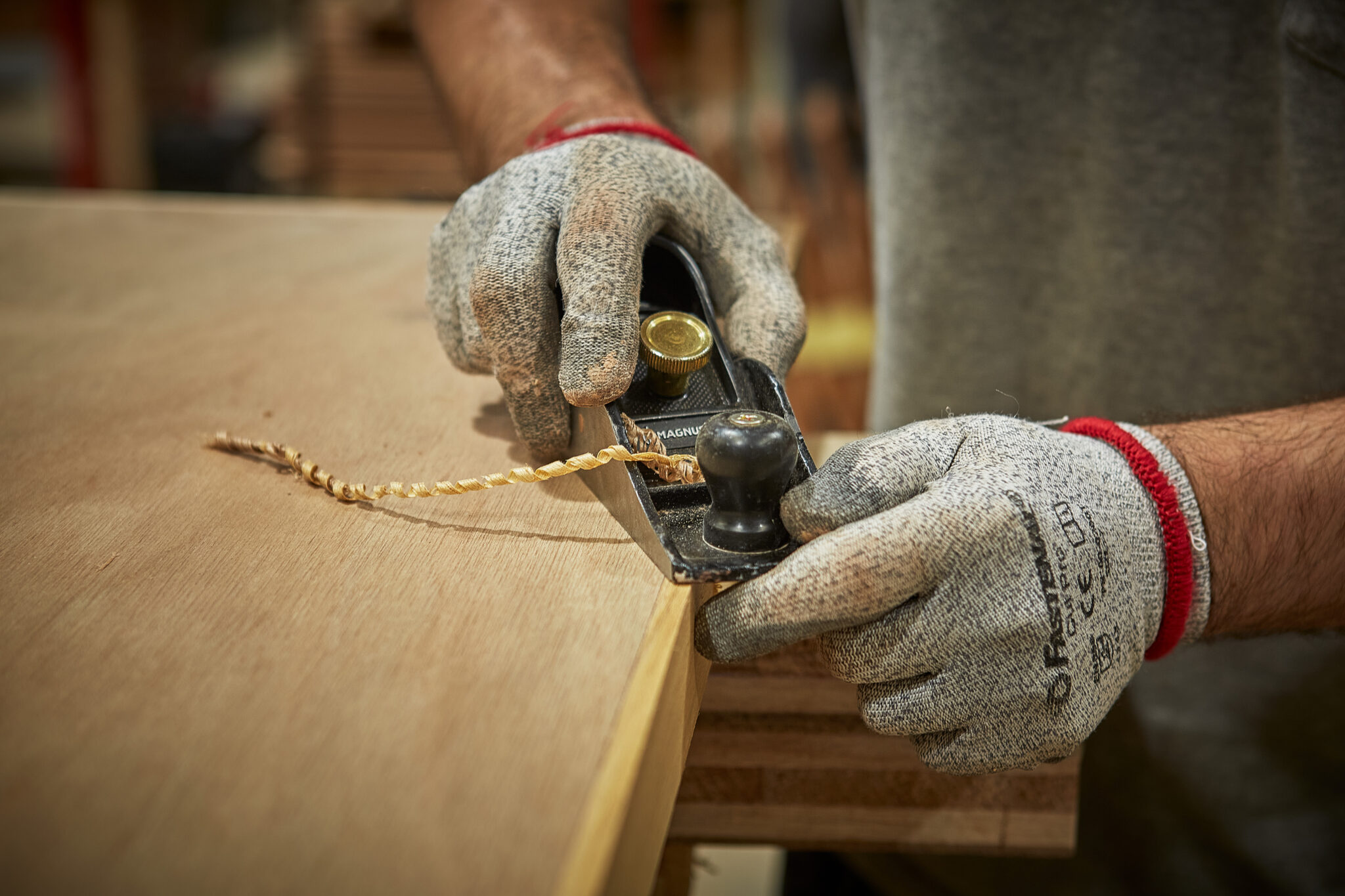
Sentry is a specialist provider of bespoke timber FD30s, FD60s doorsets, screens, and fanlights – that’s all we manufacture and consequently, we like to think we are experts! Every single doorset that leaves our factory is made specifically for a particular aperture — in order to ensure the highest safety standards and customer care, we manufacture each product specifically for an individual address, with a comprehensive choice of paint finish, glazing, security and ironmongery to complement it. Our Research & Development takes place at our facility in Doncaster, but it always has customers at its heart — we work closely with them to respond to their requirements. Budgets are whatever is required to keep us at the top of our industry.
Designed to offer peace of mind, our FD30s and FD60s doorsets undergo independent testing and approval from BM TRADA and Certifire standards. Both are certified by Secured by Design, and we are one of the few companies nationally to have achieved dual certification (Q-Mark Fire Door Manufacture and Q-Mark Enhanced Security) for both our FD30s and FD60s flat entrance doorsets. We were also the first fire and security door set manufacturer to hold the new UKCA mark, as certified by UK-approved body BM Trada. The standards, certification and compliance can be a complicated subject however, so we aim to provide ease via our certification portfolio, and we are always on hand to guide customers to ensure peace of mind.
Tell us about some of your major geographical markets, and expansion plans for 2022? Sentry has a history of serving London boroughs and their contractors — we’ve been involved in manufacturing fire safety doorsets for many of the major replacement programmes in the capital’s housing stock both pre and post the dreadful events of Grenfell. We also work widely across the rest of the UK — we have ongoing projects in the north of England, Scotland and the across the South-East. Let me put it another way: if you’ve got a project that requires fire safety doors in the UK, you ought to be partnering with Sentry!
What are some major trends in the fire door market, and what can we learn from them? The trend is clearly towards ensuring only the highest standards of fire protection: that means timber because of its clear safety advantages over other materials, it means bespoke, because UK housing stock is diverse and not standardised like other markets.
Most importantly, it is about making sure that the choice you make is tested to the extreme and then certified to show that the specific doorset will protect people in the face of disaster. Those who specify and procure fire doors are absolutely committed to avoiding another disaster, and so is Sentry. That’s not so much a trend as the only right way, of course.
Sentry had previously predicted a 30% increase of “production operatives over the next 12 months”. How confident are you about your growth in 2022?
We’re growing really fast, and we are looking for more great people who share our ethos to join us: it could be more than 30% in 2022 and beyond. We are consistently recruiting in our factory, training, and developing people to achieve our manufacturing quality through open days, via our website and more. As more and more customers understand the benefits of the Sentry solution, we have invested in another CNC and a new paint line as well as expanding into our capacity across the road from our main factory. We also have opportunities in business development, customer service and more — so anyone who shares our values and wants to be part of the exciting Sentry story, do get in touch.
In conclusion, I would like to tell your reader: Sentry is growing from strength to strength as the secure choice in fire safety doorsets. We look forward to meeting people from across our industry at the Fire Safety Event — we’ll have a prominent stand but do please contact us if you would like to book an appointment in advance. It will be great to tell you the Sentry story in person.
An investigative news channel unit has found that half of Cleveland’s commercial buildings are not up to the fire code when it comes to maintaining critical fire protection. 19 Investigates says ‘Fire alarms, sprinklers and fire doors can save lives, But they’re no good if they are not maintained. They need to be inspected routinely to make sure they’re working properly.’
The Cleveland Fire Department officials told the news outlet the problem stems from business owners who aren’t getting these systems checked often enough. And fire inspectors are having a hard time keeping track of thousands of commercial properties across the city.
At a public safety meeting last week, officials estimated about half of commercial buildings in Cleveland do not properly maintain their fire protection systems as required by law. “We project we’re at about 50% compliance,” said Battalion Chief Gregory Lightcap.
Lightcap said the fire department does not have a database to track this. They want to hire an outside company to build one and notify businesses when maintenance is due. Lightcap said many cities using services like this have gone to more than 90% compliance in a couple of years.
“So we would have a dashboard where we see these issues in red are where we need to direct our energy at in doing code enforcement, because the non-official stuff has not worked up until that point,” Lightcap told city council members at the safety committee meeting.
Alarmed by what we uncovered, we went to Mike Polensek, chair of the Public Safety Committee, for his take on this. “There’s a reason why we have a code, a basic fire, and protection code. It’s for protection,” Polsensek said.
“As a citizen walking into any building, is that a concern knowing they may not be up to date?” Investigator Sara Goldenberg asked.
“Of course it is, because there’s a code, a city code. And that’s been the problem, is it has not been enforced over the years. And now they’re telling us at the table that they don’t have the manpower, the sheer manpower to inspect all of these buildings,” Polensek said.
Polensek said unfortunately he is not surprised by these numbers. He wants to see the city and building owners step up to address the problem—quickly. “Why hasn’t there been enforcement, why hasn’t anyone been prosecuted?” he said. “And cited, and put in housing court if they refuse to make the repairs? None of us can understand why this has broken down as bad as it has.”
Fire officials said these changes would better educate business owners on fire code safety, instead of inspectors just issuing violation notices. City council is waiting to see the proposed legislation from the fire department.
IOSH has ‘voluntarily’ published its gender pay gap to demonstrate its commitment to driving positive change. Companies in the UK with more than 250 employees are legally required to release their data, and IOSH has chosen to do so as part of its dedication to equality, diversity and inclusion (EDI).
Figures for 2021-22 show the institution’s mean gender pay gap – the difference in average hourly earnings of men and women – is 16.6 per cent, which is slightly lower than the UK average of 18.0 per cent. This means that women earn 83p for every £1 earnt by men.
Although there is work to do, this sets a baseline from which to measure progress.
Vanessa Harwood-Whitcher, Chief Executive, IOSH said: “Putting people first is one of the key messages of our Catch the Wave social sustainability campaign. And prioritising people means holding ourselves accountable and recognising that we have more work to do.
“IOSH is committed to inclusion as an employer, membership organisation and professional body. We know we’re not perfect, but we are prepared to take bold steps to make everyday inclusion a reality, as demonstrated by our increased investment in EDI.”
A programme of work, which started with the appointment of EDI Lead Fayola Francis, is already under way. Fayola has already conducted in-depth research into IOSH’s current policies, processes, workforce profile and more. The result is a series of evidence-based recommendations and an action plan, in line with the Global Diversity and Inclusion Benchmarks.
IOSH will also look to publish its ethnicity pay gap – the percentage difference between the average pay of staff from different minority ethnic groups – as part of this work.
Figures from NHS Digital reveal there were 19,566 false fire alarms at NHS trusts throughout 2020 / 2021, with some trusts recording upwards of 500 false alarms.
In the past year and historically, several patients have sustained ‘injuries during evacuation’, highlighting the damaging effects of an unnecessary evacuation.
With appointments cancelled, operations delayed, and a fall in emergency department attendances during the period, we might have expected to see the number of false fire alarms fall significantly during the pandemic.
Today, it is vital to avoid the crowded corridors and large gatherings at assembly points that follow an evacuation, it has become even more pertinent to eradicate the causes of false alarms ensuring a socially distanced environment for vulnerable patients.
Of the 19,566 false alarms 5,742 resulted in a callout, firefighters respond to all alarms as if they are real. This exposes the public and fire crews to unnecessary risk in their emergency response to unwanted fire signals, directing them away from real emergencies – threatening to place added pressure on the NHS.
Across the 216 NHS trusts listed within the data, a total of 1,175 genuine fires were recorded.
False alarms cost businesses and Fire and Rescue Service authorities an estimated £1bn a year in the UK. In order to recoup this cost, the London Fire Brigade became the first fire service in the country to recover costs from hospitals with a poor false alarm record.
A false alarm is a fire alarm signal caused by means other than a genuine fire, which has activated a fire detection and alarm system, these can include: equipment false alarm, environmental influences, accidental damage, and inappropriate human action, including the malicious activation of a manual call point.
As recommended in BS 5839-1:2017 manual call points can be fitted with a protective cover to prevent false fire alarms. The British Standard Institute recommends in section 20.2b that: “All MCPs should be fitted with a protective cover, which is moved to gain access to the frangible element.
“It is now recommended that a protective cover is fitted to a Type A manual call point to help prevent false alarms.”
This is supported by fire safety guidance set out by the Department of Health which outlines the importance of “initiating measures to reduce false alarms and unwanted fire signals,” such as “the provision of lift flaps, or lift flaps combined with a local alarm device [which] are sufficient to control the possibility of undesirable actuation by patients.”
Safety Technology International manufacture a range of protective covers, from integral covers to outdoor and sounder models; there are variations to suit all applications. These covers are specifically designed to prevent false alarms whether accidental or malicious.
The Call Point Stopper is a protective cover ideal for areas with a risk of accidental activation, such as hospitals and healthcare facilities. The polycarbonate cover does not restrict the legitimate operation of vulnerable call points and helps distinguish a fire call point from a green electronic door release – often located nearby, this is a common cause of false alarms.
Fire crews recently attended a false fire alarm at the Royal Blackburn Hospital after a discharged patient broke five break glass call points. If there is a history of malicious activations whereby patients or visitors intentionally activate the fire alarms, causing unwanted evacuations and disrupting important healthcare, the Euro Stopper offers a solution.
The Euro Stopper provides a tamper-proof cover featuring the same sturdy UV-stabilised polycarbonate housing as the Call Point Stopper with the useful addition of an optional integral sounder and glow-in-the-dark frame. The 96 dB sounder emits a piercing alarm when the cover is lifted drawing immediate attention to the area, acting as a pre-alarm in a real emergency.
If further robust protection is still required the Universal Stopper provides IP56 protection from the elements, with a tough outer dome or low profile cover strong enough to withstand the severest of knocks from hospital beds, trollies, or wheelchairs. An optional sounder and break seal acts as an additional deterrent against malicious activation.
Conforming up to IP66, the Enviro Stopper offers the same protection against both accidental and malicious activation whilst guarding against ingress in harsh environments, such as wet rooms or wash down areas.