Fireray Hub Reflective optical beam smoke detector now UL and EN certified

Global launch of dual-certified smoke detector

According to FFE Ltd, the Fireray Hub Reflective optical beam smoke detector is now available worldwide following certification to UL 268 (7th Edition) and EN 54-12.

FFE stated that these approvals allow the detector to be specified in projects requiring compliance with either North American or European standards.

The company explained that the unit is intended for large interior spaces and can detect smoke at distances of up to 120 metres when used with its long-range kit.

FFE confirmed that the product supports installation in aviation hangars, industrial and warehouse environments, glazed atria, sports facilities, heritage sites and educational buildings.

Product features and operation

According to FFE, the Fireray Hub Reflective incorporates several functions intended to simplify installation and maintenance.

The company said the system includes Motorised Auto-Alignment™ to enable single-person setup.

It added that Light Cancellation Technology™ reduces the likelihood of nuisance alarms in bright or glass-heavy environments.

FFE stated that Building Movement Tracking™ is designed to maintain detector alignment over time.

The firm reported that the ground-level controller can support up to three detector heads, each with independent fire and fault signalling.

Certification details

FFE explained that the UL 268 (7th Edition) standard applies to smoke detectors used in North America and includes updated performance testing requirements.

The company added that EN 54-12 covers optical beam smoke detectors within the European fire detection and fire alarm systems standard.

It said that by meeting both sets of requirements, the product can be used in projects spanning multiple regions without the need for separate models.

FFE noted that this approach can help reduce procurement complexity in large-scale developments.

Statement from FFE

Tom McGinnes, Product Manager at FFE, said: “With UL and EN certifications in place, customers can deploy Hub Reflective on multi-region programmes with confidence.

“It’s a robust, installer friendly beam solution that keeps large-space projects on time and within budget.”

Intended applications

FFE stated that the detector is suitable for buildings where point-type detectors may be impractical due to height or size.

It said this includes aviation hangars where long detection ranges are required.

The company added that warehouses, glass atria in hotels or retail sites, and covered sports arenas are also potential installation sites.

It explained that heritage and education buildings may benefit from the reduced visual impact of the beam system compared to ceiling-mounted detectors.

Relevance for fire and safety professionals

The dual certification of the Fireray Hub Reflective means fire safety professionals can use a single detector model across projects in both North America and Europe.

This can help simplify equipment standardisation for multinational developments.

The long-range detection and alignment tracking functions may be particularly relevant in large or complex buildings where maintenance access is challenging.

By specifying equipment that meets multiple standards, professionals can reduce the need for separate procurement processes and associated training requirements.

Fireray Hub Reflective optical beam smoke detector now UL and EN certified: Summary

FFE Ltd has announced worldwide availability of the Fireray Hub Reflective optical beam smoke detector.

The detector is certified to UL 268 (7th Edition) and EN 54-12.

It is designed for large interior spaces up to 120 metres with a long-range kit.

Features include Motorised Auto-Alignment™, Light Cancellation Technology™ and Building Movement Tracking™.

The ground-level controller supports up to three detector heads with independent signalling.

FFE stated the product can be used in aviation hangars, warehouses, glazed atria, sports facilities, heritage sites and education buildings.

Tom McGinnes, Product Manager, said it is suitable for multi-region programmes.

Blackline Safety expands quality assurance program in Canada

Blackline Safety expands in-house quality testing capacity

According to Blackline Safety, its Canadian manufacturing facility has expanded in-house quality assurance operations to increase product testing, add new equipment and grow the specialist team.

The firm said the expansion includes adding more staff, upgrading inspection equipment and increasing testing across its entire product range.

It stated that the upgrades build on a previous CDN $2 million investment in Surface Mount Technology and inspection tools to improve oversight during production.

The manufacturer added that devices are tested for resistance to water immersion, dust penetration and extreme temperatures, alongside reliability checks on physical components such as buttons and connectors.

It confirmed that all testing is carried out at the company’s Canadian site.

Testing process conducted in simulated environments

Blackline Safety said its quality assurance testing is completed in simulated conditions that replicate real-world operational environments.

The company noted that this proximity to the production floor allows immediate response to any identified issues.

It explained that such responsiveness is harder to achieve when manufacturing is outsourced.

Blair Svoboda, Director, Quality Assurance at Blackline Safety, said: “All of our quality assurance testing is done in true-to-life simulated environments just steps from the manufacturing floor to enable us to react in real time as needed – a process that just can’t be achieved when manufacturing is done elsewhere.”

Staffing growth in quality assurance operations

Blackline Safety reported that its quality assurance team now includes 35 specialists worldwide.

It stated that this represents an increase of more than 250% compared to previous staffing levels.

The company said the team carries out a 68-point quality test on every safety device before it ships.

It explained that these checks include testing radios, sensors and alarms, and verifying connectivity across both cellular and satellite networks.

Focus on product reliability before deployment

Svoboda said: “When most people think of safety technology, they think about the moment it matters – a gas leak detected, an SOS alert triggered, or a worker protected – but our team is focused on everything that leads up to that moment because protection starts on the bench, in the lab, and on the line.”

He added: “Every test and check in our QA process comes down to one simple question: will this device keep someone safe when it counts?”

Svoboda said: “At Blackline, quality assurance isn’t about ticking boxes – it’s about protecting professionals like the lone worker in a remote oilfield, the firefighter charging into danger, or the technician maintaining a power grid in a storm.”

Product features and safety functions

According to Blackline Safety, its connected safety wearables and area gas monitors are currently used by more than 2,200 organisations.

It stated that these devices protect over 165,000 workers worldwide.

The manufacturer explained that the equipment provides live monitoring, automatic incident alerts and location-based insights.

It said the technology is designed to help teams respond more quickly, prevent incidents and make operational decisions using real-time safety data.

Relevance for fire and safety professionals

This development is relevant to fire and safety professionals because it highlights advancements in product quality testing for safety-critical equipment.

The expansion in staffing and testing capacity may improve the reliability of devices used in hazardous environments.

For professionals relying on connected safety systems, enhanced quality assurance can reduce the likelihood of device failure during an emergency.

It also demonstrates an example of in-house testing processes designed to maintain control over product quality.

Blackline Safety expands quality assurance program in Canada: Summary

Blackline Safety has expanded its quality assurance program at its Canadian manufacturing facility.

The company has increased its quality assurance team and upgraded its inspection equipment.

Testing capacity for all products has been expanded.

The expansion builds on a CDN $2 million investment in production technology.

Devices are tested for durability under environmental and operational stress.

Testing is conducted in simulated real-world environments.

The quality assurance team has grown by more than 250%.

Each device undergoes a 68-point inspection before shipment.

Products are used by more than 2,200 organisations worldwide.

Over 165,000 workers are protected by the devices.

The technology provides live monitoring and automatic incident alerts.

It also offers location-based insights for operational decision-making.

How to Create a Fire Emergency Evacuation Plan

A fire can break out with little warning, whether you are at home, at work, or in a public place. 

In those critical moments, having a clear fire emergency evacuation plan can save lives by telling everyone exactly how to escape quickly and safely. 

This article will explain what a fire emergency evacuation plan is, when to use it, how to create one step by step, and key tips for making it effective. 

By planning ahead and practising, you can help ensure that if a fire ever happens, you and the people around you can get to safety without panic.

What is a Fire Emergency Evacuation Plan?

what is fire emergency evacuation plan

A fire emergency evacuation plan is a written document or set of instructions that outlines how to get everyone out of a building safely if there is a fire. 

In short, it’s a guide for a quick and orderly escape during a fire emergency. 

A good plan will typically detail the designated escape routes and emergency exits, where people should assemble outside (a safe meeting point), and how to raise the alarm (for example, activating the fire alarm or shouting to alert others), as well as who will contact the fire service. 

It may also assign special roles or responsibilities – for instance, a fire marshal in a workplace might check that everyone is evacuated, or one family member might be in charge of calling the fire service. 

The purpose of a fire emergency evacuation plan is to ensure everyone knows what to do immediately if a fire breaks out, so there’s no confusion or delay when every second counts.

When is a Fire Emergency Evacuation Plan Used?

what is fire emergency evacuation plan used for

A fire emergency evacuation plan is used whenever there is a fire emergency that requires people to evacuate. 

The moment someone discovers a fire or the fire alarm sounds, everyone should follow the plan and start leaving the building to reach safety. 

This applies in all settings, workplaces, schools, shops, healthcare, and even in your own home. 

In an office or school, for example, the plan is often practised during regular fire drills so that if a real fire happens, people are prepared to act quickly and calmly. 

Essentially, any time you need to get out of a building due to a fire (or suspected fire, such as smelling smoke), you will be using your fire emergency evacuation plan. 

It’s the procedure that guides occupants to safety during those critical moments.

How to Create a Fire Emergency Evacuation Plan

Creating a fire emergency evacuation plan involves carefully thinking through how people will escape a fire safely and writing down the procedure. 

Here are the key things your plan should include and consider:

What Should Your Fire Emergency Evacuation Plan Cover?

Your fire evacuation plan should cover all the essential elements needed for a safe escape. 

Important points to include are:

Fire Detection and Alarm

Clearly state the fire detection and how people will be alerted. 

For example, note that there are smoke alarms or a fire alarm system in place and explain how to trigger the alarm (or yell “Fire!”) if someone discovers a fire. 

Also specify who will call the fire service to ensure help is on the way.

Escape Routes and Exits

Identify all the safe ways out and keep them unobstructed. 

Emergency exits should open easily. 

Provide exit signs and, if needed, emergency lighting so people can find their way even in the dark.

Assembly Point

Choose a safe spot outside (such as the far end of the car park or across the street) where everyone will meet. 

Make sure everyone knows where this assembly point is.

Training and Information

Make sure everyone in the building knows what to do. 

Employees should have training on the plan, and household members or roommates should talk through the escape steps. 

People need to be familiar with the plan ahead of time rather than trying to figure it out during an emergency.

Special Assistance

Include provisions for anyone who might need help during evacuation. 

For example, assign someone to assist individuals with limited mobility (such as using an evacuation chair for a wheelchair user), plan how to alert anyone with hearing or vision impairments, and decide who will help young children or the elderly. 

The plan should ensure no one is forgotten or left behind.

What Else Should You Consider?

Beyond the basics above, consider these additional factors to make your evacuation plan as effective as possible:

Action on Discovering a Fire

The plan should state that if anyone discovers a fire, they must immediately raise the alarm and start the evacuation. 

If the fire is very small and a person is trained to use a fire extinguisher, they can attempt to put it out only if it is safe to do so – otherwise, evacuate immediately. 

Remember that getting everyone out safely is the top priority.

Roll Call and Headcount

Your plan should include taking a headcount once everyone is at the assembly point. 

Use a staff register or headcount list to quickly see if everyone is out or if someone might still be inside. 

If anyone is unaccounted for, that information must be given to the fire service immediately when they arrive.

Liaison and Responsibilities

Assign one person to meet the firefighters when they arrive and inform them of crucial details (like if anyone is missing or where the fire is). 

Also, make sure all key roles are decided in advance – for example, who calls 911, who checks various areas, who assists people in need, and who takes the roll call. 

These clear assignments prevent confusion during an evacuation.

Fire Emergency Evacuation Plan Template

While each evacuation plan will be tailored to its location, most plans cover similar ground. 

Here is a simple outline of what a fire emergency evacuation plan document might include:

  • Introduction:  A brief description of the premises and the purpose of the plan (to ensure everyone’s safety during a fire).
  • Alarm and Emergency Contacts: How to raise the alarm and who to call in an emergency (include the fire service number and any key internal contacts).
  • Evacuation Procedures: Step-by-step instructions of what to do when the alarm sounds or a fire is discovered (for example: leave immediately by the nearest exit, do not use lifts, and close doors behind you).
  • Escape Routes and Exits: Details of primary and secondary escape routes for the building (and where maps or exit signs are posted, if applicable).
  • Assembly Point: The specific safe location outside where everyone will gather after evacuating.
  • Roles and Responsibilities: Who does what during the evacuation (for example, who calls 911, who guides people out, who takes attendance at the assembly point).
  • Assisting Vulnerable Persons: How to assist anyone who needs extra help (e.g. people with disabilities, children).
  • Post-Evacuation Actions: For example, note that a roll call will be done at the assembly point and any missing persons will be reported to the fire brigade.

How Often Should You Review Your Fire Emergency Evacuation Plan?

how often review fire emergency evacuation plan

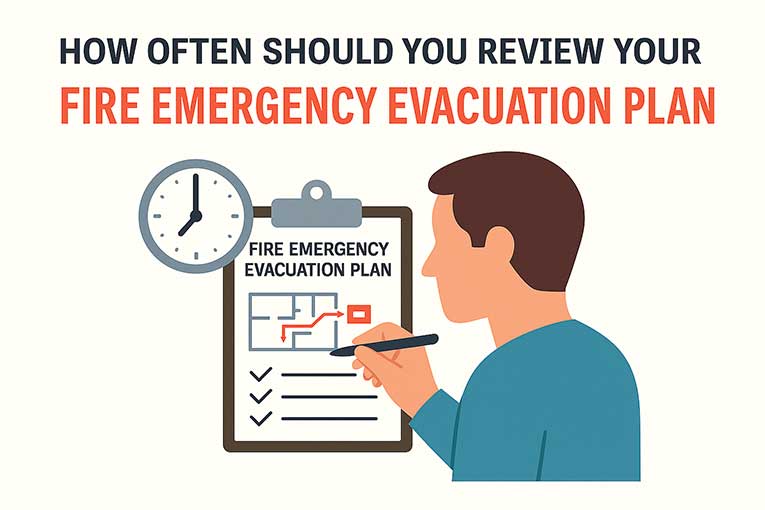
You should review your fire emergency evacuation plan regularly to keep it up to date – at least once a year is a good guideline. 

Over time, things can change that might affect your plan. 

For example, you might renovate or rearrange the space, or new people might join (employees, residents, etc.) who have different needs. 

After any such changes, update the evacuation plan accordingly. 

It’s also wise to review the plan after any fire drill or actual emergency. 

If a drill showed confusion about a particular exit or if an alarm wasn’t heard in some area, you should fix those issues and adjust the plan. 

Regular reviews ensure that escape routes are still clear, contact information is current, and everyone remains familiar with what to do if a fire occurs.

Is a Fire Emergency Evacuation Plan a Legal Requirement?

is fire emergency evacuation plan legal requirement

Yes, in most workplaces and public buildings a fire emergency evacuation plan is a legal requirement. 

Employers and building owners are legally obliged to implement and communicate these plans. 

If you have five or more employees, you are typically expected to have the plan written down as part of your fire risk assessment duties. 

Failing to do so can lead to enforcement actions or fines because it puts people at risk. 

For private homes, a written fire evacuation plan is not required by law, but it’s strongly recommended for your safety.

Fire authorities often encourage families to discuss and practise a home escape plan because it greatly increases the chance of everyone getting out safely. 

So, while you might not be legally required to have a formal fire plan in your house, the law does mandate it for most other settings where people live or work. 

Ultimately, beyond legal compliance, having a fire emergency evacuation plan is a responsible step that protects lives.

Conclusion

You should now have an understanding of how to create a fire emergency evacuation plan

A fire emergency evacuation plan is an essential part of keeping people safe from fire. 

In an emergency, a well-prepared plan can make the difference between a quick, orderly evacuation and dangerous chaos. 

By clearly outlining how to raise the alarm, the nearest exits to use, where to assemble, and who will call for help, it removes uncertainty and panic. 

Remember that for a plan to be effective, everyone needs to know it and it should be kept up to date. 

Whether at your workplace or in your home, taking the time to create and practise a fire evacuation plan can save lives. 

Fires are unpredictable and frightening, but when everyone knows what to do and where to go, the situation becomes much more manageable. 

Being prepared is not only a legal or moral responsibility – it’s also a practical way to protect yourself and others from harm.

Bulgaria uses satellite fire surveillance to support wildfire response

Bulgaria monitors wildfires using satellite fire surveillance

European News Room (enr) has reported that Bulgaria’s Ministry of Interior is monitoring national wildfire conditions using the European Forest Fire Information System (EFFIS).

Interior Minister Daniel Mitov said the country receives real-time satellite data on fire locations, hourly temperature anomalies, and the scale of destroyed areas.

Mitov explained that the information also includes long-term monthly forecasts for temperature and precipitation anomalies, statistical data, and fire danger index assessments.

He added that Bulgaria’s General Directorate for Fire Safety and Population Protection can activate the Copernicus system when operational needs arise.

EFFIS also provides Bulgaria with news and operational updates from other European Union member states and international partners.

Wildfire locations and scale in Bulgaria

Mitov stated earlier this week that Bulgaria is currently experiencing more than 1,000 active fires.

Two of these incidents are classed as more serious, one near Sungurlare in the Burgas region and another in the Blagoevgrad region near Ilindentsi.

According to Mitov, firefighting equipment provided through the European Civil Protection Mechanism has been deployed in the affected areas.

The fire near Sungurlare involved Swedish aircraft and helicopters, along with one American helicopter from the base in Novo Selo.

Mitov confirmed that this fire has now been brought under control.

Ongoing firefighting in the Pirin Mountains

Mitov reported that the fire in the Pirin Mountains remains active.

Military personnel have been deployed alongside firefighters to tackle the incident both from the air and on the ground.

Operations in the Pirin Mountains are ongoing, with no timeline given for containment.

International assistance through the EU Civil Protection Mechanism

In July, Bulgaria formally activated the EU Civil Protection Mechanism to address wildfire threats.

This resulted in the deployment of four helicopters from the Czech Republic, Hungary, Slovakia, and France.

Three Swedish planes were also sent to support Bulgarian firefighting efforts.

The Ministry of Interior stated that this international support has been essential in tackling multiple fire outbreaks across the country.

Bulgaria’s wildfire statistics and European ranking

According to EFFIS data shared in early August by Eng. Tihomir Tomanov, Executive Director of the Municipal Forests Association, Bulgaria ranks second in Europe for wildfire incidence in 2024, behind only Cyprus.

Tomanov reported that the country typically records around 600 forest fires annually.

These fires affect approximately 10,000 hectares of land each year.

Direct economic losses from these incidents are estimated at 2.5 million euros annually.

Relevance for fire and safety professionals

Fire and safety professionals can note Bulgaria’s integration of EFFIS and Copernicus systems as examples of using satellite-based intelligence in operational decision-making.

The country’s coordination with the EU Civil Protection Mechanism highlights the role of international resource sharing in wildfire response.

The data provided through these systems supports risk assessment, long-term forecasting, and the prioritisation of resources.

These approaches may inform strategies in other regions facing large-scale wildfire challenges.

Bulgaria uses satellite fire surveillance to support wildfire response: Summary

Bulgaria is using the European Forest Fire Information System (EFFIS) for real-time wildfire monitoring.

Interior Minister Daniel Mitov said the data includes locations, temperature anomalies, destroyed areas, and long-term forecasts.

The Copernicus system can be activated for operational needs.

Bulgaria currently has over 1,000 active fires, with serious incidents near Sungurlare and Ilindentsi.

International aircraft assisted in extinguishing the Sungurlare fire.

The Pirin Mountains fire is ongoing with military involvement.

In July, Bulgaria activated the EU Civil Protection Mechanism.

Helicopters from the Czech Republic, Hungary, Slovakia, and France, plus Swedish planes, were deployed.

EFFIS data shows Bulgaria ranks second in Europe for wildfires in 2024.

The country averages 600 forest fires per year.

Annual losses are about 2.5 million euros.

C-TEC announces CPD-certified open days at Wigan facility

CPD-certified open days planned for September

C-TEC has announced that it will host three CPD-certified open days at its manufacturing site in Wigan on 16, 17 and 18 September.

According to C-TEC, the events will include a presentation on the BS 5839-1 2025 update, product demonstrations and a guided factory tour.

The company stated that the programme is aimed at professionals in the fire safety sector, including engineers and consultants.

It added that attendees will also be able to gain CPD points through the sessions.

The events will take place at C-TEC’s third-party process approved facility, where its life-safety systems are manufactured.

Presentations on updated fire detection standard

C-TEC said one of the key sessions will focus on the practical implications of the revised BS 5839-1 standard.

The presentation will outline changes introduced in the 2025 update.

The company noted that the session will be CPD-certified and include a question and answer segment.

It added that the aim is to provide attendees with a clear understanding of how the changes affect real-world applications.

Factory tours and equipment demonstrations

C-TEC stated that participants will be taken on a CPD-certified tour of its production facility.

According to the company, the site features advanced manufacturing equipment, including 3D optical and x-ray inspection systems and Yamaha SMT lines.

The firm added that the tours are designed to show how the equipment is used to maintain quality control and minimise error.

Attendees will also have the option to attend product demonstrations in the afternoon.

Product showcase includes CAST-PRO

C-TEC reported that the demonstrations will feature its range of life-safety systems.

The company said this includes the CAST-PRO combined fire detection and alarm device.

It stated that CAST-PRO was named Fire Innovation of the Year.

The firm added that the demonstrations will allow attendees to see the system in operation.

Event schedule

C-TEC listed the following programme for each day.

It said the schedule will begin at 9.30am with refreshments and conclude at 3.30pm.

The morning will feature a welcome presentation, factory tour and the BS 5839-1 2025 update session.

Lunch and networking will take place from 1.00pm to 2.00pm.

Product demonstrations will be available from 2.00pm to 3.30pm.

Relevance for fire and safety professionals

The open days provide an opportunity for fire safety professionals to gain CPD points while receiving updates on industry standards.

They also allow attendees to see manufacturing processes and quality control measures used in life-safety system production.

The sessions on BS 5839-1 2025 may assist professionals in applying the updated requirements to current and future projects.

The optional demonstrations provide a chance to assess new technology in a practical setting.

C-TEC announces CPD-certified open days at Wigan facility: Summary

C-TEC will host three CPD-certified open days on 16, 17 and 18 September at its Wigan manufacturing site.

The events will include a BS 5839-1 2025 update session, factory tour and optional product demonstrations.

Attendees will be able to gain CPD points from the sessions.

The factory tours will showcase manufacturing equipment such as 3D optical and x-ray inspection systems.

The CAST-PRO combined fire detection and alarm device will be demonstrated.

The open days are aimed at fire safety professionals, engineers and consultants.

The daily schedule runs from 9.30am to 3.30pm.

Registration is available via C-TEC’s website.

Speed, scale and no wires – how a South Wales factory upgraded fire safety in one week

South Wales site adopts wireless fire detection system

Cygnus Systems has reported that its SmartNet-Pro wireless fire detection and alarm system has been installed at the A5 Hub industrial complex in Treforest, South Wales.

The company said the system was selected by Ceaton Security to meet the fire protection needs of a biomass boiler and multiple factory units on the site.

According to Cygnus Systems, the building’s insurance requirements meant a fire detection and alarm system had to be fitted quickly after the boiler’s installation.

Ceaton Security stated that the existing fire detection system in the main factory building was no longer operational, prompting a wider installation across the complex.

The A5 Hub contains a main factory, a small unit with the boiler and hopper, and seven additional smaller units, which Cygnus said made a wireless system preferable to avoid complex and costly cabling.

Selection of SmartNet-Pro for the project

Paul Biggs, Fire Division Technical Support at Ceaton Security, said: “During our site meeting, it became instantly evident that SmartNet-Pro would be the ideal solution for A5 Hub to fulfil the immediate requirements of the biomass boiler as well as expand to replace the existing non-operational fire detection and alarm system for the main factory and seven units.

“In total the installation took just over a week to complete, whereas if we had used a wired solution the installation would have taken a couple of months due to the scale and complexities of the site.

“Installing SmartNet is our preferred wireless solution.

Cygnus Systems stated that the installation addressed both the urgent need for boiler protection and the long-term requirement for reliable fire detection across all units.

The company added that the project demonstrates how wireless solutions can be deployed quickly in multi-unit industrial settings.

Landlord feedback on installation

Victoria Morton, Landlord of A5 Hub, said: “Through referral from one of my contractors, I contacted Ceaton Security who recommended SmartNet-Pro due to the fast speed required for installation with its minimal disruption.

“I was thoroughly impressed by the speed in which Ceaton Security were able to install SmartNet-Pro, as well as the lack of disruption installation caused to the site.

“I am currently in the process of arranging a pre-site meeting with Ceaton to install SmartNet in another one of my properties.

Cygnus Systems said that the positive feedback reflected the product’s installation speed and adaptability.

It added that the system can be applied across a variety of commercial and industrial sites with similar operational constraints.

SmartNet-Pro technical specifications

According to Cygnus Systems, SmartNet-Pro is the first EN 54 certified and fully wireless fire detection and alarm system in the world.

The company said the system can accommodate 511 devices and up to 96 zones on a single panel, with networking capability for up to five panels via software release code.

This allows for more than 2,500 devices to operate across a connected network.

Cygnus stated that the system uses its patented wireless mesh technology, featuring self-forming and self-healing capabilities with multipath redundancy and channel hopping.

It added that SmartNet-Pro can be installed up to twenty times faster than wired alternatives.

Training for certified installation

Cygnus Systems said attendance at its Cygnus Academy is mandatory for SmartNet installers.

The company stated that the training ensures installers can configure and fit the system to the required standard.

Paul Biggs said: “Six of our installers at Ceaton Security have attended the Cygnus Academy, gaining Cygnus SmartNet Certified Installer status.

“We found the training informative and would highly recommend it to other installers.”

Cygnus added that its training programme supports consistent quality of installation across all projects.

Relevance for fire and safety professionals

The project highlights the potential for wireless fire detection systems in complex, multi-unit industrial sites where wired solutions may be slow or costly to install.

It demonstrates how installation timelines can be reduced without compromising on system scale or coverage.

The technical features of SmartNet-Pro, including large device capacity and mesh networking, may be relevant for professionals planning upgrades in similar operational environments.

Wireless fire detection installed at Treforest industrial hub: Summary

Cygnus Systems has reported that its SmartNet-Pro wireless fire detection and alarm system has been installed at the A5 Hub in Treforest, South Wales.

The installation was carried out by Ceaton Security.

The system was required to meet the building’s insurance requirements for a biomass boiler and to replace a non-operational fire detection system in the main factory.

The A5 Hub consists of a main factory, a boiler unit and seven smaller units.

A wireless system was chosen to avoid complex and costly cabling.

Installation took just over a week to complete.

The SmartNet-Pro system can support 511 devices and 96 zones on a single panel.

Up to five panels can be networked for more than 2,500 devices in total.

The system uses Cygnus’ wireless mesh technology with self-forming and self-healing capabilities.

Attendance at the Cygnus Academy is required for SmartNet installation.

Italian hotel upgrades fire safety with Hochiki Latitude system

Installation of Hochiki fire detection technology in Verona hotel

Hochiki Europe has reported that Hotel Montresor Tower in Bussolengo, near Verona, Italy, has upgraded its fire detection and alarm system with the company’s Latitude life safety platform.

The installation formed part of a wider refurbishment project at the four-star venue.

Hochiki Europe stated that installer TOLA & C. SRL fitted a Latitude 8 loop control panel, along with voice alarm devices, call points, and ESP sensors.

According to Hochiki Europe, the Latitude system was selected for its programming features and Hotel Mode function, which enables controlled alarm delays to reduce unnecessary disruption in guest rooms while maintaining compliance with safety requirements.

The company added that to maintain the venue’s appearance, black finished ESP detectors were installed in the renovated conference centre.

Compliance with Italian fire safety standards

Hochiki Europe said that the upgrade included replacing older sensors with ESP range devices to meet Italian standard UNI11224.

The company explained that the standard requires fire detection system components to be upgraded every 12 years to maintain performance and reliability.

Hochiki Europe noted that the change ensures the hotel’s system remains compliant with national safety legislation.

It added that the upgrade also aligns with the hotel’s operational goals for long-term safety management.

Statement from hotel director

Hotel director Luca Montresor said: “We’ve been extremely satisfied with Hochiki’s technology over the years—it’s reliable, easy to maintain, and straightforward for our staff to operate. When it was time to expand and refurbish, there was no question we’d stay with Hochiki for the new system too”

According to Hochiki Europe, this continuation of the supplier relationship reflects the hotel’s satisfaction with the system’s operational history.

The company added that ease of use was a key factor in the decision.

System integration and design considerations

Hochiki Europe stated that combining the Latitude panel with ESP devices allowed the hotel to improve operational efficiency while maintaining a consistent visual design.

It said that the system was integrated into both guest areas and event spaces without altering the building’s interior aesthetics.

The company noted that the installation was designed to support both day-to-day operations and emergency readiness.

It added that the upgrade forms part of a broader strategy to prepare the venue for future needs.

Functional advantages of Hochiki Latitude system

Hochiki Europe explained that the Hotel Mode function on the Latitude platform enables time delays in certain areas to avoid unnecessary evacuations.

The company said that these delays are configured to meet all relevant safety regulations.

It added that the system’s programming flexibility allows the hotel to tailor settings for different parts of the building.

Hochiki Europe also stated that the ESP sensors’ design supports aesthetic integration in spaces with specific visual requirements.

Relevance for fire and safety professionals

This installation illustrates how hospitality venues can combine compliance with national fire safety standards and operational considerations such as guest experience.

It demonstrates the role of configurable system features, such as Hotel Mode, in balancing safety with operational needs.

The project also shows the importance of regular system upgrades to meet legislative requirements and maintain performance.

Italian hotel upgrades fire safety with Hochiki Latitude system: Summary

Hochiki Europe reported that Hotel Montresor Tower in Bussolengo, Italy, has upgraded its fire detection system with the Latitude platform.

The upgrade included a Latitude 8 loop control panel, voice alarm devices, call points, and ESP sensors.

The system was installed by TOLA & C. SRL as part of a hotel refurbishment.

Hochiki Europe stated that the system’s Hotel Mode allows controlled alarm delays in guest rooms while meeting safety requirements.

Black finished ESP detectors were installed in the renovated conference centre to maintain visual design.

Older sensors were replaced with ESP range devices to comply with Italian standard UNI11224.

The standard requires upgrades every 12 years to maintain reliability and performance.

Hotel director Luca Montresor said the decision to continue using Hochiki technology was based on past positive experience.

Hochiki Europe stated that the upgrade improves operational efficiency and maintains interior aesthetics.

The company added that the installation supports long-term safety and operational goals.

Pye-Barker acquires Southeastern System Services and Fire-X to expand US fire safety services

Pye-Barker acquires Southeastern System Services in Southeast United States

Pye-Barker Fire & Safety has announced the acquisition of Georgia-based Southeastern System Services, according to the company.

Pye-Barker said the addition expands its fire protection services and customer support across the Southeast United States.

The company stated that Southeastern System Services operates in Alabama, Kentucky, Tennessee, Florida, South Carolina, North Carolina and Georgia.

According to Pye-Barker, the business provides fire retardants, alarms and suppression systems, including water mist, high-expansion foam, dry chemical and carbon dioxide systems.

It added that the company also offers clean agent suppression systems designed to avoid environmental harm.

Pye-Barker said Southeastern System Services installs, repairs and maintains security and surveillance systems with access control, intrusion detection, remote video transmission and CCTV.

Darin Neslein, owner of Southeastern System Services, said: “I’m confident that joining Pye-Barker is the right strategic step for our family-run company.

“My parents built this business from the ground up.

“We’re grateful to be aligned with Pye-Barker for our continued growth, all while maintaining the family feel that is so crucial to who we are.”

Pye-Barker CEO Bart Proctor said: “Southeastern System Services is, at its core, a family business.

“I knew from our very first conversation that we were aligned in our values and that they would be a perfect fit to join our close-knit organisation.

“Not only that, but they bring immeasurable knowledge and expertise to the table, solidifying Pye-Barker’s fire safety presence in the Southeast.”

Pye-Barker confirmed that Southeastern System Services’ technicians will continue to work in the Southeast alongside existing Pye-Barker teams.

The company stated that Nelson Mullins Riley & Scarborough, LLP acted as its representative in the transaction.

Pye-Barker acquires Fire-X and Fire Protection Products in Maryland

Pye-Barker Fire & Safety has also announced the acquisition of Fire-X Sales and Service Corp. and its sister company Fire Protection Products, according to the company.

It said the Maryland-based firms expand its ability to provide fire code compliance services in the state and surrounding areas.

Pye-Barker stated that Fire-X and Fire Protection Products have operated since 1987 in Maryland, Pennsylvania, West Virginia, Virginia, Washington, D.C., and other locations.

According to the company, the two businesses design, install, test and service vehicle fire suppression systems for equipment such as dozers, loaders, trucks, cranes and locomotives.

It added that they also provide restaurant and kitchen fire suppression, special hazards systems, extinguisher service, and emergency lighting, signs and safety equipment.

The company said the two businesses create fire suppression systems for data centres, clean rooms and telecommunications centres.

Carroll Wollard, president of Fire-X and Fire Protection Products, said: “Joining the Pye-Barker team is an incredible opportunity to strengthen our community impact.

“Pye-Barker’s commitment to safety, compliance and customer satisfaction aligns with our values, and I’m beyond grateful we were able to find such a great cultural fit.”

Pye-Barker CEO Bart Proctor said: “We hope to provide full fire code compliance in every state across the nation, and this acquisition marks another step towards that goal.

“Fire-X and FPP have provided top-quality fire protection across the mid-Atlantic and will play a critical role in strengthening Pye-Barker’s integrated life safety efforts in the region.”

Pye-Barker confirmed that Fire-X and Fire Protection Products’ technicians will continue serving customers in Maryland and neighbouring states.

The company said Nelson Mullins Riley & Scarborough, LLP also represented it in this transaction.

Expansion strategy in United States fire safety sector

Pye-Barker described both acquisitions as part of its ongoing strategy to expand its fire protection, life safety and security services network across the United States.

The company said it now operates in multiple regions including the Southeast and mid-Atlantic, building on its goal of offering full fire code compliance nationwide.

According to Pye-Barker, acquiring established regional firms allows it to combine national resources with local expertise.

It added that this approach helps maintain service continuity for existing customers while broadening technical capabilities.

The company stated that retaining local teams ensures knowledge transfer and supports regional relationships.

Focus on specialist fire suppression systems

Pye-Barker said the acquisitions add specialist fire suppression capabilities to its service portfolio.

The company stated that Southeastern System Services contributes experience in water mist, high-expansion foam, dry chemical, carbon dioxide and clean agent suppression.

It added that Fire-X and Fire Protection Products strengthen expertise in vehicle fire suppression for heavy equipment and mining operations.

According to Pye-Barker, the combined resources will also enhance its support for environments requiring tailored solutions such as data centres, clean rooms and commercial kitchens.

The company said these capabilities align with its broader aim to provide integrated protection across diverse risk categories.

Continued operations under existing teams

Pye-Barker confirmed that all three acquired companies will retain their existing technical teams.

The company stated that this ensures minimal disruption for customers during the integration process.

It added that these teams will continue to operate from current service areas, supported by Pye-Barker’s national infrastructure.

According to the company, maintaining these local operations preserves service quality and supports long-term customer relationships.

Pye-Barker acquires Southeastern System Services and Fire-X to expand US fire safety services: Summary

Pye-Barker Fire & Safety has acquired Georgia-based Southeastern System Services.

The company said this acquisition expands its fire protection services across the Southeast United States.

Southeastern System Services operates in Alabama, Kentucky, Tennessee, Florida, South Carolina, North Carolina and Georgia.

Pye-Barker stated that the business provides fire retardants, alarms and suppression systems including water mist, high-expansion foam, dry chemical and carbon dioxide systems.

It added that the company also offers clean agent suppression systems, security and surveillance installations, and maintenance services.

Pye-Barker has also acquired Maryland-based Fire-X Sales and Service Corp. and its sister company Fire Protection Products.

The company said these firms provide fire code compliance services in Maryland, Pennsylvania, West Virginia, Virginia and Washington, D.C.

Pye-Barker stated that Fire-X and Fire Protection Products specialise in vehicle fire suppression, restaurant and kitchen suppression, special hazards systems and extinguisher services.

It added that they also create fire suppression systems for data centres, clean rooms and telecommunications centres.

Pye-Barker confirmed that existing teams from all three acquired companies will continue operations under their current structures.

NFPA Global Solutions acquires PFS TECO to expand testing and certification services

NFPA Global Solutions acquires US-based PFS TECO

NFPA Global Solutions has acquired PFS TECO, a third-party testing and certification company based in Wisconsin.

The company said this is part of its broader strategy to grow its compliance, advisory, and digital product offerings in fire and life safety.

According to NFPA Global Solutions, the acquisition brings new expertise in modular construction, hearth products, and building materials.

It follows the company’s earlier acquisition of Dyne Fire Protection Labs in 2024.

Carlos Correia, President of NFPA Global Solutions, said: “This acquisition represents a significant leap forward for both companies, providing a tremendous opportunity to advance our safety mission worldwide.”

Acquisition adds testing capacity in building materials

PFS TECO, based in Cottage Grove, Wisconsin, provides testing, inspection and certification services across multiple sectors in the built environment.

The company offers plan review and inspection for manufactured structures across the US and Canada.

Its certification division supports compliance for a wide range of building products.

Its hearth division evaluates gas and wood-burning appliances.

NFPA Global Solutions stated that PFS TECO’s services will strengthen its ability to serve clients navigating regulatory standards and marketplace requirements.

Correia said: “PFS TECO has established an excellent reputation in the industry for its testing, inspection and certification capabilities, strong customer focus and highly skilled technical team.

“This makes them a strong fit for NFPA Global Solutions and helps continue our expansion into new and emerging areas.”

Previous acquisition focused on fire protection systems

PFS TECO is the second company to be acquired by NFPA Global Solutions.

In June 2024, it acquired Dyne Fire Protection Labs.

Dyne Fire Protection Labs conducts laboratory analysis on products such as fire sprinklers, firefighting foams, antifreeze solutions, and dry chemical agents.

The company said this acquisition supported its goal of helping building owners comply with fire protection codes and standards.

NFPA Global Solutions described both acquisitions as aligned with its public safety mission.

It added that combining internal expertise with external capacity helps strengthen overall service delivery.

PFS TECO leadership comments on the transition

Scott Drake, President and CEO of PFS TECO, said: “The public safety mission of our companies aligns with our shared vision to offer our clients leading 3rd party programs and expand into new areas making this acquisition an excellent fit.”

He added: “Joining NFPA Global Solutions allows us at PFS TECO to take our business to the next level.

“By combining our teams’ technical knowledge, we gain greater access to industry expertise and can develop new services that will truly benefit our customers.

“We’re excited about the value this partnership will bring.”

Drake will continue to lead the organisation under the new structure, according to the statement.

Company profiles of NFPA Global Solutions and PFS TECO

NFPA Global Solutions is a subsidiary of the National Fire Protection Association.

The company was established in 2024 to deliver services in compliance, digital products, and advisory support.

It said it aims to extend fire, life, and electrical safety offerings beyond the NFPA’s traditional remit.

Its acquisition strategy is designed to expand both service scope and geographical reach.

PFS TECO has been active for over 85 years in the US and Canadian building sectors.

It operates across three divisions: manufactured structures, building products, and hearth appliances.

The company said it is recognised for its role as a third-party inspection and certification agency.

NFPA Global Solutions expands with second acquisition: Summary

NFPA Global Solutions has acquired PFS TECO.

The acquisition was announced on 7 August 2025.

PFS TECO is a testing, inspection and certification company based in Wisconsin.

The acquisition expands NFPA Global Solutions’ services in the built environment.

It adds expertise in modular construction, hearth products and building materials.

Carlos Correia is President of NFPA Global Solutions.

Scott Drake is President and CEO of PFS TECO.

This is NFPA Global Solutions’ second acquisition.

The first acquisition was Dyne Fire Protection Labs in June 2024.

NFPA Global Solutions was established in 2024.

It is a wholly owned subsidiary of the National Fire Protection Association.

Telgian to present fire alarm system commissioning webinar

Webinar to explore fire alarm commissioning in the US

Telgian has announced that Jim Burian, Regional Practice Leader at Telgian Engineering & Consulting, will lead a Fire Smarts webinar on fire alarm system commissioning on 14 August 2025.

According to the company, the 90-minute session will outline how commissioning ensures fire alarm systems are installed and operate according to design specifications.

The firm said the event will cover the goals of fire alarm commissioning, testing of components, documentation procedures, and stakeholder communication.

The session will take place from 2:00 pm to 3:30 pm Eastern Time.

Registration for the session is open to fire protection professionals across the United States.

Commissioning process and testing procedures

According to Telgian, commissioning involves a verification and documentation process confirming that a fire alarm system functions according to its intended design.

The company said the session will examine how to test initiating devices for alarm conditions and tamper switches for supervisory alerts.

It added that the session will also review the verification of notification appliances during alarm scenarios.

Participants will be guided through each stage of the commissioning process.

Burian is expected to explain how commissioning impacts system performance and code compliance.

Documentation and stakeholder responsibilities

Telgian stated that the webinar will include a segment focused on documentation best practices.

The firm said this will include guidance on how commissioning information should be formatted and stored.

It added that guidance will also be given on how documents should be distributed to relevant parties.

The process is expected to include recommendations for improving traceability and accountability across stakeholders.

Telgian said documentation is a critical part of system handover.

Presenter background and qualifications

According to Telgian, Jim Burian brings extensive experience in fire protection design and compliance.

The company said he has led teams of engineers, designers and code consultants on projects across the Mid-West.

It added that he has managed product safety and compliance initiatives involving UL testing and approvals.

Burian holds a Mechanical Engineering degree from the Illinois Institute of Technology.

He is the current Chair of the Chicago Chapter of the Society of Fire Protection Engineers and an active member of AIA Chicago.

Course relevance for fire safety professionals

Telgian said the webinar is aimed at engineers, contractors, and code officials involved in fire alarm system design and installation.

It explained that the content will be relevant to both new system installations and upgrades.

The firm said the session will also provide insights for professionals involved in inspection and maintenance.

Burian will provide examples and case-based guidance during the session.

The company said continuing education credits may be available through Fire Smarts.

Telgian to present fire alarm system commissioning webinar: Summary

Telgian has announced a webinar on fire alarm system commissioning.

Jim Burian will lead the session on 14 August 2025 from 2:00 pm to 3:30 pm ET.

The session will cover commissioning goals, testing procedures, documentation, and stakeholder responsibilities.

Burian is Regional Practice Leader at Telgian Engineering & Consulting.

He holds a degree in Mechanical Engineering and chairs the SPFE Chicago Chapter.

He has led design and compliance teams across the Mid-West.

The webinar will be hosted by Fire Smarts.

It is open to professionals involved in fire alarm system design, installation, and compliance.