How Much Does a Fire Truck Weigh?

How much does a fire truck weigh is one of the most common questions asked by school kids whenever the fire service comes to visit. 

Fire trucks, with their red flashing lights and blaring sirens, are a symbol of emergency response and safety in communities around the world. 

These impressive vehicles are equipped with specialised tools and equipment to combat fires and save lives. 

But have you ever wondered as an adult, not just how much does a fire truck weigh, but what equipment does it carry or even what types of fire truck are there? 

In this article, we will answer these common questions and provide insights into the fascinating world of fire trucks.

How Much Does a Fire Truck Weigh?

The weight of a fire truck is a critical factor in its design and functionality. 

The range in weight is primarily due to the size and capacity of the vehicle. 

To answer the question of how much does a fire truck weigh, the simplest answer is that a standard fire engine, which is commonly used for responding to fires and emergencies, typically falls within the 20,000 to 40,000-pound range. 

These trucks are equipped with essential firefighting equipment which add to their overall weight.

On the other hand, larger aerial ladder trucks, often used for rescuing people from tall buildings and providing elevated water streams, can be significantly heavier. 

These trucks feature an extendable ladder, which requires additional structural support and hydraulic systems, contributing to their weight of up to 70,000 pounds.
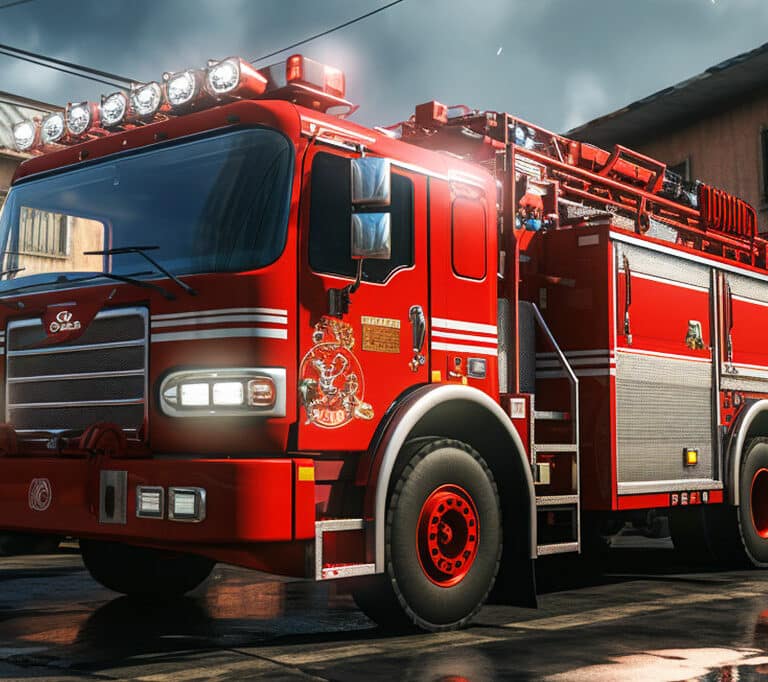
A fire truck can weigh up to 70,000 pounds

The total weight of a fire truck includes various components. 

The chassis, which serves as the foundation of the vehicle, contributes a significant portion to the overall weight. 

The body of the fire truck, made of steel or aluminium, houses the equipment and water tanks. 

Additionally, the equipment carried on the truck, such as ladders, firefighting tools, and medical supplies, further adds to the weight. 

All these factors are carefully considered during the design and construction of fire trucks to ensure they are efficient, durable, and capable of responding effectively to emergencies.

How Much Does a Fire Truck Weigh When Full of Water?

Probably the second most asked question in relation to how much does a fire truck weigh, is how much does it weigh when full of water. 

When a fire truck is filled with water, its weight can increase significantly due to the large water tank it carries. 

On average, a fire engine can hold between 500 to 1,500 gallons (1,893 to 5,678 litres) of water. 

Since each gallon of water weighs around 8.3 pounds (3.8 kilograms), a full tank can add an extra 4,150 to 12,450 pounds (1,882 to 5,647 kilograms) to the vehicle’s weight. 

This added weight is a crucial consideration for firefighters and drivers, as it affects the truck’s handling and performance during emergency responses. 

Properly managing the water supply is essential to ensure the fire truck can manoeuvre effectively and safely while combating fires and providing vital support to emergency situations.

How Long is a Fire Truck?

The length of a fire truck varies based on its type and model. 

Standard fire engines typically measure around 25 to 35 feet (7.6 to 10.7 metres) in length. 

However, aerial ladder trucks, equipped with extendable ladders, can reach impressive lengths of 75 to 100 feet (22.9 to 30.5 metres). 

These longer fire trucks are often employed in high-rise firefighting and rescue operations, where their extended reach is essential for accessing upper floors and providing a safe evacuation route. 

The varying lengths of fire trucks allow firefighting teams to choose the most suitable vehicle for specific emergency scenarios, ensuring an effective response to fires and other critical incidents.

How Wide is a Fire Truck?

The typical width of a fire truck ranges from 8 to 10 feet (2.4 to 3 metres). 

This dimension is carefully designed to ensure that the vehicle can manoeuvre through narrow streets and tight spaces in urban areas without encountering difficulties or causing damage to buildings and obstacles. 
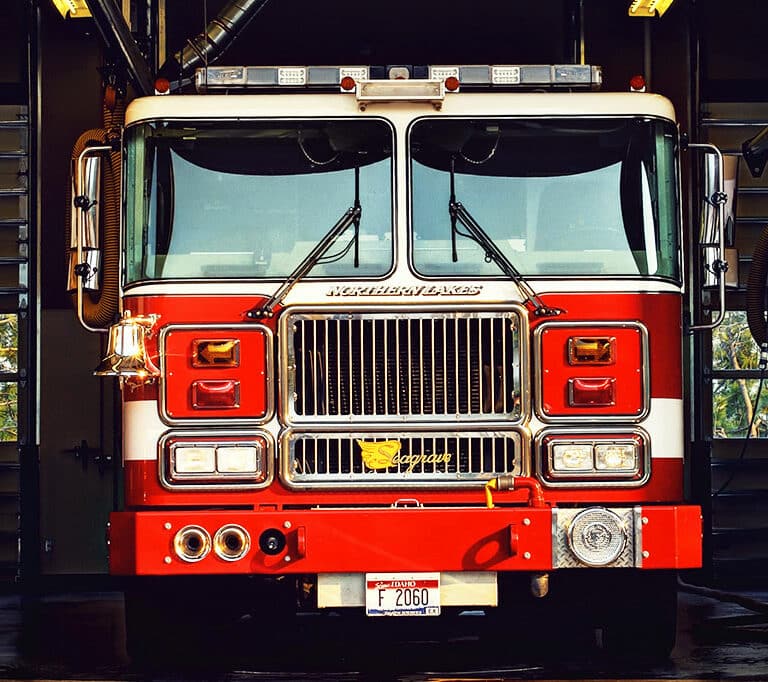
A fire truck can be up to 3 meters wide

The compact width enables fire crews to quickly reach emergency scenes and provide timely assistance, even in congested environments.

What Types of Fire Trucks Are There?

Fire trucks come in various types, each designed for specific firefighting tasks, depending on the cause and type of fire. The most common ones include:

Fire Engines 

Standard fire trucks equipped with water tanks, hoses, and firefighting equipment. They respond to most fire emergencies and carry a crew of firefighters. Recently, electric fire trucks have also been rolled out.

Aerial Ladder Trucks 

Also known as ladder trucks or hook-and-ladder trucks, these vehicles feature extendable ladders and platforms for rescue operations in tall buildings.

Rescue Trucks

Rescue trucks are equipped with specialised equipment for rescuing people from hazardous situations, such as vehicle accidents or collapsed buildings.

Wildland Fire Engines

Designed for fighting wildfires in rural and forested areas, these trucks have off-road capabilities and carry water to extinguish smaller fires.

Airport Crash Trucks

Specialised fire trucks used at airports to respond to aircraft emergencies, such as fires or crashes.

Foam Trucks

Equipped with foam-generating systems to fight fires involving flammable liquids.

Each type of fire safety vehicle is carefully designed to address specific fire scenarios, ensuring that firefighters have the right tools and resources to combat various emergencies effectively. 

The diversity of fire truck types enables firefighting teams to be prepared for a wide range of incidents, from standard structural fires to specialised hazardous material incidents. 

These versatile vehicles play a crucial role in ensuring the safety of communities and protecting lives and property during emergencies.

What Equipment is on a Fire Truck?

Fire trucks are equipped with a wide range of tools and equipment to handle various emergency situations. 

Some common equipment found on a fire truck includes hoses, nozzles, axes, saws, ladders, breathing apparatus such as oxygen masks, medical supplies, and thermal imaging cameras. 

The exact equipment may vary depending on the specific type and purpose of the fire truck. 

For example, ladder trucks will have extendable ladders and platforms for tall building rescues, while hazmat trucks will carry specialised gear for handling hazardous materials incidents. 

The availability of this diverse firefighting equipment ensures that firefighters have the necessary tools to effectively and safely respond to different emergencies they may encounter.

How Long is a Fire Truck Hose?

The length of a fire truck hose varies based on the truck’s size and intended use. 

Standard fire hoses used for firefighting operations are typically 50 feet (15 metres) long. 

Aerial ladder trucks may carry longer hoses, up to 100 feet (30 metres), to reach higher floors in tall buildings. 

The length of the hose is crucial in ensuring firefighters can effectively deliver water to the source of the fire, regardless of the building’s height or accessibility.

How Much Water Does a Fire Truck Hose Deliver?

The amount of water a fire truck hose can produce is determined by its diameter and water pressure. 

Most fire hoses have a diameter of 1.5 to 2.5 inches (3.8 to 6.4 centimetres) and can deliver water at pressures ranging from 50 to 150 pounds per square inch (psi). 

At an average flow rate of 100 psi, a fire hose can deliver around 50 to 125 gallons (189 to 473 litres) of water per minute. 

This water flow is critical for effectively extinguishing fires and controlling their spread, especially in larger and more intense fire incidents. 

Firefighters must skillfully operate the hoses to direct the water precisely and efficiently, making the most of their water supply to combat the flames and protect lives and property.

What Licence Do You Need to Drive a Fire Truck?

Driving a fire truck requires a specific commercial driver’s licence (CDL) with appropriate endorsements. 
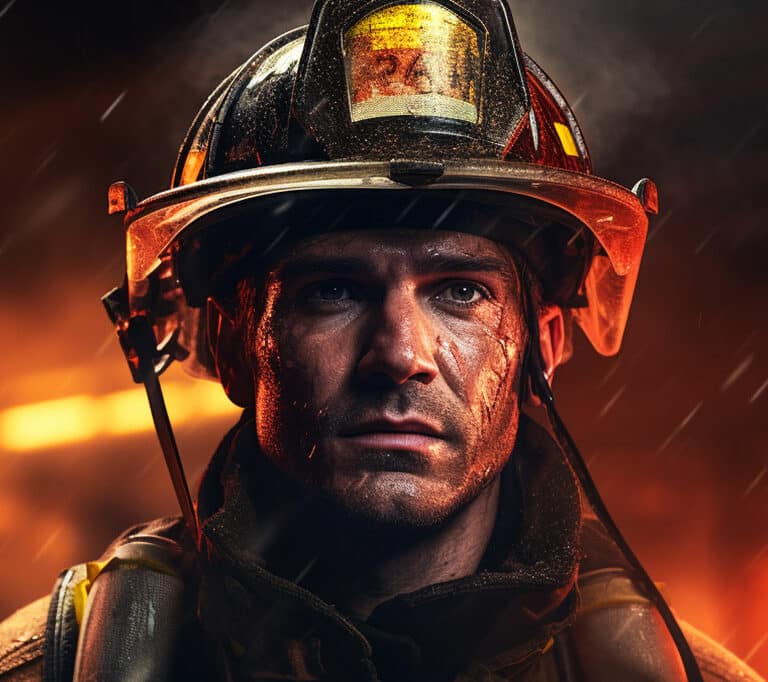
Firefighters need a special licence to drive a fire truck

The exact licence requirements vary depending on the fire truck’s weight, size, and type. For instance, a firefighter operating a standard fire engine may need a different endorsement than one operating an aerial ladder truck. 

To obtain the necessary CDL and endorsements, firefighters must undergo specialised training to operate these vehicles safely and effectively. 

This training includes learning how to handle the larger dimensions of fire trucks, understanding the unique challenges of emergency driving, and practising manoeuvres such as backing up, turning, and navigating tight spaces. 

Firefighters also receive instruction on vehicle maintenance and safety protocols to ensure the proper functioning of the fire truck during emergencies.

Conclusion

Hopefully this article provided a clear and concise answer to how much does a fire truck weigh, and some of the most common questions to do with fire trucks.

Fire trucks are essential vehicles in emergency response and play a crucial role in safeguarding communities. 

Their size, weight, and equipment are carefully designed to handle various firefighting and rescue tasks effectively. 

The training and expertise of firefighters who operate these machines are vital in ensuring their efficient use during emergencies. 

From carrying large amounts of water to navigating through tight spaces, fire trucks are equipped to tackle a wide range of challenges. 

Understanding the capabilities of these vehicles helps us appreciate the dedication and skill of firefighters who work tirelessly to protect lives and property in times of crisis.

Exclusive: Beyond the brightness with Nightstick

Derek Box, Marketing Manager for Nightstick, pulls back the curtain on the intricacies of safety-rated lighting

When did you last glance at that right-angle light on your turnout coat and pull out your magnifying glass to read the fine print? Most likely never.

For most, life is too busy for the particular details as long as your certified lighting tools are marked ZONE 0 Certified, and your lights are safety lab certified as Intrinsically Safe.

This is the beauty of safety-rated lighting – it is meant to be simple to understand.

When fully understood, those safety-rated symbols and hieroglyphics reveal secret ways you are protected, give context to your role, and can make you a better consumer with additional confidence in your equipment.

Specialised polymers with static dissipative properties

When a product is used in an ATEX Zone 0 environment, the environment alone poses unique challenges. The use of static dissipative additives in ATEX Zone 0 products has emerged as a crucial measure to mitigate the risks associated with ElectroStatic Discharge (ESD).

These additives play a significant role in preventing potentially catastrophic incidents and ensuring the well-being of all those present in such hazardous environments, but how are additives defined?

Static dissipative additives are specialised substances incorporated into materials, such as polymers, coatings, and composites.

Often found in the housing of a safety-certified torch, lantern, or angle light, these chemical additives help to minimise the buildup and discharge of static electricity, which can ignite flammable substances and trigger explosions.

By facilitating the controlled dissipation of electrostatic charges, these additives significantly reduce the likelihood of ESD-related incidents.

Some dangers are known, while others are unknown, so being prepared for both scenarios with the right certified equipment is a secret worth understanding.

One of the primary functions of static dissipative additives is to increase the electrical conductivity of the materials into which they are incorporated within.

This enhanced conductivity allows any accumulated static charges to flow safely to a grounding point, thus preventing the formation of sparks or arcs that could ignite the surrounding flammable atmosphere.

Moreover, these additives offer long-term effectiveness by maintaining their static dissipative properties throughout the lighting product’s lifespan.

The product makeup is purposely designed to resist leaching, migration, or degradation, ensuring a consistent and reliable level of electrostatic protection over time.

This means that the shelf life of the product is extended for constant use or until it is time to replace it physically.

Furthermore, static dissipative additives are typically formulated to be chemically compatible with the base material, ensuring their optimal dispersion and integration.

This compatibility ensures that the mechanical and physical properties of the materials are not compromised while providing the necessary static dissipation characteristics.

By preventing the accumulation and uncontrolled dissipation of static charges, additives significantly reduce the potential for explosions.

As technology advances, further research and development in this field will continue to improve the safety standards of ATEX Zone 0 products, safeguarding workers and minimising the risks associated with explosive atmospheres.

Overpressure valves and gas venting

One potential danger in a hazardous environment is the release of gas from batteries.

Batteries, especially rechargeable ones, can generate tiny amounts of gas during normal operation and significant amounts during a fault or malfunction.

In an intrinsically safe portable lighting product, this gas must be safely vented to prevent the buildup of flammable concentrations.

Nightstick intrinsically safe lighting products employ various mechanisms depending on the specific design to vent battery gas properly and, most importantly, safely. Here are two common methods:

  • Pressure Relief Valve: Some lights have a pressure relief valve built into the battery compartment. This valve allows any excess gas to escape, maintaining a safe pressure level inside the light. The valve typically opens when the pressure reaches four psi and closes once the pressure is normalised.
  • Sealed Enclosures: Intrinsically safe lighting may have sealed enclosures that are constructed to be dustproof and waterproof.

It is important to note that intrinsically safety-certified lighting products undergo rigorous testing and certification processes to ensure their compliance with specific safety standards and regulations.

These standards dictate the maximum allowable energy and temperature levels of the lighting tool and the battery to prevent ignition in hazardous environments.

By incorporating mechanisms for venting battery gas, intrinsically safe lights can effectively mitigate the risk of ignition and ensure safe operation in potentially explosive atmospheres.

Electrolyte leakage prevention

Electrolyte leakage can occur in lighting that uses rechargeable batteries, such as lithium-ion batteries, if there is a malfunction or damage to the battery or its casing.

When electrolyte leaks from a battery, it can potentially come into contact with the internal circuitry, causing the light to shut down to prevent a hazardous condition from occurring.

Nightstick’s intrinsically safe portable lighting products employ key design elements to prevent electrolyte leakage.

The torch enclosure, made from impact-resistant polymers, is tough and durable, protecting the battery from damage.

Specialised sealing mechanisms using rubber or epoxy secure housing parts, blocking moisture and contaminants that could corrode the battery.

Safety features like voltage regulators, overcharge protection circuits, and thermal sensors protect the battery further.

Nightstick’s lights also exclude ignition sources, reducing sparking and heat generation.

The lights meet safety standards from organisations such as the IEC and NFPA, ensuring their safe usage in hazardous locations.

Intrinsically safe lighting provides a reliable and secure solution in environments where electrolyte leakage could have severe and, in some cases, fatal consequences.

Encapsulated fuses

Intrinsically safe fuses in portable lighting serve as vital safeguards against electrical faults, helping prevent dangerous conditions such as ignition.

By acting as a check against excessive current, they provide a robust line of defence.

They limit electrical energy by interrupting the circuit if the current goes beyond their specific rating.

These fuses are also instrumental in preventing the formation of sparks and arcs that could ignite flammable substances by promptly interrupting circuits.

Compliant with safety standards set by organisations like the IEC, lights, and their components, including fuses, are suitable for use in hazardous locations.

Redundancy and safety interlocks are another key feature, as lights incorporate additional fuses and resistors to reduce the risk of electrical faults.

Metal content restrictions

Restrictions in IEC 60079 regulations limit the percentage of certain metals allowed in the external housing of Zone 0 rated devices.

Currently, the limit is 10% or less for aluminum, titanium, zirconium, and magnesium. This includes not only the housing, but pocket clips, fasteners, and accessories directly attached to the device.

Metal housings pose practical risks. Conductivity increases chances of circuit completion and sparks from drops.

Chemical reactions with gases in hazardous environments could yield catastrophic results.

Currently, there are no restrictions on engineered polymers in IEC 60079 regulations, making them ideal for Zone 0 rated products.

When combined with static dissipative additives, polymers can now have very low surface resistance that virtually eliminates static charge buildup per standards requirements.

Polymers do not corrode or chemically react with the class IIC gasses found in most hazardous environments. In addition to being lightweight, unlike metal, polymers cannot complete a circuit or create a spark if dropped.

There are many unknown and unseen ways that intrinsically safe lighting protects users from danger.

Another critical factor is the product manufacturers’ experience level with producing intrinsically safe lighting.

A single-source manufacturer ensures consistent quality and safety across an entire product line when purchasing professional lighting products rather than mixing and matching products from several companies.

This is especially important when buying hazardous environment safety lighting.

Nightstick exceeds industry standards in performance, quality, value, and user safety. From penlights to floodlights, above ground or below ground in a confined space, Nightstick has you covered. Find the certification level you need or locate a dealer near you at www.nightstick.com.

This exclusive article was originally published in the June 2023 issue of International Fire & Safety Journal. To read your FREE digital copy, click here.

High-tech military camouflage undergoes rigorous testing to save lives

In a bid to protect military personnel and safeguard assets in hostile environments, the critical aspect of undetectability cannot be underestimated.

Now, Teledyne FLIR integrator Thermal Vision Research and leading protective equipment manufacturer for military applications, BCB International, are striving to provide that elusive factor of invisibility.

BCB International: Over a century and a half of camouflage innovation

Having been in the industry for 160 years, BCB International brings significant experience in developing camouflage materials.

Their bespoke products can effectively conceal both equipment and personnel across a range of different wavelengths, ensuring both secrecy and safety.

Beyond human sight: The crucial role of thermography in camouflage

In high-risk environments, moving undetected is vital. This goes beyond human sight and regular surveillance methods.

With advancements in camouflage technologies, the capability to transcend thermography and achieve true invisibility is the next frontier.

It’s noteworthy that as camouflage technologies have improved, so has thermography.

Its ability to better pinpoint anomalies and provide insights when needed most has greatly enhanced.

Yet in this context, the ultimate goal is not to be seen at all.

Testing camouflage with state-of-the-art thermal imaging

Through a custom rig built by TVR using thermal imaging cameras, BCB International is able to test their latest and most advanced camouflage netting.

The focus here is to observe what appears under thermography and how effective the netting is.

To achieve this, three different thermal imaging cameras are utilised, each operating at different wavelengths: a shortwave, medium wave and long wave application.

The approach streamlines critical testing in both lab and field environments, detecting anomalies from -45°C to 70°C.

Rigorous quality control: Ensuring camouflage withstands extreme conditions

BCB’s range of high-tech camouflage materials is designed to be fire-resistant with anti-thermal properties, concealing troops and equipment in almost any environment.

To ensure this, BCB collaborated with TVR in a closed environment, with the thermal imaging rig set up at a distance of 10 metres.

Andrew Howell, Managing Director of BCB International, elaborated: “We need to see what shows up by thermal imaging so we can see what accurately conceals and what doesn’t – and for this, we use thermography.”

Matthew Clavey, Director of Thermal Vision Research, added: “Whether the camouflage netting is being deployed over a tank or over artillery or supplies, they’ll invariably have different wavelength requirements.

“This is why it’s so important to test the heat emissivity of different materials across the spectrum of thermographic wavelengths.”

The last word on shoring with Holmatro

Mattijn de Graaf, R&D Director of the Holmatro Group, explains the design philosophy behind OmniShore, Holmatro’s all-new rescue shoring system

Tell me about Holmatro – what work do you do in the fire and safety sector?

Holmatro was founded in the Netherlands in 1967. We are a leading global supplier of rescue equipment and services. We have around 300 employees, located in the Netherlands, USA and China. Next to these three headquarters, our brand is represented in more than 160 countries by our extensive global sales and service network, consisting of more than 400 active authorized business partners.

Holmatro’s rescue equipment is mostly used in the fields of vehicle rescue, disaster rescue and special tactics. To make sure that our users can fulfil their specialized tasks, we aim to be the best-in-class industry market leader. We do this by using game changing technology.

What is OmniShore and why was it developed?

OmniShore is an all-new rescue shoring system, designed from the ground up. It was developed to make rescue shoring operations safer, faster and easier. That is not just a catchphrase, but the key focus of our design philosophy. We wanted to create a system that is compact, intuitive and above all safe.

How does this new shoring system support firefighters during rescue operations?

Holmatro OmniShore is the only solution that helps rescuers overcome all shoring challenges with a system of just six different struts and no fixed length extension pipes. Guaranteed to save weight and space on their truck.

In addition, OmniShore enables first responders to build every construction quickly and easily. Its patented Trident Coupler ensures a safe connection between two struts and offers a seamless setup of lengths up to 17 feet or 5.2 meters.

And finally, Holmatro OmniShore’s patented OmniLock system supports rescuers in monitoring and operating struts from a safe distance. This means less manpower is required and no one needs to be near a moving load.

In what kinds of situations is OmniShore designed to be used?

You can shore it all with OmniShore! It has been designed to do more with less, so with a limited number of components rescuers will be able to handle every shoring operation safely and successfully. Whether it’s vehicle shoring, trench shoring, high directionals or structural shoring, OmniShore can do it all.

In terms of innovation, what do the next few years look like for Holmatro?

Of course, we can’t go into too much detail about the patented innovations that we are working on at the moment. But innovation is in our DNA, so you can expect us to keep coming up with groundbreaking innovations that make the world safer, healthier and more productive.

This exclusive article was originally published in the June 2023 issue of International Fire & Safety Journal. To read your FREE digital copy, click here.

Market Analysis: Tool Mounting

International Fire and Safety Journal analyses the tool mounting solutions market

The fire and rescue service industry plays an indispensable role in safeguarding public safety on a global scale. As emergency response teams continually strive for heightened efficiency and effectiveness, the proper organisation and accessibility of tools and equipment become paramount. Tool mounting solutions have become the indispensable components within fire and rescue vehicles that offer secure and efficient storage for essential firefighting tools.

Growth Drivers

Firefighter safety remains a paramount concern for fire and rescue services worldwide. In this regard, tool mounting solutions have emerged as invaluable assets, offering a secure haven for tools while ensuring easy accessibility. By doing so, these solutions not only reduce the risk of injuries but also significantly enhance response times during emergencies. The growing recognition of occupational hazards and the pressing need for efficient tool organisation have fuelled the widespread adoption of these solutions.

Tool mounting solutions have become indispensable in enabling swift response times. Firefighters can swiftly locate and retrieve the necessary equipment, minimising precious moments wasted searching for specific items. As a result, operational efficiency skyrockets, enabling responders to focus on their primary tasks with heightened efficacy.

Technological advancements have further revolutionised the realm of tool mounting solutions. Cutting-edge features such as quick-release mechanisms, adjustable brackets, and customisable storage options have been introduced, propelling ease of use, flexibility, and adaptability to new heights.

Stringent safety regulations and standards enforced by regulatory bodies have compelled fire and rescue service agencies to give top priority to the systematic organisation and safeguarding of tools. Tool mounting solutions provide a reliable means of ensuring compliance with these rigorous standards, empowering agencies to meet safety requirements and regulations with utmost efficiency.

Challenges

Implementing tool mounting solutions can pose a substantial financial burden, particularly when retrofitting existing fire and rescue vehicles. Limited budget allocations and the need to balance various operational expenses present significant challenges for agencies considering the adoption of these solutions. However, the industry is actively seeking cost-effective and modular alternatives to overcome these barriers and make tool mounting solutions more accessible to a broader range of organisations.

Fire and rescue vehicles come in a wide array of sizes, layouts, and equipment configurations, which adds another layer of complexity to the adoption of tool mounting solutions. Manufacturers are under pressure to design flexible and customisable solutions that can be tailored to fit different vehicle specifications while ensuring compatibility and seamless integration. This adaptability is crucial in meeting the unique needs and requirements of fire and rescue service agencies.

The successful implementation of tool mounting solutions hinges upon proper training and raising awareness among firefighters. It is vital to ensure that all responders are well-versed in the system’s functionality and operation. By providing comprehensive training programs, agencies can enhance adoption rates and empower firefighters to fully leverage the benefits of tool mounting solutions.

Regional breakdown

The tool mounting solutions market across all regions is driven by similar factors such as firefighter safety, operational efficiency, regulatory compliance, and technological advancements. However, each market has its own unique characteristics and requirements based on regional regulations, infrastructure development, and specific challenges faced by fire and rescue service agencies.

North America boasts a well-established fire and rescue services that place a strong emphasis on safety and efficiency. This market thrives under the influence of stringent safety regulations, remarkable technological advancements, and the pressing need to upgrade existing equipment. Meanwhile, Latin American countries such as Brazil and Mexico are witnessing a surge in investments directed towards enhancing firefighting infrastructure, contributing to the overall growth of the market.

The European market for tool mounting solutions within the fire and rescue service demonstrates remarkable diversity. European nations adhere to stringent safety standards and regulations, thereby driving the widespread adoption of tool mounting solutions. The market is currently witnessing a noticeable trend towards lightweight and space-efficient solutions. Moreover, sustainability and the utilisation of eco-friendly materials have emerged as focal points within the realm of tool mounting systems.

In the Middle East, substantial investments in fire and rescue services are being made to support the expansion of infrastructure projects and an intensified focus on safety. Within this thriving market, the demand for advanced equipment, compliance with international safety standards, and efficient tool organisation are driving forces. The Middle East particularly seeks customised solutions capable of withstanding extreme weather conditions.

Industry expert comment: Performance Advantage Company

The global firefighting industry has been witnessing steady growth over the years. Factors contributing to this growth include increasing urbanization, infrastructure development, stringent safety regulations, and the need for advanced firefighting equipment.

Advancements in firefighting technologies have led to the development of more efficient and effective firefighting solutions. Innovations such as intelligent fire detection systems, advanced firefighting foams, thermal imaging cameras, and improved PPE have enhanced the industry’s capabilities.

The demand for firefighting products and services varies across regions due to variations in fire safety regulations, infrastructure development, industrial activities as well as budgetary constraints. Developed regions like North America and Europe have well-established firefighting markets, driven by stringent safety standards and high infrastructure investments. Developing regions, such as Asia-Pacific and Latin America, are experiencing rapid urbanization, which is fueling the demand for firefighting equipment and services.

Overall, the worldwide firefighting industry is expected to continue growing as the importance of fire safety remains a priority. Advancements in technology, increasing urbanization, and stricter safety regulations will continue to drive market expansion. As a supplier to the industry as well as a member and safety advocate, PAC is excitedly looking toward future expansion and changes.

BNPB equips Riau government with firefighting equipment

The Riau government receives firefighting equipment for forest and land fire management

The Lieutenant General of the National Disaster Mitigation Agency (BNPB), Suharyanto, provided the Riau Provincial Government with firefighting apparatus on Wednesday, aimed to counter forest and land fires, according to a report from Antara News.

“The Riau Forest and Land Fires Task Force should continue to carry out routine preparedness assemblies every week. Since President Jokowi (Joko Widodo) is concerned with this issue, there should be regular patrols (to prevent the establishment of hot spots),” Lieutenant General Suharyanto said.

The assortment of supplied equipment comprised 11 main pumps, 22 hose pumps, 44 portable pumps, 231 hose units, 88 nozzles, 88 Y-connectors, 220 sets of personal protective gear, alongside 11 water tanks, each holding 5,000 litres.

Emphasising regular reviews and patrols

In addition to the material assistance, the BNPB chief stressed the necessity for the task force to routinely assess weather forecasts, hot spots, and peat groundwater levels.

“The task force must list the needs and ensure the readiness of all personnel, as well as make sure of the availability of equipment and logistics for land and air operations,” added Suharyanto. He indicated that if required, the regional government can promptly seek aid from the central government.

Riau’s efforts in fire prevention and management

The Riau Governor, Syamsuar, disclosed that several Forest and Land Fires Task Force Posts had been set up at different administrative levels, notably in fire-prone areas.

“In addition, we also use Riau Regional Police Lancang Kuning (forest and land fires prevention) dashboard, as this application is very helpful to detect hot spots,” he stated.

Syamsuar mentioned that his administration not only undertakes initial fire detection but also dispatches task force officers to examine hot spots on the ground. This allows for swift and accurate extinguishing of fires, preventing them from spreading.

They are also implementing a routine and integrated patrol while educating the community about the dangers of clearing land by burning it.

He confirmed that the government has allocated budgets and ensured that the infrastructure needed for disaster management is fully operational. Coordination and collaboration with various stakeholders, including military, police, business actors, community and traditional leaders, academics, media, and volunteers, have also been improved.

The Riau government is monitoring weather modification technology (TMC) over fire-prone areas to prevent forest and land fires.

Source

IFSJ Exclusive: The perfect fit with Performance Advantage Company

Greg Young, Senior Administrative Vice President at Performance Advantage Company looks at choosing the right tool mounting solution

Performance Advantage Company (PAC) was born from the fire industry, for the fire industry. 30 years later both our product line and the markets we serve have expanded greatly. We now serve customers outside the fire market including law-enforcement, military, utility and more. Our overall approach is to provide the most robust system so that tools are organised and secured on mobile platforms.

As a manufacturer in the United States, we serve our customers through a large and ever-growing network. Our customers include truck manufacturers, loose equipment distributors and resellers, truck refurbishment and service centers as well as original equipment manufacturers. Our products are in use in over 30 countries and demand around the world continues to grow for our robust tool mounting systems. 

Our core values drive us to make products that allow the fire industry to do their job efficiently and reliably. We believe our brackets achieve those goals by securing and organising tools. The current market conditions of long lead-times and shortages have caused many people to cut back on spending or make do with what they have. This will persist for many years, so the impetus is to keep all your equipment running longer. The same is true for loose equipment, rescue tools, etc. Our brackets keep those tools secured, safe, ready to use, and not to be misplaced. Our mission is to maintain and build our product line to meet the needs of the changing industry.

Choosing the right tool mount

There are several considerations, many of which might be considered the most important. Some of those factors could be a better response time, better accountability of tools, and less misplacing or lost tools. Another factor may be the replacement cost of the tools themselves. Rescue tools, LED lights and fans can be very expensive, and they must be secured to avoid a potential shortage of funds. Money spent on tool mounting saves investment dollars over the long term. That money can then be used for training or new tools that come on the market.

Another consideration when purchasing tool mounts for a truck may be the safety of the vehicle’s occupants. Often emergency and rescue vehicles are involved in crashes due to the speed or poor visibility, etc. Unsecured tools can be liberated from the vehicle, causing injury, or death. Tools in an occupied cab must be secured in a positive locking mount, not just a friction type mount. This will always provide safety and security, not just in case of a crash.

When purchasing tool mounting it is important to consider if that tool mounting system will be robust enough, or heavy duty enough, for the weight load that will be put into it. This can vary by a large magnitude due to the wide variety of tools used in the marketplace.

Other applications

You can commonly find hand tools wall mounted in garages or storage sheds or barns. But those static locations are not subject to the same dynamic loading that occurs in mobile applications like vehicles or trailers. When we talk about tool mounting systems, we are talking about robust and secure solutions for large heavy equipment in industrial situations. This can be on garbage trucks, police pursuit vehicles, fire and police boats, and more. And tool mounting may not even be vertical on a wall.

There are other times where heavy equipment needs to be mounted horizontally, fixed to a floor. Sometimes it must be mounted at an angle because either the tool dimensions exceed the space dimensions, or the angled installation allows a more ergonomically safe position for removing and replacing the tool into the mounted position.

New solutions

There are several new products that I’m excited about. I feel like there’s a lot of excitement to be had all around. We manufacture several different bases that locate the tips of rescue equipment like spreaders and cutters. We recently made a new rectangular pocket part number 1081 and there has been a lot of excitement around it from the market. It’s available by itself or it comes included in kits for different tools.

This pocket, and its simplicity and extreme durability, allow us to locate some rescue equipment that we were unable to previously. It’s caused excitement amongst our customers as they have recognised they can replace a part that they were fabricating their own part from aluminium or plastic. They see our part and recognise that a more efficient approach is to purchase from us a better and more durable product, saving them time and money.

PAC got started by recognising that manufactures of fire trucks for example, custom fabricate mounting brackets for each truck. It’s a much better idea to just take a part off the shelf, for a specific purpose, and finish that truck much sooner – than it is to stop work on the truck to fabricate a custom piece. We have had several customers drawn to this new product to tell us that it’s very similar to something that they make for another purpose.

These conversations have grown into more opportunities for us to provide other pockets that we don’t currently manufacture. This is great news that we love to hear because if one manufacturer tells us they need it – there is probably a greater need in the market to investigate. But this is the nature of the tool mounting business – new equipment, tools, and fire hazards for that matter, are coming into view all the time.

Remaining versatile

We do some of the development ourselves, however, we don’t completely rely on our own experience when looking for tool storage opportunities. We use a combination of actively looking at new products, monitoring the market trends and actively working with our customers to find the new trends that are outside our current offerings. While our employees have many years of combined experience PAC has over 550 dealers around the world, including 25 outside the United States. That constitutes a lot of customer-facing people, including salespeople, engineers, and service technicians.

Not only do we seek out new trends, through publications or through trade shows, our customer network trusts us for new solutions that their customers are looking for and we surely welcome those challenges. Internally we pass all this information along to our engineering and purchasing teams. They develop the concepts that meet these challenges, but only when the product meets our strict values. This is how we remain versatile and adapt to new tool innovations.

Also, I would like to repeat that we are actively looking for international customers looking for an experienced vendor of highest quality tool mounting solutions. 

Complex challenges

We continue to receive client requests. Of course we welcome all opportunities to solve problems for our customers. One recent example of a noteworthy new client is a manufacturer of specialty law enforcement tools. They make breaching tools, tear gas guns, and tear gas delivery systems. The delivery systems are vehicle mounted, at the scene, but need to be stored and secured until needed. They are a manufacturer that makes incredible products and wants to sell the product with the perfect mount so they came to us for help.

The complexity in mounting their tools is the difference in diameter when comparing the handle to the working end of the tool. This offset presents challenges when trying to hold something 4” or more away from a surface. This added complexity concerning offsets was outside the experience of the tool manufacturer. In order to provide vehicle mounts with their very unique tools and equipment, they recognised they needed to come to PAC for help.

The future of tool mounting

Having already served the company for 11 years, I’ve come to better understand our strengths as well as our shortcomings. In my new position as Senior Administrative Vice President, I will be looking at all the areas of the business, ensuring we maintain positive growth. I will be working to make sure that we educate the market about how PAC excels in the tool mounting industry. I also can address our shortcomings in new ways.

Every organisation has opportunities to improve and innovate their processes. Our company is no different. For me this means that I will become involved in more areas that I had not previously. Examples of this include coordinating and overseeing an entirely new accounting and customer management system, digging deeper into financials and budgets, looking towards the future and our aligning our goals.

It also means leading and building our team to meet those goals. This means a stronger team with more responsibilities driven by clear goals and direction. With a stronger team structure, we will cast a wider net and accomplish more. For example, product development or vendor development – It’s done by our engineering and purchasing team now instead of just our engineer, for example. Other parallels to this example, of growing our teams, are found in our core areas like marketing, sales and customer service.

While I always like to keep my ideas close to the vest, there are so many things that excite me about the future. The first of which is to continue building and strengthening our fantastic team. Also, PAC will soon publish a catalogue for the marine market because PAC products are already on boats for fire, rescue, and law enforcement. There is a whole new category of tools for administering fire suppression in the EV (electric vehicle) segment. This may require new tool mounts make that we don’t offer. So that more people experience the benefits of our mounting systems PAC will continue to seek new international dealers and manufacturers.

I will also be looking at ways to allow us to communicate efficiently amongst this growing pool of customers. And finally, as we continue to experience growth, there must be a review of our emergency plans. It is so important that we be prepared and ready to handle the next pandemic, flood, or fire for example, so we can continue to provide our assistance to the life saving market that is fire and emergency.

This exclusive article was originally published in the June 2023 issue of International Fire & Safety Journal. To read your FREE digital copy, click here.

IFSJ Exclusive: Putting firefighters on the map with MSA Safety

Matt Quigley, Product Platform Manager for MSA Connected Firefighter, and Selma Sosic, Product Line Manager for MSA FireGrid talk product development and FDIC

At FDIC in 2019, MSA Safety announced the Connected Firefighter Platform. Since then, the platform has grown and developed to incorporate new elements such as LUNAR and FireGrid. Ahead of FDIC 2023, which returns to Indiana Convention Centre on 24-29 April, IFSJ caught up with Matt Quigley, Product Platform Manager for MSA Connected Firefighter, and Selma Sosic, Product Line Manager for MSA FireGrid to learn more about the Platform, its development, latest additions and what’s coming next.

Can you give me an overview of the Connected Firefighter?

MQ: Our aim for the Connected Firefighter Platform is to utilise connectivity and technology to make firefighters and fire departments more capable. From what we see from the Global Fire Service market, firefighters are typically being asked to do more. What we see, especially in North America, is that the number of firefighters isn’t really growing. The fire service is essentially being called upon to do more with the same or less resources. Our intent for the Connected Firefighter is to utilise technology to essentially make fire departments more capable in three primary areas.

The first one is people: making firefighters safer with new technological tools. The second is products – we’re developing a lot of functionality that leverages technology and data to inform maintenance procedures to make the product last longer and be less burdensome to maintain. The final one is processes – we’re collecting information on firefighter behaviour to inform departments of additional training opportunities and to make them safer by bringing awareness to their behaviours.

A big part of the Connected Firefighter is our FireGrid cloud software. All of our connected products have wireless transmission capabilities to FireGrid, which is our centralized location for storing and providing insights from customer data. FireGrid is essentially the central focal point that’s gluing our entire platform together.

What are the major components that you’re offering for FireGrid?

SS: There are four key functionalities that FireGrid offers. The first one is the live incident management, meaning being able to monitor live MSA product data on scene to help the incident commander make more informed decisions in real time.

The second is our post-incident analytics. Firefighters don’t have to change anything about the way that they’re using the breathing apparatus, but because our devices are cloud-connected, all that data is stored in their account in the cloud, and we’re able to utilize that data to provide more insightful analytics and reporting for the customer to better inform things like training or on-scene procedures.

Third is Inventory Management and Compliance. We currently offer an inventory management solution where you’re able to track all of your MSA products and manage all of the relevant maintenance and compliance requirements for each asset. Because this tool is part of the cloud-based ecosystem, MSA is specifically able to link the G1 SCBA’s hours under pressure to the inventory management tool, allowing customers to save time and resources by maintaining SCBAs based on actual usage data.

The fourth component that FireGrid offers is the individual firefighter health and safety component which primarily takes the focus from looking at individual products to looking at individuals and behaviours.

MQ: With our head-to-toe portfolio, MSA is able to provide multiple types of equipment than an individual firefighter will use while on-scene. With the Connected Firefighter, we want to provide a singular repository of collected data from all of these products. That information can be very insightful for a department for improving safety in real time. A big focus that we have is then using that same information for driving improvements to the procedures and processes that happened after the scene has ended, such as maintaining equipment, training firefighters, and understanding their lifetime health and safety.

Can you talk a little bit about the development process of the Connected Firefighter Platform?

MQ: Voice of customer (VOC) activities are critical to how we develop products as MSA. It’s critically important for our engineers, our product marketers, and people who are responsible for designing and developing our products to have a partnership with fire departments to ensure that what we’re developing hits the mark and is actually solving a problem that they see in their everyday life.

VOC was a critical component of what led to our G1 SCBA becoming the G1 SCBA that it is today. More recently, our VOC collection activities have matured beyond just having dialogue and conversation to simulated experiences of using potential future products. We’ve evolved as our products and technology have evolved to create a much more immersive experience for firefighters and fire departments to provide us with valuable feedback.

SS: It’s not just a one-time conversation with the customer – as you’re going through the lifecycle or the development process, you’re continuously checking in with the customer to understand, ‘is this what you’re looking for? Does this meet the mark?’ The VOC process has helped us immensely as much as it’s helped the end user.

What has the customer response been to the Connected Firefighter?

MQ: We’ve had a lot of deeper, more intimate discussions with fire departments since we’ve launched the Connected Firefighter because of the capabilities of the technology provides. The Connected Firefighter has provided us the ability to work and partner with fire departments and show them discreetly how the products are being used, how firefighters are performing on scene, and opportunities that are discreetly understood and automatically provided in terms of making them visible to the fire department.

Before the Connected Firefighter existed, typically, the insights of how equipment was being used and how firefighters were behaving was circumstantial. It was word of mouth. It was what you visibly saw during a very stressful environment. I’m sure a tremendous amount of what actually happened either was not seen or potentially misinterpreted just because of all the chaos that was happening on the active scene.

The discussions that we’ve had have matured beyond just what the Platform is doing on scene, but also what this can do by giving access to data and making fire departments more capable, which was the aim of what we had when we started the Connected Firefighter journey a few years ago.

Are there any specific plans to further develop the platform?

SS: For FireGrid we have a couple of releases that we’re planning for in 2023. We will be expanding our inventory management platform on FireGrid to include both MSA and competitive turnout gear solutions – you’ll be able to add those into your inventory and track the history of those assets specifically related to cleaning and maintenance within the FireGrid platform.

We’ve also launched a large feature on FireGrid Monitor called Map View. We’re able to utilise the GPS location of our LUNAR devices to plot the individual firefighters on a map. You’re able to see not only air pressure from the G1 SCBA or any alarm status from the LUNAR device, but you’re also now able to see where that individual is relative to a location or building/structure.

We’re also advancing our FireGrid reporting capabilities. We will be expanding the data that we show within the reporting structure to focus on individual firefighter information as well.

MQ: In terms of how we’re planning to expand the platform, a lot of focus that we put into it is digitising and automating manual procedures that fire departments are actively doing today. A big one that we’re going to be launching this year is the reporting analytics capability. With the advent of a dashboard and deeper analytical tools, we’re able to provide insights a couple seconds after a scene has ended through an automatically generated report.

Typically, if there is an incident, a fire department has to manually create a report sometimes using pen and paper, by asking firefighters what happened. What we’re providing with these tools is the capability to automate that process – from an otherwise very manually intensive effort. We have a lot of launches this year that span the entire platform, including incident management, inventory management, and the reporting analytics capability that we’re planning to improve this year.

What is MSA showcasing at FDIC?

MQ: MSA’s aim for the show is to demonstrate the maturation and the growth that we’ve had with our Connected Firefighter Platform since we announced it in 2019. This year you’re going to see an explosion of new launches that we have on that platform, showing our continued commitment to growing and supporting our Connected products and our G1 SCBA which benefits from all this investment as well.

We had demonstrated a beta version of Map View at FDIC last year, and the response was overwhelmingly positive in terms of a visual representation of firefighter behaviour on scene. Now that we’ve launched it, that is something that we’re really excited for and getting strong feedback from customers.

This article was originally published in the April edition of IFSJ. To read your FREE digital copy, click here.

MSA Safety adds FireGrid Map View to Connected Firefighter

MSA Safety has released FireGrid Map View, a software enhancement of MSA’s LUNAR Connected Device. Designed enhance situational awareness and firefighter accountability, Map View enables tracking of a firefighter’s estimated location when outside of a structure.

FireGrid Map View is accessible through FireGrid Monitor, MSA’s tablet-based on-scene monitoring application. It shows a firefighter’s approximate location as a color-coded marker, using a LUNAR device’s GPS capabilities and coordinates.

By tapping on a marker in Map View, an incident commander can access additional information about a firefighter’s team assignment, self-contained breathing apparatus (SCBA) air pressure, and alarm status in addition to their estimated location.

In the event that LTE cellular connection or GPS connection is lost, Map View will display the last known location of the firefighter.

Incident commanders can see the same information for a team of firefighters, allowing for better visualisation of where team members are located and to help support the rapid decision making that occurs on scene. The three selectable views in Map View are street view, satellite and terrain.

Map View is the latest enhancement to the MSA Connected Firefighter Platform, an ecosystem of products centred around the MSA G1 SCBA that includes LUNAR, FireGrid software, HUB, and ALTAIR portable gas detectors. Together, the platform helps to keep firefighters safe, connected, and accounted for on the fireground.

Map View is now available as an update to the FireGrid Monitor application through the iOS and Google Play App stores. Compatible LUNAR devices will require a firmware update and to be registered to a FireGrid account. For more information on FireGrid Map View and the Connected Firefighter Platform, click here.

Breathing detectors help save lives in Turkey earthquake rescue effort

Camero-Tech – a member of the SK Group and a pioneer and world-leader in the design and manufacture of pulse-based UWB micro-power radar ‘Through Wall Imaging’ systems – supplied its Xaver 400 and Xaver 100 systems to the search and rescue expedition sent by the IDF Home Front Command SAR Unit to the disaster area in Turkey.

These systems – which are capable of detecting the breathing of living people buried under layers of debris/ rubble, even without movement – are part of the company’s overall search & rescue kit, which is fully equipped with Camero-Tech’s STTW radar imaging systems, enabling search and rescue teams to detect live objects in disaster scenarios such as earthquakes, tsunamis, and fires.

Amir Beeri, CEO and founder of Camero-Tech, said: “As our hearts go out to all those who have been affected by this tragic event, we are proud that we have been able to assist the rescue efforts, using Camero systems to successfully save lives.

“The technology we have developed over the years, which is usually used in military and law enforcement missions, continues to prove its effectiveness in its original purpose of saving lives. This is not the first time we have witnessed the success of our unique technology in disaster areas; it was also used to locate and rescue survivors following the 2017 earthquake in Mexico.”

How it works

On arrival at the scene of a disaster, Camero’s compact search & rescue kit is ready to be deployed in less than a minute, enabling teams in the field to move agilely even in harsh environments, and to locate life under debris and collapsed buildings.

The kit contains two Camero Xaver 100 systems, a Xaver 400, a XaverNet and various rescue accessories – including a variety of straps, holding devices, and more – that can be used in a variety of situations.

The Xaver 100 is a compact, handheld detector and tracker that provides reliable primary information on the existence of live objects. It facilitates faster go/ no-go decision-making when searching in major disaster areas, such as collapsed buildings with many rooms and voids.

The Xaver 400 is a compact radar-based device that provides accurate, real-time, mission-critical information on live and static objects, indicating their location within a structure. It also provides simultaneous detection of static and moving objects.

The XaverNet is a remote wireless ToughPad that simultaneously controls and monitors up to four Xaver systems, enabling real-time visual data and data recording/ playback in multiple locations within the disaster area. It is the force multiplier that speeds up the process of finding survivors. The critical data can also be used for post-mission analysis and training.