The case for wireless fire systems

Martin Lee, Business Development Manager for the UK and Ireland at Hyfire, delves into the financial burden of waking watches and highlights the benefits of advanced wireless fire systems

In a startling revelation, a waking watch attendant hired as part of a £500,000 contract was reportedly found ‘hiding’ in a cupboard instead of patrolling a Plymouth block of flats.

The incident at the development known as Latitude 52 – where waking watch was introduced post-Grenfell due to defective cladding – has cast a shadow over the reliability and cost-effectiveness of waking watch services, prompting a reevaluation of temporary fire safety measures in residential buildings.

The high cost of human monitoring

Waking watch, while initially seen as a necessary immediate response to fire safety concerns post-Grenfell, have proven to be an expensive and, at times, unreliable solution.

The annual service charges for residents of Latitude 52 skyrocketed fivefold within a year, from £1,600 to £8,000, largely due to the costs associated with maintaining a 24-hour patrol.

This financial strain, coupled with the recent incident, has left many in the fire industry questioning the sustainability and efficiency of such human-centric approaches to fire safety.

The technological alternative: smarter, cheaper, more reliable

In contrast to the traditional waking watch, modern fire technologies offer a more efficient and cost-effective solution.

Systems equipped with wireless fire devices, such as Hyfire’s own Taurus range, capable of monitoring not just smoke but also the status of doors and windows in exterior walls, represent a significant advancement in ensuring building safety.

These devices can be added rapidly to new or existing fire systems, providing continuous monitoring without the need for human intervention, reducing the potential for error and the hefty price tag associated with waking watches.

Enhanced effectiveness through comprehensive monitoring

Unlike waking watch, which relies on the presence and attentiveness of individuals, technological solutions offer constant surveillance of all critical points within a building.

This not only includes the detection of smoke or fire but also monitors the integrity of escape routes and barriers against fire spread.

The integration of such technology ensures that any irregularities are immediately identified and addressed, offering a proactive approach to fire safety.

Substantial cost savings

The initial investment in fire safety technology can be offset by the significant savings over time, especially when compared to the ongoing costs of a waking watch.

For instance, the residents of Latitude 52 faced nearly £900,000 in fire safety-related charges over two years, a financial burden that could have been drastically reduced with the adoption of a comprehensive wireless fire system.

The scalability and flexibility of technological solutions also mean that they can be tailored to the specific needs of each building, ensuring effective protection without unnecessary expenditure.

Insurance implications and risk management

The use of combustible cladding has not only increased the risk of fire outbreaks in high-rise buildings; it has also led to a surge in insurance premiums.

Insurers now demand more stringent fire safety measures as a precondition for coverage.

The adoption of comprehensive fire systems like Hyfire’s wireless solutions, pending the replacement of defective cladding, are becoming vital to meet these demands.

In light of this, property managers must engage in proactive risk management, incorporating advanced fire safety systems to align with the insurers’ requirements, mitigate potential fire hazards, and ensure insurability of the property.

Long-term safety and property value

Fire systems have a direct correlation with the long-term viability and value of property assets.

The installation of state-of-the-art wireless systems is an investment in the building’s infrastructure that can offset the devaluation caused by combustible cladding, even if it cannot be immediately replaced.

Such systems, beyond providing immediate safety benefits, signal to prospective buyers and tenants that the building is managed with a forward-looking approach to safety and compliance, potentially boosting its market value and appeal in a waking that Waking Watch cannot.

Installation logistics and occupant considerations

The logistical challenges of upgrading fire systems in occupied buildings are significant.

Wireless systems present a less intrusive option, with minimal installation impact, avoiding the need for disruptive cabling work and significantly reducing the time required on-site.

This benefits both the installers and residents by ensuring quick, efficient, and non-invasive upgrades to the building’s fire safety infrastructure.

Once they systems are commissioned, they also offer far less intrusion than the physical presence of a Waking Watch service, as well as removing the daily reminder that human patrols provide.

Future-proofing fire safety measures

Adopting adaptable and scalable fire safety solutions ensures that buildings are prepared for both current and future safety standards.

Modern fire safety systems are designed with flexibility and adaptability in mind, ensuring that they remain effective as standards evolve.

The modular design of Hyfire devices, for example, allows for straightforward reconfiguration, making wireless an enduring solution that can be updated or expanded in line with new technologies or regulations, or repurposed as part of a BS8629-compliant evacuation alert system once the cladding issue has been rectified.

Moving forward: policy and implementation

The incident at Latitude 52 serves as a critical reminder of the need for a paradigm shift in fire safety strategies.

With a backlog of up to a decade in cladding remediation, it also underscores the importance of transitioning from temporary, human-dependent measures to semi-permanent, technology-based solutions.

Policymakers and building owners must prioritise the installation of advanced fire safety systems, not only to enhance the safety and security of residents but also to ensure economic viability of residential buildings.

Government and industry support

The transition to technology-driven fire solutions requires the support of both government and industry stakeholders.

Initiatives to provide funding and incentives for the installation of modern fire safety systems can facilitate this shift, ensuring that residents are not burdened with prohibitive costs.

Moreover, regulatory frameworks must evolve to recognise and encourage the adoption of these advanced technologies, setting new standards for fire safety in residential buildings.

A call for change

The case of Latitude 52 is a poignant illustration of the limitations and risks associated with waking watches.

It serves as a catalyst for change, urging a move towards smarter, more reliable, and cost-effective fire solutions for cladding-blighted buildings.

By embracing technological advances, we can ensure the safety of our buildings and the wellbeing of their residents, leaving the outdated and costly methods of the past behind.

About the author

Martin Lee is Business Development Manager for the UK and Ireland at Hyfire.

He brings over 26 years of experience in the fire industry, having previously held senior sales roles with several globally recognised manufacturers.

Now at Hyfire, Martin is charged with developing the brand and promoting it to key partners, end users, and consultants.

He envisions a future where wireless continues to grow and becomes the default choice for installers and end users.

This article was originally published in the April 2024 issue of International Fire & Safety Journal. To read your FREE digital copy, click here.
FDIC International 2024: The Leading Fire & Rescue Event in North America Returns

With diverse training and educational opportunities like the Women in Fire Conference, the U.S. debut of the International Tall Building/High Rise Conference, and the LOS Experience, there is a lot to look forward to at FDIC International 2024

FDIC International 2024 is one of the most anticipated events in the world for the fire and rescue community.

The annual conference brings together thousands of fire and rescue professionals, world-class instructors, and industry experts from around the world to share knowledge, showcase innovative products and services, and participate in hands-on training and educational sessions.

The 2024 event will be held from April 15-20 at the Indiana Convention Center and Lucas Oil Stadium in Indianapolis, Indiana.

With over 35,000 industry professionals expected to attend, FDIC International 2024 offers an incredible opportunity for attendees to develop stronger industry relationships, learn from other departments about the challenges they are facing, and bring back new insights to their own departments and businesses.

The week-long event includes interactive hands-on training sessions, where fire and rescue professionals can participate in live training courses and pre-conference workshops.

Over 200 conference sessions will be taught by renowned instructors presenting new areas of interest within the fire and EMS industry along with updated content on important topics.

Attendees can learn about the latest tactics, techniques, and technologies designed to take their knowledge to the next level.

FDIC International 2024 also features special events, including the Women in Fire Conference, which provides training, support, and advocacy for women in the fire service, the U.S.

debut of the International Tall Building/High Rise Conference offering valuable insights into current best practices and safety innovations, and the LOS Experience, an immersive experience in Lucas Oil Stadium that is broken out into activations, carefully designed to deconstruct live-action scenarios to enhance firefighter and EMS professionals’ skills and prepare them for the future.

The North America region is expected to dominate the fire alarm and detection market at the event.

The exhibition will showcase advancements in technology for fire protection, such as AI-powered and IoT-enabled fire detection systems.

With its focus on learning, sharing, and innovation, FDIC International 2024 is an essential event for anyone involved in the fire and rescue industry.

Key sessions, speakers, and opportunities in store at FDIC International 2024

With over 800 exhibitors showcasing innovative products and services, the conference brings together thousands of Fire & Rescue professionals from around the world to participate in world-class, instructor-led classes, workshops, and hands-on training.

FDIC is not only about formal learning, but also offers the kind of informal hallway conversations that can lead to lifelong friendships and reinvigorate attendees’ passion for the industry.

It is a must-attend event for anyone looking to network, learn, and stay up-to-date with the latest developments in the field.

The conference is set to host over 35,000 industry professionals from across the globe, providing attendees the event with an excellent opportunity to establish and strengthen industry relationships, gain insights from other departments on the issues they are encountering, and bring back valuable learnings to their local department.

The event spans an entire week, kicking off with interactive ‘Hands on Training’ (H.O.T) sessions.

Firefighters and fire and rescue professionals can enhance their skills by participating in live training courses, pre-conference workshops, and over 200 conference sessions.

The instructors are renowned in their fields and will be covering new and important topics within the fire service.

Attendees can learn about updated content and areas of interest, making this event a valuable opportunity for professional development.

Hands-on Training

The H.O.T.

sessions and workshops offer the latest training on fire service technology and techniques, led by some of the most influential figures in the industry.

These sessions take place on 15-16 April and are designed to improve the skills of firefighters and EMS professionals who attend, equipping them with valuable knowledge to enhance the safety of their communities.

Instructor Chris Minichiello, a firefighter from the FDNY, will lead an informative session titled ‘Forcible Entry: The “Keys” to the Job’.

This class is designed to teach basic and advanced forcible entry techniques with a focus on hands-on time and repetitions with forcing inward- and outward-swinging doors.

Joseph Berchtold, Chief of Teaneck (NJ) Fire Department, will conduct a session titled ‘Live Fire: Flashover–Studying Modern Fire Behaviour’.

This class offers firefighters the opportunity to observe fire behaviour witnessing the signs and conditions that lead up to a flashover.

 Instructors will demonstrate how fuel loads have changed fire ground strategy and tactics utilizing live fire in a Phase 1 training container.

 Students will participate in a controlled environment while being instructed on the stages of fire development, flashover, and backdrafts.

New this year, FDIC’s H.O.T.

workshops are a hybrid model, split between classroom time and a hands-on training session.

Daniel Madrzykowski, Senior Director of Research at the UL Fire Safety Research Institute, will lead a two-day, 16-hour training session titled ‘Fire Dynamics Boot Camp’.

This train-the-trainer course is designed to enable fire service leaders and instructors to incorporate the most current research findings about fire behaviour and firefighting tactics into their organization’s training program.

The classroom portion will start with the “how” and “why” of fire dynamics, using hands-on tabletop fire experiments, continuing with reduced scale flow path models, and ending with full-scale hose stream and fire demonstrations.

Classroom segments combined with the hands-on activities will enable attendees to understand how to apply fire dynamics information in the street.

Getting into gear

Show attendees will have the opportunity to participate in a series of pre-conference workshops on Monday and Tuesday.

These workshops, which last around four hours, offer a comprehensive exploration of specific topics within the fire service, both traditional and new.

With a variety of topics to choose from, participants can expect to gain new insights, ideas, and approaches to bring back to their departments.

Steven Hamilton, Assistant Chief of Fort Jackson (SC) Fire Department, will be hosting a workshop on ‘Active Shooter: Preplanning the Response’.

This workshop discusses preplanning for such an incident and provides guidelines and recommended practices for identifying and analysing high-risk target areas as well as the required multiagency participation to create a practical, yet effective, pre-incident plan.

Participants will have the opportunity to apply the course content in group work during instructor-led tabletop drill scenarios and will take home tools to begin the process in their jurisdiction.

Another workshop, Building the Ladder: Officer Development Programs’ will be led by Rudy Horist, Fire Chief of the McHenry Township (IL) Fire Protection District.

This workshop links certification training with realistic job requirement training.

Rather than teaching one version of officer development, this workshop presents a step-by-step process for completing a needs assessment and building the framework for a comprehensive officer development program.

A “Learn it today, take it home and use it tomorrow” approach is used, and participants receive guidance, practical examples, and multiple opportunities for in-class application.

And for those looking to better understand fire through technology, Joseph DeVito, Captain/Paramedic of Fort Myers Beach (FL) Fire Control District, will delve into the basics of Fire Behaviour and Thermal Imaging.

Students will learn how to scan with a thermal imager, recognise flow paths, and identify go/no-go situations based on their understanding of fire behaviour.

Knowledge is power

FDIC International provides an abundance of opportunities for learning the latest tactics, techniques, and technologies in the fire service.

With world-renowned instructors, attendees can take their knowledge to the next level through a variety of classroom sessions offered throughout the week.

Chad Christensen, Battalion Chief of the Los Angeles County Fire Department, will teach a class titled ‘Evidence-based Engine Operations’.

This interactive class will discuss the facts and fiction of hose streams and use from interior or exterior positions.

Using today’s UL-FSRI research, attendees will identify best practices on the fireground depending on staffing, built environment, and deployment model.

There will be a discussion on how water and air can positively and negatively affect the fireground.

Sean Barker, Deputy Chief of Operations for Big Sky (MT) Fire Department, will be sharing his expertise on ‘Rural Firefighter Operations: Training and Tactics for Fire Departments’.

This class will show attendees how to identify the training needs of their department by performing a gap analysis and using the guidance of current best practices in the industry to formulate a one- to three-year training program that covers all the NFPA standards.

This job performance-driven methodology is used as the foundation to incorporate sound training and techniques to accommodate every staffing and department model in the rural setting.

This approach will ensure that the local fire department will walk away with a sound set of skills and templates to formulate a skill-based training program that drives a “best practice” manual that is in line with each standard operating procedure.

Learn more about firefighting challenges in tall buildings with this class titled ‘High-Rise Firefighting: “Practical to Tactical”’ by Brent Brooks, Acting District Chief with Toronto Fire Services.

This presentation will discuss and review tactical response options to address challenges and catastrophic failures in operational deployment.

Topics include coming up short and adding a length, taking nozzle reaction to ground, flowing with door control, the punch, steps for making entry, and testing glass.

View a short video on “Exterior Control” options using portable monitors, bent pipe, distributor and opposing tip nozzles for fire, autoexposure, cladding, and void space control along with water supply solutions.

Women in Fire Conference

The Women in Fire Conference is set to return to FDIC International, starting with an opening ceremony and followed by a line-up of educational classes that offer training, support, and advocacy specifically tailored to women in the fire service.

On Monday, April 15th, the dedicated day-long conference will feature a session by Kerry Henderson, Battalion Chief for James City County (VA) Fire Department, titled ‘Authentic Leadership: Being Genuine Is Harder Than It Sounds!’.

This class gets real about what leadership of the future has to be.

Buzzwords like authenticity and emotional intelligence are floating around in the leadership space, but this presentation will show attendees how to make them their own.

They’ll learn how these concepts can truly change their life and leadership abilities.

Attendees will learn how to set their own personal values and how to help others do the same.

This task will set attendees up to elevate and set expectations, improve their decision-making ability, and increase confidence.

With mental health a critical topic in the fire and rescue industry, Jada Hudson, a counsellor for first responders in the Chicago area, will teach the class titled ‘Leadership and PTSD’.

This training teaches first responder leaders how their leadership style before, during, and after potentially traumatic events (PTEs) influences if their subordinates develop PTSD, Delayed Healing, Recovery, or Resilience.

It looks at leaders leading away from PTSD and how leaders can equip subordinates with the “psychological body armour” of sufficient realistic training, social support, and empathic leadership style to help them appraise a PTE as a “challenge” rather than a “threat.”

Tiffanye Wesley, Deputy Chief with the Arlington County (VA) Fire Department, will lead the class titled ‘Imposter Syndrome: Will the Real YOU Please Stand Up?’, which will focus on the most common identifiers of Imposter Syndrome, how it shows up in your life, and useful strategies and tips to combat Imposter Syndrome.

This session will be very interactive and will include class discussion and tangible tools you can implement immediately to cultivate a sense of self-worth and authenticity.

LOS Experience

This immersive experience in Lucas Oil is at the core of FDIC’s critical mission ‘to train’ fire and EMS professionals worldwide.

The experience is broken out into activations, carefully designed to deconstruct live-action scenarios to enhance firefighter and EMS professionals’ skills and prepare them for the future.

From cutting-edge equipment to state-of-the-art devices, attendees will have access to the best resources at their fingertips.

Activations include Apparatus Bay, focusing on innovative personal protective equipment, SCBA, storage and cleaning solutions; the Drill Yard + Rescue Zone, where tactical hands-on training along with vehicle stabilization, extrication and bailable/forcible entry demos will take place; XR Studios, which will combine AR and VR interactive training in a controlled environment; Command & Control, which will utilize modern technology to coordinate incident management; EMS Evolutions Lab, which will focus on scenario-based training, simulations, and a clinical competition for the EMS community; and Health & Wellness, focusing on functional fitness, mental health, cancer prevention education and support.

Networking opportunities

FDIC International provides a unique opportunity for members of the fire service from all over the world to come together, connect, and share knowledge.

With so much to offer, attendees can maximise their experience by attending a variety of special events planned throughout the week, such as Central Park and the Endzone in the LOS Experience, and the Officers Club, new for 2024, which will bring together senior officers and leaders from larger fire departments and EMS agencies with over 125 personnel.

Small business in focus

Another exciting feature in the LOS Experience is IGNITE, an exhibiting destination for start-ups or small businesses looking to reach fire & EMS professionals at FDIC International.

Participating exhibitors will have the opportunity to establish relationships, connect with, and network among industry professionals, including fire chiefs, officers, firefighters, EMTs, paramedics, distributors, and manufacturers of all sizes.

Do not miss out on IGNITE, where you can discover the latest innovations and cutting-edge technology in the industry from emerging entrepreneurs.

Meet the IFSJ team

International Fire & Safety Journal will be present at the show on booth 244.

Feel free to stop by the stand and catch up with IFSJ Managing Editor Duncan J. White and the team who will be on hand to talk attendees.

To arrange a meeting with Duncan at the show contact duncanj.white@intfireandsafetyjournal.com.

This article was originally published in the April 2024 issue of International Fire & Safety Journal. To read your FREE digital copy, click here.

The Green Spark: Nightstick looks at sustainable LED lighting

Jonathan Gordon, Marketing Manager – Fire & Rescue at Nightstick, looks at sustainable LED lighting in fire safety

The fusion of LED lighting into fire safety marks a significant leap in both efficiency and environmental responsibility. Smarter tech raises the bar for the whole industry.

By focusing on powerhouse manufacturing materials aluminum and polycarbonate, Nightstick highlights a journey of innovation aimed at safeguarding our planet’s future.

This evolution in fire safety tech is a testament to Nightstick’s collective effort to continually hunt for solutions that enhance safety, optimise the first responder, and support a sustainable environment.

Aluminum: The sustainable vanguard

Aluminum stands as a pivotal element in sustainable efforts within the LED lighting industry, particularly for fire safety applications.

Its exceptional blend of durability and environmental benefits makes aluminum the material of choice for innovative designs.

The material’s lightweight yet strong nature not only extends the lifespan of LED portable lighting but also significantly reduces carbon emissions associated with transportation.

For instance, using aluminum can decrease the weight of lighting equipment by up to 40%, leading to an approximate 20% reduction in emissions compared to heavier materials.

Aluminum’s recycling process stands out for its energy efficiency, requiring only 5% of the energy necessary for its initial production.

This showcases aluminum’s eco-friendliness and emphasises its role in promoting a circular economy.

Remarkably, about 75% of all aluminum ever produced is still in use today, contributing substantially to waste reduction and resource conservation.

In 2020 alone, recycling aluminum helped to avoid approximately 90 million tons of CO2 emissions, equivalent to removing over 19 million cars from the roads for a year.

This demonstrates a strong commitment to sustainability and highlights aluminum’s importance in reducing the environmental footprint of LED lighting products.

Aluminum’s superior thermal management capabilities enhance the operational efficiency of LED lights, leading to energy savings and supporting a reduction in carbon emissions throughout the product’s lifecycle.

For example, aluminum-based LED lighting can improve energy efficiency by up to 20% due to better heat dissipation, extending the lifespan of LEDs and reducing the frequency of replacements.

Integrating aluminum into our product line, Nightstick commits to offering high-quality, durable products and promoting eco-friendly practices that benefit the environment.

Products such as Nightstick helmet lights FORGE™ and FORTEM® (XPP-5466 & XPP-5465), Tactical Fire Light W/ Multi-Angle Helmet Mount (FDL-300R-K01), and Rechargeable LED Scene Light W/ Magnetic Base (NSR-1516) exemplify strategic material choices that align with our dedication to sustainability.

Polycarbonate: A beacon of eco-innovation

Polycarbonate stands out as a high-performance thermoplastic polymer, distinguished by its clarity, strength, and impact resistance—key attributes for LED portable lighting in fire safety.

Its production process is eco-friendly, emitting 40% less greenhouse gas than conventional materials like glass or acrylic.

This represents a significant reduction, equating to approximately 250,000 tons of CO2 annually for the industry, highlighting polycarbonate’s role in minimising the ecological footprint of LED lighting.

Advancements in recycling techniques for polycarbonate have been pivotal in promoting sustainability.

Mechanical recycling, which processes used polycarbonate back into a raw material without altering its chemical structure, has seen an efficiency improvement of up to 30% over the past five years.

This method conserves resources and reduces waste, contributing to a more sustainable production cycle.

Chemical recycling, on the other hand, breaks down polycarbonate into its monomers, which can then be repurposed to produce new polymers.

This approach has been enhanced to achieve a recovery rate of over 90%, showcasing a commitment to sustainability by offering a second life to plastic materials and advancing towards a circular economy where waste and resource depletion are minimised.

The focus on innovative recycling methods and the quantifiable reduction in greenhouse gas emissions reinforce the critical role of polycarbonate in sustainable development.

By incorporating polycarbonate in products like the INTRANT® (XPR-5568), INTEGRITAS™ (XPR-5582RX), and DICATA® USB IS Dual-Light Headlamp (XPR-5562GX), Nightstick not only showcases the material’s versatility but also its substantial contribution to reducing the environmental impact of fire safety LED lighting and its manufacturing processes.

Certified green

In the critical domain of fire and rescue, where precision is paramount, the choice of materials in equipment transcends its functionality—it contains a profound commitment to a greener planet.

  ATEX and UL 913, while commonly recognised for their safety benchmarks, also embody principles of environmental sustainability.

These certifications are not just procedural milestones but serve as the gold standards that join safety with eco-consciousness.

Aluminum, a central player in LED lighting, excels in meeting these standards due to its inherent non-sparking properties and exceptional thermal conductivity.

These features not only align with the stringent safety criteria of ATEX and UL 913 certifications, ensuring that LED lights meet the most rigorous safety standards, but also contribute significantly to energy conservation.

For instance, ATEX and UL 913 include requirements for energy efficiency and reduced environmental impact in their assessment protocols.

This is especially crucial in settings where the margin for error is nonexistent, helping to mitigate ignition risks while promoting the principles of intrinsic safety and sustainability.

The lifecycle of aluminum, celebrated for its high recyclability, considerably lowers its environmental footprint, directly reflecting the ethos of UL 913’s guidelines for sustainable product design.

Similarly, polycarbonate stands as its perfect counterpart.

It offers a robust, lightweight alternative to traditional materials like glass and aligns with ATEX directives that encourage the reduction of environmental hazards through material choices.

It meets the most stringent safety protocols while minimising both thermal and chemical risks, and its production slashes greenhouse gas emissions, supporting the collective drive towards sustainability.

When these materials are used in LED portable lights, they do more than just save energy and cut carbon emissions.

They also support the goal of creating a more sustainable world, which is reflected in certifications like ATEX and UL 913, which focus on environmental standards throughout the product’s life cycle.

Aluminum and polycarbonate, by meeting these environmentally-focused standards, distinguish themselves as pioneers of sustainable innovation, ensuring that the tools used in hazardous conditions also conserve our planet.

Blending rigorous safety standards with environmentally conscious materials like aluminum and polycarbonate reflects a responsible approach to our planet’s well-being while ensuring the utmost safety for firefighters and public safety officials.

This integration represents a meaningful stride towards a future where our equipment not only protects you but also honors environmental commitments.

Nightstick is proactive in championing sustainable practices, actively collaborating with recycling organisations worldwide to lead by example in product lifecycle management.

This makes sure our products are not merely used and discarded, but rather given a new purpose through recycling.

In our role as battery manufacturers, we recognise the importance of proper disposal and recycling.

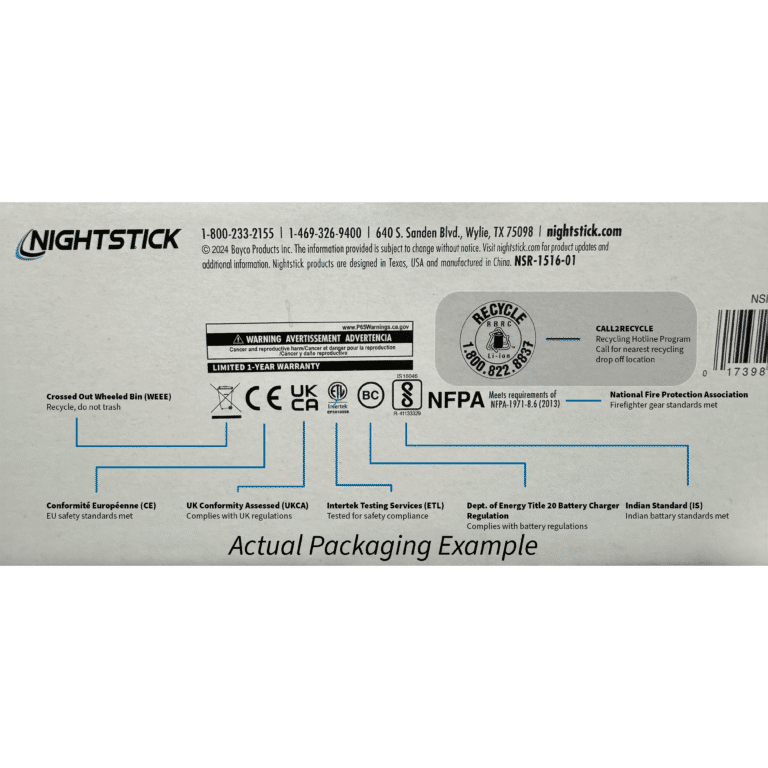
That’s why we’ve partnered with Call2Recycle, a non-profit organisation dedicated to responsible battery recycling.

The Call2Recycle icon on all Nightstick products is your guide to doing right by the environment.

A quick call to the number provided on the icon will direct you to the closest recycling facility, allowing you to easily participate in the shared goal of sustainability.

Navigating the path to sustainability

The fire safety industry’s embrace of LED lighting, powered by eco-friendly materials like aluminum and polycarbonate, marks a critical step towards a more sustainable future.

Yet, achieving true environmental stewardship within this field is not without its challenges.

The energy required to recycle aluminum, approximately 14,000 kWh per ton, emphasises the need for a shift towards renewable energy sources to ease the ecological footprint of such processes.

The landscape of sustainability is brightened by the recent advent of bio-based polymers and advanced composites, which not only promise a lower environmental impact but also superior performance.

Research into bio-polymer composites, for example, indicates a potential to halve the energy needed for production when compared to traditional materials, offering a glimmer of light for both eco-efficiency and the demanding requirements of fire safety applications.

Nightstick uses the advanced composite, glass-filled nylon polymer, in products like ATEX ZONE 0 XPP-5418 IS Helmet Light Flashlight.

It’s also used in the brand new ATEX, IS angle light, SAVIOR™.

While its tensile strength rivals that of aluminum, glass-filled nylon polymer reduces the need for frequent replacement through enhancing durability and longevity.

The energy consumption also is reduced contributing to lower greenhouse gas emissions.

Brighter horizons

In the quest for an eco-friendly future, the combination of aluminum and polycarbonate into LED lighting for fire safety goes beyond technological advancement; it reflects a deep dedication to environmental protectionism.

A comprehensive lifecycle analysis of these materials—from the extraction of bauxite and crude oil, through their transformation into durable and recyclable materials, to their eventual repurposing or recycling—reveals the nuanced balance between operational efficiency and ecological responsibility.

Aluminum, celebrated for its lightweight strength and superior recyclability, lessens environmental impacts at every stage of its lifecycle, reducing the demand for virgin materials and lowering CO2 emissions through its energy-efficient recycling process.

Polycarbonate, on the other hand, offers a stark example of innovation in reducing ecological footprints, with its production emitting significantly less greenhouse gas compared to traditional materials, and advancements in recycling techniques promising a future where waste is minimised, and resources are conserved.

As we navigate towards brighter horizons, the sustainable impact of these choices becomes increasingly clear.

The fire safety industry’s embrace of LED lighting, powered by eco-friendly materials like aluminum and polycarbonate, is not just a nod to the present but a pledge for the future—a future where every product is a testament to the possibility of harmonising human safety with our planet’s health.

The journey towards sustainability is packed with challenges, yet filled with opportunities for innovation and improvement.

By focusing on the entire lifecycle of materials used in fire safety equipment, we focus our commitment to not only protecting lives but also preserving the environment for generations to come.

In this light, each beam cast by an LED light is a step forward on the path to sustainability, illuminating the way towards a legacy of conservation leadership that honors the heroes who protect us, and pledges to leave behind a world that is safer, cleaner, and greener.

This article was originally published in the April 2024 issue of International Fire & Safety Journal. To read your FREE digital copy, click here.

The holistic approach with Fomtec

John Ottesen, CEO and Founder at Fomtec, talks to IFSJ Editor Iain Hoey about the importance of tailored foam solutions for all applications

Over the last 12 months, in many articles and interviews that you’ve done you talk about the holistic approach. What do you actually mean by this, and can you elaborate?

 In the context of foam systems, the holistic approach means that all the products need to work together in harmony to achieve the goal we’re setting out to achieve, and that is putting fires out.

All the components of a system need to work together, and that needs to be proven by testing.

The holistic approach incorporates more than just hardware and software working together, it also needs to be appropriate for the application because not all applications are the same.

For example, if we consider the marine segment, with its challenges, such as the water quality, temperatures, and so on.

You have airports with totally different missions and very different fuels, so in the sense of a holistic approach, I also wanted to highlight the differences between applications.

So are you saying that we need different foams for different applications?

Yes, we have found that we need to develop products to meet the requirements of the various missions where foam is used.

We have products especially focused on airports, others for the marine segment, others for industrial applications, and so forth and so on.

They do have slightly different needs and slightly different conditions, and to get the very best for each application, sometimes you need a different product.

Surely as an end user, you would like one product that could do everything?

Yes, we all would want to have one universal product, but that is not the case in the real world, or at least this is what we have found.

To have the optimal performance for each mission application with one product is not possible, or sometimes it is not economically desirable.

When I look at the AFFF that Fomtec manufactures and supplies it is not one product but a range of products.

The Chemistry behind an AFFF must be very well known, so why is this?

Again, it was different formulations developed and tested to meet the requirements of the different missions and other requirements or to meet the fire performance set by different testing standards or authorities.

So, we have an extensive range of different AFFF´s and that has not changed as we develop and offer our SFFF’s.

These different missions and specialized requirements still exist, so our Enviro range of SFFF’s has evolved and will continue to evolve.

As an end user, how do I determine the right product for my mission?

A good place to start is to look at which approvals we have and if the approvals are appropriate for your application.

Each different application does have special approvals.

For example, for a marine application you can have a marine approval according to IMO 1312 which is for use on shipboard with sea water or alternatively, if you need an industrial product approved for use with sprinklers then the appropriate approvals would be the UL 162 or the FM 5130.

Are these approvals are linked to fire testing?

Yes, each approval is linked to a fire performance test, but these tests are NOT the same.

They all differ based on the application.

The ARFF mission differs from that of a shipboard mission, and these differences are reflected in the approval standard and, by extension, the fire performance tests associated with that standard.

We can talk about different test fuels, different water, different test nozzles, and different test procedures.

For example, the ARFF mission outside of the USA follows a test standard developed by ICAO and uses Jet A-1 as the test fuel, whereas the marine industry follows a standard developed by IMO and uses heptane as the test fuel (but you can also test with polar solvent fuels within the standard).

There can be great differences in how a product performs in one test compared to another.

Have these standards and associated fire tests changed for SFFF?

No they have not changed, but SFFF’s are treated differently to AFFF’s and AR-AFFF’s in UL 162 and FM 5130 for topside applications.

It was these differences that perhaps led to some people to make negative statements about the performance of SFFF’s.

What are these differences?

For topside applications, the application density is 50% greater than AFFF, and you are given 2 more minutes to achieve extinguishment.

Conversely, the burnback portion of the test has become more challenging due to the waiting period increasing from 9 minutes to 15 minutes.

It is important to remember that UL and FM did not invent these differences for SFFF because these differences have been in place for many years for non-film-forming foams.

So essentially the standards and the tests remain the same?

Exactly. That is why we believe that we need to develop and supply a range of SFFF foams to meet the different missions.

What missions do you currently have Enviro products for?

We have Enviro foam agents that cover all missions, and some are mission specific while some overlap and can, similar to our AFFF range, cover multiple missions.

Worthy of mention are:

Enviro USP – which is a high-performance and multi-mission foam for hydrocarbon fuel fires.

Enviro ARK – the first SFFF to receive FM approval for use on hydrocarbon fuel and polar solvent fuel fires with standard sprinklers.

Enviro AIR – a Newtonian product with ICAO B for the ARFF mission

Enviro 3 x 3 ULTRA – a multi approved high-risk industry 3 x 3 (which is also approved for marine use)

Enviro eMAX – an alcohol resistant multi-purpose high expansion foam approved according to APSAD T12

More recently, we expanded our IMO range of marine products to include

Enviro SEA – a Newtonian SFFF, available as a 1%, 3% and 6% concentrate.

Enviro SEA sounds like good news for the marine industry. Can you give us any information about what you are working on now?

The Enviro Program hit 2,500 tests in December last year, and we have already 12 weeks planned for 2024.

Some of this relates to the expansion of approvals but we will introduce more new products in 2024.

Our focus has been on introducing high-performance SFFF products for fixed systems, but now we are devoting more time and effort to the emergency response side of the foam business.

I don’t want to tempt fate by talking too much, but stay tuned.

When we last spoke, you hinted that the US Airports would also have some good news soon?

Yes, but the nice thing about the amount of testing we do is that we have an incredible amount of data, so when we see breakthroughs, we can be optimistic that these will lead to new commercial products.

I would like to come back to the subject of the need for mission-specific foam agents.

It is a key component of Fomtec’s business approach to develop the best-performing foam products for each specific mission and not to compromise performance.

Let me clarify this further by saying that when we develop a product, we are never looking for a “borderline” pass.

To qualify as a “mission specific” product, it needs to be a “star” performer for that mission – and hence why the Enviro Range of SFFF foams is evolving in the same way that our PFAS-containing foams did.

I’m glad you mentioned PFAS-containing foams because you recently announced that Fomtec would continue producing them. Why is this?

We fully support the move to the more environmentally responsible SFFF, but many end users are going to need time to plan and execute the change.

Within the EU, the proposed legislation relating to PFAS containing foams allows derogations of up to 10 years after force of entry (for the SEVESO companies), so we decided that we need to support these end users during this period so that the existing systems can be maintained in operational condition.

This article was originally published in the March 2024 issue of International Fire & Safety Journal. To read your FREE digital copy, click here.

A new era for fire training with LION

Arnaud Lefebvre, Sales Director at LION, discusses how their NFTT solution transforms the economics and safety  of firefighter training

In the ever-evolving landscape of fire safety training, LION’s latest endeavour—a comprehensive cost calculation tool— is tailored to assist training centres in evaluating the total cost of ownership of their facilities.

LION’s selling concept is designed to enhance the decision-making process for training centres, enabling them to determine the most efficient mix of wood, gas, and digital simulations.

Arnaud Lefebvre, the Sales and Marketing Director for LION, played a key role in the development of this innovative tool.

Through customer interaction, LION sought to improve training methods and explore new technologies for fire responder readiness.

This led to the conceptualisation of the Total Cost of Ownership tool.

IFSJ Editor Iain Hoey sat down with Lefebvre to delve into the intricacies of this new calculation tool, LION’s New Fire Technology Training (NFTT), and discuss the future of firefighter training.

How does the Total Cost of Ownership tool support LION’s mission and enhance fire safety training?

Training is key for preparedness and safety in incidents.

Regular, realistic practice is essential.

Most firefighters acknowledge the benefits of combining wood, gas, and digital technologies for optimal training, yet this is perceived as costly.

This tool demonstrates that integrating these technologies, despite the initial investment, actually reduces the Total Cost of Ownership compared to solely wood-based training, which is typically considered the most economical option.

How does the cost calculation tool enhance LION’s NFTT sales strategy?

LION’s NFTT concept initially focused on the benefits for trainees and trainers.

However, it’s increasingly recognised that a mix of technologies – wood-based, gas-based, and digital – is crucial for superior and safer training experiences.

Each technology offers distinct advantages: wood-based training is invaluable for understanding smoke behaviour and fire dynamics, gas-based setups are excellent for simulating intense, hot tactical scenarios, and digital technology is unparalleled in providing high-frequency, repetitive training exercises.

Digital methods also allow for training in highly realistic settings, including actual building environments, which is critical for practical skills development.

One common misconception is the presumed high cost of integrating such diverse training methodologies.

This new tool challenges that perception by allowing users to experiment with different training configurations.

It provides a comprehensive assessment of the total cost of ownership, encompassing initial purchase costs, ongoing operational expenses, maintenance and service fees, and even end-of-life disposal costs.

Moreover, it offers a unique feature: the ability to evaluate the environmental impacts of these varied training technologies.

This holistic approach underscores the cost-effectiveness of such an integrated training system but also highlights its sustainability, aligning with modern environmental consciousness and the need for eco-friendly training solutions.

In this way, the tool not only complements LION’s NFTT selling concept but significantly extends its scope, offering a more nuanced, cost-effective, and environmentally responsible approach to firefighter training.

How does the tool calculate the total cost of ownership for training centres?

The tool, only available to LION and its carefully selected partners, is pre-set with various parameters, allows the LION sales team to make adjustments to mirror the requirements of each first responder brigade.

First, we set the desired training mix, like a combination of wood containers and a digital system.

Then, input the frequency of training – the number of sessions per day, and days per year.

Next, specify the number of simulators used in regular sessions.

Based on this data, the tool calculates average consumption of wood, gas, water, and electricity, with an option for users to adjust utility costs.

It then presents the total cost of ownership, detailing investment costs, annual utility expenses, estimated service costs, PPE cleaning costs, waste disposal, salaries for trainers and technicians, and end-of-life costs.

Additionally, the tool calculates environmental impact, estimating emissions of particles, CO2, Carbon Monoxide, NOx, Soot, and other pollutants like Polycyclic Hydrocarbons (PAH).

The customer receives a detailed report from LION, allowing them to review the calculations and make budget decisions accordingly.

How does this assist training centres in choosing the best combination of wood, gas, and digital simulations for their needs?

This tool facilitates the creation of diverse training scenarios.

For instance, if a centre wants to explore the impact of incorporating a smoke treatment system into their wood containers, the tool can simulate this addition.

It provides detailed information about the extra costs involved, including investment, operation, and service expenses, and also assesses the environmental benefits, such as reduced particle emissions.

The tool allows training centres to experiment with various scenarios, aiding in decisions about whether to integrate new simulators with different technologies, both from economic and environmental perspectives.

What insights did you gain from developing the cost-evaluation tool?

Our research using this tool has led to a surprising conclusion: a mixed-method approach to training is more economical in the long run.

Incorporating a combination of training technologies, rather than relying solely on traditional methods like wood burning, proves to be more cost-effective.

This finding counters a common assumption.

Many believe that adopting new technologies is financially daunting due to their initial costs.

However, our tool’s analysis reveals that the less obvious expenses associated with traditional methods, such as wood burning, accumulate to a greater extent over time than the costs of investing in a diverse range of technologies.

How does this tool cater to the diverse safety, environmental, and realism needs of various training centres?

The tool offers a selection of different training technologies for consideration:

Wood-Based Burns (Carbonaceous)

These provide high realism but are the least environmentally friendly and carry the highest risk in training scenarios.

Gas Simulators

They offer a consistently hot environment and high repeatability with greater safety, though they have a slightly lower realism factor compared to wood.

Digital Simulators

Highly flexible and portable, these simulators offer the safest and most environmentally friendly option.

They can be used in real buildings, but they do not generate heat.

Are there any plans to integrate this tool with additional LION products or services for a broader training solution?

The cost evaluation tool is a key component of LION’s comprehensive NFTT concept.

The aim here is to illustrate how various training technologies contribute to more efficient training.

NFTT is a holistic concept, addressing all critical aspects for fire responders, from training to safety, environmental impact, and economic considerations.

Initially, we focused primarily on fire responders, but the NFTT concept is equally applicable to other sectors requiring specialised training, such as hospitals, petrochemical and chemical industries, naval operations, etc.

For these sectors, a thorough understanding of Total Cost of Ownership (TCO) is essential.

Can you talk more about the NFTT and how it compares to traditional training methods?

NFTT introduces a variety of training technologies, contrasting traditional methods like wood burning and gas use with evolving digital and virtual reality options.

The misconception that these newer technologies will entirely replace traditional methods isn’t reflected in current trends.

Each technology, whether traditional or modern, offers unique advantages and limitations.

Our concept promotes diverse training methods, with each contributing distinct benefits to enhance training quality.

Some traditional wood-based practices can now be effectively supplanted by digital or gas technologies.

This transition is beneficial not only for the training process but also financially.

While wood might appear cost-effective, it incurs additional expenses in maintenance, cleaning, safety measures, and time for setup and restarts.

Burning solid materials like wood in training poses inherent risks due to heat, potential explosions, burns from real smoke, and particularly the airborne particles.

These factors present health hazards, especially to trainers who face prolonged exposure.

What are the health advantages of the New Fire Technology Training (NFTT)?

Traditional firefighter training methods, involving intense scenarios in training containers, pose significant health risks such as heat exposure leading to conditions like heat stroke.

The stress of mastering multiple skills, like using breathing apparatus and understanding fire behaviour, can be overwhelming for new firefighters.

This can lead to dangerous behaviours and necessitates close supervision.

Incorporating training technologies can mitigate these challenges by gradually introducing complex scenarios, allowing trainees to build confidence and competence in a controlled environment.

Moreover, traditional training methods, such as wood burning, are physically demanding for trainers due to intense heat and water loss, and also contribute to pollution from burning materials, posing long-term health risks.

This pollution releases harmful particles, increasing the risk of inhalation-related health issues.

Training in a cleaner environment with alternative technologies can offer similar experiences with less physical strain and reduce long-term health risks, benefiting both trainees and trainers by minimising exposure to harmful particles.

What effects do you anticipate this tool will have on the fire safety training industry?

Its primary contribution will be in demonstrating that the integration of various training technologies is not just beneficial for the quality of training but is also a more economical and environmentally friendly approach.

I’m optimistic that, as a result, there will be a heightened level of preparedness among fire responders.

This tool has the potential to make a profound and lasting impact on the entire industry, enhancing both the efficiency and effectiveness of fire safety training.

This article was originally published in the February 2024 issue of International Fire & Safety Journal. To read your FREE digital copy, click here.

Preview: IFSJ Leaders in Fire & Safety to return on 9 May 2024

The one-day event for industry leaders returns to the Grosvenor House Hotel, Dubai Marina, on 09 May 2024

International Fire & Safety Journal is thrilled to announce the return of the IFSJ Leaders in Fire & Safety 2024.

Scheduled for May 9, 2024, at the prestigious Grosvenor House Hotel Dubai Marina, this year’s conference promises to build on the success of its inaugural year, further surpassing expectations and setting a new benchmark in the industry’s discourse.

As the world grapples with evolving challenges in fire safety and emergency response, the importance of innovation, strategic planning, and expert collaboration has never been more pronounced.

The IFSJ Leaders in Fire & Safety event serves as a critical hub for these discussions, bringing together the brightest minds and influential figures in the field.

This gathering is more than a conference; it is an unparalleled meeting of minds, experiences, and strategies aimed at shaping the future of fire safety and emergency management.

As we gather at the crossroads of tradition and innovation, the IFSJ Leaders in Fire & Safety 2024 is a pivotal platform for knowledge, collaboration, and progress.

Join us in Dubai for an enlightening and transformative experience that will redefine the paradigms of fire and safety management.

Visit the official website.

The format

This year’s conference is scheduled for May 9, 2024, and will be hosted at the Grosvenor House Hotel, Dubai Marina – a venue known known for its sophistication and luxury, perfectly complementing the distinguished nature of our event.

The event will unfold in the hotel’s premier conference facility, arranged in a classic theatre style.

Centre stage there will be a prominent speaker podium which will be the focal point of the event.

This will be complemented by high-quality, large LCD screens serving as a backdrop, ensuring that speakers and sponsors receive optimal visibility.

Throughout the day, this main stage will also serve as the platform for various panel discussions, allowing for a dynamic and interactive exchange of ideas among industry leaders.

Attendees will have access to an exclusive ‘inner sanctum’ networking environment positioned just outside the conference hall.

This area is designed to foster meaningful connections among delegates, facilitating valuable conversations and potential collaborations.

Here, our attendees will have the unique opportunity to engage directly with a select group of commercial partners, carefully chosen to ensure a diverse yet focused representation of industry-leading solutions and services.

This approach prioritises quality interactions offering a relaxed and non-competitive setting for in-depth discussions with some of the region’s most influential decision-makers and buyers in fire and safety.

The content

For the inaugural IFSJ Leaders in Fire & Safety event in 2023, industry leaders converged to engage in vital discussions on a range of pivotal topics.

The agenda featured a keynote address by the Dubai Civil Defense, highlighting their AI-enabled Readiness Programme for pre-emptive fire management.

A significant moment saw the signing of a Memorandum of Understanding between the Dubai Civil Defense and The Institution of Fire Engineers, symbolising a collaborative commitment to fire safety.

The conference also delved into the impact of sustainability on fire safety in buildings, the transformative role of data in fireground operations, and the rapid evolution of technology in fire safety.

Panels discussed the challenges of lithium-ion batteries, the use of PFAS in firefighting foams, and the critical need for protecting transportation infrastructure.

Additionally, presentations covered managing carcinogens in firefighting and the importance of strategic leadership and crisis management in the industry.

The 2024 edition is once again meticulously designed to address the most pressing issues facing the industry today.

This year’s conference will explore the complexities and challenges posed by emerging technologies such as alternative fuels and advanced vehicle systems, assessing their associated risks and the adaptations needed in fire safety measures.

A significant focus will be on fire and emergency response, highlighting potential methods to revolutionise operational strategies.

Moreover, the agenda will include in-depth discussions on enhancing safety measures, notably in personal protective equipment management and the decontamination processes vital for firefighter safety.

The presentations and discussions will also reflect on lessons learned from significant fire incidents, providing a global perspective on fire safety practices and policies.

Additionally, a landmark panel debate on ‘Women in Engineering’ will underscore the importance of diversity and inclusion in fostering innovation and excellence within the engineering and safety sectors.

A word from the Conference Chair

Terry Johnson, Director of Emergency Services, Jasara NEOM The Line, will return as Conference Chair.

 Commenting on the 2024 edition Johnson said: “The inaugural IFSJ Leaders in Fire & Safety Conference was a testament to the determination of the IFSJ team, the valuable collaboration with the Institution of Fire Engineers, and the unwavering support of Dubai Civil Defense.

“Their combined efforts made the event an unprecedented success, fostering meaningful dialogues that I believe will have lasting impacts on the fire and safety sector.

“As I eagerly anticipate returning as Chair for the next conference, I am committed to building on our achievements, driving further advancements, and continuing to create a platform for sharing knowledge and innovations.”

The advisory panel

The IFSJ Leaders in Fire & Safety Conference is indebted to its esteemed advisory panel, a group of seasoned professionals whose expertise shapes the direction and content of the conference.

This year’s panel includes returning event Chair Terry Johnson.

We also panel also welcome back: Engineer Salma Al Ali, Head of Engineering Section, Dubai Civil Defense; Mark Buckingham, Head of Emergency Preparedness at Abu Dhabi Airports;  David Campbell, General Manager at Dubai Civil Defense’s Emirates Safety Laboratory; Sinclair Duffie, Chief Fire Officer at Nawah Energy Company; and Robert Davies, Operations Director at WSP in the Middle East

New to this year’s panel are distinguished professionals bringing fresh perspectives and diverse expertise to the IFSJ Leaders in Fire & Safety Conference.

Sawsan Dahham, CEO of SIENA, steps into the panel with a formidable 17-year track record in engineering consultancy and fire and life safety design strategy.

On joining the panel, Dahham said: “I am always excited to see people working very hard to spread Fire safety awareness, and that is exactly what the IFSJ team has been doing.

“Working closely with them made me realise why last year Leaders in Fire & Safety conference was a successful and efficient event.

“I am looking forward for the 2024 edition with its instructive and diverse fire topics that covers significant safety concerns and tackles the interest of all leaders in this sector.”

Dana Kamal, recently appointed as the NFPA Director of International Development (MENA), brings a wealth of experience in healthcare engineering and business development to the panel.

She is joined by Ghaith Bakir, a Senior Regulatory Engineer at UL Solutions.

His expertise in regulations, codes, standards, and product installations across the Middle East and Africa will provide crucial insights into regional compliance challenges.

Finally, Peter Stephenson, Director of the Hydrock Fire Safety Division, brings over 40 years of experience overseeing international fire safety projects.

“It’s an honour and a privilege to be a member of the IFSJ Advisory Panel and have the opportunity to provide input into current industry topics for inclusion in the conference programme,” said Stephenson.

“It is very important that the fire sector comes together at conferences to share knowledge, experiences and lessons learnt to improve safety within the built environment and for first responders to fire & emergency incidents.”

This article was originally published in the January 2024 issue of International Fire & Safety Journal. To read your FREE digital copy, click here.

Proportioning precision

Per Aredal, International Sales Director at FIREMIKS AB, discusses the advantages of water driven variable viscosity proportioners

The current shift in the market from AFFF (Aqueous Film Forming Foam) to SFFF (Synthetic Fluorine-Free Foam) concentrates poses challenges for both existing and new foam systems.

One critical aspect is the proportioning in a firefighting solution, where understanding the viscosity of the new SFFF concentrates is key in selecting the appropriate proportioner.

The FIREMIKS concept is a water-driven volumetric pump proportioner designed for fixed installations, connected to an atmospheric concentrate tank with gravity feed to the dosing pump.

The system requires solely the extinguishing water to power a volumetric water motor, which, in turn, operates a positive displacement pump.

This pump accurately doses the required concentrate into the extinguishing water across a broad flow and pressure range.

Notably, no additional energy source is necessary for its operation.

Regulatory bodies are driving the shift from PFAS-containing concentrates to SFFF concentrates, prompting a reassessment of many proportioning systems for compatibility.

Various manufacturers offer SFFF foams with a wide range of viscosities, including very high-viscosity concentrates.

To select an appropriate proportioner, understanding the concentrate’s properties—whether it falls within a viscosity range of 1cP to around 5-6000 cP (measured using a Brookfield Viscometer Spindle #4 at 30 rpm)—or if it’s classified as very high viscosity is crucial.

FIREMIKS stands out by offering two types of dosing pumps—Piston and Gear pumps—alongside a robust multi-vane motor based on over 30 years of market experience.

When working with clients, apart from considering flows and pressures, we prioritize understanding the concentrate type and viscosity, a quite complicated subject, before recommending the suitable pump type.

Piston Pump Proportioners

Our models equipped with Piston pumps are classified as “Variable viscosity proportioners” in FM approval terminology.

They maintain precise dosing rates within approved tolerances across a broad viscosity spectrum—from low viscosity to around 5-6000 cP (dependent on variables like temperature, concentrate type and brand).

Important to know is that all Piston pumps systems on the market have a limit upwards on handling viscosity concentrates, due to the Piston pump reciprocating principle; for each revolution, the plunger sucks concentrate and then presses it out and the concentrate goes from zero to full speed twice per revolution.

If the static viscosity is too high with non-Newtonian concentrates, the concentrate might not flow smoothly and therefore the correct dosing rate may not be achieved.

Typically, our Piston pump models excel in systems with low start-up flows relative to the maximum flow rate, ideal for applications like sprinkler systems, providing versatility across a wide flow range.

Water motor-driven pump proportioners equipped with Gear pumps are well-suited for handling high and very-high viscosity concentrates.

We have successfully tested Gear pump models using Fluorine-free foams with a viscosity of up to 8,040 cP (Brookfield Viscometer Spindle #4 at 30 rpm).

Gear pumps excel with high-viscosity fluids due to their counter-rotating gears that create a consistent, non-agitating flow, ensuring effective sealing with such fluids.

Our Gear pump models are particularly efficient in applications operating at the higher end of the maximum flow rate, such as deluge and large fire monitor systems.

For all systems dealing with higher viscosity concentrates, ensuring adequate foam supply pipe diameter, good gravity feed, and minimizing concentrate line lengths are crucial.

Our datasheets specify recommendations, and we’re available for more tailored guidance for your project.

Catering to any flow size

FIREMIKS offers a diverse range of models catering to various flow sizes and proportioning requirements.

Our smallest model has a max flow of 180 lpm and the largest single model a capacity of 10000 lpm flow.

To achieve larger flows, up to 20000 lpm, we offer parallel installed FIREMIKS, on a base skid or mounted as” double-deckers”.

Our three standard models are: 12000 lpm (2 x 6000 lpm), 16000 lpm (2 x 8000 lpm) and 20000 lpm (2 x 10000 lpm).

For fixed proportioning we offer 1% and 3% as standard.

We may also supply units with special dosing rates, for example 0,1%, 0,3% 0,5%, 2%, 2,75% and 6%, on customer’s request.

Models with selectable proportioning are available with 0,3-0,6-1% and 1-2-3% (For selected flow sizes 0,5-1-3%).

Economical and environmentally beneficial testing with FIREMIKS is easy with optional Dosing/Return valve (DRV) and two separate flow meters.

If requested we may offer a complete dosing rate testing system that follows the guidance of EN 13565-1, NFPA11 and FM 5130.

Advantages of FIREMIKS Variable viscosity proportioners over Bladder tank systems

FIREMIKS ensures an uninterrupted foam supply as long as water and concentrate are available.

Adding more concentrate is as simple as connecting another container/drum.

In contrast, Bladder tank systems experience downtime when the bladder needs refilling.

As a Variable viscosity proportioner FIREMIKS Piston pump models handles concentrates from 1 cP (like wetting agents) up to around 5-6000 cP without the need of calibration.

A Bladder tank system is often designed for one specific concentrate viscosity and needs to be recalibrated and balanced to fit a new concentrate with another viscosity, adding crucial down-time for this replacement or recalibration.

To change foam type or brand concentrate, including to another viscosity is also a simple task with FIREMIKS if an IBC-container is used as foam concentrate supply, just exchange the IBC-container to another with the new/other concentrate within the approved range.

In comparison, to exchange foam concentrate in a rubber bladder may be a challenging task, including cleaning or replacement of the bladder.

In summary the FIREMIKS-system is a straight-forward system, easy to understand and to install, handle, maintain and test.

About the author

Per Aredal is International Sales Director at Firemiks AB, with + 30 years of experience of producing and delivering water driven volumetric pump proportioners worldwide.

For more information contact Per at per.aredal@firemiks.com, on mobile: +46-76-139 70 34.

For more information, go to www.firemiks.com.

This article was originally published in the January 2024 issue of International Fire & Safety Journal. To read your FREE digital copy, click here.

The trends ahead: Advanced at Intersec 2024

IFSJ catches up with Advanced’s Middle East team to find out what the fire safety specialist has in store at Intersec 2024

In 2022, Advanced appointed Sasi Kumar as Commercial Manager for Middle East and Africa, to spearhead the company’s expansion in the Middle East, a key initiative of its comprehensive international sales strategy.

Kumar, a seasoned professional, transitioned to Advanced from FFE Ltd, a Halma group company at which he notably advanced the business’s beam and flame detector segment as the Head of Sales for the Middle East, Africa, and Asia Pacific regions.

Following Kumar’s appointment, Advanced also welcomed two Business Development Managers to its Middle East operation: Sargunan Sellamuthu, Advanced’s second appointment to the region within a year, bringing nearly a decade of experience in the fire industry; and Hossam Badwy, previously a sales lead for a global systems manufacturer now operating out of Jeddah, Saudi Arabia.

As we look ahead to Intersec which returns this month, IFSJ caught up with Kumar, Sellamuthu and Badwy to find out more about Advanced’s offerings at the exhibition and discuss current trends in the GCC.

Sasi Kumar, Commercial Manager for Middle East and Africa

We’re delighted to be exhibiting at Intersec again and demonstrating how we can meet a variety of fire safety needs across a wide range of different sites and sectors.

It is an exciting time in the Middle East region with a high level of development, including the giga projects in Saudia Arabia.

Alongside this there is also an increase in safety regulation being rolled out which is improving fire safety in the region.

We are keen to show visitors at Intersec that we can provide proven, robust, fire safety solutions that they need.

Advanced is also thrilled to be celebrating its 25th anniversary in 2024 too, we are proud to have been a trusted UK manufacturer during this time providing high quality products.

Advanced is committed to the Middle East region and is increasing its presence for the long term.

We have already expanded our sales and support teams but are looking to further build on this.

We think it is vital to have a team based in the Middle East with local knowledge, that are here to speak directly to our customers.

That is why I joined in 2022, followed by Sargunan and Hossam this year, and we are looking to expand our team still further.

Advanced also has distribution partners in UAE, Oman and South Africa and we are actively looking for partners in the rest of the GCC and beyond, as well as OEM partnerships across the world.

At Intersec 2024 Advanced will be showcasing both new and updated products and explaining the benefits of each and the problems they can solve.

We will also be demonstrating the versatility of our wireless offering at Intersec and will be showcasing our MxPro 5 open protocol approach.

As an EN Standard open protocol fire panel, the MxPro 5 offers freedom, flexibility and safety thanks to its compatibility with a range of leading detector protocols, including Apollo, making it ideal for retrofits.

One current trend in the Middle East is the growth in wireless fire alarm technology with customers recognising its benefits including its robust performance.

This growth follows a similar trend in Europe where it is estimated the wireless fire alarm sector will increase by 10% from 2023 to 2032.

With wireless technology now tried and tested in Europe, the Middle East region is opting for wireless solutions too, especially following the development of the robust, reliable mesh technology.

Wireless fire alarm systems are now taking market share from wired variants.

Plus, last April, the Dubai Civil Defense announced that wireless technology could be used for both residential and commercial projects.

Other countries in the Middle East look set to follow.

As fire safety regulation tightens across the region, wireless fire alarm systems are becoming an attractive solution to retrofit, since buildings do not have to undergo the disruption of running cables which comes with installing a wired system.

Some wireless systems, such as Advanced’s Axis EN, also have the advantage of being able to integrate with existing fire alarm systems too when an upgrade is required, offering a hybrid system.

Visitors to Intersec will be able to see for themselves the wireless Axis EN on our stand (Stand F22, Hall 4).

Harnessing the power of proven technology, Advanced’s versatile Axis EN wireless range offers an easy-to-install robust fire alarm system which saves crucial time and disruption.

Offering a wireless fire safety system customers can trust, Advanced’s Axis EN wireless devices are powerful, reliable and fast to install and configure.

Rigorously tested and approved to EN 54 Parts 2 and 4 Axis EN, wireless fire systems carry the prestigious FM Approved mark.

Axis EN devices operate seamlessly with Advanced’s Axis EN range of high-performance addressable panels and can be used as part of completely wireless or hybrid systems.

Sargunan Sellamuthu, Business Development Manager at Advanced

I am thrilled to be at Intersec as we will be showcasing our UL-approved Axis AX fire system.

  UL-approved fire safety systems are gaining in popularity in the Middle East with our Axis AX fire system offering a solution that suits both large commercial sites and high-rise residential applications, as well as offering vital voice evacuation.

A growing awareness and implementation of fire-safety measures in the Middle East region is driving the popularity of UL fire safety systems.

When selecting a fire system, it is reassuring to know that it has the versatility to protect both large sites such as shopping centres, schools, universities and hospitals, as well as high-rise residential projects.

Fortunately, Advanced’s network systems are fully scalable to suit virtually any application including ‘campus’ style and high-rise style configurations.

Advanced’s UL-approved Axis AX fire system is suitable for very large projects.

What is particularly impressive about the versatility of the Axis AX is that it can deliver fast, reliable, communications from a two-panel network up to a large 200-node network.

Very few manufacturers can offer the capacity to connect to up to 200 panels.

One of the current trends is that high-rise residential buildings require a fire alarm system with voice evacuation.

Fortunately, the flexible Axis AX offers integrated audio for automatic (and manual) fire alarm signalling and live voice paging during emergencies.

However, with voice evacuations problems can sometimes arise if the audio doesn’t sync and people are able to hear multiple messages at once.

To solve this our Axis AX range features PerfectSync which ensures audio synchronisation across the entire network to avoid confusion by a mixed message.

This includes large networks where we are able to deliver the message from the first panel to the 200th with highly synchronised fast messaging to help people evacuate faster in case of fire.

Hossam Badwy, Business Development Manager, Middle East

The Middle East is an exciting, unique market where both EN and UL fire safety solutions are used.

Not all companies can fulfil both requirements but at Advanced we are able to help customers that need both standards in our Axis EN and Axis AX product ranges respectively.

We will have our Axis ranges, with solutions for both EN and UL standards on show.

The Axis ranges are not only robust and versatile, but also easy to use – from installation and commissioning to servicing, maintenance and day-to-day operation.

At Advanced we not only offer fire systems for complex buildings, we also offer solutions for small applications, such as retail and the housing sector.

At Intersec we will have our new-generation AxisGo single-loop fire panel on display, which can be used in applications such as villas and smaller commercial sites.

This versatile fire panel is packed with premium features, offering a powerful option for less complex sites.

It provides cost-effective access to Axis EN range performance, quality, and ease of use, in a simpler, non-networkable format.

AxisGo is available as a wired, wireless or hybrid system, bringing additional versatility.

At Intersec, we will have products on show for critical and high-risk sites, including our ExGo gas extinguishing panels at Intersec.

It is vital to be able to protect critical infrastructure, data centres and sensitive sites where water extinguishing could destroy irreplaceable assets, so gas extinguishing is required.

ExGo provides the control for the extinguishing system and is certified to extinguishing system standards.

We will also have on show our specialist redundant panel that kicks in if the main fire panel stops working and so maintains fire protection.

It’s ideal for big oil and gas power plants, manufacturing, datacentres and places requiring uninterrupted fire protection.

We provide a 100% hot redundant panel so users have the assurance the fire system will continue to work should a fire panel fail as the redundant panel takes over completely.

This also allows repairs and maintenance to take place without any operational downtime.

Advanced’s team of technical experts are there to help, whether customers are planning, installing or servicing an Advanced system.

Advanced offers free training and support throughout the lifetime of an Advanced product.

Plus, this is all backed up with a good warranty for extra peace of mind.

Meet Sasi, Sargunan and Hossam and learn more about Advanced’s full range of intelligent solutions at Intersec, 16 – 18 January, Stand F22, Hall 4.

This article was originally published in the January 2024 issue of International Fire & Safety Journal. To read your FREE digital copy, click here.

IFSJ Influencer Insight: Mike Ward, Managing Director of the Association for Specialist Fire Protection

‘True growth only happens when you use what you’ve learnt to create change.’

Across all professions and trades, the UK construction industry is without question the largest single employment sector in the country, yet, it has some of the lowest education levels and ill-defined professional development structures. You could say this is because the industry is so fragmented, or that professions and trades evolved at different times and at different rates, creating silos across the sectors. The truth of course, as with all of these issues, is a combination of many contributing factors applied at different times by different individuals and organisations; including respective Governments of the time.

In the case of passive fire protection (PFP), the challenge is exacerbated by the fact that this specialist area of the construction sector cuts right through practically all of the design, engineering, procurement, construction/installation, sign-off and occupation disciplines that are in place, regardless of whether the project be new-build or refurbishment. We’re asking generalists to be specialists and vice-versa for structures from a shed to the Shard, with every stakeholder now being asked to improve and evidence greater levels of competency within their relevant profession or trade.

Without running the risk of a lack of joined up thinking, it has to be the responsibility of the representative associations of such specialist areas, such as PFP, to support the more generalist professions and trades in improving their skills and knowledge and have it contextualised for their specific sector. Architects spend very little time learning how to design in the required application and performance requirements for PFP; main contractors base procurement decisions on more commercial factors rather than purchasing the ‘as specified’ product or system(s); and installers may have been carrying out installations “that way for 20 years”, not realising they may not have been correctly following the manufacturers’ guidelines in respect of the required field of application.

The good news is associations like the ASFP are developing far more comprehensive and robust competency regimes which are aimed to support every stakeholder from design to occupation and every function. Not only that, but the ability to audit company employees’ accrual of skills and knowledge, whether that be continuous professional development (CPD) hours, attained qualifications or holistic participation. The general consensus is that critical professions can’t rely on a degree they achieved years ago and then only develop themselves through CPD. There has to be the requirement and ability to achieve further qualifications in the more specialist areas that are critical to building safety. The mission of ASFP and other associations is to support this learning, after all knowledge on its own is not growth. True growth only happens when you use what you’ve learnt to create change.

About the IFSJ Influencer

Mike Ward joined the Association for Specialist Fire Protection (ASFP) four years ago as Business Manager and became Managing Director in 2023. Ward has 16 years’ experience in the fire sector, including 12 years with Coopers Fire and eight years in the door and window industry. He represents ASFP on various groups working to improve standards and competence within passive fire protection across the built environment. 

This article was originally published in the December 2023 issue of International Fire & Safety Journal. To read your FREE digital copy, click here.

IFSJ Influencer Insight: Eddie Sell, City of Hemet Fire Chief

‘Chief officers need to take an active role in hosting state-wide recruitment and retention workshops, and collaborating with organizations on short term and long term solutions.’

‘Leave it better than you found it’. This is a phrase many of us have heard regarding the responsibility of paying it forward, paying homage to the fire service, and remembering those who came before us. Did we ever think that phrase might be something we explore as we deal with the reality of recruitment and staffing challenges. When I heard that saying as a kid in high school starting off as a volunteer firefighter, and fire explorer, I took it to heart.

Fortunately I had career firefighters who took me under their wing to teach me the fundamentals that made the fire service thrive for decades. There are so many examples we have hopefully witnessed over the years of people who truly did leave it better than they found it. Can we say the same thing about our current era? Are we ensuring that firefighters who are early in their careers understand the importance in keeping this fundamental principle alive? Are we truly doing all we can to ensure we value our current workforce, and implement plans that will address recruiting the next generation of firefighters?

Recruitment challenges rank at the top of many of the issues that are impacting the fire service. These issues associated with recruiting the next generation of firefighters is not going to go away, and serious planning and a shared commitment to being creative to new ideas is critical.


It’s important to recognize that our workforce, both career and volunteer, come from many different backgrounds and customs. We cannot assume that everyone understands the concept of paying it forward, and why mentorship at all levels is critical. We have an opportunity to educate and mentor our workforce regarding the importance of being engaged, having a voice, and paying it forward.

There are several examples of making assumptions about our new generation without context, or an understanding of people’s perspectives. Instead of mocking those members that don’t possess certain skills or abilities, why don’t we teach them? Instead of spreading rumors or engaging in hazing, why don’t we ask our members about their upbringing and what they were or weren’t exposed to.

I never thought I’d see a time when the fire service was struggling to recruit and fill vacancies. This is not unique to one type of agency, but instead is impacting small rural areas, mid sized departments, and metro departments. Most of us don’t have the time to study why this is happening. We are tasked with the duty of ensuring we staff our departments and meet the mission, and expectations of our residents. Chief officers need to take an active role in hosting statewide recruitment and retention workshops, and collaborating with organizations on short term and long term solutions. As call volumes continue to increase, and populations explode, the fire service needs to continue to adapt and remain sustainable as we deal with staffing shortages.

Short term recruitment efforts can involve signing bonuses, offering higher base salary, shortening probationary evaluation periods, and easing components of the hiring process. Other short term recruitment efforts have to account for the culture, and reputation of the fire agency. Today’s firefighters are much like professional athletes that are on the free agent circuit. Lateral firefighter candidates are in this category, more so than entry level firefighter candidates.

Long term recruitment strategies have to target our youth, and at the very least in our high schools. I am grateful for the opportunity to have created a first responder youth pathway program in the city of Hemet, CA. This program started off as an idea, then a conversation with the school’s principal, and ultimately came to fruition in a collaborative effort with the Hemet Fire and Life Safety Agency, and the Hemet Unified School District.

We are in the second year of this career technical education (CTE) program, and have had success. After the first year of the program, four of the students graduated from high school, and are now enrolled in EMT school. They are off on their journey towards a career in fire and or EMS.

Other similar programs exist in California, and as I am discovering also take place around the country. I truly believe this is a model that needs to be replicated throughout the US and Canada, to create a new steady wave of future first responders.

We have to acknowledge the times we’re in, and pivot to something that occurred in the past with trade schools, and blue color inspired occupational programs. The irony is today’s firefighter is a hybrid of requiring blue color physical skills, with white collar inspired formal education, that embraces innovation and technology.

These pathway programs must be created, supported, and integrated with fire explorer and cadet programs to ensure optimal results. It is in our best interest to have young people who embrace a career in public safety, and who are armed with the tools to succeed at all levels of fire and EMS training. Though this is a long term recruitment strategy, it is a way to ensure our strategic planning includes a defined pathway from high school, to junior college, a fire academy, EMT school, and beyond.


Part of leaving it better than we found it is taking a leadership role in education, training, and mentorship for the entire Fire Service. Aside from serving as a fire chief/agency director in California, I also currently serve as the president of the California State Firefighters’ Association (CSFA). The CSFA is a 101 year old trade association that is committed to serving and supporting the entire California Fire Service.

Since January of 2023 CSFA has hit the ground running with hosting and participating in many events throughout the state. I have worked with our CSFA leadership and marketing team to participate at the CSFA Training Academy in Williams, CFPI in Santa Barbara, FDAC in Napa, Training Officers Symposium in Fresno, California Mutual Aid Summit and FIRESCOPE, and our inaugural California Training and Education Expo (CTEX) at the Pechanga Resort in Temecula.

2024 is going to see an even greater presence throughout California, that will culminate with the newly created partnership between CSFA and Firehouse Magazine to present the next several CTEX events to Southern California.

We are very proficient at planning for, managing, and mitigating all hazards incidents, but are we truly planning for our future recruitment concerns with the same level of attention. The fire service can’t do it alone, and it is going to take a cooperative approach with government agencies, elected officials, and the educational system to address sustainability concerns into the future.

The fire service has been fortunate for the last 50 years to have had constant interest in our occupation. We have to accept that the once steady candidate pool is nowhere near the thousands of candidates who would wait in lines, travel long distances, and accept employment anywhere, just to serve as a firefighter.

We need to work with our new members, and future members to define and prepare for what the next 50 years will look like. I appreciate all of you who are mentoring, coaching, and inspiring current and future fire service professionals. Our ranks will continue to grow one member at a time by sharing with people the positive aspects of serving others.

Stay well, and take the time to pass on fire service traditions that support positive growth, enhanced culture, and a sustainable future.

About the IFSJ Influencer

Eddie Sell, the Fire Chief/Agency Director at Hemet Fire and Life Safety Agency, began his 30+ year public service as a volunteer firefighter and US Navy Admiral’s Chef. He has worked in various fire service roles and leads the California State Firefighters’ Association, blending his diverse expertise and leadership skills.

This article was originally published in the December 2023 issue of International Fire & Safety Journal. To read your FREE digital copy, click here.