Quelfire talks the importance of early engagement in firestopping products

Craig Wells, Sales Director, Quelfire highlights the importance of early engagement in firestopping products and what’s required from a client’s perspective

As a manufacturer and supplier of specialist firestopping products for gaps and penetrations in buildings, Quelfire has made it their mission to use their knowledge to promote the importance of early engagement in firestopping. This being the practice that firestopping should be considered at the earliest stages of construction and firestopping contractors, as well as the firestopping manufacturers, should be involved.

Early engagement in firestopping is imperative because ultimately, it saves lives and protects property. By designing and installing firestopping solutions correctly, this allows it to do its job when exposed to fire.

To ensure buildings are safe and comply with relevant regulations, firestopping needs to be designed according to manufacturers’ tested details. If firestopping is not considered when decisions are made about the location of compartmentation walls and main routes of M&E services, there is no guarantee that the manufacturer will have a tested solution. If these discrepancies come to light too late in the project, participants can face serious extra costs and delays due to needing to redesign service penetrations. By involving the specialist firestopping contractor and the manufacturer in the early stages, these can be avoided.

Moreover, considering firestopping at the early stages will support work further down the line when the project enters the installation stage. It will give all parties involved extra time to utilize the support offered by the manufacturer, such as on-site training about the correct installation of products as per the design and manufacturer’s guidance.

Passive fire protection is a complex matter, needing coordination between several trades and for all factors to be considered. However, having a clear, structured plan will safeguard reputations and give a competitive edge, eliminating any concerns about non-compliance amidst the increased scrutiny in the construction industry. 

Who Else Needs to be Engaged?

The virtual panel discussion titled: “Firestopping service penetrations – the importance and benefits of early engagement” of the London Build (2020) highlighted that firestopping service penetrations should not only be about the firestop products, but about the services themselves and the substrate construction. It’s important to engage with all trades and system manufacturers involved, such as manufacturers of gas pipes or sprinkler pipes, as well as contractors installing these systems. For example, the insulation that is added to the pipes will need to be determined that there is a tested firestopping solution compatible with it before building can start. Therefore, every participant must communicate with each other before anything gets designed or built to avoid running into any problems later.

Quelfire’s support

Committed to protecting people and property, Quelfire are advocates of early engagement in firestopping and are keen to educate the construction industry about the importance of fire safety. By working together with every participant involved in a construction project, from design to installation, Quelfire offer value-added services and support material to facilitate all parties in achieving compliance.

An early engagement consultation can be hosted via Teams or Zoom, with face-to-face meetings being an option if required. This consultation will identify the requirements of the project through the Quelfire information collection form (ICF) with additional drawings for more complex scenarios. This is an internal process, designed by Quelfire, that helps collect all necessary information to provide a correct tested detail. For example, the composition and size of services running through a compartment wall, or whether a letterbox is being formed. A follow up with a package of suitable standard details will then be issued accordingly. These consultations will involve and primarily work to educate all members of the project team.

As Quelfire specialise in firestopping, they have a dedicated technical team who are readily available to help with any questions and challenges that come up during the later stages of the project. To support design and specification, on the website there is no-strings-attached technical documentation such as: NBS specifications, BIM models, tested detail drawings and product datasheets.

Other than technical advice, Quelfire offer high-level, CPD certified, training on Effective Passive Fire Protection. This is beneficial for anyone involved in the design or management of installation of firestopping solutions. The CPD training is available as an open webinar for individual registration and as a dedicated session for organisations such as: architect practices, main contractors, and other organisations.

One important detail that gives Quelfire a competitive advantage is their wider range of tested details. By using real-life scenarios and regular customer feedback, they carry out fire tests monthly, with a significant proportion of their annual investment going into R&D. 

The requirements

Quelfire appreciate how difficult it is to change current practices within construction. However, they firmly believe that it is a necessary change to help reduce the risk of further incidents and overall, help improve the perception of the construction industry. In most cases, a cultural change is required to appreciate that decisions made about fire stopping are life safety decisions.

Being dedicated to ‘doing it right the first time around’ and paying attention to detail will not only improve fire safety but work to serve all parties. By taking these measures at the design stage, all parties can relish in the fact that they are saving lives and protecting property, whilst knowing that they are preserving their reputation.

Further to this, it is essential for cross-party communication and coordination. Referring to the ‘Firestopping of service penetrations: best practice in design and installation’ and ASFP’s development, there are 37 questions that need to be considered when designing and installing firestopping solutions. Not a single party involved will know the answer to all questions, so it is vital that every party participates and shares their expertise. This further links to competency and the idea of knowing what you do not know and being prepared to seek professional advice from firestopping contractors and manufacturers.

By providing these value-added services, Quelfire can educate all parties involved to decrease the risk of any catastrophes, like Grenfell, happening in the future. Through using every platform to get the word out, they hope to be the catalyst of a cultural change that encourages buildings being designed around available tested solutions. As FIREX approaches, there has never been more of an urgent time than now to have these important conversations about early engagement in firestopping.

This article was originally published in the May edition of IFSJ. To read your FREE digital copy, click here

The future of fire detection: greener and smarter

Over three days, from the 17th to the 19th May, FIREX International brought together the entire fire safety supply chain for a unique opportunity to explore innovative products and solutions available for the first time since the pandemic.

Greener life safety products and protecting the UK’s commitment to low carbon energy

For building owners looking to improve their energy consumption or installers looking to offer more environmentally friendly and cost-effective solutions, the Hochiki team will be providing live demonstrations of their power saving and environmentally friendly products they manufacture. Visitors to the Hochiki stand will also get a chance to hear about a recent customer life safety project at one of the UK’s largest offshore windfarms.

FIREscape+ combined fire detection and emergency lighting system, features LED downlighters consuming only 0.1W once fully charged. This low energy consumption directly correlates with lower CO2 emissions, providing building owners with a greener solution.

The system helps improve energy efficiency, as unlike traditional emergency lighting systems, each luminaire and exit sign is only ‘trickle charged’ until the integral batteries are at full capacity.  But the system also helps building owners to reduce costs in other ways.  Because both fire and lighting devices run on low voltage cables from the control panel, a qualified electrician is not required to wire each device, thus drastically reducing labour costs during install and during any ongoing maintenance visits.

Visitors also learned how Hochiki are helping to protect and keep operational one of the UK’s largest offshore windfarms at Margate, critical as thoughts turn to how the UK can start to produce more of its own energy and rely less on foreign sources. For a country once solely reliant on coal to power its homes and businesses, the UK is now the leader in offshore wind energy. Encouragingly, today 44% of the UK’s electricity comes from renewable sources – a figure expected to accelerate given the Government’s April 2022 announcement, committing to “supercharge” clean energy deployment, which would see 95% of Great Britain’s electricity set to be low carbon by 2030.

Operated by London Array and generating about £1million worth of electricity a day when all 175 turbines are in operation, Margate wind farm produces enough electricity to power half a million UK homes a year and reduces harmful CO2 emissions by around 925,000 tons per year.

Hochiki were thrilled to be appointed as the manufacturer of the life safety devices on board the offshore and onshore substations.

Dan Smith, Technical Services Manager for KM Security Solutions explains: “The constant change in weather combined with sea-salt spray makes offshore wind farms an incredibly hostile environment to work in, not only for people but also for the systems, cabling and devices that help to run it and keep it safe. Therefore, it is imperative we install life safety devices that won’t let the teams and premises down in an emergency. We have been using Hochiki products for well over a decade now. Not only do we trust them to work, but we also trust the devices to last.”

Visitors to FIREX will be able to find out more about this exciting and complex project when they visit the Hochiki stand.

Sophisticated design combined with powerful customer insight

Consumer insight can provide a business with the opportunity to better personalise and tailor products to the needs, wants, and demands of their customers. Organisations that leverage their customer behaviour to generate insights outperform their peers by 85% in sales growth, according to Microsoft.

Over the last two years the teams at Hochiki Europe have focused a lot of time and attention into customer insight which in turn has driven product development. The team are excited to be able to demo the new and improved L@titude system. With huge investments made in the research and development of this product, led by customer feedback, this latest model combines the very latest in hardware and software and is the company’s market leading control and indication system.

Sophisticated enough to operate anywhere in the world, in multiple languages, across all manner of applications – from schools and hospitals, city skyscrapers filled with thousands of office workers, apartment blocks and entertainment venues, cultural and commercial spaces as well as international travel ports, manufacturing warehouses and logistics hubs. The system has been designed to be simple to configure and easy to use, utilising touchscreen technology with a graphical user interface to help display vital information in a user-friendly manner. The L@titude system is EN approved and recently DBI certified for the Danish market following its EN54 Part 13 BRE approval.

Hochiki Customer, Jardine Motor Group, commented: “We were absolutely blown away with the professionalism and levels of support shown by Hochiki Europe; both of which were demonstrated from our tour of the manufacturing facility and their ongoing liaison. Having the chance to see the production and design process gave us reassurance in their ability to provide state-of-the-art life safety systems which would meet our needs as a business. This end-to-end support was a truly personalised experience, with Hochiki Europe even taking onboard our suggestions for improvements. Taking such an interest in our needs confirmed our decision in choosing them as our manufacturer and ultimately our trust in their products”.

Demonstrations of the system will be available on the Hochiki stand.

A new generation of Hybrid Wireless Fire Detection is the Waking Watch alternative.

Following the Grenfell Tower disaster, Waking Watch schemes have been used to monitor buildings identified as fire risks, until dangerous cladding is removed. However, these schemes come at a high operational cost, and sadly, human error. Building owners and local authorities are looking to life safety manufacturers, installers, and innovative technology to help with a more cost-effective and more importantly more reliable alternative to these schemes.

One such piece of technology is Hochiki’s next generation of hybrid wireless fire detection product, Ekho. At the core of the system is the wireless Translator module, hard-wired to the existing fire alarm control panel loop which communicates continuously with the wireless devices. Wireless Expander modules are then used to extend the self-healing radio mesh network, increasing the reach and capacity of the overall system. The Expander mesh network guarantees an “always on” connection between the wireless devices and the Translator/fire control panel.

The system can be installed as a temporary solution to continuously monitor individual apartments within a building, as it is easily removed without damage to the structure.  Alternatively, can be installed as a permanent extension of the house fire system. Customers are saying that this hybrid life safety technology helps residents feel safer and building owners reassured, due to the self-configuring mesh network which keeps the devices connected and communicating with the fire panel 24/7.

Commenting on a recent install in a London Borough one Hochiki customer said: “This was an incredibly complex and highly involved project across six buildings each with 16 floors. We worked closely with the team at Hochiki who recommended the Ekho range as it offered a hybrid wireless solution which allowed us to work around issues such as cabling inside private spaces. Ekho being wireless still allowed for early detection but most importantly, detection at windows to monitor for any incident outside of the building, within the problem cladding, for example.

Using the Hochiki technology gave the residents peace of mind that the new system was ‘always on.’  The Ekho range is ultra-dependable, and much more cost effective than the existing Waking Watch scheme.”

Hochiki’s Sales Director, Nathan Hudson said, “I am immensely proud of our teams and how they have continued to develop and bring to market leading products as well as serve our customers especially over the last two years. There is a reason we are the trusted as the leader in fire detection, it is our people and their passion to ensure our customers get the best.”

This article was originally published in the May edition of IFSJ. To read your FREE digital copy, click here

Detection: Evolving to meet the UL 7th edition standard

Underwriters Laboratories (UL) have introduced challenging new requirements for smoke detectors. Apollo have responded by building the most solid, stable, and dependable fire detector yet based on our decades of experience and innovation in fire detection.

The Challenge

We know that one of the biggest challenges our customers face is false alarms. UL know this too, and through research conducted by National Institute of Standards and Technology (NIST) have introduced new requirements on smoke detector manufacturers, like us, to reduce the risk of false alarms. At the same time, UL have responded to the evolution of construction methods and materials that can change how fire behaves in a building. This has led to the introduction of a new fire test that requires faster and earlier detection of flaming fires than ever before.

Solution

We like to get the basics right. To Apollo this starts with the performance characteristics of the smoke sensors.

An optical smoke sensor must be protected from stray light, dust, and insects. These roles are all fulfilled by the enclosure, which we call the optical chamber. Whilst blocking these potential nuisances, the chamber must freely admit smoke allowing it to be measured by the optical sensor. A surprising amount of fluid-dynamics know-how is required to achieve this; since smoke from a fire tends to move relatively slowly with little energy to push it along. This has led to the unique chamber design of Soteria UL that collects smoke form the outer edges of the detector, removing any impediment to airflow, and achieving a particularly fast detection of fires without airflow delays.

Smouldering fires, in particular, tend to generate vast amounts of smoke, but due to the lack of heat in the fire, that smoke doesn’t have the energy to reach the optical chamber; and this problem worsens when the stack effect is introduced. Stack effect is when tiny pressure differentials, between ceiling cavity and a room, cause clean air from the ceiling to be forced through a detector and out of the smoke inlet, preventing smoke from a room fire entering the detector.

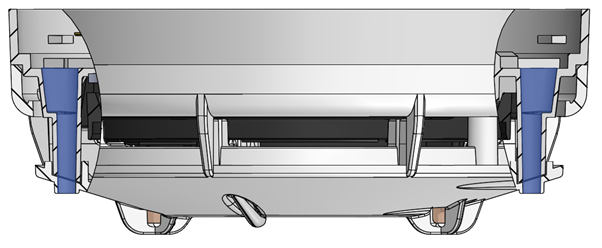
Soteria UL overcomes this issue through its patented vent design. These vents allow pressure differentials to be exhausted through a carefully positioned hole in the lid, so that is does not impede the flow of smoke into the smoke inlet or deeper into the optical chamber. Further, the vents allow any condensation that may occur in the cavity behind the detector, or in cable conduits, to escape without harm.

The drains, highlighted in blue, allow water and air to pass from the rear of the detector without affecting the smoke entry paths.

An often-overlooked characteristic of smoke sensors is their ability to operate uniformly no matter which direction the smoke is coming from. UL test detectors for this parameter in four different orientations and allows a variation of +/-50%. To ensure the most stable operation, we exceed this requirement and measure our detector at 360 orientations and achieve a variation of less than 10%/ft.

Why should a user care that Soteria UL’s directionality is so good? Well, if we had just one angle that was less receptive than others, then we would be forced to increase the overall sensitivity of the detector to ensure it can detect fire when tested in the poor orientation. By avoiding this pitfall, we can offer a detector with a perfectly balanced sensitivity.

Once smoke gets into the chamber, then it’s the job of the optical sensor to measure it, whilst discounting false readings from any foreign materials. The optical sensor consists of an industrially rated InfraRed (IR) light source. When smoke is present, light is scattered onto the light sensor. This sensor is a highly integrated Application Specific Integrated Circuit (ASIC), custom to Apollo, that combines the light sensitive element and electronic amplification.

Smoke is an aerosol – a mixture of air and tiny smoke particles. Because these tiny particles are similar in size to the wavelength of IR light, then they send that light scattering off in many directions via a quantum mechanical process that is described by Mie theory. Smoke from fires have precise characteristics; for example, it tends to scatter most light in the forward direction, rather than ‘reflecting’ it backwards.

We use this knowledge in the design of our optics, positioning the smoke sensor so it is more sensitive to the angles of scattering smoke, than the pattern of aerosols produced by cooking, for example. This is achieved with our unique patented optical sensor design.

The next nuisance that might trick our sensor is dust and insects. Traditional detectors suffer from the IR light source illuminating parts of the optical chamber, rather than just the scattering region in front of the light sensor. Because the light sensor is looking for only a tiny quantity of light to be scattered by smoke, then it can easily be fooled by light reflecting off chamber walls when dust or insects are present in the chamber.

Our first line of defence is stopping such things getting into the chamber. The Soteria UL uses a unique serpentine air inlet to prevent the ingress of dust. A fine nylon mesh prevents insects over a certain size from entering the chamber, but not all can be stopped is we still wish smoke to enter the chamber. Instead, we design the chamber to be robust to these smaller insects and accumulation of dust.

Firstly, a unique patented light absorbing surface of the chamber prevents the IR light being reflected around the chamber. This means that dust and insects on other surfaces of the chamber are less illuminated. Secondly, and this step takes some effort, all possible surfaces where an insect could stand and spread its wings, whilst being in the view of the light sensor, are eliminated. That means that even when an insect smaller than the screen finds its way into the chamber, it is very unlikely to be able to cause a false alarm. The same advantage is experienced when dust accumulates inside the chamber – there are no surfaces where dust can gather to cause stray light and trigger a false alarm.

And it’s not just our lab that this high performance is achieved. Every Soteria UL detector is produced and certified to conform to the same narrow range of sensitivity. This means that every product you install will behave the same as the last, it will not be more sensitive to common nuisances, or less sensitive to the attributes of fire. This is achieved in our factory with a blend of skilled hand assembly and highly automated modern manufacturing processes. Every single product is measured and calibrated for smoke sensitivity.

Once we have crafted the best smoke sensor, our next focus is the intelligent signal processing that determines when there is a real fire. Because the basics are right, we don’t need a highly complex, unpredictable, and opaque artificial intelligence algorithm. We simply add the right amount of smoothing, the right amount of delay, and a little enhanced detection of fast flaming fires. False alarms are avoided, not only by getting the basic smoke sensor right, but by reducing the response to slowly developing nuisance signals like cooking. The detector is constantly processing information, and if it decides there’s a fire, this is signalled to the panel via Core-Protocol with exceptional speed.

Keeping you safe from fire, every second of every day.

For more information on Soteria UL, Apollo’s 268 7th edition solution, contact enquries@apollo-fire.com or visit www.apollo-fire.co.uk/

This article was originally published in the May edition of IFSJ. To read your FREE digital copy, click here

Hochiki wireless fire detectors installed in London apartment blocks

Ekho, the newest hybrid wireless fire detection solution from global life safety manufacturer Hochiki, has been installed in six blocks of apartment buildings for North London borough to help improve fire detection.

EN54-25 approved and RED compliant, Ekho uses radio networking technology and provides a robust ‘always on’ network of devices which automatically adapt to changing environmental conditions.

Commenting on the project Fire Alarms Fabrication Services, Kevin Dodge, sales Account Manager at FAFS said: “The technology used in the Ekho devices helps residents feel safer compared to relying on a team of people prone to human error. The building owners are reassured due to the self-configuring mesh network which keeps the devices connected and communicating with the fire panel 24/7”

“This was an incredibly complex and highly involved project, we worked closely with the team at Hochiki who consulted on best devices for this project. The Ekho range offered a wireless solution which allowed us to work around issues such as cabling inside private spaces. Ekho allowed for early detection and most importantly detection outside of the building on cladding by installing heat sensor devices adjacent to every single window, including the windows for individual dwellings. The Ekho range is ultra-dependable, and much more cost effective than the Waking Watch scheme that was in place in these buildings.”

Following the successful completion of the project, Hochiki Regional Sales Manager, Tony Obadipe said: “We are pleased that our Ekho product range is making such an enormous difference in keeping people safe. The fact that our technology is also helping to drive huge cost efficiencies for our partners and their end users is a bonus. In the current economic climate this cost saving is essential, especially for local authorities. We are incredibly proud of our teams that have been involved in this project, it really is protecting people’s lives”.

Evac-Alert system installed in London residential block

C-TEC’s evacuation alert system, EVAC-ALERT, has been specified for a new purpose-built residential building in London located in the Elephant and Castle area of the London Borough of Southwark

Joyce Newman House is an 8-storey block of 40 living spaces commissioned by Leathermarket JMB, Southwark’s largest resident-managed housing organisation. The affordable-housing development also features landscaped gardens, an interactive playground and a communal kitchen garden for residents to grow their own vegetables.

Specified and supplied by Churches Fire & Security working alongside Blu Electrical Installations Ltd, EVAC-ALERT has been specifically designed to comply with the new BS 8629, which recommends evacuation alert systems be installed in all new blocks of flats over 18 metres to assist the Fire and Rescue Service (FRS) in evacuating part or all of a building in an emergency.

The system consists of a 2-loop control panel connected to a host of single and multi-way interface units, self-testing sounders and visual indicators. The system features manual controls to allow firefighters to easily operate the evacuation alert devices located inside flats on a zone by zone or floor by floor basis, the panel is stored in a secure vandal resistant cabinet which can only be accessed by the FRS using a special copy-protected key.

David Collins, Project Manager at Churches Fire & Security, said: “Evacuation alert systems ensure firefighters can alert occupants in a building of the need to evacuate if a fire gets out of control. The EVAC-ALERT system we’ve specified provides peace of mind for residents and, crucially, also demonstrates that building management have taken every precaution possible to protect the people residing in the property. Our client is delighted with the system.”

SIKA updates Fire Protection Solutions handbook

Building chemicals manufacturer Sika has updated its Fire Protection Solutions handbook for the UK market as part of its commitment to helping specifiers and building managers develop a passive firestopping strategy.

The handbook contains detailed information on Sika’s extensive range of passive fire protection products which have been specifically developed to help restore the fire resistance of walls and floors when disrupted by linear seals, cavity barriers or penetration services.

The handbook has been updated to better meet the specific needs of specifiers working in the UK, with the guide providing technical advice and detail on the relevant testing and safety standards that need to be met.

Sika’s passive fire protection handbook is part of a range of resources that have been developed to help specifiers control and contain the spread of fire across a wide range of sectors. Most recently, Sika has launched a new online Fire Stopping Solution Finder tool has been created to support the specification process by helping to identify the most appropriate and effective fire stopping products to use.

Additionally, Sika’s experienced technical team is on hand to provide detailed technical evaluations for more complicated joint specifications. These technical evaluations are offered free of charge, and can usually be completed within a working week, providing all the necessary information is supplied. These are legal documents which can then provide building owners with the reassurance of knowing that they adhere to the relevant building regulations.

To discover more about Sika’s passive fire protection range and to download a copy of the Sika Fire Protection Solutions handbook, visit www.sika.co.uk/passivefire

Jersey Fire and Rescue Service expand home fire safety checks

​Jersey Fire and Rescue Service (JFRS) has expanded its current home fire safety checks to offer further safety advice to islanders in their homes.

Called Safe & Well, the initiative will see that when Fire Safety officers visit Islanders to conduct a home fire safety check, they will also assess other safety concerns such as slips, trips, and falls, winter warmth (when relevant) and areas such as potential loneliness and isolation.

The idea behind the initiative is to help reduce the number of accidents and injuries in the home and subsequent visits to the hospital, as well as reducing the number of emergency calls to the Ambulance Service, Police and Fire & Rescue Service.

JFRS have partnered with agencies such as the British Red Cross, Eye Can and the cardiology department, to develop the guidance and signs to look out for. If Fire officers see anything of concern, they can either provide some advice immediately, or refer them to one of the partner agencies for help.

Fire Officer Mark Bailey-Walker said “We’re delighted to be expanding our current home fire safety check service to include a wider safety assessment, particularly for the more vulnerable members of our community, such as the elderly and sight impaired. The aim is to provide a person-centred safety visit that focuses on the individuals’ needs”.

Marketing Manager from Island Insurance, Gary Kelly said: “Islands have been supporting Jersey Fire and Rescue to deliver their prevention initiatives for several years now, so we are delighted to be involved with the Safe and Well initiative.

“This service is not only designed to help islanders stay safe in their homes, but also to help them recognise potential health concerns that could severely impact their lives, such as sight loss, mental wellbeing, and cardiac concerns linked to stroke”.

Cost to alleviate life-safety fire risks from external walls revealed

Following the Grenfell Tower tragedy, the UK government has established a new Building Safety Programme to ensure that residents of high-rise and mid-rise residential buildings are safe, and feel safe from the risk of fire, now and in the future.

From the findings outlined in the report, the costs to alleviate external wall system life-safety fire risks for leasehold dwellings in mid-rise residential buildings is estimated to be between £3.1 billion and £5.3 billion.

This Data Release provides estimates on: the total number of mid-rise (between 11 metres and 18 metres in height) residential buildings in England; the proportion of mid-rise residential buildings that require remediation, partial remediation and mitigation to alleviate life-safety fire risks from external wall systems; the costs of funding the alleviation of life-safety fire risks of leasehold dwellings in mid-rise residential buildings, in England.

The estimates in this Data Release have been calculated using a sample survey of 2,856 mid-rise (11 – 18 metre) residential buildings in England. Ordnance Survey Address Base data was used to produce the sample, and in estimating the population of mid-rise residential buildings in England.

DLUHC hired an expert contractor to complete desk-based surveys on the sample, to assess the probable life-safety fire risk of the external wall system on each building.

DLUHC’s pilot study estimates 7-9% of residential midrise buildings containing dwellings in England require external wall system remediation to alleviate life-safety fire risks. A further 1% are estimated to require partial remediation and 0.5-1% are estimated to require mitigation measures to alleviate life-safety fire risks.

It is estimated that between 6,220 and 8,890 mid-rise residential buildings, containing dwellings, require remediation, partial remediation or mitigation to alleviate life-safety fire risk, of a building population of 71,000 – 79,000 in England.

Of the 2,000 – 3,000 non-dwelling residential mid-rise buildings (hotels, student accommodation, sheltered accommodation), 8-12% (190 – 330 buildings) are estimated to require work to alleviate external wall system life-safety fire risks.

The full report can be found here.

NFPA issues guidance on Sprinkler usage

The National Fire Protection Association (NFPA) has issued guidance on best practice for sprinkler systems following National Sprinkler Week which took place from 16-22nd of May.

Today NFPA 13E – the ‘Standard for the Installation of Sprinkler Systems – provides the information necessary to ensure fire departments are trained on and operate effectively with automatic fire sprinkler systems.

The guidance document explains that although some fire sprinkler systems are designed to suppress a fire, most are designed to control a fire. The main difference between fire control and fire suppression is related to the fire sprinkler systems impact on the fires heat release rate. 

The three principal causes of fire sprinkler system failures identified in NFPA 13E are a closed control valve, inadequate water supply for the system and occupancy changes that render the installed system unsuitable.

Beyond the primary causes found in the recommended practice, NFPA has conducted research on the U.S. Experience with Fire Sprinklers to help understand fire sprinkler effectiveness. 

The NFPA said that familiarisation with the types of control valves and their layout in a system will allow firefighters to both understand what valves will disrupt water flow and what position have they should be in for effective operation. 

If firefighters encounter a valve which is not in the correct position during a fire, placing that valve in the correct position may restore the system effectiveness.

Additionally, fire departments should never turn off a sprinkler system that has activated until they have confirmed the fire is fully extinguished and overhaul has taken place, and noted that simply turning the system back on may not reestablish fire control.

On water supply, it said it may be inadequate due to a lack of available water flow, lack of available pressure or both, and since fire department pumpers often have the capacity to supply water at higher flow rates and pressures than the normal water supply, utilising a fire department pumper to supply water to the fire department connection (FDC) can address most inadequate supply concerns. 

On occupancy changes, it said that although the fire department does not have an ability to impact occupancy changes during a fire incident, an effective pre-plan and inspection program has the potential to identify occupancy changes which can adversely impact fire sprinkler system effectiveness before fires occur.

It advised training those conducting these inspections to understand what types of commodities would represent a high heat release rate fire and how to identify if a sprinkler system could be designed to deliver the necessary water density can reduce this potential cause of failure.

It concluded by saying: “As with all NFPA recommended practices, the language is less rigid than a standard or code, utilising “should” instead of “shall” as to not limit the individual fire departments, allowing them to adopt more effective procedures.

“Familiarisation with NFPA 13E provides anyone who may be utilising a fire sprinkler system the knowledge necessary to positively impact the systems effectiveness. 

Three quarters of UK fire doors fail inspections

UK fire door inspection organisation, the Fire Door Inspection Scheme (FDIS) has revealed three quarters of the fire doors inspected in the UK by its approved inspectors did not meet the required standard.

The FDIS’s data, based on more than 100,000 fire door inspections carried out by its approved inspectors in 2021, found that 75% of fire doors failed to meet the required standards, putting lives at risk in the event of a fire.

Buildings that had the highest number of fire door inspection failures included healthcare buildings, local authorities and housing associations, and private housing.

As these buildings’ fire doors are subject to higher use and traffic than other building types, regular inspection and maintenance is key to ensuring they remain fit for purpose throughout their lifespan.

Louise Halton, FDIS Scheme Manager, said: “With the vast majority of fire doors in the UK failing inspections, it’s sad to say that a tragedy is simply waiting to happen, especially so in buildings that are home to vulnerable residents. But this situation is entirely preventable and, at this stage, still reversible.

“A fit for purpose fire door can save lives, so now is the time for all of those responsible for fire safety to urgently inspect fire doors in their buildings and act immediately if faults are identified.

“It’s crucial that reputable and trained fire door inspectors, such as those approved by the FDIS, carry out fire door inspections. However, the ongoing reporting of maintenance issues with fire doors is a role for us all — every building user should play a proactive role in reporting any faults to ensure they are quickly addressed so that the building’s safety is maintained.”