How to Create a Fire Emergency Evacuation Plan

A fire can break out with little warning, whether you are at home, at work, or in a public place. 

In those critical moments, having a clear fire emergency evacuation plan can save lives by telling everyone exactly how to escape quickly and safely. 

This article will explain what a fire emergency evacuation plan is, when to use it, how to create one step by step, and key tips for making it effective. 

By planning ahead and practising, you can help ensure that if a fire ever happens, you and the people around you can get to safety without panic.

What is a Fire Emergency Evacuation Plan?

what is fire emergency evacuation plan

A fire emergency evacuation plan is a written document or set of instructions that outlines how to get everyone out of a building safely if there is a fire. 

In short, it’s a guide for a quick and orderly escape during a fire emergency. 

A good plan will typically detail the designated escape routes and emergency exits, where people should assemble outside (a safe meeting point), and how to raise the alarm (for example, activating the fire alarm or shouting to alert others), as well as who will contact the fire service. 

It may also assign special roles or responsibilities – for instance, a fire marshal in a workplace might check that everyone is evacuated, or one family member might be in charge of calling the fire service. 

The purpose of a fire emergency evacuation plan is to ensure everyone knows what to do immediately if a fire breaks out, so there’s no confusion or delay when every second counts.

When is a Fire Emergency Evacuation Plan Used?

what is fire emergency evacuation plan used for

A fire emergency evacuation plan is used whenever there is a fire emergency that requires people to evacuate. 

The moment someone discovers a fire or the fire alarm sounds, everyone should follow the plan and start leaving the building to reach safety. 

This applies in all settings, workplaces, schools, shops, healthcare, and even in your own home. 

In an office or school, for example, the plan is often practised during regular fire drills so that if a real fire happens, people are prepared to act quickly and calmly. 

Essentially, any time you need to get out of a building due to a fire (or suspected fire, such as smelling smoke), you will be using your fire emergency evacuation plan. 

It’s the procedure that guides occupants to safety during those critical moments.

How to Create a Fire Emergency Evacuation Plan

Creating a fire emergency evacuation plan involves carefully thinking through how people will escape a fire safely and writing down the procedure. 

Here are the key things your plan should include and consider:

What Should Your Fire Emergency Evacuation Plan Cover?

Your fire evacuation plan should cover all the essential elements needed for a safe escape. 

Important points to include are:

Fire Detection and Alarm

Clearly state the fire detection and how people will be alerted. 

For example, note that there are smoke alarms or a fire alarm system in place and explain how to trigger the alarm (or yell “Fire!”) if someone discovers a fire. 

Also specify who will call the fire service to ensure help is on the way.

Escape Routes and Exits

Identify all the safe ways out and keep them unobstructed. 

Emergency exits should open easily. 

Provide exit signs and, if needed, emergency lighting so people can find their way even in the dark.

Assembly Point

Choose a safe spot outside (such as the far end of the car park or across the street) where everyone will meet. 

Make sure everyone knows where this assembly point is.

Training and Information

Make sure everyone in the building knows what to do. 

Employees should have training on the plan, and household members or roommates should talk through the escape steps. 

People need to be familiar with the plan ahead of time rather than trying to figure it out during an emergency.

Special Assistance

Include provisions for anyone who might need help during evacuation. 

For example, assign someone to assist individuals with limited mobility (such as using an evacuation chair for a wheelchair user), plan how to alert anyone with hearing or vision impairments, and decide who will help young children or the elderly. 

The plan should ensure no one is forgotten or left behind.

What Else Should You Consider?

Beyond the basics above, consider these additional factors to make your evacuation plan as effective as possible:

Action on Discovering a Fire

The plan should state that if anyone discovers a fire, they must immediately raise the alarm and start the evacuation. 

If the fire is very small and a person is trained to use a fire extinguisher, they can attempt to put it out only if it is safe to do so – otherwise, evacuate immediately. 

Remember that getting everyone out safely is the top priority.

Roll Call and Headcount

Your plan should include taking a headcount once everyone is at the assembly point. 

Use a staff register or headcount list to quickly see if everyone is out or if someone might still be inside. 

If anyone is unaccounted for, that information must be given to the fire service immediately when they arrive.

Liaison and Responsibilities

Assign one person to meet the firefighters when they arrive and inform them of crucial details (like if anyone is missing or where the fire is). 

Also, make sure all key roles are decided in advance – for example, who calls 911, who checks various areas, who assists people in need, and who takes the roll call. 

These clear assignments prevent confusion during an evacuation.

Fire Emergency Evacuation Plan Template

While each evacuation plan will be tailored to its location, most plans cover similar ground. 

Here is a simple outline of what a fire emergency evacuation plan document might include:

  • Introduction:  A brief description of the premises and the purpose of the plan (to ensure everyone’s safety during a fire).
  • Alarm and Emergency Contacts: How to raise the alarm and who to call in an emergency (include the fire service number and any key internal contacts).
  • Evacuation Procedures: Step-by-step instructions of what to do when the alarm sounds or a fire is discovered (for example: leave immediately by the nearest exit, do not use lifts, and close doors behind you).
  • Escape Routes and Exits: Details of primary and secondary escape routes for the building (and where maps or exit signs are posted, if applicable).
  • Assembly Point: The specific safe location outside where everyone will gather after evacuating.
  • Roles and Responsibilities: Who does what during the evacuation (for example, who calls 911, who guides people out, who takes attendance at the assembly point).
  • Assisting Vulnerable Persons: How to assist anyone who needs extra help (e.g. people with disabilities, children).
  • Post-Evacuation Actions: For example, note that a roll call will be done at the assembly point and any missing persons will be reported to the fire brigade.

How Often Should You Review Your Fire Emergency Evacuation Plan?
how often review fire emergency evacuation plan

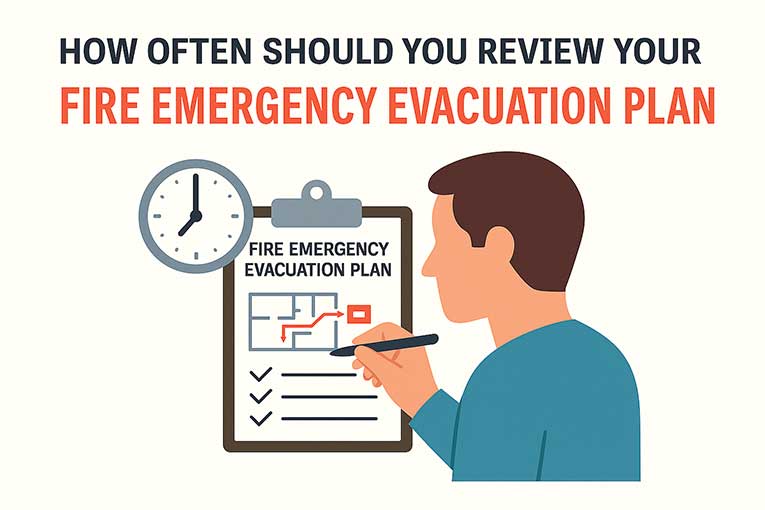
You should review your fire emergency evacuation plan regularly to keep it up to date – at least once a year is a good guideline. 

Over time, things can change that might affect your plan. 

For example, you might renovate or rearrange the space, or new people might join (employees, residents, etc.) who have different needs. 

After any such changes, update the evacuation plan accordingly. 

It’s also wise to review the plan after any fire drill or actual emergency. 

If a drill showed confusion about a particular exit or if an alarm wasn’t heard in some area, you should fix those issues and adjust the plan. 

Regular reviews ensure that escape routes are still clear, contact information is current, and everyone remains familiar with what to do if a fire occurs.

Is a Fire Emergency Evacuation Plan a Legal Requirement?

is fire emergency evacuation plan legal requirement

Yes, in most workplaces and public buildings a fire emergency evacuation plan is a legal requirement. 

Employers and building owners are legally obliged to implement and communicate these plans. 

If you have five or more employees, you are typically expected to have the plan written down as part of your fire risk assessment duties. 

Failing to do so can lead to enforcement actions or fines because it puts people at risk. 

For private homes, a written fire evacuation plan is not required by law, but it’s strongly recommended for your safety.

Fire authorities often encourage families to discuss and practise a home escape plan because it greatly increases the chance of everyone getting out safely. 

So, while you might not be legally required to have a formal fire plan in your house, the law does mandate it for most other settings where people live or work. 

Ultimately, beyond legal compliance, having a fire emergency evacuation plan is a responsible step that protects lives.

Conclusion

You should now have an understanding of how to create a fire emergency evacuation plan

A fire emergency evacuation plan is an essential part of keeping people safe from fire. 

In an emergency, a well-prepared plan can make the difference between a quick, orderly evacuation and dangerous chaos. 

By clearly outlining how to raise the alarm, the nearest exits to use, where to assemble, and who will call for help, it removes uncertainty and panic. 

Remember that for a plan to be effective, everyone needs to know it and it should be kept up to date. 

Whether at your workplace or in your home, taking the time to create and practise a fire evacuation plan can save lives. 

Fires are unpredictable and frightening, but when everyone knows what to do and where to go, the situation becomes much more manageable. 

Being prepared is not only a legal or moral responsibility – it’s also a practical way to protect yourself and others from harm.

Firedos Middle East hosts first live demo day in Abu Dhabi

Firedos Middle East presents live foam firefighting demonstrations

FireDos has reported that its Middle East team hosted its first live demonstration day at the JAHEZIYA training facility in Musaffah, Abu Dhabi.

According to the company, the event was attended by around 50 invited guests and focused on fluorine-free foam firefighting for oil and gas industry applications.

FireDos said the demonstrations featured its proportioning systems and fire monitors in real fire scenarios.

The firm stated that the technology is used in protecting tank farms and liquid fuel facilities, where Class B flammable liquid fires present high operational risks.

It added that the use of foam is considered essential in these environments to help ensure safety and operational continuity.

Equipment on display during demonstrations

FireDos said the demonstration involved a pick-up truck equipped with a remote-controlled M2 fire monitor and an FD2000 proportioning system with remote monitoring capabilities.

The company reported that these systems were tested in three scenarios: a vehicle fire, a pan fire and a helipad fire.

According to FireDos, all tests used fluorine-free foam provided by Perimeter Solutions.

It added that the equipment was shown operating in different modes, including spray jet, to demonstrate versatility.

The firm stated that the scenarios were intended to replicate operational conditions found in high-risk industrial sites.

Attendance from regional fire sector representatives

FireDos said the event attracted integration partners, consulting engineers and distributor partners from across the region.

The company reported that foam concentrate for the tests was supplied through its partner Fotleia in cooperation with Perimeter Solutions.

According to FireDos, Haven Fire and Safety also participated in the event.

The firm stated that attendees engaged directly with technical experts throughout the programme.

It added that the day began with networking before moving to outdoor demonstrations.

Technical presentations and Q&A sessions

FireDos said Stuart, Regional Director for the Middle East, Africa, SE Asia and Oceania, opened the event with an introduction to the company and its foam-based systems.

According to the company, live demonstrations followed, giving participants the opportunity to observe performance in active fire suppression.

The firm stated that attendees used the opportunity to ask questions and discuss operational strategies for foam firefighting.

FireDos added that its representatives provided detailed explanations of the technology’s capabilities.

The company reported that the exchange of technical information formed a key part of the day’s activities.

Plans for future events

FireDos said the event was hosted by Stuart, Anoop and Jason from its Middle East team.

The company stated that the team guided guests through each stage of the programme.

According to FireDos, feedback from attendees indicated strong interest in the systems demonstrated.

The firm added that plans are being developed for a follow-up live demonstration day in the region.

It stated that the event showed the operational readiness of its technology for use in high-risk environments.

Firedos Middle East hosts first live demo day in Abu Dhabi: Summary

FireDos reported that its Middle East team held a live demonstration day in Abu Dhabi.

The event took place at the JAHEZIYA training facility in Musaffah.

Around 50 invited guests attended.

Demonstrations featured fluorine-free foam systems.

The technology included an M2 fire monitor and FD2000 proportioning system.

Three live fire scenarios were staged.

Foam concentrate was supplied by Perimeter Solutions.

Partners Fotleia and Haven Fire and Safety attended.

Attendees included engineers and integration partners.

A technical presentation introduced the company and its systems.

Guests asked questions and discussed operational strategies.

FireDos said the event showed operational readiness.

Plans are being made for a follow-up event.

Southwark firefighters lead Borough Market fire safety outreach

Firefighters focus on above-shop fire safety risks

The London Fire Brigade (LFB) has reported that Southwark firefighters and Fire Safety Officers held a fire safety awareness event at Borough Market, aimed at residents living above commercial premises and local businesses.

LFB said the focus was prompted by Southwark recording the highest number of residential dwelling fires in London last year.

According to LFB, firefighters set up interactive stalls to address risks linked to lithium-ion batteries, hot weather, and other hazards.

It added that the stalls also promoted the Brigade’s Home Fire Safety Checker and offered information for those living above businesses.

Fire Safety Officers visited around 150 businesses with residential accommodation above in the Borough Market area on the same day.

Firefighters and public engagement

Southwark Borough Commander Daniel Capon said: “This event has been a fantastic opportunity to showcase the positive work being carried out by London Fire Brigade and our partner agencies.

“Our crews engaged with a wide range of residents, offering tailored advice on how to stay safe from fire risks in the home.

“Meanwhile, our Fire Safety Officers worked closely with local businesses, providing guidance on how to protect their premises and the people living above them.

“Unfortunately, we still come across unsafe conditions in some commercial properties that could put lives at risk — particularly those living in flats above shops.

“Events like this are vital in helping us reduce those risks and ensure safer communities.

“We continue to remind business owners of the importance of maintaining proper fire separation between commercial and residential areas.

“This includes keeping shared escape routes clear of obstructions, especially flammable materials, and sealing any gaps that could allow smoke to spread.

“Where possible, residents should have a separate, protected means of escape in case of emergency.

“We’re grateful to Borough Market and Southwark Council for their support in making this event a success. Their collaboration is a great example of how working together can make a real difference in keeping Londoners safe.”

Safety checks and inspection data

LFB said Southwark firefighters have carried out 1,532 Home Fire Safety Visits since 2024.

It added that these visits have reached 3,484 residents, more than 2,200 of whom live in flats.

The Brigade stated that firefighters carry out fire safety checks across London daily.

It said that where concerns are identified, these can be referred to Fire Safety Officers for further action.

Collaborative safety initiatives in other boroughs

LFB’s Area Fire Safety Manager Ben Dewis said: “Recently we hosted a similar initiative at The Glades Shopping Centre in Bromley and saw the positive impact on businesses and the public.

“These events are a great opportunity to work alongside our operational colleagues, sharing fire safety knowledge, upskilling firefighters, and developing our own staff.

“It’s this kind of collaboration that helps us build safer communities across London.”

Borough Market and council support

Borough Market’s Head of Operations, Stephen Shirley, said: “The safety of our traders, visitors and residents is always a top priority for us, so we were pleased to support this day of action.

“It was great to see London Fire Brigade engaging with the public and our community of traders, offering practical advice and raising awareness of key fire safety issues.

“We’re proud to play a part in helping to keep this historic market safe.”

Councillor Sarah King, Cabinet Member for Housing at Southwark Council, said: “We’re proud to have supported this important day of action with the London Fire Brigade at Borough Market. With so many Southwark residents living in homes above shops and other businesses, fire safety advice must reach both business owners and residents alike.

“We are investing £250 million over the next three years to improve the health and safety of our own homes, including significant work on fire and electrical work to bring all our homes up to standard.

“Since the start of 2024, we’ve installed 2,850 smoke alarms and checked the electrical safety of 6,300 homes, and we seek to do the same in all 37,000 of our council homes.”

Fire safety guidance for above-shop residences

LFB advises that shared access between commercial and residential units should be separated by proper fire doors that are kept closed.

The Brigade said escape routes should remain free of stored rubbish or supplies.

It stated that exposed gas or electricity meters under stairs without fire protection can increase risk in a fire.

It added that visible electrical cables and gas pipes in entrance areas can make fires more severe if exposed to heat or flame.

LFB also warned against unprotected smoking or Shisha areas under canopies at the rear of commercial premises due to the risk of fire spread up building exteriors.

It said excessive storage of flammable items, such as tyres or refuse, can also pose hazards in rear areas or gardens.

Relevance for fire and safety professionals

This initiative highlights the ongoing need for targeted fire safety education in areas where residents live above commercial premises.

It demonstrates how data on incident frequency can guide local engagement and inspection strategies.

The work also underlines the importance of collaboration between operational firefighters, specialist Fire Safety Officers, and partner organisations in addressing local risks.

Such events may serve as a model for other jurisdictions aiming to reach mixed-use property occupants with tailored guidance.

Southwark firefighters lead Borough Market fire safety outreach: Summary

Southwark firefighters and Fire Safety Officers held a community fire safety event at Borough Market.

The London Fire Brigade said the focus was on residents living above commercial premises and local businesses.

Interactive stalls covered risks from lithium-ion batteries, hot weather, and home safety checks.

Fire Safety Officers visited around 150 businesses with residential accommodation above.

Southwark Borough Commander Daniel Capon said the event helped address unsafe conditions in commercial properties.

The Brigade said Southwark recorded the highest number of residential dwelling fires in London last year.

Since 2024, firefighters have carried out 1,532 Home Fire Safety Visits in the borough.

These visits reached 3,484 residents, including over 2,200 living in flats.

Similar initiatives have taken place in other London boroughs.

The Borough Market event was supported by Southwark Council and market management.

Council figures show investment of £250 million in housing safety over three years.

The council has installed 2,850 smoke alarms and checked 6,300 homes since 2024.

LFB provided guidance on fire doors, escape routes, and hazard identification.

The advice covered flammable storage, smoking areas, and exposed utilities.

The Brigade said these measures aim to improve safety in mixed-use buildings.

California’s new firefighter training centre puts pressure on federal staffing crisis

California expands training infrastructure with new firefighter centre

The LA Times has reported that the California Department of Forestry and Fire Protection (Cal Fire) has opened a new firefighter training centre in Merced County.

The Atwater Training Center welcomed its first 40 students on Monday, marking the latest step in a multi-year expansion of Cal Fire’s training programme.

The facility joins three existing training centres and is designed to help prepare new entry-level firefighters and company officers.

According to Cal Fire, the Atwater site has capacity for 300 students per year and is located on the grounds of a former Air Force base.

The department expects to train approximately 1,600 firefighters across its four centres in 2025.

Growing workforce capacity to meet operational needs

The expansion comes as Cal Fire continues to grow its workforce to match the demands of increased fire risk and response.

According to California Department of Finance data, the number of authorised fire protection positions at Cal Fire has nearly doubled since 2017.

In the same period, Cal Fire’s annual budget has risen from $2 billion to $4.2 billion, with 90 percent of funding allocated to fire protection.

A Cal Fire spokesperson said that, as of July 2025, the department employs 12,223 people, including seasonal firefighters.

This figure exceeds 2024’s peak staffing level of 11,754 and is expected to increase further during the fire season.

Cal Fire is currently recruiting for a range of roles, including entry-level firefighters, heavy equipment operators and battalion chiefs.

Curriculum includes live fire training and leadership skills

Nicole Gissell, Cal Fire assistant chief and curriculum lead, said the training programme is designed to prepare recruits for field command responsibilities from day one.

Gissell said: “Students could graduate from our academy and, their next day, arrive on scene and have to command the fire.”

She added: “Our training programme is probably one of the best in the fire service.

“Our training programme has been growing in the last five years to meet the demands of the department and to train all 12,000 employees.”

The Atwater centre delivers a 10-week training programme covering core firefighting techniques, fire science, equipment handling and leadership.

Students also complete practical exercises including a week of live fire response and training in fire towers and off-road driving.

Federal shortages contrast with state investment

The new facility opened as federal agencies continue to report high vacancy rates across their firefighting units.

According to a July 2025 investigation by ProPublica, over 4,500 positions in the US Forest Service remain unfilled.

This figure represents around 27 percent of federal wildland firefighting roles.

Governor Gavin Newsom has called for greater national support for wildfire preparedness, including in a proposed executive order sent to the federal government earlier this year.

The LA Times reported that Newsom’s proposal challenged federal authorities to match the state’s level of investment in training and workforce readiness.

Historic development of Cal Fire’s training programme

Cal Fire’s original training centre opened in Ione, California in 1967 with 32 students and remained the sole facility for 50 years.

A second centre was established in Riverside in 2017, followed by a third in Redding in 2023.

The opening of the Atwater Training Center in 2025 brings the total number of Cal Fire training centres to four.

Each centre is supported by cadres of instructors delivering standardised training across the state.

The Atwater facility will house two of the department’s seven instructor teams.

California firefighter training centre opens amid national staffing shortage: Summary

The LA Times has reported that Cal Fire opened a new training centre in Atwater, Merced County.

The facility welcomed its first 40 students on Monday.

It is the fourth training centre operated by Cal Fire.

The site has capacity for 300 students annually.

Cal Fire expects to train 1,600 firefighters across all centres in 2025.

The training programme lasts 10 weeks and includes live fire exercises.

Nicole Gissell, assistant chief, said graduates must be ready to lead incidents.

Cal Fire currently employs 12,223 personnel.

The number of authorised positions has doubled since 2017.

The department’s budget has also doubled since 2017.

Federal firefighting roles remain 27 percent vacant, according to ProPublica.

Governor Gavin Newsom has urged federal investment in wildfire preparedness.

Telgian to present fire alarm system commissioning webinar

Webinar to explore fire alarm commissioning in the US

Telgian has announced that Jim Burian, Regional Practice Leader at Telgian Engineering & Consulting, will lead a Fire Smarts webinar on fire alarm system commissioning on 14 August 2025.

According to the company, the 90-minute session will outline how commissioning ensures fire alarm systems are installed and operate according to design specifications.

The firm said the event will cover the goals of fire alarm commissioning, testing of components, documentation procedures, and stakeholder communication.

The session will take place from 2:00 pm to 3:30 pm Eastern Time.

Registration for the session is open to fire protection professionals across the United States.

Commissioning process and testing procedures

According to Telgian, commissioning involves a verification and documentation process confirming that a fire alarm system functions according to its intended design.

The company said the session will examine how to test initiating devices for alarm conditions and tamper switches for supervisory alerts.

It added that the session will also review the verification of notification appliances during alarm scenarios.

Participants will be guided through each stage of the commissioning process.

Burian is expected to explain how commissioning impacts system performance and code compliance.

Documentation and stakeholder responsibilities

Telgian stated that the webinar will include a segment focused on documentation best practices.

The firm said this will include guidance on how commissioning information should be formatted and stored.

It added that guidance will also be given on how documents should be distributed to relevant parties.

The process is expected to include recommendations for improving traceability and accountability across stakeholders.

Telgian said documentation is a critical part of system handover.

Presenter background and qualifications

According to Telgian, Jim Burian brings extensive experience in fire protection design and compliance.

The company said he has led teams of engineers, designers and code consultants on projects across the Mid-West.

It added that he has managed product safety and compliance initiatives involving UL testing and approvals.

Burian holds a Mechanical Engineering degree from the Illinois Institute of Technology.

He is the current Chair of the Chicago Chapter of the Society of Fire Protection Engineers and an active member of AIA Chicago.

Course relevance for fire safety professionals

Telgian said the webinar is aimed at engineers, contractors, and code officials involved in fire alarm system design and installation.

It explained that the content will be relevant to both new system installations and upgrades.

The firm said the session will also provide insights for professionals involved in inspection and maintenance.

Burian will provide examples and case-based guidance during the session.

The company said continuing education credits may be available through Fire Smarts.

Telgian to present fire alarm system commissioning webinar: Summary

Telgian has announced a webinar on fire alarm system commissioning.

Jim Burian will lead the session on 14 August 2025 from 2:00 pm to 3:30 pm ET.

The session will cover commissioning goals, testing procedures, documentation, and stakeholder responsibilities.

Burian is Regional Practice Leader at Telgian Engineering & Consulting.

He holds a degree in Mechanical Engineering and chairs the SPFE Chicago Chapter.

He has led design and compliance teams across the Mid-West.

The webinar will be hosted by Fire Smarts.

It is open to professionals involved in fire alarm system design, installation, and compliance.

Real decisions made in simulation: How XVR 10 is extending immersive wildfire training

Chris Thain, UK Business Development Manager at LearnPro Group, explains how XVR 10 extends immersive training with wildfire, emissions and image-capture modules for safer command decisions

XVR 10 is the latest release of the XVR On Scene platform already adopted by hundreds of fire and rescue organisations.

The update introduces three integrated modules – Wildfire Simulation, Emissions Modelling and Photo Mode – that allow instructors to recreate fast-moving vegetation fires, track toxic plumes in real time and capture still images for forensic debriefs.

Because every addition sits inside the same three-dimensional environment, incident commanders can rehearse strategy, allocate resources and gather evidence without tying up front-line appliances or exposing crews to danger.

The new toolkit does not replace the water, smoke and casualty systems that made earlier versions popular; it extends them.

Practitioners who have used XVR for structural fires or road-traffic collisions will recognise the drag-and-drop interface and the detailed resource logs but will now find fresh controls that mirror hazards dominating today’s call-outs.

By removing physical risk and compressing logistics into a few clicks, XVR 10 lets services run more frequent, more demanding exercises while preserving operational availability.

Wildfire simulation

Recent fires along the Los Angeles wildland–urban interface underline how quickly flame fronts can overwhelm built-up areas.

Rising temperatures, longer dry seasons and new housing on once rural slopes mean that almost every brigade now lists vegetation fire among its top risks.

Traditional training helps but never quite matches the speed, scale or unpredictability of a live hillside blaze.

XVR 10 fills that gap by providing a repeatable, scientifically grounded Wildfire Simulation that large cohorts of officers can use simultaneously.

The model draws on advice from European subject-matter specialists and uses wind direction, terrain profile, fuel load, plant type and moisture level to calculate flame behaviour.

As the session runs, trainers can lock certain factors, then introduce sudden shifts such as a 20-kilometre-per-hour wind change or a late-afternoon drop in humidity.

Within seconds the fire edge alters shape and pace, forcing the incident commander to reassess priorities.

Because the screen updates in real time, crews witness how a single tactical choice – lighting a back burn, for example – either slows the head fire or, if mistimed, drives a new flank.

Resource management follows real-world limits.

If a county owns two helicopters, only two appear in the scenario; additional appliances arrive after realistic travel times, not instant teleportation.

This insistence on authentic numbers encourages disciplined requests and sharpens prioritisation.

Officers can order ground crews to cut firebreaks, call for retardant drops or stage evacuations at trigger points they define on the map.

Each action is logged, creating a timeline the group can replay during the hot debrief.

A virtual wildfire also provides a safe venue for joint drills.

Police officers can test road-closure plans while paramedics rehearse casualty collection behind a shifting smoke curtain.

Utility engineers may practise grid isolation or gas-line shutdown without leaving their office.

All participants share one live map, hear each other over integrated voice, and refine inter-agency language long before a real incident forces them together.

Perhaps the greatest advantage is the chance to experiment.

Officers can try an aggressive frontal attack, watch it fail, reset the clock and explore a defensive strategy – all within one morning.

Lessons are fast, vivid and cheap, giving new commanders confidence that textbook doctrine will hold under pressure.

Emissions modelling

When warehouses or chemical plants burn, the flames are often less dangerous than the smoke.

Fine particulates, acidic gases and carcinogenic compounds can migrate kilometres downwind, threatening crews and communities for hours after ignition.

Knowing where that plume will travel is now a core task for any incident commander.

XVR 10 addresses this need by layering an emissions model over its immersive scene.

The module lets instructors enter source strength as kilograms per second or select a breached vessel so the software calculates release rate.

Atmospheric data can come from the built-in library or, if available, a live feed.

Terrain roughness is imported automatically, ensuring the plume bends and pools in believable ways.

Colour bands then hover above the three-dimensional landscape, refreshing every few seconds to show concentration at ground level and in five-metre steps aloft.

With a glance at the display, commanders see which streets require shelter-in-place advice, where self-contained breathing apparatus is mandatory, and which evacuation routes avoid the densest cloud.

Because the timeline slider rolls forward four hours, crews can test alternative ventilation tactics or resource plans without rerunning the scenario.

A warehouse door left open, for instance, might vent carbon monoxide quickly yet drive hot gases across the only safe access road.

Closing that door traps heat but may keep the plume away from a nursing home.

Such trade-offs become clearer when the visual model shows consequences minute by minute.

Repeated exposure to emission forecasts builds a stronger link between hazmat theory and field decisions.

Officers start to match protective clothing to numerical exposure rather than intuition.

Public-information staff refine language for media releases, anchoring their statements to the moving plume instead of generic warnings.

Environmental-compliance officers gain a realistic context for the air-quality thresholds they monitor, making later audits smoother and more collaborative.

Photo mode

Post-incident learning stands or falls on evidence.

Written notes capture intent, and continuous video records movement, but each misses something.

A note cannot show the smoke roll that somebody failed to spot; a roaming camera may face the wrong way when a decisive moment occurs.

XVR 10’s Photo Mode bridges that gap by letting trainers freeze any viewpoint, adjust depth of field and store a crisp image without pausing the session.

During a live run, the instructor can zoom on a breached valve, highlight the glow under a warehouse roof or frame a casualty lying behind debris.

Each capture drops into a timeline pane and accepts annotations – circles, arrows, questions – ready for debrief.

Because the simulation continues in the background, key frames accumulate without breaking immersion.

At review, the group steps through the images, seeing exactly what cues were available when a decision was made.

The value extends beyond immediate feedback.

Services can file image sets in their learning-management system, tagging each by hazard type and difficulty.

When a new cohort starts a command course, tutors pull up earlier captures to illustrate best practice and recurring pitfalls.

Auditors who need proof that an officer met national standards can trace decisions to visual evidence rather than second-hand testimony.

Over time, this growing library becomes a catalogue of lessons specific to the organisation’s geography, equipment and doctrine.

Why XVR 10 matters

The three modules broaden XVR’s reach but do not complicate its use.

A mid-range gaming PC still runs the software; a basic local network still links stations, classrooms or remote offices.

What changes is the depth of scenario available on that hardware.

An evening shift can now practise a hillside fire, a chemical-plant leak and a photo-based debrief without leaving the appliance bay.

Financial benefits follow.

Live burns demand fuel, facility hire and protective gear that soon erode a training budget.

A virtual drill reduces those costs to electricity and instructor time, making weekly command practice achievable rather than aspirational.

For managers tracking competence, exported logs, plume maps and annotated images give hard evidence of progress, replacing vague recollections with measurable data.

The platform suits more than municipal brigades.

Forestry services can rehearse landscape-scale containment plans.

Industrial fire teams can test shutdown sequences while the control room watches.

Civil-protection agencies can bring power, water and transport representatives into the same virtual space to rehearse coordinated evacuation from a spreading smoke cloud.

Regardless of sector, the common gain is an authentic problem, tackled safely, repeated until mastered.

XVR 10 mirrors the hazards most crews now face – rapid wildfires, toxic plumes and the demand for evidence-based review – inside one cohesive environment.

By giving firefighters, police and medical responders a realistic but risk-free arena, it delivers more training hours, sharper decision-making skills and clearer proof of competence.

When the next call arrives, that preparation translates into faster, better-informed actions on the incident ground.

This was originally published in the August 2025 Edition of International Fire & Safety Journal. To read your FREE copy, click here. 

Mixed reality fire training expands in ANZ: FLAIM Systems and FRSA partner

New sales partnership to support virtual training delivery

FLAIM Systems has announced a new sales and distribution agreement with Fire Rescue Safety Australia (FRSA), according to the company.

The Australian firm said the deal will support the delivery of its mixed reality (MR) immersive training systems across the Australia and New Zealand (ANZ) region.

FRSA will promote, sell and support the MR systems to fire and emergency customers.

FLAIM Systems said the partnership will enable wider access to virtual training environments designed to develop practical skills for high-risk fire and hazardous materials incidents.

The company stated that FRSA was selected for its regional expertise and its existing customer base of more than 500 organisations.

Fire sector background and training platform details

FLAIM Systems is an Australian-based provider of simulation-based learning platforms used in fire, emergency and industrial safety training.

According to the company, its MR technology includes 180 training scenarios designed to replicate high-risk incidents in a controlled virtual environment.

The systems are intended to supplement traditional methods by providing repeatable, measurable exercises that do not expose learners to live fire risks.

The firm said this approach supports workforce readiness while reducing training costs and resource consumption.

Its platform is already in use by a range of public safety organisations globally.

Role and strategy of Fire Rescue Safety Australia

FRSA is an emergency response equipment and services provider based in Australia and operating across the ANZ region.

The company provides gear, systems and support to clients in firefighting, industrial safety and emergency services.

FRSA will now offer FLAIM’s virtual training products as part of its technical services portfolio.

The organisation said the agreement will allow it to increase the availability of MR training across its customer base.

It also stated that immersive learning can support fire safety improvements by making incident response training more accessible and consistent.

Executive comments on the collaboration

FLAIM Systems Managing Director Simon Miller said:

“We’re very excited to welcome FRSA into our global partner network.
I have known and admired the FRSA approach since entering this industry in 2020.
Their experience, reputation and customer first culture serving the fire and emergency services sector make them our ideal partner to expand our customer reach in the ANZ region”

FRSA Managing Director Mick Richards added:

“FLAIM’s technology is uniquely positioned to complement the traditional training methods our customers use.
They have a portfolio of 180 training scenarios that significantly increases the capacity of high-risk incident training to our 500+ regional customers.
Since FLAIM commenced in 2020 we have witnessed growing interest in their solutions and are excited to partner with them as they continue to mature and grow”

AFAC 2025 plans and technology demonstration

FLAIM Systems confirmed that its technology will be featured on stand 206 at AFAC 2025 in Perth.

The event runs from 26 to 29 August 2025 and brings together fire and emergency professionals from across the ANZ region.

According to the company, delegates will have the opportunity to experience live demonstrations of its virtual reality fire and HAZMAT training tools.

FRSA will also be present to discuss the applications of MR training in operational and industrial contexts.

The company said the platform is intended for use in both frontline firefighting and workplace fire safety education.

Mixed reality fire training expands in ANZ: FLAIM Systems and FRSA partner: Summary

FLAIM Systems has entered into a new sales and distribution agreement with Fire Rescue Safety Australia.

The partnership covers the Australia and New Zealand region.

FRSA will support sales, promotion and technical delivery of FLAIM’s mixed reality training systems.

FLAIM said the platform offers 180 training scenarios for fire and hazardous materials incidents.

The company stated the system supports skill development in a safe virtual environment.

Simon Miller, Managing Director at FLAIM Systems, said FRSA’s experience made them an ideal partner.

Mick Richards, Managing Director at FRSA, said the training tools complement existing approaches.

FLAIM and FRSA will demonstrate the technology at AFAC 2025 in Perth.

Magirus ladder failure in Germany caused by worn extension ropes

Investigation attributes injury to rope fatigue

An incident involving a Magirus turntable ladder injured two firefighters during a training exercise in Preetz, Germany, according to a company statement.

The event occurred on 17 October 2024 during a scheduled session at the Preetz Fire Service Technical Centre, involving personnel from the Kiel Fire Service.

Magirus has reported that investigations into the event have now been concluded, drawing on expert analysis from TÜV Süd, TÜV Nord and other independent assessors.

According to the manufacturer, the analysis confirmed that the cause of the failure was a fatigue fracture in one of the ladder’s extension ropes, followed by the failure of a second worn rope.

The company said both cables showed signs of advanced wear and lacked adequate lubrication.

Expert findings cite lack of maintenance

The final reports concluded that the damaged cables had reached the end of their service life in line with manufacturer guidelines.

Magirus stated that the condition of the ropes indicated the damage had developed over a long period and should have been detected during regular maintenance.

The company said that more rigorous inspection and lubrication procedures could have extended the service life of the ropes.

However, it added that this would not necessarily have prevented the incident.

The inspection found no faults in the vehicle’s design or structure.

No design or operator faults identified

The assessment confirmed that no operating errors were made during the incident.

Magirus reported that the training was being conducted as intended and that vehicle operation was within standard parameters.

According to the company, all findings support the conclusion that the failure was mechanical and related to maintenance rather than design.

The technical experts ruled out any structural defects in the Magirus turntable ladder model involved.

No safety alert or recall has been issued at this time.

Magirus cooperates with Kiel Fire Service

Magirus said it worked closely with the Kiel Fire Service throughout the investigation process.

The company thanked the department for its cooperation and professional engagement during the review.

It noted that communication between the organisations remained constructive throughout the inquiry.

Magirus stated that it remains available to answer any technical questions relating to the product.

It added that guidance on maintenance practices and specifications will continue to be provided on request.

Magirus responds to incident and recovery

The company confirmed its findings in a formal statement issued following the investigation’s conclusion.

Magirus said: “Magirus would like to thank the Kiel Fire Department for their objective and cooperative collaboration during the investigation.”

It added: “Magirus remains available at any time to answer questions about the product, its technical condition, and compliance with and interpretation of maintenance specifications.”

The company also addressed the individuals affected by the incident.

It said: “We wish the injured firefighter a full recovery!”

Magirus ladder failure in Germany caused by worn extension ropes: Summary

An incident occurred on 17 October 2024 during a training session involving a Magirus turntable ladder in Preetz, Germany.

Two firefighters from Kiel Fire Service were injured.

Magirus said the failure was due to a fatigue fracture in an extension rope.

A second rope failed shortly after due to advanced wear.

Both cables had reached the end of their service life.

Reports were provided by TÜV Süd, TÜV Nord and other experts.

Magirus said no design or operator errors were involved.

The manufacturer thanked the Kiel Fire Service for its cooperation.

Magirus said it remains available to answer technical questions.

Training launched to support resident directors in building safety roles

Free digital course available for RTM and RMC directors

The Leasehold Advisory Service (LEASE) has announced a new free training programme aimed at improving building safety understanding among resident directors in England.

According to LEASE, the digital training was developed in collaboration with the Building Safety Regulator (BSR) to help directors of Right to Manage (RTM) and Resident Management Companies (RMCs) meet their legal duties under the Building Safety Act 2022.

The initiative is designed to help non-professionals understand their responsibilities for managing fire and structural risks in residential buildings over 18 metres in height.

LEASE stated that more than 3,500 RTMs, RMCs and Commonhold Associations operate across England, many of which rely on unpaid resident volunteers to manage safety obligations.

The training aims to simplify complex legal requirements, whether duties are undertaken directly or delegated, and equips directors to assess the quality of services they receive.

Legal context under the Building Safety Act 2022

The Building Safety Act 2022 introduced new regulatory duties following the Grenfell Tower fire.

LEASE explained that individuals who manage buildings above 18 metres must now take on formal roles as Accountable Persons (APs) or Principal Accountable Persons (PAPs), even if operational tasks are outsourced.

The advisory body said that volunteer directors must remain legally responsible, regardless of whether external managing agents or third parties are involved.

The training addresses how to remain compliant within these roles and what directors should know when commissioning professional advice or services.

LEASE added that the training builds confidence in making informed decisions that affect safety and compliance.

Course structure and topics

LEASE said the training comprises four 30-minute eLearning modules.

Module 1 covers preparation for the new safety regime, including the Golden Thread requirement.

Module 2 addresses managing building safety risks and preparing the Safety Case Report.

Module 3 focuses on resident engagement, mandatory occurrence reporting, and complaint handling.

Module 4 outlines the Building Assessment Certificate process and regulatory interactions.

The course uses practical examples and plain language to make the regulatory framework easier to understand.

Applicability across the housing sector

LEASE stated that while the course is targeted at RTM and RMC directors, it is also relevant for others involved in managing residential buildings.

This includes freeholders, housing associations, local authorities, and professional building safety managers.

Managing agents and leaseholders are also encouraged to complete the training to better understand obligations and financial charges.

According to LEASE, the course aims to support everyone involved in building management, not just those with formal legal duties.

The organisation emphasised the importance of shared understanding across all stakeholders.

Joint statement from LEASE and the Building Safety Regulator

Ella Norman, Senior Legal Advisor at LEASE, said: “The new Building Safety eLearning programme fills a critical knowledge gap in building safety guidance.

“Many leaseholders that have volunteered, unpaid, to help manage their high-rise residential buildings often have limited formal training yet now carry significantly more legal responsibility.

“This training will ensure that residents involved in managing high-rise residential buildings have access to the knowledge they need to carry out their legal duties confidently and competently.

“In collaboration with the Building Safety Regulator, we created this free online course to empower and protect both residents and resident directors.”

Andy McGrory, Policy Lead for resident matters at the Building Safety Regulator, said: “We are delighted to have worked with LEASE to make this invaluable training openly available to the directors of thousands of high-rise Resident Management Companies.

“Their role is critical in upholding the highest standards of building safety for high-rise residents across England.

“This programme provides RMCs with the information needed to understand their responsibilities, to work towards implementing robust building safety measures, to be intelligent customers where they secure assistance from third-party providers and to ensure residents feel safe and are safe in their own homes.”

Resident directors, leaseholders and housing professionals can access the Building Safety eLearning via the LEASE website.

Building safety training launched for resident directors in England: Summary

LEASE and the Building Safety Regulator have released a free online training course.

The training targets directors of Right to Manage and Resident Management Companies in England.

It addresses legal duties introduced by the Building Safety Act 2022.

The course includes four interactive 30-minute modules.

Topics include risk management, resident engagement, and safety certification.

The course is also relevant for freeholders, housing associations, and managing agents.

The aim is to help directors understand their roles and legal responsibilities.

It uses clear language and real-life examples.

LEASE said over 3,500 such resident-led groups exist across England.

Ella Norman of LEASE said the training fills a gap in formal safety education.

Andy McGrory of BSR said the training supports consistent standards in high-rise buildings.

The Building Safety eLearning course is now publicly available.

SFPE Foundation updates handbook to support fire services addressing WUI fire risks

New handbook to support WUI fire risk assessment

The SFPE Educational & Scientific Foundation (SFPE Foundation) has announced the upcoming release of the second edition of its Wildland-Urban Interface (WUI) Virtual Handbook for Fire Risk Assessment & Mitigation.

According to the SFPE Foundation, the handbook will be available online and for download from 19 August 2025.

The second edition has been produced with funding from a 2022 U.S. Department of Homeland Security Federal Emergency Management Agency Fire Prevention & Safety Grant.

The organisation said the handbook expands on the original 2023 edition with new content covering parcel-level and community-level mitigation.

It explained that the new version includes assessment tools, educational flyers, four instructional videos and a basic risk checklist.

The SFPE Foundation stated that the handbook is not intended to replace existing programmes, but can be used as a supplementary training and mitigation tool by any department.

Assistant Fire Chief Brad Cronin, Chair of the SFPE Fire Service Subcommittee, said: “With more and more areas becoming prone to wildfires, having the WUI Virtual Handbook available free to the fire service is an invaluable resource in addressing this hazard.

“This versatile reference can be used by departments that have no experience with WUI risk assessments to quickly evaluate areas of their jurisdiction or by those departments that are well-versed in the topic to dial in their methods.”

Handbook designed for use across all fire department experience levels

The SFPE Foundation stated that the handbook was developed to support both experienced and less experienced departments.

It said the resource can be used to support property inspection training, structure-specific fire risk assessments, homeowner education and stakeholder engagement.

The Foundation added that it may be particularly useful in jurisdictions with limited WUI experience or where fire risks are emerging.

Dr Hubert Biteau, Senior Technical Advisor at Code Red Consultants, said: “It is important to promote the 2nd Edition of the SFPE WUI Handbook for Fire Risk Assessment & Mitigation to fire services located in the WUI and with little to no WUI expertise.

“It is equally important to identify WUI locations where wildland fires are not currently a threat but may become a challenge in the near future to proactively educate communities on the identification of the foreseen hazards, adequate prevention and mitigation.”

New training pilots to test advanced WUI modules

The SFPE Foundation also announced a pilot training programme for advanced WUI fire engineering.

According to the Foundation, the training is supported by a 2023 FEMA Fire Prevention & Safety Grant and will be delivered through in-person and virtual sessions over the next nine months.

It stated that the pilot modules will cover WUI fire dynamics, fire modelling, and human behaviour in wildland-urban fires.

Two virtual pilot courses will take place in September 2025 and early 2026, and a pre-conference feedback session will be held at the SFPE Annual Conference on 21 October in Vancouver, Canada.

The Foundation said registration details for training participation will be provided during a free webinar scheduled for 19 August.

White paper highlights global collaboration and engineering approaches

In July 2025, the SFPE Foundation published a white paper titled The Contributions of Fire Engineering in Addressing the Wildland-Urban Interface Fire Problem.

The Foundation said the paper was authored by Dr Pascale Vacca and based on findings from the WUI Working Group and the 2023 Virtual WUI Summit.

According to the Foundation, the paper presents an overview of knowledge gaps, fire engineering challenges and proposed solutions related to WUI fire risk.

It stated that the paper highlights the contribution of international volunteers and is available at https://doi.org/10.64167/x5h6-75nw.

The Foundation said this forms part of its strategy to build a body of open-access WUI research.

Online WUI library launched to share global research

The SFPE Foundation has also launched a new online WUI research library.

It said the resource brings together articles, research projects and tools that focus on the role of fire engineering in addressing WUI fire risk.

The Foundation explained that the library includes outputs from its Grand Challenges Initiative and Student Research Grants, as well as other publicly available resources.

Lisa VanBuskirk, WUI Programme Manager, is coordinating submissions of new open-access content.

Dr Leslie Marshall, Director of the SFPE Foundation, said: “Over the last few years, the SFPE Foundation has greatly expanded our efforts to bring fire engineering expertise and resources to addressing the growing wildland-urban interface fire problem, both in the United States and around the world.

“With the announcement of the Second Edition of the WUI Virtual Handbook, our efforts to develop advanced WUI training modules for the U.S. Fire Service, the publication of a white paper on WUI Fire Engineering, and our efforts to promote and publicize a growing body of global WUI research and resources through our new online library, we hope to demonstrate that fire engineers have a unique and important role to play in this ecosystem, and that we are committed to working alongside our partners – like the U.S. Fire Service, among others – to develop tools, education, research, and resources that fill critical knowledge gaps.”

Updated WUI handbook and training launched in United States: Summary

The SFPE Foundation has announced the release of the second edition of its WUI Virtual Handbook for Fire Risk Assessment & Mitigation.

The handbook will be available for free download on 19 August 2025.

It includes new content for both parcel-level and community-level mitigation.

The resource was funded by a 2022 FEMA Fire Prevention & Safety Grant.

Four videos, flyers and a risk checklist are included in the updated edition.

The Foundation said it is designed for use by fire departments with varied levels of WUI experience.

It stated the handbook does not replace existing tools but serves as a flexible companion resource.

A free webinar on 19 August will provide further guidance on how to use the handbook.

The SFPE Foundation is also piloting advanced training modules covering WUI fire dynamics and human behaviour.

These pilots will run over the next nine months, with initial sessions in late 2025.

A white paper on fire engineering and WUI fires has also been published.

An online library of WUI research has been launched by the Foundation.

This collection includes open-access material from funded and independent studies.