Rhino Doors has successfully tested its full range of CPNI doors, with both single and double leaf variations achieving impressive results for fire integrity and acoustic attenuation.
Following successful tests on its single leaf door in September 2021, the company put its double leaf CPNI product to the test in March 2022.
The FD30 door, which was fire tested in accordance with EN1634-1: 2014, achieved the same 60-minute integrity rating as its single leaf counterpart and an insulation rating of 30 minutes.
It was also tested to measure its effectiveness at sound reduction, achieving an impressive attenuation rating of Rw 40dB.
Rhino has been producing CPNI doors for many years and is now manufacturing its range of personnel doors with fire and acoustic ratings as an option, to cater to the needs of its diverse client base and to deliver high-security products capable of withstanding complex environmental stressors.
“We’re very pleased with the recent successful performance of our double leaf CPNI door”, said Ceri Couser, Head of Security Projects of Rhino Doors.
“These fire and acoustic tests, which conclude our testing on our full CPNI range, solidify our industry-wide reputation for producing high-security doors built to safeguard people and assets in challenging environments.
“As we continue on our path of growth, building on the successes of the last year, we’re delighted that our CPNI range continues to offer our clients the strength to protect.”
For over a decade the Winkhaus UK technical team have been involved in the creation and implementation of the latest standards and guidance for fire doorsets. Following the launch of a series of new fire training modules, Winkhaus share how these changes impact the entire life cycle of a fire doorset and what a compliant fire doorset specification should contain.
Over the last five years, since the Grenfell disaster, there have been many changes in legislation and guidance, but important question remains: “Do specifiers and those responsible for fire safety in social housing understand the changes and have they implemented these changes into their specifications?”
In October 2021, Winkhaus UK commissioned a survey that asked respondents to vote for which tests they think are required for a MHCLG (Ministry of Housing, Communities & Local Government) 2020 compliant fire doorset. Following the results of the survey, only 40% of respondents said fire doorsets should be smoke and fire tested, 20% said security tested and 20% said that fire doorsets should be third party accredited. The results from the survey provided an insight into the respondents’ knowledge about the new legislation and guidance. The conclusion highlights that in all likelihood, some specifications may have not changed in line with the correct guidance.
Guidance on fire regulations have changed post-Grenfell, with changes in recent years highlighting the requirements for compliance, how this should be delivered and maintained through the lifecycle of a fire doorset. The 2020 MHCLG guideline identified the three critical performances for a fire doorset as: ‘fire, smoke, and security’. The MHCLG guideline, along with the independent review of building regulations and fire safety, also clearly states that these critical performances should be third party audited and certified.
Traditional test evidences most often include smoke resistance but the smoke evidence has not been controlled by the 3rd Party independent audit / Certification scheme as recommended by the MHCLG. To precisely follow this guidance the independent audits must relate to fire, smoke and security.
Insert test images (IMG_0022 and IMG_3892) with caption: Picture shows: Successful fire testing of the most complex and definitely the largest construction Winkhaus have ever tested.
Both Winkhaus and Secured by Design (SBD) agree, to precisely follow this guidance the independent audits must relate to fire, smoke and security. This change ensures that all three performances are tested and regularly independently audited to prove all production this week, next month, and next year continue to provide the safest door set solution, for the lifecycle of the door.
Winkhaus FireFrame composite fire doorset solutions are the first to attain the new Q Mark third party audit certification for ‘Smoke’ and Winkhaus is the first company to attain individual ‘Q Mark’ certification for all three critical performance requirements: fire, smoke and security. The company’s timber door set solutions are currently completing the same certification process.
As a business Winkhaus has always tested its fire doorset solutions against all three critical performances, with both fire and smoke now having their own mirrored FoAp (Field of Application) that identifies the design and range of products that are covered. The Q Mark certification system brings together the information from these FoAp’s and consolidates the approved design range within the door manufacturers “Scope of Certification”.
Importance of 3rd Party Auditing
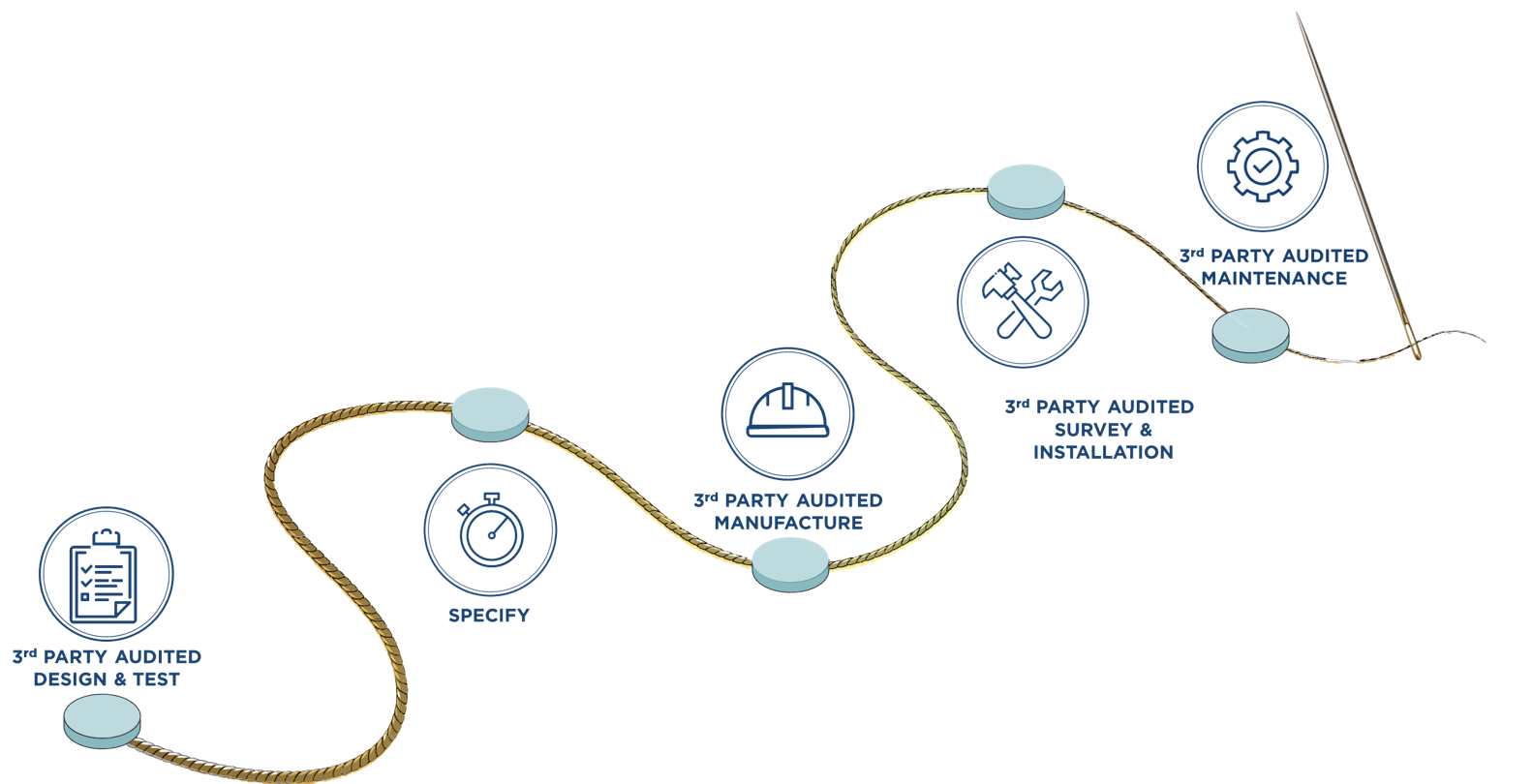
UKAS accredited third party auditing is not just required to verify test data for fire doors, it is a critical requirement throughout the ‘Golden Thread’ or lifecycle of a fire doorset. There are five key stages within the Golden Thread: design and test; specify; manufacture; survey and installation; and maintenance.
Design and test is the first stage of the Golden Thread and this is where the doorset is tested for fire resistance, smoke control and to PAS24 for enhanced security, both inside and outside. All the test reports are compiled and become a FoAP that shows all the variations and permitted parameters. Testing must be done with an independent UKAS accredited test house or laboratory.
A specification is then written which outlines the requirement of skills and other specifics required for each doorset. The specification stage must follow the Golden Thread and ensures every stage is third party audited to ensure test evidence is current and correct. The key purpose of the specification is to ensure the fire door set is consistent and compliant through manufacture, installation, and maintenance.
Next in the Golden Thread is the ‘manufacture’ stage; which is third party audited to ensure the fire doorset is consistently manufactured to the same standards as the test evidence and specification.
Survey and installation is conducted by a third party accredited installer with an additional system training to ensure consistency and clear understanding of the tested solutions specified. This then leads to ‘maintenance’ which is the final stage of the Golden Thread. It is mandatory that annual audits are carried out and undertaken by a third party audited and accredited company to ensure compliance throughout the life of the doorset. Any remedial work identified through annual or routine inspection should be related back to the original test evidence, so again we recommend training is provided throughout the golden thread.
Every stage from manufacturing, through survey and installation, annual inspection, and any remedial maintenance required must be third party audited. All of the stages within the Golden Thread refer back to the original design testing ensuring the correct components are being used to make or maintain a door.
To aid the understanding of the new requirements for a compliant fire doorset specification, Winkhaus has recently expanded its free training. The firm now offers three different levels of training which can be tailored to the audience to ensure it meets company / client requirements and we will even write your fire door set specification:
First option – This training provides an overview of the Golden Thread for fire doorsets, covering the requirements for a compliant doorset throughout its lifecycle. The five key stages in the lifecycle are covered from design and testing, specification, manufacture, survey, and installation through to inspection and maintenance.
Second option – This training module covers the fire doorset legislation which is the next level of data for those who need a more detailed understanding of the changes that have been made to legislation for fire doorset standards over the past few years. Topics covered include the latest legislation and guidance, testing requirements for the three critical fire doorset performances of Fire, Smoke and Security and third party auditing.
Third option – If you require a deeper understanding on legislation and guidance, need support in writing your specification or require further advice on compliance, we can arrange for a question-and-answer session with a member of our expert fire doorset team.
Both option one and option two can be presented as a formal CPD or informally without CPD certification.
For further information about our Fire, Smoke & Security doorset solutions, support with your fire door specifications or to register for our free training, please visit firetraining.winkhaus.com or email marketing@winkhaus.co.uk
Euralarm, the European association representing the electronic fire safety and security industry, has given feedback on the NLF. The association’s response to the questions of the European Commission were laid down in a Position Paper.
Euralarm says it remains convinced that the New Approach and the New Legislative Framework (NLF) are the best tools to support the free movement of goods and the proper functioning of the European Single Market for Goods. The NLF in its broad set-up is fit for purpose to deal with upcoming challenges through technological developments. Thus, Euralarm believes that changes should be made only in response to clear needs, within the existing framework.
Among the main benefits of the NLF Euralarm considers: strengthened coherence across different sectoral legislation, improved legal certainty, higher compliance levels, ease of compliance, improved level-playing field, strengthened CE marking use and functioning. When it comes to conformity assessments, Euralarm strongly believes that Module A, in combination with an effective market surveillance, provides a good and fair level playing field for manufacturers. The combination of modules (particularly the use of Module A, self-assessment), acceptable time to market and good market surveillance system is an essential element of the NLF and the most effective regime to preserve safety and the level-playing-field.
The introduction of the NLF has also been beneficial for SMEs in that it has opened the EU market to them, thanks to the use of hENs and module A. Having a stronger Single Market has further benefitted the global competitiveness of European industries and it has improved the speed of adoption of state-of-the-art technologies, as compared to the old approach. The NLF has set the basis for a strong market surveillance system, notably by providing for a Union framework for market surveillance comprising both competencies and obligations for national authorities and by organising effective administrative cooperation between these authorities on the one hand and with the EU Commission on the other hand.
In the Euralarm Position Paper Euralarm further explains its position towards CE marking itself, harmonised standards, conformity assessment procedures, notified bodies, the accreditation system and digitalisation of the information.
Based on this position, Euralarm believes that a full revision of the NLF might not be necessary to address problems with specific legislation.
Command Light, a leader in emergency vehicle lighting, has launched the all-new Trident Tripod. The lights can be powered by AC power, truck 12V DC or one of Command Light’s different non-proprietary battery options with Akron Revels, FRC Spectras, FireTech Helios, Whelen Pioneer Plus or a Feniex Arrow Stick.
“Our tripod is available in AC or DC models, but it’s our DC models that are really going to be a gamechanger in the market. It’s the first time in industry history that fire departments can pair a DeWalt FLEXVOLT, Makita XGT, Milwaukee M28 or HURST EWXT/E3 battery with a high-lumen LED made for the fireground,” Command Light President Roger Weinmeister explained.
“We really wanted to create a tripod that works with crews’ other battery-operated tools, all the while delivering even more light than the traditional tripod. We know that tripods aren’t new to the market, and yet we recognized that the choice in LEDs and power sources was always limited, so now, we’re changing that with the Command Light Trident.”
The Trident is available in 10 DC models and 8 AC models, depending on LED fixture. Each DC tower can be spec’ed with additional options, like shore power, 12V DC truck power and truck mounting brackets with disconnect.
Command Light’s tripod features a compact 50” collapsible design, weighing between 25-35 lbs. depending on model. When deployed and extended, the Trident Tripod features a 91” reach.
“Historically, Command Light has been known for its patented light tower, and while we still firmly believe every truck should be equipped with this important piece of equipment to properly illuminate a scene, we also know mobile lighting is important,” Weinmeister added. “Really, we just want to help crews get light where it’s needed most, whether that’s by setting up lighting near the victim or elevating, rotating and backlighting a large scene.”
The new tripod will be unveiled at FDIC International 2022 (Command Light Booth #3411).
Firms refusing to contribute to the fund set up to fix dangerous cladding will be warned they could be blocked from selling new homes, the Guardian has reported.
Michael Gove, the UKs levelling up secretary, will explicitly threaten retaliation, citing powers in the building safety bill that would stop uncooperative developers getting planning permission.
It is understood that Galliard Homes will be one of the major developers singled out as a potential target for the punitive measures, although other companies are also expected to be named by Gove.
Earlier this month Gove, who was tasked with addressing the cladding scandal – which has involved thousands of leaseholders facing crippling bills for the removal of dangerous cladding – signed an agreement with 35 developers, which collectively agreed to contribute £2bn towards fixing buildings they had a role in constructing.
Some developers did not sign up to this supposedly voluntary agreement, and Gove will this week ratchet up the pressure by reminding them that if they continue to refuse, they risk harsh sanctions under legislation about to become law.
The Building Safety Bill was introduced to create a new regulatory framework for building safety after the Grenfell Tower fire. But as it was going through its final stages in the House of Lords Gove introduced amendments that would give him the power to stop firms that have failed to sign his cladding pledge from selling homes.
Under the bill, these firms could be blocked from obtaining planning permission, or prevented from getting building control signoff.
Ministers believe that even the threat of these sanctions could be enough to deter investors. According to an internal document about the strategy seen by the Sunday Times, officials are arguing that it would be “irresponsible” not to warn prospective consumers of the potential risks.
Galliard is one of at least nine large developers that has yet to sign the Gove pledge. They are expected to be given just a few weeks more to comply. Galliard said at the weekend that it had acted quickly on cladding but that, before signing the pledge, it required “certainty” from the government and “a clear and succinct plan for developers, the government, the supply chain and insurers to all work together to find an equitable solution”.
Under the Gove plan, in addition to the £2bn from developers to fix their own buildings, the industry will commit a further £3bn for the removal of unsafe cladding through an expansion of the building safety levy, a charge on new residential buildings.
Under the current system, local authorities can impose section 106 agreements on developers telling them that, as a condition of getting permission, they must construct a certain number of affordable homes.
Gove wants to abandon these arrangements and instead force developers to contribute to an infrastructure fund that could be used by councils. In a recent white paper, the Department for Levelling Up, Housing & Communities argued that a new approach was needed because the current system “enables some developers to benefit disproportionately and unfairly from the land they develop”.
Super Vac, one of the leading manufacturers in fire ventilation equipment, will showcase an unmanned misting turbine by EmiControls in its booth at FDIC International 2022 (Booth #3417).
The robotic fan features a water mist system that atomizes water and extinguishing foam into a fine mist before propelling it up to 300 feet with Quadrijet nozzles and turbine propeller. The fan can be maneuvered an additional 1,000 feet toward the hazard thanks to advance remote controls, making these turbines the ultimate unmanned firefighting fans for chemical operations, tunnel systems, subway shafts, recycling plants and urban areas.
The fan’s water misting system includes 40 turbine-ring Quadrijet nozzles, which provides up to 400 gpm of water, and a powerful turbine propeller, which combines 25kW power with a polymer blade to deliver 35,000 cfm. An integrated Akron nozzle (or brand of choice) produces up to 1,200 gpm that can be propelled up to 300 ft. with remote adjustable pattern. In addition to its misting capabilities, the turbine is also highly maneuverable. The robot can tilt
19-degrees down and 43-degrees up, while the turntable features 362 degrees of rotation. The design can also fit into parking garages as low as 80” while having the ability to raise an additional 67”. This large industrial fan can be mounted on tracks, trailer or truck.
When mounted to the crawler tracks, the robotic fan can navigate harsh terrain, 30-degree inclines and 15-degree traverses with the mobile unit’s 71HP Kubota diesel engine. A number of optional features can be added to the firefighting robot, including forklift, railway wheels, camera kit, remote winch, air duct hose, ground-sweep nozzles and web-based GPS.
“We’re excited to partner with EmiControls so that we could bring this firefighting robot to the United States market,” Super Vac President Roger Weinmeister said. “This fan is a great addition to our large-scale PPV lineup, which includes 30”, 48” and 80” industrial fans, all designed for ventilating large structures. At Super Vac, we know every ventilation scenario is different, so we pride ourselves in this addition because we know it’s important to offer a wide variety of tools to get the job done.”
Ferrara Fire Apparatus, Inc., a subsidiary of REV Group and a manufacturer of custom built, heavy-duty fire apparatus, announces the addition of R&R Fire Truck Repair to its nationwide dealer network.
R&R Fire Truck Repair, Inc. has added the Ferrara product line at its full-service centers in Northville, MI with service technicians located in LaSalle and Alpena. Established in 1992, the modern facility offers sales, service, parts, repairs and more. R&R has been serving the fire apparatus and emergency vehicle industry for 30 years.
“We are excited to bring the Ferrara product line to the Michigan fire service and support the apparatus with parts and service,” said Rick Roselle, Vice President of R&R Fire Truck Repair.
“R&R brings a wealth of knowledge with their many years of experience. We are delighted they are our partner in the great state of Michigan,” said Jason Louque, Director of Sales, Ferrara.
The company is also a Spartan Emergency Response and Smeal dealer for Michigan, both REV Group subsidiaries.
Independent Fire Training Ltd.’s range of fire training courses have been tailored to varying levels of experience and training outcomes, Ben Freeman talks to IFSJ
Fire safety has never been more of a focus than it is currently within facilities, construction, and maintenance. It is at the forefront of media following the unnecessary loss of life at the Grenfell Tower and further-more in relation to the subsequent ongoing enquiry.
Independent Fire Training Ltd (IFI) are passionate about developing knowledge and competency to ensure that the buildings of the future are safer than the past.
Fire doorsets, their importance and compliance has been a focus point for discussion and opinion in the Fire Safety Industry recently. Brought to the attention of the world following the tragedies at Grenfell and the failures in compartmentation, the importance of fire doors in life safety has never been more relevant.
The purpose of fire doorsets is to restrict the spread of fire and smoke by maintaining the fire separation of compartmentation, to protect escape routes and to restrict the initial development of fire. Fire resisting doorsets are generally required along escape routes, staircases, at the principal entrance to flats and in locations where fires are expected to occur. A fire doorset and its importance is often overlooked, and that is why it is paramount that fire door training isn’t just limited to those people within the industry who are looking to develop their wealth of knowledge and is made more accessible to the wider audience.
It is important to recognise that not all candidates require the same level of training. Many will not require to become a Fire Door Inspector but do need to understand the properties of a fire doorset and the tell-tale signs of a poor installation or maintenance. Those candidates who are manufacturing, installing, maintaining, repairing, and inspecting fire doorsets should be held to a higher standard of training.
IFI pride themselves on providing a range of courses suitable for varying levels of experience and training outcomes, assisting the varying levels of candidate looking to continue their professional development and support competency within the industry.
The company’s fire doorset training portfolio includes a variety of training formats such as classroom-based, e-Learning and virtual training to suit any training preference and availability. The classroom-based courses include the Level 3 Award in the Inspection and Testing of Fire Resisting Door Installations (a formal inspection qualification), Timber Fire Doorsets and Fire Door Maintenance & Repair Modules with options for additional practical on-site training, and the BWF Fire Door Installation and Awareness Course. Recently launched, The Fire Doorset Inspection Course is an e-Learning training option.
Training courses dates are pre-booked for throughout 2022 and any candidate can join these courses by contacting the Training team to reserve their place. IFI also conducts training for clients at a site of their choosing for groups of candidates where this is more suitable.
The Level 3 Award in the Inspection and Testing of Fire Resisting Door Installation offers a formal qualification in the inspection of fire doorsets. This is a ProQual qualification regulated by Ofqual, the governments office for examination and qualifications. The qualification is best suited to site managers, supervisors, inspectors and to anyone else who works directly with fire doors. However, one of the major benefits of this qualification is that a 3-day theory and practical course is ran prior to their respective assessments which details all the information and knowledge required for the assessment. For those candidates lacking prior experience and learning with inspecting fire resisting doorsets, the Fire Doorset Inspection e-Learning Course will provide a comprehensive foundation of knowledge to enable them to progress to the qualification in the future.
Launched in March 2022, The Fire Doorset Inspection e-Learning Course is the newest addition to IFI.’s course portfolio. This course was developed in response to the ever-increasing demand for comprehensive fire doorset training. This would include key topics such as inspection, installation, maintenance, specification and testing but in a more accessible format. This course also consolidates the importance of a fire doorset and its upkeep with in-depth information on the Building Regulations and associated legislation that is specific to fire doors. A major benefit of this course is that once purchased, the candidate will have access to the training material via the Independent Fire Training website for 3 years, allowing them to refer to the course material as required. This e-Learning course is accredited by the Institute of Fire Safety Managers (IFSM), meaning a well-respected and recognised body within the Fire Safety Industry has reviewed the course content and are happy that it is up to a standard that they approve of.
It is important to mention that IFI’s trainers and assessors are Senior Fire Door and Fire Stopping Inspectors by trade, meaning that the training is being delivered by an expert within the industry and allows delegates to ask specific questions and promotes a wealth of active discussion throughout the training.
IFI is a registered delivery centre of the National Open College Network (NOCN) an Ofqual regulated Awarding Organisation and licensed by the British Woodworking Federation (BWF). As an approved NOCN training provider IFI are approved to deliver the SiteRight assured BWF Fire Door Installation Awareness 2-day course. The course has been developed in collaboration between NOCN Group and the British Woodworking Federation to promote awareness in the construction and manufacturing industries of the factors involved in the appropriate installation of timber fire doors and doors sets. IFI hold this course publicly at a central location throughout the year and it can also be delivered at a customer’s premises for a minimum number of participants.
IFI take fire doorset training very seriously and aim to make their training accessible to everyone. By providing top quality, recognised and accredited training IFI ensure that they uphold the integrity that should be seen across the industry. All training courses are continually reviewed and amended in line with current best practice, Building Regulations, and associated Legislation.
IFI’s overall course portfolio covers all aspects of passive fire protection, such as fire stopping, cavity barriers, linear gap seals, structural steel protection, fire rated partitions and ceilings, fire dampers and fire rated ductwork and many other courses at varying levels of expertise.
IFI are committed to maintaining the integrity of the industry and the high standards outlined Regulation and Legislation. IFI makes a promise to stay current within this developing industry so that everyone taking part in our training receives informative relevant learning and excellent service.
Ben Freeman, MD, IFI Group Ltd and Founder of IFI says; “As a leading training provider, our focus is on increasing the knowledge and competency of all those who are involved in the delivery and management of fire safety within buildings. We ensure that our training is fit for purpose regardless of what level of experience the training is aimed at and deliver training that covers varying levels of expertise. We work in an industry where you can certainly be under qualified, but never overqualified.”
For further information around the courses available, please contact info@thefiretraining.co.uk or visit our website for further details.
This Heather Schafer Memorial Scholarship is set to recognise exemplary emerging leaders in public safety who are committed to improving the fire and emergency services in the areas of health, safety, recruitment and retention, department culture, and emergency response. Four recipients will each receive up to $1,500 to attend one of the NVFC’s training conferences in 2022.
This scholarship honors the legacy of longtime NVFC CEO Heather Schafer and is designed to assist the recipient’s professional growth as an emergency volunteer fire and emergency service leader through educational and networking opportunities offered through the NVFC’s training events and conferences.
Candidates must have made an exemplary impact at their local level by demonstrating leadership in one of the following ways:
Promoting and supporting projects or activities that have positively impacted health and safety within their department.
Assisting in the development of a sound recruitment/retention plan for their department or region.
Participating in actions or activities that have measurably improved the emergency response capability of their department.
Contributed to an innovative solution that has improved the culture of the department in ways that relate to improved health, safety, recruitment and/or retention, and emergency response.
The scholarship covers the cost of the registration fee, airfare (or mileage), meals, and lodging, up to $1,500, to a designated NVFC training event. In 2022, two scholarships will be awarded for the Health & Safety Training Summit and two scholarships will be awarded for the Recruitment and Retention Experience.
Eligible candidates must meet the following criteria:
Candidate must be 18 or older.
Candidate must be a member of the National Volunteer Fire Council.
Candidate must be an active volunteer fire or emergency service responder or have served a significant role in the volunteer fire and emergency service community.
A candidate for the Heather Schafer Memorial Scholarship cannot nominate him/herself. An application must be submitted by an individual who possesses a strong understanding of the candidate’s contributions to the fire and emergency services at their local level.
Candidate cannot be a previous recipient of the Heather Schafer Memorial Scholarship.
Nominations for the Heather Schafer Memorial Scholarship should be submitted online and include:
Letter of Nomination: The nomination letter must demonstrate how the actions or achievements of the candidate have made an exemplary, positive impact at the local level in advancing the capabilities of the department in health, safety, recruitment, retention, department culture, or emergency response. This statement should focus on specific activities and outcomes, including metrics when available, and specifically address the scholarship goals that are met by this candidate. Max length: 1000 words.
Letter of Support: A letter of support signed by the department president and/or chief is required.
Additional Materials (optional): Accompanying materials, such as additional letters of support, can be included in the application; however, the selection committee will place special emphasis on the aforementioned letters of nomination and support, which should convey how the candidate’s contributions have addressed any of the four goals described above.
Martin Joosen, Managing Director EMEA, Lion EMEA sheds light on the company’s roots, and the latest trends in fire training.
Tell us a bit of Lion, and how you’ll got to where you are in the market as a fire training specialist.
Lion EMEA was a Dutch company formed 30 years ago, we were founded by firefighter for firefighters. The mission was to offer better products and training scenarios. The desire was born out of the fact that the founder, Jac Haagen, was not happy with the quality of the smoke generators that were being using used, which were like the ones used in theatres / night clubs. He created his own products, small generators to begin with.
We then progressed, sold our products to other fire brigades in the Netherlands, followed by Belgium, France, UK, Germany. Eventually, we got into the Middle East and into the USA. In 2012, we were bought by the Lion Group, which gave them the opportunity to broaden their portfolio beyond PPE. The benefits of the takeover were mutual, giving us the opportunity to expand as well. Lion also bought one of our competitors in America, that continues to provide training products in the USA.
How did the takeover benefit Lion’s operations?
The takeover allowed us to grow our footprint, we were able to attract larger projects. Along with our purpose-built firehouses and containers, we were able to build complete fire training skyscrapers in Shanghai and Melbourne. These are fully functional buildings, residential / office blocks whose sole purpose is to be set on fire.
The facility in Melbourne includes scenarios that replicate everything that can catch fire such as a boat, car, helicopter, building, and a house. We are the biggest company in the market in our sector. We offer everything from the smallest training products, such as smoke generators and fire trainers, to delivering training centres.
Since our centres involve burning gas, wood, and other components it requires the highest standard of maintenance. Ultimately, the training we impart is lifesaving in critical situations, which is paramount to firefighters and the industry. Well imparted training makes all the difference in critical situations where lives and property are at risk.
The EMEA is a massive region, what are a few complexities of the different regions?
Absolutely, the Europe Midde East and Africa is a broad region. The European market is different from the Middle East or Asia for that matter. Meanwhile the African market is still developing, and we are not there yet in terms of competition. We have an appetite to increase our market share in all these regions, but it needs to be done strategically, without loss of quality or standards.
When we talk about our competition in the market, there aren’t too many companies that offer what we do. Some of our peers, for instance, cater to a specific market segment.
Ultimately, in the fire training business it all comes down to the expertise of a company. The trainers you employ, methods and techniques they use, and standards we follow. For example, our competitors might focus on smoke generators in sewage extraction or night clubs, which is their remit. On the other hand, we are one of the only companies that’s looks at it from a firefighter’s point of view, and not from a product perspective.
To what extent are Lion’s training regiments customisable?
We always start with a blank canvas and paint the picture with our clients. We have more than 30 years expertise in the field, we are able to offer insight at different points throughout the journey. We want to be in a position, where we handover the keys to a client and they can get started straight away.
Tell us about your other training facilities.
Fire departments have a different thinking process across different regions. Each country tends to have its own set of training requirements. We don’t have many projects (in Europe) the size of our China or Australia facilities. We have several smaller purpose-built training facilities based on container systems, or a firehouse, kitted out to the requirements of the client. The most recent one was a facility we set up in Cardiff, Wales. A firehouse can be purpose built to any fire technology required by the client, wood, or gas fires, and so forth.
What costs are involved in building training facilities?
A fire training facility is resource intensive, after all we are burning critical components and resources, then you need to consider rising costs of natural gas and other non-renewable materials. You also need to go through the props that will catch fire for a period of 45 minutes. The costs tend to stack up a fair bit.
Before training, we need to decide whether we are going to train in the defence or attack of firefighting or tracking fire dynamics. In Western Europe, clients are extremely precise about each training facility, geared to tackle each vertical within the industry. In France, there are approximately 95 to 99 fire departments, and we are present in 80 of them. Each region tends to have its own training facilities, which are based on the budget of their councils.
Martin Joosen.
How receptive is the market in general towards making new investments?
Budgets constraints usually impact negatively on training-related spends. Clients tend to invest more in PPE protection, which is critical because you need to have good tools for intervention and rescue. However, if firefighters are better trained, which also means better techniques to equipment, it would lead to saving a lot more lives. Compromising on training can be fatal.
For instance, with the tragic Thailand bus disaster in 2018; there was a lack of training to rescue people from that situation. In the aftermath, within six months of the incident, authorities set up a bus simulator to help stay prepared.
It’s a paradox when there are no catastrophes it’s hard to justify expenses towards training. On the flip side, without adequate training the results of an accident could be a lot worse. Slashing training budgets could also lead to more expenses in the form of compensations, use of hospital resources, and so forth.
What new techniques are being introduced in firefighting?
We are incorporating digital technology in our training centres. We have introduced screens within the training centres, along with sensory devices such as heat and smoke generators to replicate an emergency scenario. Having said that, these additions are nothing more than training aides for firefighters, which will never replace traditional techniques. That’s something we want to assure your readers. We are cautious when adding new technology to our facilities. It does have its benefits, they go a long way in helping firefighters drill repeat scenarios, helping them create muscle memory to specific situations.
On one hand veteran firefighters love to deal with the actual fire, replicating the stress and tension of an emergency. This is also extremely important for newly qualified fire fighters as they need to experience 1,000 degrees Celsius environments where it’s nearly impossible to humanly function. It’s a fine balancing act to get the best training, in the most effective way.
What new products are you’ll working on to meet different requirements?
We will launch a range of seven fully customisable container systems, which can be easily transported on site, and ready for use. Due to the high costs, it’s also important that our client’s get maximum ROI. Our containers and fire houses usually last for about 10 years, which is industry benchmark, which is a tried and tested tenure from our side. A few of our customers train in a London facility that has been in operation non-stop, day-after-day for more than 10 years. That’s testament to the quality and ingenuity of our products.
Tell us about your initiatives to make your offerings more environment friendly.
Burning non-renewable resources such as natural gas and wood are not the best for the environment, and we are extremely conscious about that. We try our best and use eco-friendly materials wherever we can. The inherent nature of fire means it’s always going to be a challenge to cut down on the pollution created by burning different components. That’s where our digital and technological offerings play a huge part.