Dräger calls for increased use of fire escape hoods in evacuation safety.

Dräger, an international leader in the fields of medical and safety technology, is calling for fire escape hoods to become part of any fire safety plan where evacuation takes more than a couple of minutes – including educational facilities, hospitals, hotels and high-rise buildings.

Fire escape hoods are designed to provide wearers with crucial minutes of protection from fire-related vapours, particles and gases, including carbon-monoxide. Dräger’s PARAT smoke hood range provide wearers with up to 15 minutes of protection.  According to the UK Government, nearly one in three (30%) of fire-related fatalities are the result of being ‘overcome by gas or smoke’[1], which makes fumes a fire’s most deadly killer.

Dräger therefore believes it is essential that fire escape hoods are used as a supplementary support to other fire safety evacuation measures, e.g., fire doors and disabled refuge areas.

Indeed, the Fire Door Inspection Scheme (FDIS) recently found in a study of more than 100,000 fire door inspections that three in four, or 75% of all fire doors failed to meet required standards[2]. Buildings that had the highest number of fire door inspection failures included healthcare buildings, local authorities and housing associations, and private housing, but across the board the research supports the need for supplementary fire safety measures.

Ian Gil-Rodriguez of Dräger Safety UK says the Industry has a responsibility to promote the increased use of fire escape hoods “The fact that Fire and Rescue Services globally and in the UK are now using fire escape hoods is evidence of their critical importance,” he says. “Our Industry needs to come together and join forces to push this change, for the good of public safety. Fire Escape Hoods should be a standard component of evacuation plans, a complementary part of the complicated puzzle, as opposed to a standalone solution.”

For more information on Dräger or its product offering, please visit www.draeger.com  

[1] https://www.gov.uk/government/statistics/detailed-analysis-of-fires-attended-by-fire-and-rescue-services-england-april-2021-to-march-2022/detailed-analysis-of-fires-attended-by-fire-and-rescue-services-england-april-2021-to-march-2022#:~:text=2.4%20Causes%20of%20deaths%20and%20injuries&text=In%20the%20year%20ending%20March%202022%2C%20where%20known%2C%20the%20most,of%20fire%2Drelated%20fatalities).

[2] https://www.ifsecglobal.com/fire-news/three-quarters-of-fire-doors-fail-inspections-according-to-fdis/

IAFF marks Fire Fighter Cancer Awareness Month

The International Association of Fire Fighters (IAFF) has marked Fire Fighter Cancer Awareness Month by raising awareness of the risk of occupational cancer among firefighters.

At the 2022 IAFF Fallen Fire Fighter Memorial, almost three quarters of the names added (348 out of 469) were of members who had died from occupational cancer.

In partnership with the Firefighter Cancer Support Network (FCSN), the IAFF has designated January as Fire Fighter Cancer Awareness Month to provide fire fighters the necessary tools and guidance to develop life-saving protocols for cancer prevention and to support those with a cancer diagnosis within their departments.

The IAFF said it hopes bringing increased public awareness to occupational cancer in the fire service will help generate greater legislative support for states and provinces to establish presumptive disabilities for all cancers affecting fire fighters.

The association has created an online resource designed to educate IAFF leaders, members, and their fire departments on why fire fighters are getting cancer and provide best practices on how to limit day-to-day exposures to carcinogens.

Each week will focus on a specific theme with the aim that by the end of January, members, locals, and fire departments will have the knowledge and resources to understand how fire fighters are exposed to carcinogens, what happens when they are exposed, how to prevent exposures, make culture changes in their department, and assist those who are diagnosed with cancer.

IAFF said: “All resources are available to review at your convenience, but we encourage you to hold a weekly safety stand down in your department. In addition to weekly content, the training briefs should be used as discussion tools to educate fire fighters on reducing the risk of occupational cancer.

“Fire Fighter Cancer Awareness Month takes place in January, but these resources can be shared throughout the year. We encourage you to check back frequently for more information about specific topics.”

Average fire response times in England rise by 15 seconds

Official Statistics containing detailed analysis of response times to fires attended by fire and rescue services: England, April 2021 to March 2022 have revealed that fire response times have increased by 15 seconds.

According to the statistics, the average response time to primary fires in the year ending March 2022 was 8 minutes and 50 seconds: an increase of 15 seconds compared with the year ending March 2021. The largest component was drive time which increased by 17 seconds to 5 minutes 55 seconds.

All primary fire types showed an increase in average response times – dwellings by 16 seconds, other buildings by 13 seconds, road vehicles by 21 seconds and outdoor primary fires (by far the smallest category of primary fire) by 9 seconds

The average total response time to secondary fires (which can broadly be thought of as smaller outdoor fires, not involving people or property) in England decreased by 10 seconds, compared with the year ending March 2021, to 9 minutes and 13 seconds

Overall, response times to fires increased gradually between the year ending March 1995 and year ending March 2015. There was then a plateau at around 8 minutes and 40 seconds from the year ending March 2015 to the year ending March 2018. Every year since response times have increased except from the year ending March 2021, where drive times decreased probably due to decreased traffic levels due to COVID-19 lockdowns.

The average total response time to primary fires in year ending March 2022 was 8 minutes and 50 seconds, an increase of 47 seconds over the past decade, and an increase of 12 seconds in the past 5 years – the pattern across different types of fire was varied

Portugal to invest €250 million in firefighting in 2023

Portugal’s Minister of Internal Affairs, José Luís Carneiro, has reaffirmed that the Government will invest €250 million euros in preventing and fighting fires in 2023.

Speaking to local media, Carneiro said that all climate and meteorological forecasts point to an even more demanding 2023 and 2024 which will mean a likely increase in extreme fire events.

“We cannot wait for April, May, or June”, he warned, explaining that public investment planned in this area for next year is part of the “national effort” assumed by António Costa’s executive. The Minister of Internal Administration said it is important ‘to work on prevention well in advance’.

“There are more than 250 million euros that illustrate well the support of this Government to firefighters and the priority given to preventing and fighting rural fires”, Carneiro added.

He said that 52.7 million euros are likely to be allocated the Special Device for Combating Rural Fires (DECIR) and added: “The Portuguese Government will continue, in 2023, to pursue a path of strengthening the means for civil protection. We are going to go from 29.7 million euros of permanent funding to fire brigades to 31.7 million euros, which means an increase of 6.7% compared to 2022.”

Exclusive: The WFCA is putting wildfire on the map

Take an inside look at the Western Fire Chiefs Association’s new Fire Map which provides near real-time information about active wildfires

Whilst they are no new phenomenon, with the number of wildfires increasing across the world the danger is closer to home for many. The mounting wildfire crisis in the US presents a very real and significant danger to people, homes, and communities – particularly those in wildfire urban interface settings.

Fires are most likely to take hold when moisture levels and humidity are low and temperatures are high. These conditions can be exacerbated by climate change and when environmental conditions reach a certain threshold in terms of available fuel and dryness, the risk of intense and dangerous fires can increase quickly. In response to the rising temperatures and increased risk of fire the Western Fire Chiefs Association (WFCA) introduces its Fire Map to provide near real-time information about active wildfires.

The WFCA Fire Map pulls data from the US Forest Service via National Interagency Fire Centre IRWIN feed and 911 Dispatch data via PulsePoint to track the location of the wildfire as they start and while they are burning. The WFCA Fire Map is the first map of its kind to pull this data from 911 Dispatch in relevant areas.

“The current climate situation is incredibly scary,” says Chief Mark Niemeyer, Vice President of the WFCA and Fire Chief of the Boise Fire Department. “The WFCA is providing public access to definitive information around the paths of wildfires so that communities can quickly take action.”

He continues: “The WFCA is committed to provide an even deeper level of intelligence around wildfires as they happen.” As the WFCA looks to the future, it is creating a development path in the next year which will include 3D and predictive mapping models, air quality and weather data, as well as text message notifications.

The Fire Map

The WFCA Fire Map was launched to provide near real-time information about active wildfires in a mobile[1]friendly platform. Brent VanKeulen, Deputy Director of the Western Fire Chiefs Association says the WFCA is providing the map to everyone free of cost, as a resource to save lives, land and property. He explains: “By providing public access to definitive information around the paths of wildfires, we are hopeful that communities can take quicker action to stay safe.”

 The WFCA Fire Map pulls together data supplied by the US Forest Service via National Interagency Fire Center IRWIN feed and combines it with 911 Dispatch data via PulsePoint. Together, this information is used to track the location of the wildfire both as it starts and whilst it is burning.

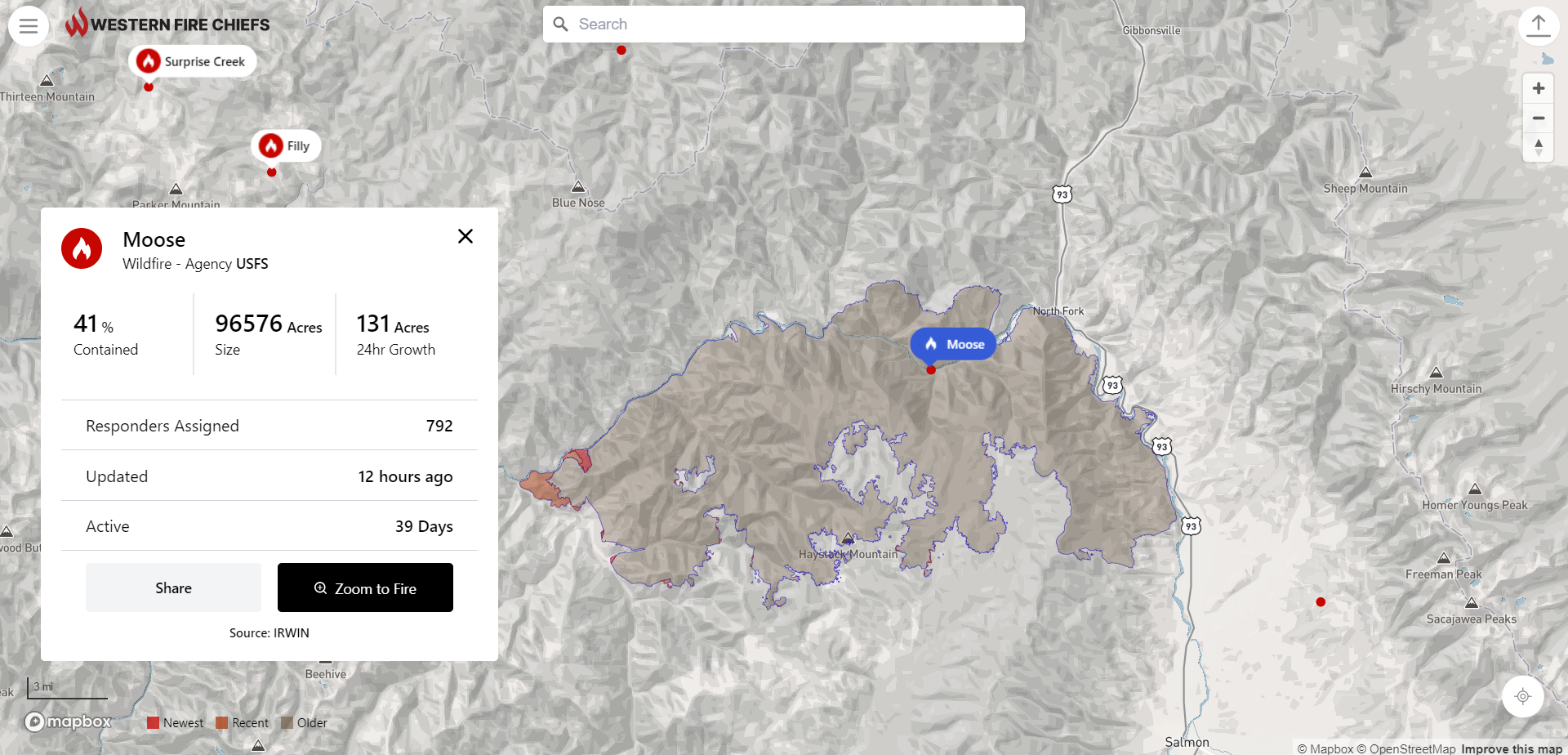
 The fire map was developed by Gartrell Group for the WFCA. Users can search for a fire by name, zoom to a location or zoom to their location and explore the area nearby. Where larger fires are mapped these will display the perimeter as changes are reported. Along with the map visualisation, the app provides details including fire size in acres, 24-hour growth, percent containment, number of personnel assigned, how long the fire has been active, and when the information was last updated.

The app features a share button and clicking this allows users to easily share information about a fire. There is also an embed option to link to a live map of the McKinney Fire. Users can click the fire symbol on the map to view information about the fire, and to share to social media. Other features such as weather and wind information are in the pipeline.

Looking ahead, the fire map in its current state is just the beginning. VanKeulen adds: “Wildfires will be a part of our lives for the foreseeable future. We will always have areas where people live in the forest. We need to focus on building adaptive communities so that we can be safe in the presence of fires. The WFCA and many other organizations are working towards solutions that help us adapt. The fire map is one of several initiatives.

PulsePoint

PulsePoint is a 501(c)(3) public non-profit foundation building applications created to help public safety agencies inform and engage their citizens. The development of the PulsePoint app began in June 2009 as a partnership between the San Ramon Valley Fire Protection District (SRVFPD), where its founder Richard Price was the chief, and the College of Informatics at Northern Kentucky University (NKU).

The application was released in the Apple App Store in April 2010. At a meeting almost a year later the Board of Directors of the San Ramon Valley Fire Protection District established a committee to address the affairs related to the application, including the transfer of responsibility for the software to an independent and external non-profit foundation. This resulted in the formation of the PulsePoint Foundation to oversee the future direction of the application.

In September 2013 the PulsePoint Foundation entered into a strategic partnership with Physio-Control, Inc. to expand the availability of PulsePoint to public safety agencies and on January 1, 2017, these responsibilities transitioned back to the foundation. Physio-Control became an invaluable partner that helped establish a presence in the market and helped prove the value of using mobile technology to activate early bystander response in sudden cardiac emergencies.

As the WFCA looks to the future, it is creating a development path in the next year which will include 3D and predictive mapping models, air quality and weather data, as well as text message notifications. “The addition of text notifications will be a game changer.” Richard Price, Founder PulsePoint.

“We are excited to offer the opportunity for PulsePoint[1]connected agencies to seamlessly display fire incidents within the WFCA Fire Map.”

This article was originally published in the September edition of IFSJ. To read your FREE digital copy, click here.
Exclusive: The Rural Firefighting Challenge

Joel Wright, President and Co-Owner at FOL-DA-TANK, speaks exclusively with IFSJ about the company’s portable water tanks and the challenge to supply water for firefighting in rural areas.

Manufacturer of portable water tanks and tank accessories for firefighters and environmental first responders, FOL-DA-TANK, was founded in 1954. Its founder Giles Eldred worked in the business loan department of a small bank in Rock Island, Illinois, in the early 1950s, when he met a customer who was applying for a loan to start a company that repaired fire trucks.

In the conversations that Eldred had with this customer regarding the firefighting industry, the issue of providing water was a common topic. In some rural areas where fire hydrants were not available, firefighters were staging water in temporary water reservoirs fashioned out of extension ladders tied together in a square with a canvas tarp draped over them.

The problem faced by these emergency responders stuck in Eldred’s mind, and he began to wonder if there was a more efficient way to create a temporary water storage container. One day, when he was folding his daughter’s playpen, he got the idea for a folding tank that could easily be stored on a ladder rack in a fire truck. He started the company under the name FOL-DA-TANK.

After 68 years in business, the company makes several styles of portable water tanks and specialty water moving strainers and fittings needed to move large volumes of water at rural structural and remote wildland fire scenes. IFSJ caught up with Joel Wright, FOL-DA-TANK’s President and Co-Owner to discuss the rural firefighting challenge that is water supply.

Prior to acquiring FOL-DA-TANK in 2020, Wright was the CEO of MoboTrex, Inc. which manufactures and distributes equipment for traffic signal intersections throughout North America. “My engineering background and early career experiences as a project manager and process engineer formed my foundation for the leadership and business skills I have built throughout my career,” Wright tells.

Wildland firefighting

Mobile water supply systems assist rural, structural and remote wildland firefighters by containing water at the fire scene. Rural structure fires are often miles from the nearest hydrant and tankers cannot carry enough water to extinguish a large fire. Instead, portable drop tanks need to supplement the water supply which can be refilled by shuttle tankers. A growing issue is that remote wildland fires are fast moving and far away from municipal water sources.

“A recent use case involves protecting high voltage transmission lines in a remote and mountainous area of Utah with nearby wildfires,” tells Wright. “The power company purchased several 1360-litre helicopter tanks which will be flown full of water directly to a staging area near each tower. Crews will use the water to create a fire line around the tower thus protecting it from damage. As the fire moves, the tanks can be re-filled and staged at towers where the fire may potentially burn.”

As rural fire departments are staffed by volunteers who have regular fulltime jobs, he points out that finding time to train volunteers on the best practices for complicated fire trucks and the related mobile water supply equipment is a huge challenge for the industry: “Manufacturers are always on the lookout for ways to add value by making the equipment easier and safer to use. “One thing FOL-DA-TANK has invested in recently is creating ‘how-to’ videos for the products we manufacture,” he says.

Rural concerns

Rural settings often have narrow roads and other limiting space constraints which is why FOL-DATANK offers a single lane tank kit for use in these locations. “The standard single lane tank is rectangular in shape compared to the original square folding frame tanks,” describes Wright. “A 9500-liter tank is typically 4m by 4m square whereas our diamond shaped second generation single lane tank is 6.7m long by 2.4m wide.

“The 1.6m width savings clears valuable roadway allowing emergency vehicles to pass in and out of the fire scene. Single lane tank users couple the tank with an aluminium 90 degree elbow attached to the suction inlet on the fire truck and to a hard suction hose which runs to the single lane tank.

“The hard suction hose is connected to a low-level drafting system permanently mounted to the tank. The flange mount plate is designed to stabilise the inner/outer flange set. The plate mounts to the tank frame and the flange set goes through the tank wall. Inside the tank and fastened to the inner flange is a low flow strainer which can maintain maximum pumping capacity down to 40mm-50mm water depth.”

Increasing fire activity

Global demand for mobile water supply systems is on the rise because of an increase in wildfires and the desire to protect land and property. The length of the annual fire weather season has increased on average globally as has the frequency of days with extreme fire. While hotter, dryer weather can facilitate increased fire activity, human fire management policy of past decades is also a root cause.

Wright says that land use, fire mitigation and prevention policies have increased the fuel available for wildfires causing them to burn hotter and over larger areas. “As we learned at Interschutz, truck builders outside of North America are just beginning to offer auxiliary water tanks on new truck builds,” he says. “Firefighters in Europe who visited our stand were eager to understand how this system could deliver more water to rural structure fire scenes. We expect international growth as the word spreads.”

Driving innovation

When FOL-DA-TANK was purchased from the founding family in late 2020, Wright says the new owners and management team brought some fresh perspective. “As we were meeting customers, conversations naturally led to stories about how our products were used and what worked well and what didn’t. We made a series of improvements to our original folding frame tank design including: the Rapid Release mechanism; Hi-Vis drain sleeves, the Jumbo Drain; and the flange mount plate.”

The Rapid Release mechanism is a slim profile device built into the tank frame. It firmly holds the drain sleeve in place and releases easily with one swift motion. “It was important to firefighters that this mechanism could be operated with gloves on,” he explains. “Hi-Vis drain sleeves are made from the same heavy duty PVC vinyl as the tank liner, but with a contrasting color. The problem solved is much better visibility at night.”

FOL-DA-TANK’s jumbo drains are bigger versions of its standard drain sleeves and drain leftover water from the tank six times faster than the standard size sleeve. “This can be vital in grass fires when a wind shift demands a fast relocation of equipment,” says Wright. “The flange mount plate is a permanent through wall flange set on a folding frame tank. The device connects two tanks or a low flow strainer which eliminates running a hard suction hose over the tank frame.”

Looking ahead

Since the ownership transition and changes in management took place in November 2020, Wright says that FOL-DA-TANK has focused on three areas in our core firefighting market: providing reliable supply; winning at the point of sale; and driving demand for innovation.

“One of our favourite success stories is reducing lead time from 45 days to less than 10 days and then sustaining it for 10 consecutive months so far,” he tells. “Another is the introduction of our Rapid Release mechanism for the drain sleeves on frame tanks. The device has been very well received by experienced firefighters who have used our products for decades.”

On future plans, he reveals this includes growth through acquisition into the first responder market: “We have an excellent operating team and manufacturing infrastructure with capacity to do more. Our ideal target is to purchase a company that manufactures lose equipment sold through our existing distributor network.”

Finally, Wright talks about the importance of durability and functionality, something he says the company’s founder understood well when he first designed the folding frame tanks. “A nearby customer recently replaced their department’s two 30-year-old tanks which were still functioning but in need of patches and other repairs,” he tells.

“While the local government was thankful the tanks had outlasted the original fire trucks on which they were originally supplied, the fire chief was even more appreciative of the design enhancements made over the 30 years.

“He liked the new Rapid Release mechanism for the drain sleeves, hinge guards at the pinch points on the frame, lift handles in the liner to move residual water to the drains, and our hi-vis drain sleeves made from contrasting colours of vinyl. FOL-DATANK has a solid design concept and culture of innovation. We welcome the voice of the customer and are thrilled when our team makes improvements to an already outstanding product.”

This article was originally published in the September edition of IFSJ. To read your FREE digital copy, click here.

UK firefighters considering strike action over real-terms pay cut

Firefighters and firefighter control staff are preparing for a ballot for strike action, following consultation in Fire Brigade Union branches and a meeting of the union’s executive council which was held on 2 September. 

The decision follows firefighters and firefighter control staff receiving a 2% annual pay offer on 27 June, which has not been increased despite union representations to multiple parties. The Fire Brigades Union pointed out that inflation has been measured at 10.1%, meaning that such a pay offer represents a significant real-terms pay cut. 

The aim is for the ballot to be held in five weeks’ time. 

Matt Wrack, general secretary of the Fire Brigades Union, said: “Taking strike action is always a last resort. But our employers are increasingly leaving us with no choice. And there is huge anger among firefighters at falling pay. 

“Firefighters must be paid fairly: there is absolutely no question when it comes to this. It is the responsibility of fire service employers to provide decent pay offers and that has not happened.

“The ball is now in the fire service employers’ court. It is not too late for them to make a much better pay offer for consideration by our members.”

NVFC awarded grant from Motorola Solutions Foundation

The National Volunteer Fire Council (NVFC), the association representing the volunteer fire, emergency medical, and rescue services, has received a grant for $25,000 from the Motorola Solutions Foundation, the charitable arm of Motorola Solutions.

This is the seventh consecutive grant the NVFC has received from the Motorola Solutions Foundation to support training initiatives.

NVFC has said it will use the grant to prepare first responders across the US to serve their communities in a safer, more efficient manner through online and in-person training courses.

The grant will enable the NVFC to develop a new course as well as offer existing courses in its catalogue for free to the volunteer emergency services community. The training covers critical topics including health, safety, preparedness, leadership development, and retention and recruitment, among others.

NVFC chair Steve Hirsch said: “Training is consistently the number one resource that our members request. With the varying schedules of volunteer firefighters and limited resources of departments, online training is a pivotal tool in enhancing the knowledge and awareness of responders on an array of topics that will increase their safety and effectiveness.

“We are grateful to the Motorola Solutions Foundation for supporting the NVFC and our efforts to provide greater training access to our nation’s volunteer firefighters, EMS providers, and rescue workers.”

Karem Perez, executive director of the Motorola Solutions Foundation added: “The Motorola Solutions Foundation is proud to partner with organizations like the NVFC that share our values and passion for driving positive change in the community.

“We believe in the work that the NVFC is doing and look forward to seeing their continued impact.”

Delhi Fire Service trains women in basic firefighting techniques

Delhi Fire Service has launched an initiative that trains women in JJ clusters to assist its firefighters in controlling emergency situations.

The Fire Department, BSES and Mehar Charitable Trust, an NGO, signed a Memorandum of Understanding with an idea to create awareness and train people to control fire incidents using the available resources at home.

Upon completing the training, the participating women were given a ‘Main bhi firefighter hoon’ (I too am a firefighter) certificate. The DFS has so far trained two batches of 200 women each from two JJ colonies.

Delhi Fire Service (DFS) Chief Atul Garg, said a detailed record of every woman trained in basic firefighting techniques will be maintained by the DFS so that they can be called for help during emergencies.

He added: “The purpose is to make the women feel confident and help fire tenders reach the spot by guiding them about alternate routes in case of emergencies. The trained women can also help by clearing the roads for DFS vehicles and also apprise the firefighters of the nearest sources of water.”

Nargis Begam, who undertook the training programme, said she enrolled myself in a training programme by Delhi Fire Service to assist firefighters when fires break out. “I can now teach others how to tackle such situations,” she said.

The NGO, in coordination with the DFS, plans to reach out to women through Residential Welfare Associations in all the JJ clusters across the city.

DuPont discusses the Durability and Longevity of Firefighting Gear

DuPont’s Alfons Held and Jian Xiang explore what firefighters should look for to help ensure they are investing in durable gear that will last

As a developer and manufacturer of fire-retardant fibres and fabrics, DuPont sits at an early stage in the value chain of firefighter gear. It is the manufacturer of two main brands of inherent flame retardant materials used in firefighting garments: fabrics made with Kevlar and Nomex aramid fibres. IFSJ spoke to Alfons Held, Global Marketing Manager for Emergency Response, and Jian Xiang, Global Technology Leader in Emergency Response at DuPont to learn about the latest developments in firefighting fabrics from DuPont.

Whilst not a garment manufacturer itself, DuPont works with weavers and garment manufacturers along the value chain to help ensure that the fabrics are meeting customer specifications. “We have technical development centres in each and every region where we can test features and benefits of the fabrics,” tells Held.

One of DuPont’s key testing protocols involves DuPont Thermo-man: a mannequin which is dressed in whatever gear is to be tested and blasted with fire to determine how much protection it offers, playing out the worst-case scenario to understand how well the firefighter would be protected.

With regards to durability and longevity, firefighters want to make sure that when they are investing and buying gear that will not only perform but last. Typically, turnout gear could face occupational wear and tear which could affect performance, whether its heat and fire exposure or rubbing up against sharp materials.

In recent years there has also been an increasing awareness towards gear contamination. The International Agency for Research on Cancer recently confirmed that occupational exposure to smoke as a firefighter has been classified as carcinogenic.

Driven by the concern about contaminated gear and the toxicity of smoke particles, Held says the rising concern surrounding decontaminating gear is completely new to some fire departments: “Decontamination puts a lot of stress on the garments to the extent that the firefighters are afraid of cleaning their gear. That’s exactly where we can step in and help support these departments by looking at materials and how they behave under frequent cleaning.”

The standards for cleaning gear have changed dramatically in recent times. “The frequency of washing gear has definitely increased dramatically,” says Xiang. “We’ve seen one fire department looking to wash gear 50 times per year. From our perspective, this really elevates the requirement for gear to be durable to wash and wear after every single thermal exposure. That really adds a lot of stress to specific fabrics.”

She says that DuPont is looking into every fibre that goes into a fabric and wants to ensure that it uses excellent fibres that are thermally strong, mechanically durable, UV sustainable and repeated wash resistant.

DuPont Nomex Xtreme Performance

Nomex has been in the market for more than 50 years and was one of the first fibres used in textile firefighter gear. In a bid to innovate, DuPont has recently launched Nomex Xtreme Performance, a new premier protection and performance solutions category for emergency responders. Nomex Xtreme Performance provides thermal protection and moisture management, along with protection from heat and flame, chemicals, cuts, and particulates for a comprehensive and game-changing solution for the next generation of firefighting PPE.

“We have a long-standing commitment to firefighter safety, and we continue to innovate to meet the evolving protection needs of the emergency response community. The Nomex Xtreme Performance category offers a superior choice for firefighter PPE, providing a wide range of benefits from comfort to durability to advanced thermal protection,” says Held.

Products made of Nomex and Kevlar fibre have been the backbone of the emergency response industry for the past 50 years. The Nomex Xtreme Performance category combines the benefits of Nomex, Kevlar and high-performance materials like PBO, Nomex Nano or Nomex Nano Flex. Nomex provides essential heat and flame resistance with the practical benefits of wash durability and abrasion resistance, softness and comfort, as well as aesthetic benefits that include multicolour design options. Along with providing trusted and foundational strength, Kevlar helps to make garments more lightweight and brings new levels of performance with improved heat and flame protection.

PBO offers heat-blocking properties and strength, which are characteristics that are essential in protective gear. After thermal protective performance (TPP) exposure, smart blend fabrics made of Nomex, Kevlar and high-performance materials like PBO show significantly higher strength retention and integrity, with proven performance as a garment component in firefighting applications.

Best performance at every level

Quality control exists at every stage of DuPont’s process. Xiang says: “When we’re looking into the fibre level, we make sure it’s the best of the best. We work to help weavers develop fabrics that meet or exceed their requirements. We test at every single step of the process to ensure we are delivering the thermal and mechanical performance their gear needs.”

Then, she says, they test it in a way that relates to firefighters: “What does the fabric look like and how does it behave before, during and after the fire? When we go through the whole cycle, the data tells us if we have created the best all round performance material. Because of the resilience of our fibres, we can work with fire departments to help reduce the weight of the outer shell and make the whole ensemble lighter and more mobile so firefighters are not restricted in their movement during firefighting.”

Most fire departments use their gear for an average of five to eight years. She adds that there is an increased concern that frequent washings could potentially reduce the lifetime of the garment. These concerns make the durability of the fabric even more important during development.

Contamination awareness

At INTERSCHUTZ, Xiang shares that one thing they learned from speaking to firefighters is that people are not as focused on extra thermal protection anymore. “For the past decade, people focused solely on what the TPP is,” she tells. “They make a big deal if the TPP is a 38 vs a 40. What has been happening recently is that their concerns are shifting towards sustainability and washing durability when cleaning their gear.”

Held adds that they have also notices changes in the procedures at fire departments where they are handling contaminated gear differently than in the past: “Firefighters will not go back in the truck with their contaminated gear. They will now put it in a plastic bag so that if it is heavily contaminated they will not contaminate their trucks. This has created many procedural changes in the fire station and the way they handle their gear.”

On their commitment to delivering the best fabric, Xiang adds: “As science leaders in the industry, we really work to understand the firefighters’ needs. We are intimately engaged with our firefighters on a daily basis, communicating and engaging in conversations not only to understand their unmet needs but also communicating what we know and the information we gather because it is such a complicated industry to know what to look for in terms of personal protective equipment.”

This article was originally published in the August edition of IFSJ. To read your FREE digital copy, click here.