How to Dispose of Fire Extinguishers Safely: Step-by-Step Guide

That red canister sitting in the garage for the past six years isn’t just unused space. It’s pressurized and likely expired, and if it lands in a curbside bin, it becomes someone else’s problem the moment a hygiene worker picks it up. That’s the part most people never think about.

According to the U.S. Environmental Protection Agency, improper disposal of household hazardous waste can pollute the environment, damage wastewater systems, and put sanitation workers, kids, and pets at risk. A fire extinguisher fits directly into that category, even when it looks harmless sitting in a corner of the garage. Toss it in with the regular trash, and there’s a real chance the cylinder breaks during collection or the chemical agent dissolves into soil at a landfill.

This guide walks through how to dispose of fire extinguishers the right way, from figuring out whether the unit is actually done for, to depressurizing it safely, to finding a location that will take it away from your hands safely. None of it is complicated once someone lays out the steps in order, and that’s exactly what this article does.

When Should You Dispose of a Fire Extinguisher?

Not every old extinguisher needs to go immediately to the trash collection. Some just need a recharge and a fresh inspection tag. The trick is knowing which situation applies before deciding whether disposal is even the right call.

Expired Fire Extinguisher

Most extinguishers carry a service life of somewhere between five and fifteen years, depending on the type and the manufacturer. Check the pressure gauge and the manufacture date stamped on the bottom or side of the unit. If the gauge needle sits in the red zone, or the extinguisher hasn’t been serviced in years, it’s time to think seriously about disposing of the fire extinguisher options rather than hoping it still works.

Damaged or Discharged Extinguisher

Dents, rust, a cracked hose, or a handle that won’t hold pressure are all signs the unit is no longer trustworthy in an emergency. A discharged extinguisher, even one that’s only been partially used, loses its ability to fight a fire effectively and should be treated the same way as an expired one.

Recharge vs Disposal

Small damage or a low gauge reading doesn’t mean it’s not usable. A licensed fire equipment technician can often recharge a unit and extend its service life for a fraction of the cost of a new one. Disposal makes sense once the cylinder itself is compromised, the extinguisher type has been discontinued, or a routine fire extinguisher inspection indicates it is unrepairable.

How to Dispose of Fire Extinguishers Safely?

Getting a fire extinguisher disposed of isn’t a one-step job, and skipping a step is where most people run into trouble. Here’s the sequence that keeps things safe for the person disposing of it and for whoever handles it later.

Check If the Fire Extinguisher Is Empty

Look at the pressure gauge first. If it reads zero, the unit is likely empty, but don’t assume that automatically. The EPA notes that even containers that previously held hazardous products can contain residual chemicals, so an empty-looking extinguisher still requires careful handling rather than a quick throw in the bin.

Identify the Extinguisher Type

Water, foam, dry powder, CO₂, and wet chemical extinguishers each contain different chemicals, and that changes how they should be handled at the end of their life. Understanding the different classes of fire and fire extinguishers matters here, because a CO2 unit disposal process looks nothing like disposing of a halon-based one. Halon extinguishers in particular fall under stricter rules, since the EPA requires them to be recovered or recycled through facilities that follow NFPA standards rather than thrown out through normal waste channels.

Depressurize Safely If Applicable

Never attempt to puncture or crush a pressurized cylinder at home. That’s a fast way to turn a routine disposal task into an injury. Depressurizing should be left to trained technicians or handled at a facility equipped to do it correctly, especially for larger commercial units.

Follow Manufacturer Guidance

Check the label on the extinguisher itself. Manufacturers often print specific disposal instructions, and the EPA recommends reading product labels before disposing of any hazardous household item. If the label is broken away or missing, the manufacturer’s website or customer service line usually has the same information.

Prepare for Approved Disposal

Once the type is confirmed and the unit is considered safe to transport, set it up ready for disposal at an approved location. Don’t leave it loose in a car trunk for weeks. Keep it upright and secure until it reaches its destination.

Where to Dispose of Fire Extinguishers

Knowing what to do with an old extinguisher is only part of the process. Finding somewhere that will actually accept it makes the whole process feel a lot less like guesswork.

Household Hazardous Waste (HHW) facilities are usually the best option. The EPA recommends taking hazardous household products to approved HHW collection sites or community collection events rather than placing them in general household waste or throwing the material into a drain. Most states run these programs on a scheduled basis, and a quick search for the local municipality’s waste management page will usually turn up dates and locations.

Fire extinguisher recycling programs, run either by manufacturers or specialty recyclers, are another solid option, particularly for larger commercial units. Some fire equipment suppliers will take back old extinguishers when a customer buys a replacement.

A local recycling center may also accept empty, depressurized units, though it’s worth calling ahead since acceptance rules differ by location. Because household hazardous waste is regulated mostly at the state and local levels, one town’s rules won’t necessarily match the next town over.

Authorized fire equipment service providers round out the list. These are companies already familiar with extinguisher recharge and disposal work, and they’re often the quickest route for anyone who’d rather not spend an afternoon calling around.

Can Fire Extinguishers Be Recycled?

Recycling an old extinguisher sounds easy, but the process is a bit more layered than throwing an aluminum can in the bin. Understanding what actually gets reused and what needs special handling makes the decision easier.

The metal cylinder, usually steel or aluminum, can often be recycled once it’s been safely depressurized and confirmed empty. That part is genuinely good news for anyone trying to keep old equipment out of a garbage dump. The extinguishing agent itself is a different story. Dry chemical powder, foam powder, and especially halon require specialist handling rather than standard scrap processing. As mentioned earlier, halon extinguishers must be recovered through facilities operating under NFPA standards, since releasing halon into the atmosphere carries its own environmental consequences.

That’s why fire extinguisher recycling almost always runs through a facility rather than a disposal system. The environmental benefit is real. Steel recovery reduces the need for new raw material extraction, and keeping chemical agents out of landfills protects groundwater. It just takes the right facility to make that happen properly.

Mistakes to Avoid When Disposing of Fire Extinguishers

A handful of avoidable mistakes cause most of the problems people run into with extinguisher disposal, and nearly all of them are due to skipping a step for convenience.

Throwing an extinguisher, even an empty fire extinguisher, directly into household trash is the most common one. Garbage trucks compact waste, and a pressurized or partially pressurized cylinder can split if caught in that process. Puncturing or crushing the cylinder at home is another mistake worth avoiding entirely; it might seem like a quick way to “make sure it’s really empty,” but it’s genuinely dangerous and unnecessary.

Ignoring fire extinguisher disposal regulations in the local area is a mistake too, since fines and liability can follow if hazardous waste ends up somewhere it shouldn’t. Dissolving out any remaining chemical agent onto the ground or into a drain is equally risky, contaminating soil and waterways in the process. Skipping manufacturer instructions, assuming every extinguisher type follows the same rules, rounds out the list of things to avoid.

Conclusion

Disposing of an old extinguisher doesn’t have to be a complicated process once the proper steps are taken. Confirm whether the unit is expired, damaged, or simply due for a recharge. Identify the extinguisher type before doing anything else, since that determines the correct disposal route. Take it to an approved household hazardous waste facility, recycling center, or fire equipment provider rather than the regular trash. A little care at each stage protects the people handling waste down the line and keeps hazardous material out of places it doesn’t belong.

FAQs

How should fire extinguishers be disposed of safely?

Check the pressure gauge first, then figure out what type of extinguisher it is, since that changes everything that follows. Skip the pressure to puncture the cylinder. Bring it to an approved household hazardous waste center or a fire equipment recycler instead of leaving it curbside with regular trash.

Can expired fire extinguishers be recycled?

Mostly, yes. Once the cylinder is safely depressurized, the metal shell usually gets recycled without much effort. The extinguishing agent inside is trickier, though. Depending on whether it’s powder, foam, or halon, it often needs a specialist process before it can be handled responsibly.

Where should old fire extinguishers be taken for disposal?

A handful of solid options exist: household hazardous waste collection sites, fire extinguisher recycling programs, local recycling centers willing to take them, or an authorized fire equipment service provider. Any one of those beats planning it out with the weekly garbage.

Can empty fire extinguishers be disposed of in household waste?

Even a unit that looks totally spent can still be holding onto residual chemicals or a trace of pressure inside. Taking that extra step to an approved hazardous waste or recycling facility is worth the small effort.

What steps should be followed before disposing of a fire extinguisher?

Confirm it’s empty, identify the type, and depressurize it if needed. Then check the manufacturer’s disposal guidance before dropping it off somewhere equipped to handle it properly.
Do Fire Extinguishers Have an Expiry Date? Lifespan & Safety Standards Explained

Walk through any plant room or warehouse corridor and you will pass a red cylinder bolted to the wall. Most people do not pay it any attention. Safety professionals cannot afford that luxury. The question, do fire extinguishers have an expiry date, sits at the centre of lifecycle management, because an extinguisher that fails under pressure protects nobody. Expiry timelines, inspection responsibilities, and fire extinguisher maintenance records all feed into one outcome, which is equipment that works the moment a fire starts. Miss a service date and you invite enforcement action, insurance invalidation, and a genuine risk to life. 

This article explains how expiry and service life differ, how long fire extinguishers last, how to spot a fire extinguisher manufacture date during checks, and when to replace a fire extinguisher. Read it as a working reference for audits, not a theory piece.

Do Fire Extinguishers Have an Expiry Date?

So, do fire extinguishers have an expiry date? Not in the way a carton of milk does. You will rarely find a printed date that says the unit stops working on a given morning. What every extinguisher does have is a finite fire extinguisher service life, and that life ends whether the unit has been discharged or not.

Here is why. The cylinder sits under constant pressure, often for years. Seals harden. O-rings shrink. Dry powder settles and compacts at the base until it pours like damp sand. Stored pressure bleeds away so slowly that the gauge needle barely seems to move month to month. None of this activity is visible from across the room, which is exactly why lifecycle monitoring matters even for a unit that has never been touched.

Expiry Date vs Service Life of Fire Extinguishers

Three separate dates get confused whenever someone asks, do fire extinguishers have an expiry date. The fire extinguisher manufacture date is stamped on the cylinder and starts the clock on overall lifespan. The service date, recorded during each fire extinguisher inspection, confirms the unit passed its most recent check. Maintenance records then tie the two together, showing every recharge, part swap, and pressure test across the asset’s life. An extinguisher can be well within its manufacturer lifespan yet still fail compliance because its service record has lapsed.

Why Expired Fire Extinguishers Create Compliance Risks

In the UK, the Regulatory Reform (Fire Safety) Order 2005 places a legal duty on the responsible person to keep firefighting equipment in efficient working order. An expired fire extinguisher on the wall is documented evidence that this duty was not met. GOV.UK figures for the year ending March 2025 record more than 1,700 enforcement notices issued after unsatisfactory fire safety audits. Insurers take the same view. A claim can collapse over one out-of-date cylinder.

How Long Do Fire Extinguishers Last?

How long do fire extinguishers last in practice? Overall fire extinguisher lifespan ranges from 10 to 20 years for a well-kept unit. Under BS 5306-3, the British fire safety standard for portable extinguisher maintenance, most types receive a basic service every 12 months and an extended service at 5 years, which involves a discharge and an internal examination. CO₂ units follow a different path. Their cylinders face hydraulic testing at the 10-year mark, and many organisations simply retire them at that point rather than pay for testing.

Fire extinguisher lifespan is not a promise, though. It is a ceiling. Real-world conditions decide whether a unit reaches it.

Environmental Conditions That Impact Extinguisher Performance

Corrosion is the quiet killer. Coastal salt air eats steel cylinders from the outside. A leaking pipe above a wall bracket does the same job faster. Extinguishers mounted in vehicles absorb years of vibration that loosen fittings and compact the powder. Temperature swings in unheated warehouses stress seals through constant expansion and contraction. Even a dented base from a careless forklift can compromise cylinder integrity. This phenomenon is partly why interest in composite fire extinguishers continues to grow, as they resist corrosion that shortens the lifespan of traditional steel units.

Role of Maintenance in Extending Fire Extinguisher Service Life

Routine fire extinguisher maintenance is what carries a unit toward that 20-year ceiling. Annual servicing catches slow pressure loss before it leads to a total failure. Recharging after any discharge, even a two-second squeeze, restores the unit to readiness. Skip the schedule and a 20-year asset becomes a five-year liability.

How to Identify a Fire Extinguisher Expiration Date During Inspections

Finding a fire extinguisher expiration date takes about a minute once you know where to look, and it belongs in every routine fire extinguisher inspection. Each check turns the question, do fire extinguishers have an expiry date, into a yes or no answer for the unit in front of you. Start with the paper or plastic label on the body. Then check the cylinder itself. Then the tag. Together, they tell you the unit’s age, its service history, and whether anything has slipped.

Checking Manufacture Dates and Service Records

The fire extinguisher manufacture date is usually stamped into the metal near the base, on the dome, or etched around the neck ring. A four-digit year, sometimes with a month code, is standard. The maintenance label shows the last basic service, the last extended service, and the engineer’s details. Cross-check both against the site logbook. If the label says one thing and the records say another, treat the unit as unverified until proven otherwise. Missing documentation is a finding in itself, not a shrug.

Inspection Indicators That Require Immediate Action

Some faults cannot wait for the next scheduled visit. Pull a unit from service immediately if you see a gauge needle sitting outside the green zone, rust or pitting on the cylinder, a cracked hose, a missing safety pin or tamper seal, or a service label so faded that no date can be read. Each one signals that the extinguisher may not deliver its charge when squeezed. Swap in a serviceable unit before you walk away.

When Should Fire Extinguishers Be Replaced?

When to replace a fire extinguisher depends on three factors: what inspections reveal, what testing shows, and how old the cylinder is. Repair and recharge are sensible for younger units with minor faults. Replacement wins once the cost of servicing approaches the cost of new stock, or once the cylinder can no longer pass testing at all.

Signs of an Expired or Unserviceable Fire Extinguisher

Replace any unit that shows structural corrosion, a cylinder past its stamped lifespan, repeated pressure loss between services, or a failed extended service. Obsolete types belong on the list too. Halon units, and foam extinguishers containing PFOA-based agents banned in the UK from July 2025, should already be gone from most estates. An expired fire extinguisher kept as a spare is a trap. Someone will grab it during a fire and discover the problem at the worst possible moment.

Fire Extinguisher Testing and Replacement Planning

Hydrostatic and extended service fire extinguisher testing gives you reliable data on cylinder integrity, and the results should drive a rolling fire extinguisher replacement budget rather than panic purchases. Regulators are watching the situation more closely. The London Fire Brigade’s 2026 message notes that over 1,500 London buildings are still operating under revised evacuation strategies due to fire safety concerns, and that scrutiny of equipment records has sharpened since the Grenfell Inquiry, whose aftermath continues to shape UK fire policy. Plan replacements a year in advance, as auditors notice the difference.

Conclusion

So, do fire extinguishers have an expiry date? Not a printed one, but every unit carries a service life that ends, used or not. Knowing the difference between manufacture dates, service dates, and maintenance records lets you manage extinguishers as ageing assets rather than fixed wall decorations. Regular inspection, disciplined servicing, and planned fire extinguisher replacement keep equipment reliable and keep the organisation on the right side of fire safety standards. The cylinder on the wall only earns its place if it works on the one day it is needed.

FAQs

Do fire extinguishers have an expiry date printed on them? 

No printed expiry date exists on most units. Instead, a stamped fire extinguisher manufacture date and service labels together indicate age, condition, and when servicing or replacement becomes due.

How long do fire extinguishers last on average?

Most portable extinguishers last between 10 and 20 years with proper care. CO₂ units are often retired after 10 years, while well-maintained powder and water types can serve longer.

Can an expired fire extinguisher still be used in an emergency? 

It might discharge, but nobody can guarantee it. Pressure loss, compacted powder, and degraded seals make expired units unreliable, so they should be removed from service and replaced promptly.

How often should fire extinguishers be inspected and serviced? 

Monthly visual checks by staff, a basic professional service every 12 months, and an extended service at five years form the standard cycle under BS 5306-3 in the UK.

When should a fire extinguisher be replaced instead of recharged? 

Replace the unit when it shows corrosion, fails hydrostatic or extended-service testing, repeatedly loses pressure, exceeds its manufacturer’s lifespan, or uses an obsolete or banned extinguishing agent.

The only FM approved automated monitor system

FM approved automated monitor systems have received dedicated guidance for the first time under FM Data Sheet 4-14. Ryan Fogelman of Fire Rover explains what the new standard means for industrial fire protection, insurers and high-risk facilities

For years, automated monitor fire suppression technology has occupied a unique position within the fire protection industry. While conventional sprinkler systems have long been regarded as the gold standard for property protection, certain occupancies and hazards have continued to present challenges.

Now, a significant development from FM is helping to reshape the conversation. In April 2026, FM published Data Sheet 4-14, Automated Monitor Fire Suppression Systems, marking the first time the organisation has issued dedicated guidance covering FM Approved automated monitor fire suppression systems.

For Fire Rover, the publication is particularly noteworthy because it reflects years of development, testing and industry adoption that have helped establish automated monitor technology as a recognised fire protection solution for some of the most challenging hazards faced by industrial operators.

The hardest part to understand is that an automated monitor is not what you think it is. The automated monitor solution still requires use of a UL/FM approved central station in order to be considered “automatic.”

FM Data Sheet 4-14 signals a new era for automated monitor fire suppression systems

Historically, water monitors have primarily been used as supplementary fire protection equipment. In many facilities they have supported sprinkler systems, assisted firefighting operations or provided additional suppression capabilities in difficult-to reach areas.

FM’s new guidance acknowledges that modern automated monitor systems are fundamentally different from traditional manually operated monitors. Equipped with advanced detection technology, thermal imaging, visual analytics, remote monitoring capabilities and automated targeting, these systems can identify a fire, locate its source and direct suppression streams without human intervention.

The data sheet recognises that while automated monitor systems are typically used as supplementary protection, there are specific applications where they may serve as sole have viewed automated monitor technology as an enhancement to sprinkler protection.

FM’s new guidance now recognises that in certain environments these systems can provide primary protection when designed and installed in accordance with FM’s occupancy-specific guidance and approval requirements.

Waste and recycling facilities drive demand for automated monitor technology

The occupancies identified within FM’s guidance are not typical commercial or industrial environments. Instead, they represent some of the most demanding fire protection challenges in the industry.

Among the applications specifically highlighted are waste fuel-fired facilities, including tipping halls and bunker buildings. These areas frequently contain large volumes of combustible waste materials, constantly changing fuel loads and operational conditions that can make traditional sprinkler protection difficult.

Waste facilities face a unique fire risk profile. Materials are often delivered continuously, stockpiles change throughout the day and fires can develop deep within waste piles before becoming visible. Early detection and rapid suppression are critical to preventing significant losses, operational disruption and environmental impacts.

Automated monitor systems have increasingly been deployed in these environments because they are capable of continuously monitoring large areas and directing high-volume water streams precisely at developing fire events.

FM’s recognition of tipping halls and bunker buildings as suitable applications for automated monitor protection reflects the industry’s growing understanding of how these systems can address hazards that do not always fit conventional models. “

Firestopping InternationalFireandSafetyJournal.com 29 July 2026 But all solutions are not the same. While some automatic systems have shown vulnerabilities during their deployment, especially in “active” locations with a ton of activity, like we see on tipping floors, baling operations and bale storage operations.

In these cases, the only FM Approved Smart monitoring Solution has proven 99.9% effective stopping major or catastrophic losses during events. The Fire Rover solution can work with front line responders to provide experienced firefighting capabilities to the front lines.

Last year Fire Rover agents responded to over 3600 confirmed fires/hotspot and suppressed 473 fires on the front lines. This year they are on pace to suppress over 700 fires. Expanding recognition within storage environments

The FM guidance also recognises applications within pulp and paper operations, particularly or primary protection. This distinction is significant. For many years, facility owners, insurers, engineers and risk managers outdoor storage and storage within non-combustible buildings associated with baled wastepaper.

Fire protection within bale storage environments has long presented challenges. Traditional suppression approaches can face limitations when dealing with large, densely packed storage arrangements.

Automated monitor systems provide an alternative method of applying large volumes of water directly to affected areas while maintaining coverage. For operators managing baled wastepaper, recycling materials and related commodities, the inclusion of these occupancies within FM’s guidance provides additional recognition of automated monitor technology as a viable protection strategy when implemented in accordance with FM recommendations.

The importance of FM approval

One of the most significant aspects of the new data sheet is its emphasis on FM Approved systems. The document repeatedly stresses that automated monitor fire suppression systems are more complex than conventional sprinkler systems and that approval, testing, validation and compliance with manufacturers’ design, installation, operation and maintenance requirements are critical to achieving acceptable levels of reliability and performance.

FM notes that only one FM Approved automated monitor system was commercially available at the time of publication. That solution is Fire Rover. Please reach out to rfogelman@ firerover.com if you are interested in learning more.

This highlights the extensive testing, evaluation and validation required to achieve approval status. For facility owners and insurers, FM Approval provides confidence that systems have undergone rigorous assessment for performance, reliability, functionality and integration.

In an industry where reliability is paramount, third-party validation plays a crucial role in supporting adoption and acceptance. Beyond suppression A defining characteristic of modern automated monitor technology is that it extends beyond simple water delivery. Today’s systems integrate advanced detection capabilities, thermal imaging, visual analytics and automated decision-making.

These capabilities allow facilities to identify developing incidents at a much earlier stage than would be possible through traditional suppression systems alone.

Rather than waiting for a fire to activate a sprinkler head, automated monitor systems continuously observe protected areas, detect abnormal heat signatures or visible flames, verify incidents and initiate suppression activities.

This combination of early detection and targeted suppression can be particularly valuable in environments where fires can grow rapidly or develop within large open areas. The technology’s ability to provide continuous monitoring also delivers operational benefits beyond fire suppression, including improved situational awareness, faster incident verification and enhanced support.

What FM recognition means for the future of automated monitor fire protection

The publication of Data Sheet 4-14 is not occurring in isolation. Automated monitor systems are also referenced within other FM property loss prevention data sheets covering specific hazards and occupancies.

This broader integration demonstrates how the technology is increasingly being recognised as part of a comprehensive risk management strategy.

As FM continues to gain experience with automated monitor systems and as additional applications are evaluated, future guidance will likely continue to evolve. The data sheet itself notes that the range of recognised occupancies may expand as technology develops and additional performance experience is gained.

For Fire Rover and the wider automated monitor sector, FM’s publication represents an important milestone. The new guidance reflects a growing industry recognition that certain hazards require specialised protection strategies beyond traditional approaches.

It acknowledges the role that automated monitor systems can play in addressing those challenges

LEADER GROUP acquires MERCEDES TEXTILES to strengthen firefighting equipment portfolio

LEADER GROUP acquisition of MERCEDES TEXTILES expands its North American presence

LEADER GROUP has acquired Canadian manufacturer MERCEDES TEXTILES as part of its strategy to expand its international presence and strengthen its portfolio of firefighting and rescue equipment.

The acquisition brings together LEADER GROUP’s existing range of emergency response technologies with MERCEDES TEXTILES’ expertise in manufacturing fire hoses, fittings and portable pumps, enhancing the Group’s offering for fire and rescue services worldwide.

Founded in 1979 in Quebec, MERCEDES TEXTILES designs and manufactures equipment for municipal, military, industrial and wildland firefighting services. The company exports products to more than 50 countries through its three entities – MERCEDES TEXTILES Ltd., HIGHWATER HOSE Inc. and HYDRO-WICK INDUSTRIES Ltd.

LEADER GROUP said the acquisition will strengthen its long-term presence in North America while expanding its product offering, particularly for wildland firefighting, and supporting MERCEDES TEXTILES’ international growth through the Group’s global distribution network.

The move represents the latest stage in LEADER GROUP’s transformation from a specialist manufacturer into an international provider of complementary firefighting and rescue solutions.

Since 2021, the Group has doubled its revenue through a combination of organic growth and strategic acquisitions, including ZELUP in France and C.E.T. Fire Pumps in Canada.

The expanded portfolio now covers key operational requirements across emergency response, including fluorine-free foam concentrates, firefighting nozzles and monitors, ventilators, search and rescue equipment, portable pumps and high-performance fire hoses.

Miguel Ferreira, President & CEO of LEADER GROUP, said: “This operation marks a major milestone in the development of LEADER GROUP. With MERCEDES TEXTILES, we strengthen our presence in North America and expand our range of solutions dedicated to firefightingng and rescue professionals.

“This complementarity enables us to support our customers with an ever more complete, innovative, and high-performance offering, driven by a single mission: helping save lives.”

Wildfire danger awareness raised in NFFF video

With a growing need for education and awareness surrounding wildfires, the National Fallen Firefighters Foundation (NFFF) has released a Safety INSight video designed to educate both the fire service and the public on these fires.

“Wildfires are becoming more frequent and more destructive, which makes this a critical time for education.” Said Victor Stagnaro, CEO of the NFFF. “We’re proud to bring more attention to the issue by highlighting the advancements being made in wildfire safety while also giving people practical information on how they can better protect their homes and communities.”

The video is said to explain what areas are considered Wild-Urban Interface fires and provides historical context around some of the deadliest and most destructive events in U.S. history.

Also in the video, Insurance Institute for Business & Home Safety (IBHS) representatives discuss the organisation’s research and testing facilities that recreate real-world scenarios. This work is claimed to help identify vulnerabilities in homes and communities while developing practical solutions that can reduce wildfire risk.

Advanced fire protection systems for battery storage, offshore wind and critical infrastructure

HAFEX CEO Ufuk Can Günaydın discusses how advanced fire protection systems are evolving to support battery energy storage, offshore wind, marine operations and critical infrastructure in increasingly complex risk environments

As industries accelerate investment in renewable energy, electrification, critical infrastructure and offshore operations, fire protection requirements are becoming increasingly complex.

From Battery Energy Storage Systems (BESS) and offshore wind turbines to marine vessels, high-risk environments require suppression systems designed specifically for operational demands that conventional solutions may not fully address.

In this context, HAFEX, a fire protection engineering company specialising in suppression technologies for technically demanding sectors, develops and manufactures fire protection systems with a focus on reliability, certification and performance in mission-critical environments.

Led by Fire Engineer and CEO Ufuk Can Günaydın, the company has expanded internationally by developing sector[1]specific solutions tailored to challenging operating conditions, including offshore environments, battery storage installations, telecommunications infrastructure and military assets.

“The key factor has been our ability to combine engineering expertise with sector-specific fire protection solutions,” Günaydın tells IFSJ. “These industries require more than standard fire suppression; they demand reliability, certification, adaptability and a deep understanding of operational risks.”

Fire protection strategies for battery energy storage systems

As renewable energy deployment accelerates globally, HAFEX has identified BESS as a major strategic growth area.

“BESS applications are one of the most important focus areas for us,” says Günaydın. “Lithium-ion battery fires behave very differently from conventional fires, especially because of thermal runaway and the risk of re-ignition.”

To address these challenges, HAFEX has developed aerosol and clean-agent suppression technologies designed for rapid activation, early-stage suppression and protection within enclosed battery environments.

The company also places emphasis on system integration, detection and risk-based design, aiming to reduce fire spread and support safer long-term operation of infrastructure.

Fire protection challenges across offshore wind and marine infrastructure

Marine and offshore environments represent another major focus area for HAFEX, particularly as offshore wind development continues to expand globally.

“Offshore and marine environments are challenging because fire protection systems must operate under harsh conditions such as vibration, humidity, saltwater exposure, limited access and extreme weather,” Günaydın explains.

For its part, HAFEX has developed systems incorporating real-time fire detection, continuous temperature monitoring and daily reporting of environmental changes to support early risk identification.

The company protects wind turbine risk zones separately, including nacelles, transformers and electrical cabinets, allowing more targeted suppression and risk management.

This approach has already been tested in operational environments. According to HAFEX, seven discharge cases have been recorded within installations for Enel Green Power Mexico across more than 300 Siemens Gamesa wind turbines, with three confirmed fire incidents successfully extinguished.

Following these deployments, the company has expanded further into the Asia-Pacific region, where it has reported protecting more than 400 offshore wind turbines across multiple global turbine brands.

Fire suppression solutions for critical electronic infrastructure

Meanwhile, in environments containing sensitive electronic infrastructure, fire suppression requirements differ significantly from conventional industrial settings. The priority is not only extinguishing fire quickly but doing so without damaging critical assets or disrupting operations.

“For sensitive electronics, the goal is not only to extinguish the fire but also to protect the equipment and avoid damaging the electronics,” says Günaydın.

Accordingly, HAFEX manufactures a certified strontium-based aerosol suppression system designed to avoid the conductivity issues that potassium-based extinguishing agents faces, particularly strontium-based aerosols has no hydrophilic characteristics.

The company proves that it’s clean and electrically non-conductive suppression technologies are suitable for data centres, server rooms, electrical cabinets and telecommunication systems.

HAFEX also reports protecting more than 4,000 4G and 5G base stations globally. “Our approach focuses on fast detection, targeted suppression and minimal residue—nearly none—which allows critical systems to remain protected without causing secondary damage,” Günaydın explains.

Fire protection requirements for defence and military applications

HAFEX also supplies fire suppression systems for naval and air force applications, where reliability and compliance requirements are significantly more demanding than in many commercial projects.

“Defence applications require a much higher level of reliability, durability and technical compliance,” says Günaydın. “Systems must perform under vibration, shock, restricted space, temperature variation and demanding operational conditions.”

Because defence platforms often involve mission-critical assets, fire protection systems must be engineered to function consistently under extreme operational stress.

In that respect, its defence-focused aerosol generators incorporate three detection and activation mechanisms within a single unit, alongside self-activation capability at 300°C.

Preparing for future fire risks

Looking ahead, HAFEX sees one of the biggest challenges as managing fire risks associated with rapidly evolving technologies. “The biggest challenge will be protecting new technologies before risks become widespread,” Günaydın explains.

Electrification, automation, renewable energy infrastructure, data centres and high-density battery systems are all creating new fire scenarios that legacy suppression technologies may not fully address.

At the same time, they are creating new opportunities for manufacturers capable of delivering specialised and application-specific solutions. “We believe the future will require smarter, more compact, environmentally responsible and application-specific suppression systems,” says Günaydın.

How to Test Smoke Alarms Properly

A smoke alarm is one of the most important safety devices in the home, yet they’re often overlooked until it’s too late.

If you have one installed, testing your smoke alarm regularly is a simple task that can save lives.

To test a smoke alarm, press and hold the test button on the front panel until you hear a loud, continuous sound.

If the alarm does not sound, replace the battery. If it’s a sealed unit, speak to a specialist to replace the alarm. 

You can also use a smoke detector test spray or safe smoke source to check the sensor, following the manufacturer’s guidance.

Our article explains exactly how to test your smoke alarm properly, how often you should test it, what to look out for, and what to do if something’s not right.

Whether you’re a homeowner, renter, or responsible for a business premises, this guide will leave you better informed and safer.

What is a smoke alarm and do I need one?

What is a Smoke Alarm

Smoke alarms are devices specifically designed to detect smoke (a primary indicator of fire), and sound an audible warning to alert people in the building.

Most smoke alarms operate using either ionization sensors, which respond to fast, spreading fires, or photoelectric sensors, which are better at detecting slow, smoldering fires. 

Some units combine both technologies for a more comprehensive coverage.

Every single building, residential or commercial, needs a smoke alarm – bar none!

In most countries, having at least one working smoke alarm on every level of a home is a legal requirement.

In the United States for example, the National Fire Protection Association (NFPA) recommends smoke alarms are fitted inside each bedroom, outside each sleeping area, and on every level of the home, including the basement.

In the UK, Australia, and many other countries, similar laws and recommendations also exist.

Why Test Your Smoke Alarms?

Testing your smoke alarm is the only way to know its working properly.

Even if the unit appears in good working order, components inside can degrade over time.

Batteries can die. Dust or insects can clog the sensors. Wiring can loosen.

A malfunctioning smoke alarm is essentially useless in an emergency.

Fire statistics consistently show that the risk of dying in a home fire is cut in half when working smoke alarms are present.

Regular testing ensures you and your family are alerted in time to escape.

How Often Should I Test My Smoke Alarms?

Woman Testing Smoke Alarm

Experts recommend testing your smoke alarms once a month.

This frequency ensures that any battery issues, sensor faults, or connectivity problems are identified before a real emergency happens.

Here’s some additional maintenance recommendations to remember:

  • Battery-powered alarms: Replace batteries at least once a year, unless the alarm uses a 10-year sealed battery.
  • Hardwired alarms: These are connected to your home’s electricity supply but typically still have a backup battery that needs yearly replacement.
  • All smoke alarms: Replace the entire unit every 10 years, or sooner if the manufacturer recommends it or if the unit fails testing.

Marking these tests on your calendar or making them a part of your monthly routine is an easy way to stay safe.

How to Test a Smoke Alarm

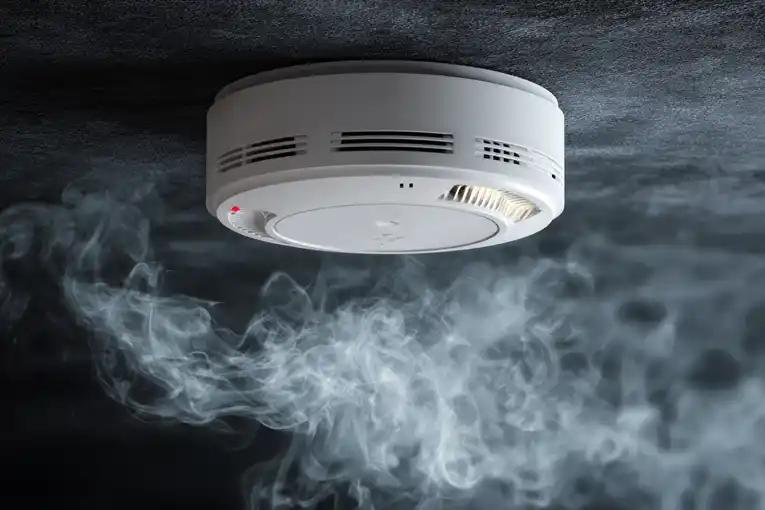
Smoke  Detector
Image credit: Pixabay

Testing a smoke alarm is a very straightforward process, but it varies slightly depending on the type of smoke detection unit you have installed.

Battery Units

  1. Locate the test button: This is usually visible on the front face of the alarm.
  2. Press and hold the button: After a few seconds, the alarm should emit a loud, high-pitched sound.
  3. Listen for consistency: The sound should be continuous and strong. If it’s weak or erratic, replace the battery immediately.
  4. No sound? Replace the battery first, then test again. If there’s still no response, replace the entire unit.

Hardwired Units

  1. Locate the test button: Press and hold the test button exactly as you would on a battery-operated alarm.
  2. Interconnected alarms: If your home has interconnected alarms, pressing the test button on one unit should cause all the alarms to sound. This is normal and confirms they’re correctly linked.
  3. Backup battery: Even though these alarms are connected to mains power, always check the battery backup. If the alarm fails the test and replacing the battery doesn’t fix it, call an electrician to inspect the wiring or replace the unit.

Optional Sensor testing

If you want to test the smoke sensor itself (not just the loudspeaker or battery), you can use a smoke detector test spray.

This creates a safe, simulated smoke environment.

Unless advised by the manufacturer, avoid using real smoke such as candles or matches, as this can contaminate and damage the sensor.

Troubleshooting

If your alarm fails the test or behaves strangely, here’s what to do:

  • Weak or chirping sound: This usually indicates a low battery. Replace it and retest.
  • No sound at all: Try a brand new battery. If still silent, the unit may be faulty.
  • Frequent false alarms: Dust, steam, cooking fumes, or insects can all cause false triggers. Clean the alarm with a vacuum cleaner or soft brush. Avoid using sprays or solvents.
  • Random beeps: Some units beep to signal end-of-life, often every 30 to 60 seconds. Check the label on the back for the recommended replacement date.

Safety Tips

  • Always test your alarms after a vacation or extended period away.
  • If you’re hearing impaired, install smoke alarms with strobe lights or vibration alerts.
  • Avoid painting over smoke alarms since this can block sensors.
  • For rental properties, landlords are usually responsible for installing alarms, but tenants should still test them regularly.
  • Don’t ignore chirps or unusual sounds, since they’re indicators telling you something’s wrong.

Key Takeaways

Testing your smoke alarms is one of the simplest ways to protect everyone in your home.

It takes less than a minute, but it could be the difference between life and death in the event of a fire.

Make it a habit, stay informed, and stay safe.

When testing, press and hold the test button monthly to check your smoke alarm’s function.

Replace all batteries at least annually, or sooner as needed.

Alarms should be fully replaced every 10 years, even if they seem to function properly.

Use some test spray for a more thorough check of the smoke sensor if desired.

And address any beeping, silence, or false alarms promptly. Don’t ignore them.

Survitec completes testing of alcohol-resistant fluorine-free firefighting foam

Marine system testing shows foam compatibility

Survitec has reported the successful completion of performance testing for new alcohol-resistant, fluorine-free firefighting foam concentrates.

The company confirmed that the results demonstrate compatibility with marine foam proportioning and pump systems, supporting the global transition away from PFAS-based products ahead of incoming IMO regulations.

According to Survitec, testing was required to confirm that the denser, more viscous foam formulations can operate effectively within systems originally designed for lower-viscosity compounds.

The manufacturer stated that this process involved modifications to existing dosing and pumping components, rather than full equipment replacement.

Testing confirms performance with high-viscosity foams

Survitec explained that the latest round of trials builds on previous laboratory tests examining foam performance under various marine conditions.

Last year, Survitec conducted fire tests using different sprinkler nozzles and fuel types.

These earlier tests showed that the foam retained its stability and effectiveness, even with volatile substances like methanol.

However, as Survitec noted, the alcohol-resistant variant introduced new challenges due to its increased viscosity. Standard systems were not designed for such properties, creating dosing accuracy risks.

Maciej Niescioruk, Product Manager, Foam Systems at Survitec, said: “Standard proportioners are not typically designed to handle this kind of fluid.

“So it was essential that we rigorously test the system to ensure compatibility and dosing accuracy.”

Adjustments reduce dosing risk in existing systems

Niescioruk explained that proportioning accuracy is a key requirement under marine fire safety standards.

He said: “An incorrect dosing ratio can result in a foam that is ineffective in suppressing a fire.

“Foam proportioning systems must comply with a strict dosing accuracy range of -0% to +30% to ensure that underdosing does not occur.

“This is a critical requirement to avoid system failure.”

He added: “This is particularly important when using high-viscosity foam concentrates, which typically generate higher flow resistance.

“If a standard, unchanged, proportioner is used, the increased resistance can cause the actual mixing ratio to fall below the nominal value, violating regulatory requirements and compromising foam performance.

“By implementing our findings from these tests, we can ensure that our customers won’t face that risk.”

Survitec reported that the extent of system redesign varied depending on configuration and scale. In some cases, changes to internal components and orifices were enough to meet the required dosing precision.

Regulatory compliance drives fluorine-free transition

The tests were carried out ahead of new International Maritime Organization (IMO) rules coming into force in January 2026.

Survitec stated that under IMO MSC.532(107), the use and storage of foams containing PerFluoroOctane Sulfonate (PFOS) will be banned. PFOS is one of several PFAS compounds being phased out globally due to environmental and health concerns.

Niescioruk said: “Fluorine-free, alcohol-resistant foams are particularly suited for chemical tankers, Norwegian double-ended ferries, and methanol-fuelled vessels, where environmental performance and fire safety are paramount.

“The successful completion of these performance tests allows Survitec to offer a tested and validated solution that mitigates technical risk and supports a smooth, compliant transition to fluorine-free technology.

“The findings are already being implemented in current projects, including a system commissioning in Turkey.”

He added: “These are safety-critical systems.

“Any significant changes to these systems must be handled carefully, allowing time to assess the engineering requirements and obtain the proper approvals.

“Our message to the market is clear: plan now, test early, and work with an OEM partner who understands the technical and regulatory landscape.”

Survitec completes testing of alcohol-resistant fluorine-free firefighting foam: Summary

Survitec completed testing of new alcohol-resistant, fluorine-free firefighting foam concentrates.

The company reported the results confirm compatibility with marine foam proportioners and pumps.

Testing focused on managing the increased viscosity of fluorine-free formulations.

Modifications were made to dosing and mixing components to maintain regulatory accuracy.

Proportioning systems must deliver foam within a -0% to +30% mixing range.

Survitec stated that incorrect dosing can lead to ineffective foam during fire suppression.

IMO regulation MSC.532(107) will prohibit PFOS-based foams from January 2026.

Survitec highlighted the importance of early planning to support compliance and safety.

The company confirmed that the tested foam will be used in current marine projects.

Applications include chemical tankers and vessels using methanol as fuel.

Greece enhances firefighting capacity ahead of 2025 summer season

Operational plans for 2025 firefighting season presented

The Ministry of Climate Crisis and Civil Protection has reported that Prime Minister Kyriakos Mitsotakis visited the Ministry on 28 April 2025, ahead of the firefighting season starting on 1 May.

The Ministry stated that the Prime Minister was informed about updated operational plans including an increase in staffing levels, acquisition of new equipment, expanded drone deployment, and prevention activities aimed at addressing the risks posed by climate change.

According to the Ministry of Climate Crisis and Civil Protection, the Fire Brigade now has more than 18,000 permanent and seasonal firefighters, compared to approximately 15,500 personnel in 2022.

The Ministry also reported that the fleet of firefighting vehicles has grown by 270 over the last three years, reaching a total of 3,700.

Growth in drone bases and aerial monitoring capabilities

The Ministry of Climate Crisis and Civil Protection explained that drone use has expanded significantly to support early fire detection and rapid response efforts.

It reported that drone bases have increased from 45 to 80, with the unmanned aerial fleet now capable of operating in extreme weather conditions and equipped with thermal imaging cameras.

The Ministry added that drones would be deployed extensively in Attica and other vulnerable areas to assist with immediate detection and early intervention in case of fire outbreaks.

The Ministry noted that the “AIGIS” programme, aimed at modernising Civil Protection equipment and systems, is progressing with the intention to increase the number of contracted projects by the end of 2025.

Extension granted for land clearance deadlines

The Ministry of Climate Crisis and Civil Protection confirmed that due to prolonged rainfall, the deadline for land clearances has been extended until 15 June 2025.

It reported that land clearance activities are a critical element in fire prevention strategies, particularly near archaeological sites and around electricity transmission networks.

According to the Ministry, last year approximately 800,000 citizens completed plot cleanups, helping to prevent the spread of fires into urban areas.

The Ministry indicated that municipal authorities will closely monitor compliance with land clearance requirements, and fines will be imposed where necessary.

European cooperation and increased volunteer involvement

The Ministry of Climate Crisis and Civil Protection stated that Greece’s firefighting efforts will again be supported by approximately 300 personnel from five European countries.

It reported that the number of Forest Commando Units (EMODE) has grown from six in 2022 to 20 units, now comprising more than 1,500 members.

The Ministry highlighted that alongside professional staff, around 5,500 volunteers from organisations and 5,000 volunteer firefighters will support firefighting operations during the 2025 season.

It added that the General Secretariat of Civil Protection has been certifying voluntary actions, encouraging greater citizen participation in fire prevention and response.

Greece enhances firefighting capacity ahead of 2025 summer season: Summary

The Ministry of Climate Crisis and Civil Protection reported that Prime Minister Kyriakos Mitsotakis visited the Ministry on 28 April 2025.

The visit aimed to review operational plans for the firefighting season beginning on 1 May 2025.

The Fire Brigade now includes more than 18,000 permanent and seasonal firefighters.

The Ministry reported an increase in firefighting vehicles to 3,700.

Drone deployment has expanded from 45 to 80 bases with new thermal imaging capabilities.

The “AIGIS” programme for modernising Civil Protection infrastructure continues its implementation.

The Ministry confirmed an extension to 15 June 2025 for land clearance deadlines.

Approximately 300 firefighters from five European countries will assist during the season.

The Ministry reported that more than 5,500 volunteers from organisations and 5,000 volunteer firefighters will support operations.

Forest Commando Units now total 20 with more than 1,500 personnel.

The Ministry emphasised the importance of citizen participation in land clearance and fire prevention.