Offshore oil and gas safety report released

A flagship report released has outlined the state of the UK offshore oil and gas safety, health, and environmental performance in 2019, and highlights future plans for further improvement.

The latest findings were revealed by leading representative body OGUK, which today published its first combined report into health, safety and environment data, showing encouraging signs of improvement across a broad range of HSE indicators.

While the findings reveal an increase in total hydrocarbon releases, more serious RIDDOR-reportable releases decreased year-on-year, from 85 to 67. Overall, 49 per cent (62) of all releases were classed as minor, with 10 per cent still to be classified, and three were classified as major releases.

Offshore oil and gas safety improving

In aviation safety, last year saw a third consecutive year of accident-free flying in the UKCS, and for the second year running, the five-year fatal accident rate per 100, 000 flying hours remained at zero.

The results demonstrate that, overall, 2019 saw stabilised environmental performance, underlining that good management remains a priority alongside continued improvements in this area.

Commenting on the report, OGUK’s health, safety and environment director Trevor Stapleton said:

“The COVID-19 pandemic has had a significant impact on oil and gas operations in the North Sea. However, this virus should not and will not distract industry from focusing on its key goal of maintaining safe operations while continuing to provide the energy society needs – however challenging that might be.

“Understanding our past performance means we can identify areas of strength and areas that need further work and focus our efforts accordingly.

“As an industry, we take any hydrocarbon release very seriously. The UK offshore oil and gas industry’s work to improve safety performance is delivering in many areas – but we must continue our relentless focus on safe operations in every aspect.

“The number of these releases considered reportable under RIDDOR requirements is down year-on-year, but there are signs of an increase in the three-year rolling average. We are working closely with operators and regulators to maintain Principles of Process Safety, and our hydrocarbon release prevention strategies will be refined for next year.

“It is encouraging to see that dangerous occurrences and the non-fatal injury rate both fell to their lowest levels in 2019 and, while a single one is too many, it is a testament to industry that continued focus in these areas has resulted in improvement.”

Mr Stapleton added: “We are taking action and working with the UK government on a major sector deal. The deal will give industry opportunities and guidance on decarbonisation, electrification of assets and the development of carbon capture and storage – all of which will drive down emissions.

“Despite the signs of improvement, there can be no room for complacency and offshore oil and gas safety of our workforce remains a key priority for our members.”

The Report can be found at: https://oilandgasuk.co.uk/product/health-safety-environment-report/

Cardiff fire costs company £2m in lost stock

80 firefighters tackled a blaze in Cardiff on Sunday at a warehouse for a sports clothing company.

The fire out at an industrial unit on Seawall Road on and spread to other properties. It is claimed that the company, YC Sports, lost up to £2m in stock.

The blaze spread to a nearby warehouse used by Rhino Global, destroying stock.

The family-run business YC Sports supplies school uniform and sports kit, with stores in Cathays, Canton and Whitchurch.

Their other company, Rhino Global, is well known for the Rhino rugby brand, one of the world’s largest suppliers of rugby kit, balls and equipment, including tackle bags and scrummaging machines.

Fire started in tyres

Finance director Ye Wai Lim explained the fire started in tyres outside the neighbouring business Topline Tyres and then took out the whole block.

“It is difficult but we’ve been quite lucky,” Mr Lim said.

“We’ve been speaking to our suppliers and we’ll receive emergency deliveries in three to four weeks which will get us through maybe three months.

“Some items of stock are a bit more complicated.”

He said the company was also receiving support from insurers after the fire.

People were warned to stay indoors and close their windows, after the blaze broke out on Sunday evening, with pictures appearing on social media of the billowing flames.

Story originally posted on BBC website

Ryan Darley, International Sales Manager at Darley reveals what makes them unique

In an exclusive interview with IFSJ, Ryan Darley, International Sales Manager at Darley reveals the key elements that make the company a unique fire and safety equipment supplier – including their enhancements in robotics and automation.

What makes Darley a key aspect to the fire safety sector?  

Darley provides lifesaving equipment to first responders around the world.  We manufacture high quality pumps, trucks, CAFS and other life safety products built to handle the tough environments.  

We also supply most all the equipment you will find on a fire truck.  We are a family-owned business dedicated to serving our first responders. Darley is proud to provide the highest quality products available backed by a team who cares about those who serve our countries.   

What makes Darley’s range of fire equipment an integral part of fire safety strategy? 

Darley partners with industry-leading manufacturers to offer trusted and innovative equipment that is built to last, improving first responder preparedness and efficiency.  

In addition to focusing on providing solutions to current challenges, we are also looking towards the future needs of the fire industry, partnering with companies to provide virtual reality training, wearable technology to monitor firefighter health and wellness, drones and robots to work where firefighters can’t.   

Our focus on quality and bringing new technology into the industry make Darley not only a great choice for today’s product needs, but also a company to look to for emerging technology.  

Could you tell us about Darley’s pump solutions and how the pump division is starting to embrace robotics and automation?  

We have been implementing robotics and new machinery/technology into our production process for years. We invest heavily into unmanned robotics to automate critical processes. We utilise machines that fix themselves or select a replacement tool to eliminate down time.  

Darley uses smart hoists to keep our employees from heavy lifting. We have used telematics so that pumps can be run and monitored from across the world. We also utilise CMM’s (coordinate measuring machines) that ensure our products are built to the tightest tolerance and specification in the industry.  

Our test room uses electric engines and state-of-the-art monitoring devices ensuring a great product is delivered every time. We have X-Ray machines to scan products for quality. Technology, precision, and care go into every fire pump we manufacture.   

How does Darley compare to other similar fire and emergency service providers in the market?  

Not only do we offer the best products in the market, but they are also backed by the longest warranty in the industry by a team that takes pride in what they produce. Our customer service and sales team are always available, and you can even reach our company president 24 hours a day.   

We publish our numbers and stand behind our product. Our price is generally higher than competitors, but customers save money over the life of the product. Buying less expensive/lower quality products will incur higher costs in the long run and potentially put first responders at risk.    

What are Darley’s plans over the next 12 months?  

Darley is looking toward innovation and a return to somewhat normal business practice. We have quickly adapted to the digital transformation and virtual meeting environment, while in-person events and visits continue to be postponed.  

We are excited to be offering PPE and introducing new and innovative products to the industry. Our goal is to continue to be the first-choice solutions provider serving those who serve.  

Pelican Products Announce Brad Antoine as VP of Financial Planning and Analysis

Pelican Products, Inc. is pleased to announce the addition of Brad Antoine to its financial leadership team. As of October 26, 2020, Brad has taken the reins as Vice President of Financial Planning and Analysis.

As Pelican’s newest VP, Brad is responsible for managing the company-wide business planning process, the capital expenditure process and modeling the financial aspects of various initiatives and transactions. His role includes an emphasis on delivering disciplined growth for Pelican, and continually enhancing financial and operational analysis, reporting, and leading business review processes. Brad also leads and manages a team of Finance professionals, maintaining a strong focus on professional people development, accountability, and driving for results.

“Brad is a strategic financial expert whose breadth and depth of experience makes him an invaluable addition to the team,” stated Chief Financial Officer, George Platisa. “We look forward to his strengths lending themselves to Pelican’s financial planning efforts and having a positive impact on Pelican’s future growth”.

Pelican products
Brad Antoine (Credit: Pelican Products)

Prior to joining Pelican Products, Brad held senior financial positions at Sierra Aluminum, Sun Opta and Kaiser Aluminum, where he took the lead on modeling, valuation, due diligence, deal financing, and integration activities post acquisitions.

Brad holds a Bachelor of Arts Degree in Economics and Finance from San Diego State University and earned his MBA with a concentration in Finance at California State University Fullerton.

Should Covid-19 uncertainty make you delay taking on a franchise?

Jackson Fire and Security discuss whether Covid-19 uncertainty should stop you opening a franchise in the fire industry.

For someone who aspires to be their own boss, the right franchise offers an excellent opportunity and in many ways, it’s a much safer option than choosing to start a business from scratch. You’ll be responsible for running it, but will have the support of the franchiser behind you.

You’ll also benefit from the fact that your business is already part of a well-established brand. You must however be careful about the choice of franchise and now more than ever one of the most vital criteria is finding a franchise that operates in an industry with strong demand, no matter what’s going on in the economy.

Fire and security remains a strong sector

We know that we offer a franchise that can weather tough times. In fact, our customer demand is actually increasing. Fire and security solutions will always be needed. In England and Wales, employers, owners, landlords and occupiers of business or other commercial premises are legally responsible for fire safety.

Amongst other things they must regularly complete fire risk assessments, decide on measures needed to address the risks they find, then put steps in place to reduce or eliminate those risks.

That will include installing fire alarms and fire prevention equipment such as fire extinguishers. And even once they’re installed, there’s an ongoing need for servicing and maintenance.

Aside from the very obvious potential harm that could occur if a fire broke out, if these fire safety regulations aren’t adhered to, it could mean fines and even prison sentences. So it’s rare that people with fire safety responsibilities would take a chance and disregard them.

At the same time, crime remains a challenge in many settings. That means there is an ongoing need for a variety of security solutions such as CCTV systems, intruder alarms and control systems that manage access into buildings.

Employers, owners, landlords and occupiers of business premises want a straightforward way to ensure they’re managing their risks – and an integrated solution from a trusted supplier is exactly what they’re after.

Jackson Fire and Security is an extremely well-established brand. The company started nearly thirty years ago and has gone on to become an industry leader with a superb reputation.

We’re the first fire and security company to offer franchise opportunities and those branches are now flourishing. Thanks to the combination of excellent service and a growing market, there’s constant demand and repeat business.

Take the time to do your research

For some people the pandemic, and perhaps the extra reflection time due to being furloughed, might have provided a positive opportunity to take stock of where they are now and where they want to be in the future. For others, disruption to their work and possibly even redundancy might mean they have found themselves forced to contemplate what comes next.

Whatever your circumstances, we would definitely encourage you to take your time to do your research. We are confident we offer an excellent franchise opportunity, and indeed there are many other good franchise opportunities out there. Don’t delay because of the pandemic but you must be sure that it’s a good move for you.

Think through the financial and personal commitment carefully. Find out as much information as you can about the franchise and franchising business. Scrutinise the market you will be selling into.

Talk to franchisees in the business you are interested in. Taking on a franchise is a rewarding but also significant commitment so do your research to make sure it’s the right move for you.

Would you like to know more about the Jackson Fire and Security opportunity?

We are continuing to run our discovery days on a socially distanced basis at our Head Office in North Wales. They are an excellent way to find out more about our franchise opportunity and to ask all the questions you might have. If you would like to book onto one then you can do so here or you’re welcome to give us a call on 01352 755866 to find out more information.

Blog originally posted on the Fire Safety Event website

E-ONE to install 70 purification systems in fire and rescue apparatus

E-ONE®, a subsidiary of REV Group, Inc. and a leading manufacturer of fire apparatus, has received an order for 70 Active Air Purification Systems to be installed into existing fire and rescue apparatus by Marion County Fire Rescue in Ocala, Florida.

The Active Air Purification System kills 99 percent of pathogens, including COVID-19, in the air and on surfaces delivering better air quality and a safer cab environment. Designed with advanced photohydroionization™ (PHI) and UV technology, this system also offers proven reduction in sneeze germs by 99% within three feet, proven efficiency on microbes (3rd party tested on H1N1, Avian Flu, sneeze test) and proven impact on odour reduction.

The compact design of the Active Air Purification System allows it to be placed in multiple locations within the cab while still achieving the same results, giving the Marion County fleet management team the flexibility needed when retrofitting the system into its existing vehicles. Funding for the units is made possible through the county from the Coronavirus Aid, Relief and Economic Security (CARES) Act.

“Marion County Fire Rescue has put in place a plan to outfit all transport units and fire apparatus with the air purification units,” said Division Chief Drew Rogers with Marion County Fire Rescue. “These units safely sanitize the interior of the apparatus and combat communicable diseases.  This addition to our frontline apparatus will increase safety for both our first responders and the citizens we transport.”

E-ONE is proud to partner with Marion County Fire Rescue on the industry-leading Active Air Purification System,” said Larry Daniels, E-ONE’s Director of Sales. “Our first responders deserve every defense possible against harmful pathogens. This technology will provide a safer environment to and from incidents and anytime they are in the truck.  Protecting the safety of our first responders is a priority for Marion County and for E-ONE.  We are proud to serve our first responders as they protect and serve our citizens.”

Better crew training needed for CO2 firefighting systems

Survitec discuss the need for better crew training needed for CO2 firefighting systems.

Fire is the most common and most dangerous emergency at sea. Yet while the International Maritime Organization’s FSS Code provides engineering and design standards for all types of fire extinguishing systems, there are no mandatory regulations governing their installation, commissioning, operation and maintenance, only recommendations.

Although recommendations and guidelines are in place, and which should be followed to obtain certification from classification companies and flag state authorities, there have been several incidents in recent times where fixed fire extinguishing systems have failed.

For instance, in May last year, the accidental release of CO₂ aboard a 69,121dwt bulk carrier during routine checks of a CO2 firefighting system during repair work at shipyard, resulted in the death of ten seafarers and the hospitalisation of a further 19. The ensuing incident report found the system itself to be faultless, but it was incorrectly operated by the crew.

Similarly, an incident report published in 2015 by the Marine Accident Investigation Report (MAIB) in to the 2004 fire aboard a fishing vessel found the lack of training in the use of CO2 firefighting systems to be of significant concern.

Lack of knowledge of Co2

“The CO2 system did not operate effectively because it was poorly maintained, the crew were unaware of the correct operating and compartment isolation procedures, and there were no system-specific operating instructions posted….The crew were also unfamiliar with the safety procedures required for re-entry following use of CO2…. If the CO2 had been successfully discharged, then it is highly likely that fatalities would have resulted when re-entry was made to the engine room,” cited the report.

The 2004 fire aboard a 11162gt passenger ship also highlighted flaws in the crew’s knowledge, experience and training in the use of the CO2 system, with the MAIB concluding: “Despite instructions to release the CO2 having been carried out, unbeknown to the officers and crew at the time, no CO2 was released into the engine room to fight the fire.”

The vessel’s CO2 system was neither checked nor made secure after the fire, and during the investigations after the vessel’s arrival in Southampton, CO2 from a bank of cylinders was accidentally released into the engine room. Three crew members were lucky to escape without loss of life or serious injury.

Investigators concluded that officers misunderstood the system and how to operate it effectively. But what was also interesting about this incident, was that the investigators found that the system had been incorrectly installed. Only 51 cylinders would have activated instead of all 66.

Problems with the installation and commissioning of the fixed firefighting system were also found aboard a general cargo vessel. Inspectors discovered the system had “not discharged completely as one of the bottles had been installed incorrectly”.

“While it is difficult to put a number on all the fire related incidents where incorrect installation, operation or maintenance of a fixed firefighting system has resulted in system failure, injury or death, the above investigations do offer a difference perspective on the effectiveness of the current regulations and guidelines,” says Mats Hestmann, Survitec Group QHSE Manager.

“Fire safety systems are inherently designed to protect and save lives. However, if these systems are incorrectly used, installed or insufficiently inspected and maintained, the consequences can be severe. These can range from time delays and port penalties for non-compliance to serious injury or even fatality,” says Hestmann.

MSC.1/CIRC 1318, the Guidelines for the Maintenance and Inspections of Fixed Carbon Dioxide Fire-Extinguishing systems was released in June 2009 and have been adopted by most Flag states, but some are still following their own set of standards. Hestmann, believes that it would be beneficial for MSC.1/CIRC 1318 to become even more structured as is the case with MSC 1432, clearly defining what should be inspected. Once the majority of flag states have adopted an MSC circular, it then becomes a resolution making it mandatory.  

Hestman adds: “Great improvements to safety have come as a result of IACS Z-17 Service provider approvals. However, it’s not the failure of the firefighting system that is resulting in so many incidents, but rather the lack of system knowledge and poor operator training.

There should be more effective rules governing system training; because a crew member is familiar with one firefighting system doesn’t mean they are appropriately trained to use another manufacturer’s system or even a different system configuration. While the product itself might be standard, the layout of the system, the location of valves, cylinders, and vents and so on will differ from ship to ship. Certainly, crews need to be better trained in the use, operation and maintenance of these systems.”

Erik Christensen, Technical Director Fire Fighting says: “We have seen a number of incident reports where human error in the use of firefighting systems has been a common factor. Valves have been closed when they should have been open, ventilation flaps left open with main generators still running during the fire.

“Carbon Dioxide is a dangerous gas and any system that has been incorrectly installed, maintained or operated could not only fail to extinguish the fire but be very harmful to the crew.”

Colourless with a slightly astringent smell, CO2 is about 50% heavier than air and therefore highly effective in smothering a fire in a relatively short time. However, split seconds after its release, the covered space concentration level is life threatening. Therefore, to allow personnel time to escape, from the moment the CO2 alarm is activated, time delays delaying the release of CO2 are present on CO2 systems. Time delays can be programmed ranging from 20 seconds up to 2 minutes depending on the system.

Any re-entry into the space should only be once the space has been thoroughly vented and the air quality tested.

“As the market leader and a champion of maritime safety initiatives, it is important we foster greater fire safety and systems awareness,” says Christensen. “We have already issued advice offering our recommendations and we are nearing the final cut of an informative video to raise wider awareness of the need to ensure firefighting systems are correctly installed, regularly maintained, serviced and that crew operating the systems are trained and understand how to use the specific system.”

Survitec recommends that:

•             Fixed firefighting systems are commissioned by the Original Equipment Manufacturer or an OEM-approved and certified technician after installation

•             Systems are inspected regularly in line with the routine inspection regime detailed in the system manual. These are monthly checks and should be carried out by trained individuals.

•             Ships’ crews undergo basic systems configuration training and personal protective equipment training by the OEM.

•             Inspections and maintenance works are carried out by a trained systems technician in accordance with Maritime Safety Committee Circulars 1432 (Firefighting Systems) and 1318 (CO2 systems), or special flag/class requirements, in order to receive renewal of the Safety Equipment Certificate.

“We want to ensure that operators and crews have a much better understanding of how fixed firefighting systems operate and the importance of regular, properly carried-out maintenance. With greater knowledge, they will be able to overcome many of the operational challenges they face and prevent system failure when it is required in an emergency.

“Crews can be better equipped to fight fires more effectively, more safely, but any initiative needs to work in harmony with the rules, some of which could do well to be revised.”


Building costs grow as a result of safety defects

Owners of flats in blocks clad in combustible materials, or with other fire safety defects, have seen buildings insurance costs grow ‘by as much as’ 800% in a year.

The Times reported on the cost of cover for apartments in blocks with combustible cladding having ‘soared’ in the three years since the Grenfell Tower fire, and stated that ‘hundreds of thousands’ of residents living in this situation have seen buildings insurance costs ‘increase by as much as’ 800% in one year. Premiums ‘are skyrocketing’, it adds, because some residents are ‘now being covered by a hotchpotch of different insurers because no company will provide cover on its own’.

In turn, other insurers ‘refuse to provide cover altogether’, and The Times states that ‘about’ 700,000 people continue to live in flat blocks 18m or taller clad in combustible materials. While the government has provided cladding remediation funding, ‘that will pay for only a fraction of the work needed’, and repairs taking place ‘are being carried out so slowly that it will take 150 years to replace all the flammable cladding’.

Number of flats with safety defects

There are also thousands of other residents living in blocks smaller than 18m or six storeys, who ‘do not qualify for government help’, and leaseholders are required to pay freeholders for replacement cladding, while insurance providers are ‘refusing to provide cover – or are increasing the cost – on buildings of all sizes’.

safety defects

The news outlet discussed a number of examples of blocks across the country, mentioning first the Paddington Walk development in west London, which is clad in both timber and aluminium composite material (ACM), and whose residents saw premiums increase from £130,000 in 2019 to £690,000 in 2020. The building’s previous insurer Axa used to cover the whole development ‘but will now only cover 50%’, with the remainder provided by Allied World, AIG, Ecclesiastical and Aviva.

This increase means each flat’s average service charge is now £4,540 a year, an increase of £3,684 on last year. The second development mentioned, New Festival Quarter in Poplar, east London, is having ACM cladding replaced by its developer, but a recent survey highlighted other fire safety issues including missing cavity barriers – as a result, building insurance rose from £137,000 in 2016 to £340,000, or from £273 for a two bedroom flat up to £677.

Resident Philippe Wilson said that ‘we have been landed with massive rises that many residents just can’t afford’, while flat owners in the Albion Works development in Manchester have seen their two bedroom flat premiums increase from £200 to £800 per year – it ‘had been so difficult to find cover that the block went for a month without any insurance at all’.

The Association of Residential Management Agents found the biggest rise at a block in Peckham in south east London, where the 2019 premium of £34,000 increased to £300,000, a growth of 782%. A spokeswoman for the Association of British Insurers stated: ‘The rise in insurance costs for properties with combustible materials on the outside of the building — including cladding and insulation — is rational given the current risk and the declaration that some combustible materials are unfit for purpose.

‘There is a clear responsibility on building owners and the government to step in and ensure these buildings have dangerous combustible materials removed as soon as possible to make sure people are safe in their homes.’

A spokeswoman for the Ministry of Housing, Communities and Local Government said that building owners ‘should ensure their buildings are safe without passing costs to leaseholders, where possible’, and added: ‘We empathise with everyone who is concerned about the safety of their home.

‘Our comprehensive reforms will hold building owners to account on safety, regardless of the height of the building – including the new Fire Safety Bill, that will strengthen enforcement powers to ensure building owners protect residents and manage and reduce the risk of fire in their buildings.’

Story originally posted on Fire Protection Association website.

What are the best practice’s to help reduce firefighter risk?

The role of a firefighter has never been more challenging. Some of these challenges are because of climate change with firefighters called out to incidents of flooding, wildfires and other natural disasters, but others are as a result of the changes in the fabric of our own lives.

Recently, the fire service industry has become aware of long-term health and safety risks inherent in the fire service profession, including indications of higher incidence rates of cancers and other malignancies believed to stem from occupational exposure. While it is impossible to precisely discern the causes of long-term malignancies, it is now generally accepted that firefighting is linked to long-term health hazards, which is believed to be connected to exposure to unknown chemicals and constituents released during the fire.

Picture1

Industry organisations and leaders are making a push to raise awareness about these risks and have suggested several best practices by which firefighters can help to reduce their risk. Firefighters must properly wear the best protective gear, and, more importantly, maintain, clean and disinfect it.

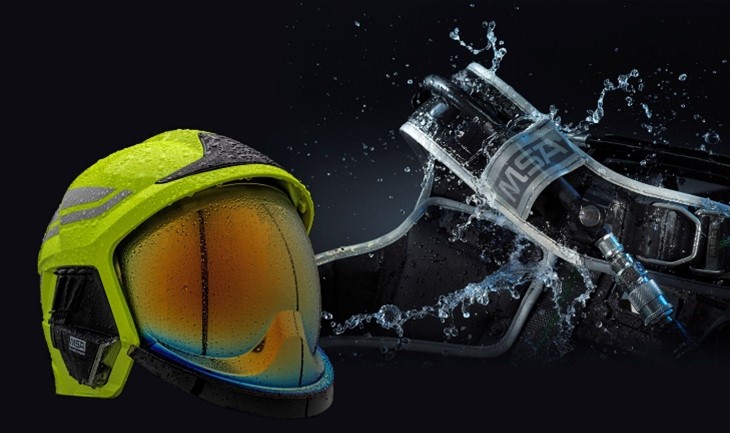
How does MSA Safety address that topic to the Firefighter community?

For many fire departments, garment cleaning and maintenance already has an established protocol, with many brigades working with garment suppliers who provide a full-service solution for regular repair and maintenance. However, there has been a strong culture that says,“The dirtier the kit the more of a hero the firefighter!”. There’s a growing realisation that actually, the dirtier the kit, the greater the risk of exposure to harm. In some regions, the culture is changing with firefighters having a better understanding of the risk and demanding a clear set of guidelines to help them safely wear, remove and decontaminate or clean their kit.

MSA Safety is working with its customers to provide a “head to toe” recommendation on cleaning and disinfection of its flagship products, such as SCBA and Fire Helmets. As a trusted advisor to brigades all over the world, MSA has established a set of recommended guidelines on cleaning and disinfection available in the product manuals.

Cleanability is now a key focus for all new product development. MSA is helping to advise its customers of industry-accepted cleaning and disinfecting processes and procedures in an effort to help maintain firefighters’ equipment and protect it from damage caused by cleaning agents or the cleaning methods themselves.

Learn more athttp://msane.ws/Firefighter-Health

High volume pumping incidents – which garments are best?

Whilst high volume pumping (HVP) incidents aren’t the most common call out for firefighters, they still require specialist support from brigades. So, what conditions do firefighters face on these types of jobs? And what garments are best for firefighters to wear to handle these conditions?

Reece Buchner, technical sales manager at FlamePro, a British specialist manufacturer of life-saving garments for firefighters, details everything you need to know about HVP incidents and which garments should be worn on the job in his guest blog for Fire Product Search.

What conditions do firefighters face at High volume pumping incidents?

More often than not, HVP will be used during a flooding accident. Whether this is caused by a river bursting its banks or high volumes of rain overwhelming roadside drainage systems, they usually involve firefighters spending hours wading around in inches or even a few feet of water.

High volume pumps can also be utilised when a significant amount of water needs to be moved quickly – such as the incident at Whaley Bridge in Derbyshire last year, where the reservoir dam wall threatened to collapse due to heavy rainfall. Several HVPs were deployed, as 150 firefighters battled to remove 70,000 litres of water a minute from the reservoir.

What is the best PPE for HVP incidents?

HVP incidents are unique in the sense that firefighters do not need protection from extreme heat and flames, unlike the majority of other call-outs. However, it is still important that firefighters can be easily identified on these jobs, given the number of emergency services that will likely be present.

It is important to note that HVP operatives are different to those that will be wearing dry suits in deeper water; the HVP is usually situated on dry ground, but the prevailing conditions are wet and the work is active, meaning lightweight, waterproof garments are the order of the day.

Therefore, the best type of kit for these jobs is a single-layer, waterproof and lightweight suit, to allow firefighters to move around easily and comfortably. Ensuring the kit is waterproof is essential as standard turn-out gear will become soggy and heavy from rainfall, compromising a firefighter’s mobility.

The lightweight nature of the garments is also essential, due to the physical nature of these jobs; manning pumps, unrolling kilometres of hoses and packing everything away once the job is complete.

The conditions also mean that waterproof and rubber boots are a must, given the high volumes of water firefighters are required to trudge through. Boots used in a standard turn out kit are often described as ‘waterproof’, but, these are designed only to resist splashes when tackling fire with hoses. Therefore, having rubber boots ensures firefighters will still have dry feet at the end of the job.

Whilst HVP incidents are far from the most common call out, as the colder and wetter months now approach, it is more and more likely fire brigades will be involved in such an incident. That’s why it is essential that firefighters are prepared and equipped with the right PPE now, for whenever an incident may arise.