Emergency responders 15 times more likely to contract Covid

Research undertaken by ERG Open Research has claimed that emergency responders were 15 times more likely to have contracted during the first wave to hit New York.

The report states that “between 1/3/2020 – 31/5/2020, we observed that the COVID-19 infection rate among FDNY responders was 362/1000 – 15 times the NYC rate (24/1000).[1] EMS had over a four-fold increased risk of severe COVID-19 and a 26% increased risk of confirmed COVID-19 disease when compared with firefighters.

“It is likely that their higher-intensity COVID-19 exposures contributed to the increased risk and severity of COVID-19 illness. Although both FDNY firefighters and EMS responded to the pandemic-related surge in 9-1-1 emergency medical calls and followed the same PPE protocols,[4] EMS had greater COVID-19 exposure than firefighters due to greater COVID-related call volume and being solely responsible for patient transport, nebulization of bronchodilators and intubation.”

Emergency responders exposed to Covid

The increased exposure to potential Covid-19 patients would also mean that PPE for emergency responders would play a crucial role in keep them as safe as possible. “To protect healthcare workers, including pre-hospital responders, requirements of proper PPE use, environmental controls, influenza vaccination (to minimize additional medical leave, mischaracterization and potential additional comorbidity) and COVID-19 vaccination, when available, are all critical.”

The study included 14,290 of the 15,000 front-line workers at the Fire Department of the City of New York (FDNY) and was funded by FDNY. Of those 15,000 more than 5,000 were either confirmed or suspected Covid-19 cases.

Government announce £33 million grant projects

The UK Government have announced the projects that are part of a £33 million grant scheme that focuses on ground-breaking aviation projects solving major global challenges.

One company, Windracers Distributed Avionic, based in Southampton and Bristol, were awarded part of the grant for its innovations in drone technology. They will use the grant to further develop swarming technology, an approach to coordinate multiple robots, to allow multiple drones to fly in close formations and work together to provide humanitarian aid or fight fires.

Business and Industry Minister, Nadhim Zahawi, said: “As the UK leads the way in the aviation revolution, these bold proposals showcase the pioneering spirit of the UK’s aerospace and aviation industries in solving global issues, and those facing us here in the UK.

Government announce £33 million grant projects

“Today we have announced over £7 million of funding for projects across the country which demonstrate how using the latest and most cutting-edge aviation technologies can step up our response to the coronavirus pandemic, help us build back better and cement our well-earned reputation for research and development excellence, while creating hundreds of new jobs.”

Transport Minister Rachel Maclean added: “The UK is already a world-leader when it comes to innovation in aviation and this funding will allow us to carry on supporting the extraordinary work taking place right across the country.

“Innovation delivers real change and our support for dynamic ideas in this exciting sector means we are now seeing real life solutions, like the drone delivery of COVID-19 medical supplies, for challenges such as public health and climate change.”

Lloyds Building Installs MxPro 5 Panels Advanced Fire Protection

A network of 10 MxPro 5 fire panels from Advanced, have been installed to protect London’s famous Lloyds Building.

About Lloyds Building

Also known as the Inside-Out Building, the Lloyds Building is located in the City of London’s main financial district and is a leading example of radical Bowellism architecture in which services for the building such as ducts and lifts are located on the exterior to maximize space in the interior. Built-in 1986, commercial office development became the youngest structure ever to obtain Grade I listing in 2011.

The state-of-the-art Advanced fire panels, which were installed as part of a phased upgrade to the fire system, cover all areas of the 14-storey building, include BMS integration for graphics and are linked to over 3200 Hochiki devices, including wireless devices installed within the building’s towers.

Installation Of Fire Panels

Undertaking phase one, the design, installation, and commissioning of the fire panels and graphics system at the Lloyds Building were Kent-based Pacific Security Systems Ltd.

Kirk Short, Director at Pacific Security Systems Ltd, said “Our client’s brief was to retain the existing Hochiki devices and wiring while upgrading the panels and graphics system on site. The system also needed to be both user-friendly and reliable.”

“Advanced’s MxPro 5 panels were able to tick all of the boxes. Its network performance is particularly good, no matter the size of the system or complexity of the site Advanced’s products have the capability to deliver complete protection.”

“Our customers are always happy with the product and find the panels very easy to operate with limited technical understanding.”

Custom-Built Fire Safety Products

As part of the work for phase two of the upgrade, a custom-built annunciator for sprinkler, wet riser, and plant status control will be designed and manufactured by the Advanced’s AdSpecials department.MxPro 5 fire system is certified by FM Approvals to the EN 54 standard

Regional Sales Manager at Advanced, Ken Bullock, said: “It’s a pleasure to be able to support Pacific Security Systems Ltd with the equipment needed to protect such an iconic London landmark, and as a high performance yet a user-friendly solution, the MxPro 5 just makes sense.”

“Our industry-leading fire panel offers the ideal solution for this project, where an intuitive interface that the end-user can easily operate and superior networking capabilities that can deliver protection across a large area, are crucial. Pacific Security Systems Ltd will also benefit from the MxPro 5’s built-in false alarm management software, AlarmCalm, enabling the configuration of the building’s investigation delays and double knock procedures with ease.”

Multiprotocol Fire System

MxPro 5 is the fire industry’s multiprotocol fire system solution and is certified by FM Approvals to the EN 54 standard. It offers four detector protocols and a completely open installer network, backed up by free training and support.

MxPro 5 panels can be used in single-loop, single-panel format or easily configured into high-speed networks of up to 200 panels covering huge areas. Its ease of installation and configuration as well as its wide peripheral range make it customizable to almost any application

961 Firefighters attacked on bonfire night

Fire chiefs have voiced their concerns after 961 firefighters were attacked during the bonfire night period.

The stark warning comes from the National Fire Chiefs Council (NFCC) as Home Office statistics show attacks on firefighters rose from 578 to 961 between 2014/5 and 2018/9. And in the last year there were 897 attacks recorded,

In some areas of the country, firefighters can no longer attend some types of fires – unless they have a police escort. NFCC warns these can escalate quickly into large scale fires, putting properties and lives at risk. 

Chris Lowther, Chair of NFCC’s Operations Committee and Chief Fire Officer for Tyne and Wear, has urged people to show respect to all emergency service workers. He has also called for the courts to hand out the maximum jail sentences available to send a clear message.

He confirmed in parts of Tyne and Wear firefighters cannot attend a secondary fire – a small outdoor fire or a fire on grassland or derelict buildings – without police in attendance.

He said: “It is disgraceful that firefighters are attacked when trying to protect the communities they serve; ultimately saving lives.  I would like to see custodial sentences handed out as we need a deterrent which makes people think twice.  Jail sentences for attacks on emergency services workers are very rare; this needs to change.

“Attacking firefighters is abhorrent; if one or two members of staff are injured on a shift, this can result in fire appliances having to be taken off the road while other staff are called in. This leaves communities at risk if there is a major incident.”

Some fire services have reported an increase in attacks of firefighters during COVID-19. Mr Lowther has said in his own service, there have been physical assaults, including missiles such as fireworks and bottles thrown at firefighters.

As well as stronger sentencing, NFCC would like to see body worn cameras made available to all firefighters, which would assist the courts by providing vital evidence.

NFCC Chair Roy Wilsher made it clear that chief fire officers in every UK fire and rescue service have responsibility for the health and well-being of all firefighters. “As part of their duty of care – which every chief fire officer takes very seriously – measures including technology which can help to protect them should be fully utilised. The purpose of these cameras is to record assaults and bring those attacking firefighters to justice.

“NFCC made it clear we are we are disgusted with emergency services being attacked and wanted to see the courts have legislation to give out longer jail sentences. This has now been increased from 12 to 24 months, but we now need to see stronger sentences imposed to send a clear message. Emergency services staff must be treated with the respect they deserve; blue light services are here to keep people safe.

“NFCC is issuing advice on how to hold safe displays at home, although this year we would urge people to find other ways to celebrate Bonfire Night.”

Mr Lowther added: “In my professional opinion, we are likely to see an increase in antisocial behaviour this year as people are not attending organised displays and may flout current COVID-19 laws. Due to restrictions, fire services have not been able to do their normal educational activities, which could also have an impact.”

Removal of ACM cladding ‘77% complete’

The ministry of Housing, Communities and Local Government (MHCLG) has said in its latest data release that removal and replacement of aluminium composite material (ACM) cladding has ‘begun or completed’ on 77% of ‘identified’ high rise buildings.

IFSEC Global reported on the claim by MHCLG in its latest data release for cladding remediation, stating that works have ‘either started or been completed’ on 77% of the high rise buildings identified as having ACM cladding. This was an increase of 10 since August, with 41% of buildings having ‘completed all’ works, an increase of 22, but 105 buildings have still not seen work begin, and only eight ‘are vacant’.

The news outlet pointed out in turn that 23% of high rises identified as ‘unlikely to meet’ building regulations by the government are ‘still yet to begin any remediation work’, and that ‘many in the sector will argue that the process has not been carried out quickly enough’. MHCLG said that this is a ‘complex process’, and remediation work is ‘addressing any issues with the exterior cladding system and broader fire safety systems for each building’.

ACM cladding

ACM cladding unlikely to meet regulations

It added that ‘all of this work takes time and varies considerably depending on the building structure’, with the estimated total number of multi occupant high rises 18m or taller in England said to be 12,500, with 456 of these identified as high risk and having ‘ACM cladding systems unlikely to meet building regulations’. The ‘majority’ or 95% of social sector buildings have completed or started works, while 61% of private sector buildings have begun works.

Despite these figures, IFSEC Global pointed out that industry experts ‘regularly argue that there are many more thousands of potential “at risk” buildings with unsafe cladding’, and ‘continue to highlight the dangers’ of not identifying other buildings ‘with just as dangerous non-ACM cladding’ as high risk.

Testifire supports faster testing in spain

Recently we (detectortesters) featured how Testifire was benefiting engineers across the Middle East by supporting productivity on site, this month it’s been great to hear from some of our customers in Spain who shared their experience of using the industry’s leading all-in-on solution.

Like other countries, Spain has been hit particularly hard by the COVID-19 out-break, however testing and maintenance of buildings fire systems has remained vital to ensure the ongoing safety of people and premises.

This has certainly been the case for a large number of our customers who we’ve heard from, many have continued to work throughout the pandemic to ensure sites that need to remain open are able to do so safely with a compliant fire system and that those that have been forced to close temporarily remain protected from the risk of fire.

M Conejero are a fire maintenance company based in Alicante, they have continued working during the current pandemic and recently shared some photos and thoughts about Testifire with our distribution partner in Spain, Ingstrom.

Increasing productivity

The photos were taken from a recent site visit to Texduo Trading, a company in the footwear manufacturing industry, like many commercial sites, there are a number of different usage areas on site – including production, office and warehousing – all presenting slightly different challenges in terms of access and detection type.

“The feedback from M Conejero was that Testifire makes their daily work much easier, there are numerous ways in which Testifire does this but the standout reasons for M Conejero were the time savings it offers and the savings in brings in terms of consumables.”

It was great to hear this feedback and even better to receive these photos, at a time when the industry looks to build on the early signs of recovery – productivity is as important as ever and from the feedback we’ve had we know that Testifire continues to make a massive difference in this area to users worldwide.

Amthal Adds DHF Membership To Its Credentials

Amthal has become a full member of the prestigious Door & Hardware Federation (DHF,) highlighting its ongoing commitment to health and safety across its automated gates, product and service portfolio.

The DHF is a not for profit trade association for companies associated with Locks & Building Hardware; Doorsets; Industrial Doors & Shutters; Domestic Garage Doors and Automated Gates.

Regarded as a Centre of Excellence, they offer specifiers and end users of individual and commercial buildings, alongside domestic customers a single source for technical expertise, information, knowledge, and advice.

DHF the go-to association for influencing the future of technical security

Says Jamie Allam, CEO Amthal Fire & Security: “DHF is undoubtedly the go-to association when it comes to influencing the future of technical security, helping organisations understand and comply with latest health and safety legislation, relevant to our industry.

“Our membership aligns us with an organisation that represents the agreed, best and most effective way of delivering a product and service. As a business, we are looking forward to receiving first-hand the latest developments on our industry, whilst presenting our customers with a portfolio of automated gate products that achieves DHF requirements for, safety and compliance.”

Amthal will now be able to present its membership of DHF with the use of its logo on all printed and digital media; to demonstrate its dedication to an organisation associated with quality, credibility and raising industry standards.

Nick Perkins, Training & Compliance Officer added: “At DHF, in our role as an industry leading trade association, we provide the knowledge that members use to enable them to put a safe a compliant product on the market. We sit on various standards committees throughout the UK and Europe and are at the forefront of safety and compliance. Our aim is to advance standards to improve the quality and safety of products, services and systems. We welcome new members on their journey to demonstrate commitment to best practice.”

NFPA release guide for structural fire fighting

NFPA have released NFPA 1700 Guide for Structural Fire Fighting, the first NFPA document connecting fire dynamics research to response strategy, tactics, and best practices for firefighters controlling fires within a structure. 

In 2014, NFPA received a new standards project request from a retired Kansas City fire chief asking for the development of a guide that filled the gap between the fire science community and the fire service. The request, which was eventually endorsed by the International Association of Fire Chiefs (IAFC), National Institute for Safety and Health (NIOSH), UL Firefighter Safety Research Institute, the International Society of Fire Service Instructors (ISFSI) and others, sought to ensure that the methods utilised by the fire service for fire control were based on science and not past fire service traditions or practices.

The 13-chapter guide provides standard operating procedure (SOP) recommendations for responding to a structure fire based on recent large scale testing and line of duty death findings. 

Recognised research efforts complement fundamental occupancy, building construction, and building service references within NFPA 1700, while addressing the health and safety of firefighters by reinforcing the need for personal protective equipment (PPE) and methodologies for contamination control. 

The Technical Committee on Fundamentals of Fire Control Within a Structure Utilising Fire Dynamics looked at basic fire science, fire dynamics, PPE, equipment, extinguishment, staffing needs, and ways to adopt these strategies into practice and train the fire service – all in the interest of public and first responder safety.

The 27-member Technical Committee is made up of representatives from the fire service and insurance industry, as well as subject matter textbook publishers, special experts, and stakeholders actively engaged in fire dynamics research; they hail from the United States, Canada, Germany and Belgium.

NFPA 921 Guide for Fire and Explosion Investigations served as a model for how to translate fire dynamics findings in practicable, applicable ways.

Fire Truck Doors: Hinged Vs. Roll-Up Doors

As fire departments think about the components required on a custom fire truck, one anticipated decision involves choosing between hinged or roll-up doors for fire truck compartments.

The choice of either hinged and roll-up doors depends on the type of missions a fire department responds to, and the required compartmentation’s functional and operational needs.

Part of this decision often includes a review of the following questions:

  • What is the difference between hinged and roll-up doors?
  • What are the construction differences?
  • What safety and operational considerations are important?
  • What additional door features should be considered?
  • What is the look or appearance desired?

Learn construction, safety and operational details, and common questions regarding hinged and roll-up doors below.

What is a Hinged Door?

A hinged door on a fire truck compartment is a flat, double pan door that opens with a hinge secured on either the vertical or horizontal side of the door as a point of connection to the apparatus or chassis body.

Hinged doors may also be referred to as lap doors, double pan doors or traditional compartment doors.

Hinged doors can be installed on both the driver and officer side of the apparatus, on the rear of the fire truck and covering compartments on top of the apparatus. Hinged doors cover all compartments that have been designed to maximize storage for the unique needs of a fire department.

Hinged Door Construction

Hinged doors are sized and constructed to match a fire department’s compartment specifications. Manufactured by Pierce to match the body construction, hinged doors can be made using aluminum, stainless steel or galvanneal, and offer solid protection with a clean, smooth finish.

Each hinged door includes:

  • Double pan sheet metal construction to provide two pans of prefabricated metal on the exterior and interior surface.
  • Reinforcement C-sections between the inner and outer panels to provide additional strength.
  • Nearly 2.0 inches of door thickness to improve impact resistance and compartment protection.
  • Door locking mechanisms that are fully enclosed within the door panels to prevent fouling of the lock in the event equipment inside shifts into the lock area.
  • Painted exterior and interior surfaces for additional protection.

Hinged doors are opened using a rotating D-ring mechanism, which can be operated with a gloved hand. Pneumatic cylinders or a positive door holder bracket, with a spring-loaded sliding tube, keeps the door in the open position when firefighters need to remove gear or work at an emergency scene.

Another feature is the doors have a closed cell rubber gasket around the surface that laps onto the body. A second heavy-duty automotive rubber molding with a hollow core is installed on the door framing that seals onto the interior pan, to ensure a weather resisting compartment.

Benefits of Choosing a Hinged Door
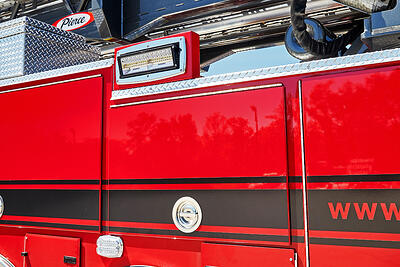
A red hinged fire truck door with a black stripes is shown in the closed and locked position.

Smooth, Clean Look. Many fire departments select hinged doors for the smooth, clean appearance and because they offer a more traditional look for fire apparatus. In many instances, fire departments are accustomed to hinged panel doors because that is what has been used historically and choose to maintain the same look and feel with new apparatus selection.

Easy Operation and Functionality. With a hinge construction, fire departments have little to worry about in regards to operational efficiencies, because of the intuitive construction and ease of operation.

Minimal Maintenance. The simple, clean construction of a hinged door with lock-tight screws means maintenance is minimal. Washing the doors regularly with warm, soapy water and lubricating the hinges to maintain smooth open and close functionality are the only maintenance required.

Minor Equipment Interior Mounts. With a smooth interior door finish, a fire department can opt to include minor equipment attachments on door interiors. An axe, bolt cutter, rope, cord or other lightweight tools can be mounted to the interior door panel to optimize storage space.

Maximum Storage Space. The ability to use the full compartment, floor to ceiling.

Operator and Vehicle Safety

Hinged doors offer some unique operator and safety benefits, including:

  • Hinged doors open up or out and require operator understanding of the amount of space required to open and move around the door. As part of strategic response planning, firefighters must be cognizant of their compartment door type and place the truck appropriately on-scene.
  • Off-road, woodland and rough terrain are not a problem for hinged doors, with sturdy hinges and closure systems to appropriately protect the contents inside.
  • Hinged doors that lift up with a horizontal hinge have been used to provide shade for firefighters in warm climates. The ability to quickly erect a shading solution at an emergency scene is an added benefit of a hinged door.

Hinged door construction offers many benefits and added features that make it a great option for fire departments seeking a more traditional, clean and sleek appearance. How do hinged doors compare to roll-up doors? Keep reading to learn more.

What is a Roll-Up Door?

A roll-up fire truck door is constructed of a series of double-sided extrusions that are sealed together to open vertically and gather in a roll at the top of the compartment out of sight.

Roll-up doors are sometimes referred to as shutter-style doors.

Roll-up doors can be used on the driver and officer side of the fire truck, as well as the rear of the vehicle. Roll-up doors offer quick and efficient access to equipment at an emergency scene.

Roll-Up Door Construction

Roll-up doors are constructed of aluminum extrusions that are joined together to create a solid, yet flexible protective door. Each door rolls up on a spring-loaded roller take-up spool and disappears into the header at the top of the compartment opening.

The extrusions run through tracks on either side of the compartment opening and are sealed from top to bottom to prevent water, dirt and debris from getting stuck in the tracks.

Roll-up doors can include a lift-bar with contoured bottom flange cut-outs to allow for easy opening and closing even with gloved hands.

Some additional features of roll-up doors include:

  • A smooth interior wall that provides protection against equipment hang-ups.
  • Individual extrusions that can be removed and replaced easily.
  • Highly durable seals with resistance to UV light and designed to perform in both extreme cold and hot temperatures.

Benefits of Choosing a Roll-Up Door
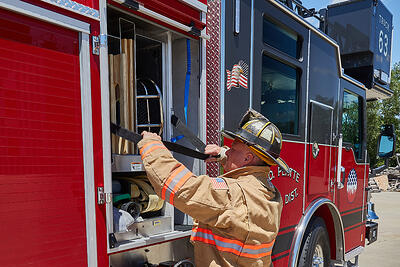
A firefighter at an emergency scene opens a compartment roll-up door to access equipment inside. There are many benefits to choosing a roll-up fire truck door.

Modern Look. The more modern look of sleek roll-up doors is something many fire departments are drawn to. Doors can be painted to match the apparatus or can include custom designs.

Fast Access to Equipment. Firefighters can quickly and easily open roll-up doors at an emergency scene, knowing they spool up in the header and not in the way when accessing equipment.

Full Sight Lines at an Emergency. Roll-up doors are rolled up at the top of the compartment opening, which means there are no visual barriers around the perimeter of the apparatus.

Bracket-Free Interiors. Some fire departments prefer the bracket-free interior that comes with roll-up doors. The compartment interior is clear, and equipment can be accessed easily.

Operator and Vehicle Safety

Roll-up doors offer some unique operator and safety benefits.

  • Roll-up doors allow compartments to be opened in parking bays to air-out or dry gear between calls. There is never a concern about hitting a door upon exit or damaging the firehouse walls.
  • Strategic apparatus placement at the fire scene can be more forgiving. The doors roll-up into the header and are easy to access and open in even the tightest rescue scenarios. This makes truck roll-up doors particularly suited to perform in busy highway rescue operations and the narrow roadways of urban areas.
  • The area around the truck can become crowded at an emergency scene. With rollup doors, firefighters maintain lines of vision around the apparatus and don’t have to move around any barriers to access equipment or gear.
  • Additional Compartment and Door Safety Features

Additional Fire Truck Door Features 

Whether a fire department decides to choose a hinged or roll-up door, there are several additional features that Pierce Manufacturing is proud to offer customers as they build a custom apparatus, including:

  • Manual and electric locks
  • Keyed locks
  • Door ajar switches
  • Door pull-straps

As you determine the right type of door for the missions of your department, reach out to one of our trusted dealers with further questions.

Which type of compartment door does your fleet use? Why do you love it?

Originally posted by Pierce
UL explore sustainability trends in Asian business

UL, a global safety science company, has helped companies adopt more sustainable practices for more than 10 years. In a new white paper, Five Sustainability Trends for Businesses in Asia, UL explores five sustainability trends that are impacting businesses across Asia as they pursue measures in accordance with the UN SDGs.

Adopted by 193 countries in 2015, the UN Sustainable Development Goals outline 17 objectives designed to end extreme poverty, reduce inequality and protect the planet by 2030. Companies worldwide are aligning their sustainability plans to take their part in advancing these critical objectives. In fact, 72% of companies mentioned the SDGs in their reporting, according to PwC. This has driven companies to pursue a variety of sustainability initiatives that demonstrate progress toward global sustainability goals:

  • Convergence of green and wellness in building standards – Support of human health and wellness is increasingly a priority among businesses. By ensuring indoor environments offer good air quality and other wellness features, companies protect occupants and increase productivity.
  • Driving insights and performance from environmental data – Growing demand from green investors, consumers and regulatory agencies alike calls for companies to advance their sustainability reporting. Comprehensive reporting from across the organization is quickly becoming commonplace.
  • Innovation optimises manufacturing processes – In the midst of increasing urbanization and a growing global population, we face particular urgency for effective waste management solutions. Companies will continue to advance this effort with rigorous verification of recycling and other waste diversion strategies.
  • Rise of the circular economy – With e-waste expected to reach 52.2 million metric tons by 2021, according to the Global W-waste Monitor, there is growing pressure to achieve more responsible consumption and production through circular business models. Companies will continue to pursue innovative circular models that will prove sustainable in the new economy.
  • The advent of carbon regulations – As more countries introduce carbon regulations in an effort to mitigate climate change, businesses will work to increase their carbon emissions reporting.

Asian business introducing sustainability efforts

“We are excited to see leading businesses in Asia introducing these sustainability efforts into their strategy, reporting and daily operations. As local companies expand their sustainability efforts and report on progress toward the U.N. Sustainable Development Goals, UL will be here to offer the expertise, solutions and support to help them on their journey,” said Alberto Uggetti,  vice president and general manager of UL’s environment and sustainability division.

UL is a leader in science-based safety and sustainability solutions and manages some of the most respected and rigorous sustainability programs in the world, including UL GREENGUARD for low-emitting products and UL ECOLOGO, a certification for products that achieve reduced environmental impact and sustainability software and reporting tools, such as UL’s 360 Software and Turbo Carbon™. UL supports companies worldwide with solutions that build transparency and trust through testing, inspection and certification.

To download the white paper, visit five-sustainability-trends-businesses-asia or explore our other resources or solutions at www.UL.com.