Seek Thermal, a leading manufacturer of affordable, high-performance thermal imaging sensors and products across the globe, today announced the expansion of its Mosaic Core™ family, which now includes 53 total product offerings. This wide range of highly versatile OEM Thermal Cameras are configurable by resolution, field of view and frame rate – for virtually any application – to give developers the ability to integrate high-resolution thermal imaging into even more products that can be manufactured and sold under their own brand.
Designed for performance and versatility to enable new applications and products, the Mosaic Core is available in 320×240 and 200×150 resolution and is now more customizable to meet any program or project need. Applications include, but are not limited to, Test & Measurement, Security Surveillance, Public Safety, Outdoor Recreation, IoT, Personal Vision System, and beyond.
The benefits of integrating Seek Cores include:
Best Price for Performance: Unmatched price-per-pixel with excellent image clarity and sensitivity
Low Power & Lightweight: Engineered to optimize performance with low power consumption, packaged in a small, lightweight design
Easy to Use Development Tools: Get access to SDKs, APIs, visual tools, support documentation, and other important tools to ensure projects are successful
Dual-Gain Smart Pixels: Maximize resolution contrast when viewing scenes with extreme temperature differences
12 Micron Pixels: More resolution packed into a physically tiny array enables small form factor applications and lower cost
Flexible Integration: Starter Kits have everything developers need to evaluate and integrate thermal imaging into a variety of platforms
“With our full family of Mosaic Cores now available, implementing and delivering high resolution thermal technology has never been this simple and affordable,” said Sumitra Giri, Senior Product Manager, Seek Thermal. “As part of our mission to offer thermal imaging solutions for a better and safer world, we strive to make it easier for any developer or company to explore the possibilities of thermal imaging. To achieve this, our increasing line of cores deliver the high-end thermal capabilities, accuracy, and performance needed for virtually any existing – or revolutionary – application or product.”
Starter Kits are available for simple, plug-and-play thermal imaging to kick off evaluation and testing. Additionally, the Simple Viewer, along with access to the Developer Portal for Seek Thermal SDKs, APIs, and other important tools, enables any project team to begin successful development quickly and easily.
Mosaic Core Specifications:
320×240 or 200×150 Sensor Resolution
15˚ to 105˚ Field of View
10 x 20 x 21mm to 23 x 20 x 21mm (L x W x H)
-40C to 330C Detection
Up to 32Hz and <9Hz Frame Rate
Seek Thermal products and thermal cores are designed and manufactured in Santa Barbara, California with Global Components. For more information, watch this video or visit: https://www.thermal.com/oem.html
An innovative online tool to help people identify fire hazards at home has been launched by London Fire Brigade. The Home Fire Safety Checker allows people to receive tailored advice based on their building and guides Londoners around the rooms of their home to help them identify any risks and hazards.
The tool is the latest innovation developed by the Brigade as it tries to make people living in one of the world’s most complex and diverse cities safe.
In 2018, the Brigade was the first fire service in the UK to begin using fire escape hoods, which were used successfully at the recent New Providence Wharf fire and new ways of fighting fires in high-rise buildings have also been introduced.
The launch of the checker comes days after concerning images of the blaze at New Providence Wharf were circulated across social media. Firefighters hope that doing an online fire safety check could help residents worried about safety in their flat.
In addition, they also want to reassure residents that procedures for how high-rise fires are responded to made a significant difference to how the recent fire was resolved.
These include:
the increased number of resources and firefighters sent to all high-rise fires as standard;
new procedures on how information is relayed from Control Officers to the incident ground and back, including vital details about fire survival guidance calls;
and the introduction of fire escape hoods which were used to rescue 22 people from the fire.
The Home Fire Safety Checker is another measure which the Brigade has introduced to encourage people to do all they can to identify fire hazards at home as well as what to do in the event of an emergency.
After reports emerged of residents purchasing rope ladders to carry out their own escapes and many instances of residents ignoring their buildings’ evacuation plans following the New Providence Wharf fire, the Brigade is warning people that they could be putting themselves at more risk by taking drastic measures and is encouraging them to use the checker to familiarise themselves with their home.
The Brigade wants to focus as many of its in-person Home Fire Safety Visits on vulnerable people and the online checker is an easy to use tool for everybody. It will signpost people to book an in-person visit if any significant risks are raised.
The Brigade’s Deputy Commissioner, Richard Mills, said: “We completely understand that people have seen concerning images recently, but this is a message to all Londoners – have faith in us. In London, in the past year a fire engine has been at the scene of a fire, on average, within five minutes.
“If you are living in a building with flammable cladding please make sure you familiarise yourself with what action you should take in the event of a fire. In the majority of high-rise and purpose-built blocks of flats in London, as long as they are properly maintained, you are usually safer to stay in your flat unless you are being directly affected by smoke or fire.
“To further reassure people, we are pleased to launch the Home Fire Safety Checker which has been developed by the Brigade using a collaborative approach with both internal departments and external stakeholders, including people who have received in-person Home Fire Safety Visits.
“This checker isn’t just about clicking boxes – we hope it will really make people think about the potential fire hazards in each room of their home and feel like they have taken action to make them and their families as safe as they can be.”
Home Fire Safety Visits were introduced in a bid to prevent accidental fire deaths and injuries in the home as well as to reduce the number of fires occurring
Since they were launched in London in April 2005, more than a million visits have been carried out and staff have given advice to more than 2.5 million people
The Brigade has installed more than 938,000 smoke alarms and more almost 28,000 pieces of specialist equipment such as alarms for deaf or hard of hearing people
Alison Hayward, Director at 3ET, looks at what measures should be put into place to ensure everyone can be evacuated safely in an emergency
Being able to evacuate a building quickly and safely is an integral part of any fire safety strategy.
Indeed, those who neglect to put proper evacuation measures into place can be found guilty of failing to provide a duty of care and face significant fines and even imprisonment. So, what constitutes a ‘proper evacuation measure’ and how do organisations go about ensuring they comply?
The requirement
The Regulatory Reform (Fire Safety) Order 2005 (England and Wales), the Fire Safety (Scotland) Regulations 2006 and the Fire Safety Regulations (Northern Ireland) 2010 state that commercial buildings, non-domestic and multi-occupancy premises must appoint a ‘responsible person’ who is required to ensure the safe evacuation of the premises in the event of danger or an emergency.
This Responsible Person, or a person acting on their behalf, is required to carry out certain fire safety duties which include ensuring the general fire precautions are satisfactory, demonstrating they can evacuate all persons without the assistance of an external service and conducting a fire risk assessment.
An important part of this risk assessment under the Disability Discrimination Act 1995 and the Equality Act 2010 is to consider anyone with mobility or serious illness issues who would be unable to exit the building in an emergency. This includes able-bodied people with temporary changes in mobility, for example, a broken ankle or leg, or anything that might prevent them from evacuating quickly and safely, such as pregnancy or breathing difficulties. Their needs should be identified and a Personal Emergency Evacuation Plan (PEEP) or a General Emergency Evacuation Plan (GEEP) devised.
In the UK today, 7.6 million people between the ages of 16 and 64 have some form of disability such as the above, equating to approximately 1 in 8 people. This makes it highly likely that, in the event of an emergency, someone in the building will require additional assistance and it’s vital that the equipment and planning is in place to manage the process safely and efficiently.
Planning an evacuation
The evacuation plan should be specific to the premises and explain the method of evacuation, including details of escape routes, the evacuation equipment available and those persons involved in making it happen, to ensure everyone on the premises knows their role in an emergency.
According to comparethemarket.com, 54% of people in the UK wouldn’t know what to do in the event of a fire, so the importance of disseminating this information throughout an organisation cannot be emphasised enough and the details should be re-examined and refreshed regularly.
Employees should also undergo practical training in the use and operation of vital emergency evacuation equipment.
Choose the right equipment
Equipment in this case traditionally means evacuation chairs, also known as emergency chairs. These specially-designed chairs have tracks that attach to the stairs to create friction, slowing down the descent and allowing an individual to be carefully lowered down stairs. Once on the ground the chair can be used as a wheelchair to aid further evacuation.
These specially-designed chairs have tracks that attach to the stairs to create friction, slowing down the descent and allowing an individual to be carefully lowered down stairs.
Generally designed to be used by a single person, in reality it’s common for extra operatives to be required, especially if a heavier person is being evacuated or multiple flights of stairs are involved. Nevertheless, they are a well-used and accepted way of evacuating individuals. However, they do have some disadvantages.
Getting a person into the chair can be difficult, especially with certain conditions or if the individual is immobile. In that situation, they would need to be lifted into the chair, and that can cause problems in itself.
Not only is it undignified to have someone pulling at your clothes and limbs to move you, but this manual handling is also a risk for the people doing the evacuating, especially with bariatric individuals. The Health and Safety at Work Act states that an employer has a duty of care to ensure staff are not injured in the process of carrying out their job. Therefore it follows that any emergency evacuation equipment provided should reduce the risk of injury to both the person being evacuated and the person/persons doing the evacuating. If there’s lifting involved, it’s not doing this.
Slide, don’t lift
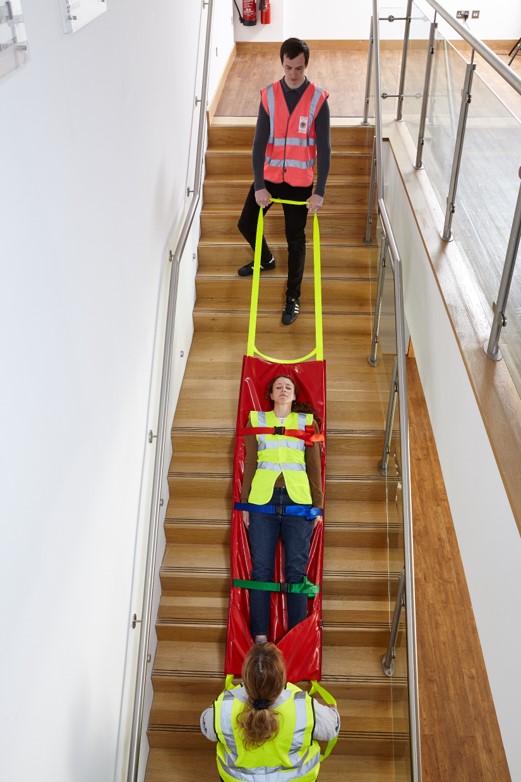
Moving a patient by sliding is much easier and safer, and our EvacPAD is designed with this in mind. A robust, padded evacuation mat with a hard, durable plastic base, it slides easily over most floor surfaces. Because it’s low to the ground, individuals can easily place themselves onto the mat or, if they are immobile or unconscious, be rolled into position, reducing the risk of manual handling injuries.
Soft-touch, high visibility pull handles at each end allow the mat to be gently manoeuvered up or down stairs and are easily seen in smoky or low light environments. The securing cross straps are colour-coded for ease and speed of fitting and have adjustable, ergonomically-shaped plastic buckles for patient comfort. A large foot pocket keeps the feet in place and there is the option to add a thermal blanket for additional warmth and protection. And because of the straightforward design, one size fits all, from a small child to a large adult, with any physical disabilities easily accommodated.
It’s very simple, quick and easy to use – but incredibly effective. And this simplicity means virtually anyone can use it.
Easy and intuitive to use
In these times of remote working and changing office culture, when training days are difficult to co-ordinate, there are obvious benefits in having evacuation equipment that is accessible and easily understood.
One of the things that comes up, again and again, particularly with evacuation chairs, is skills decay.
If you’re not using something regularly, you forget how to and lose confidence, especially with a large piece of equipment like an evacuation chair. But in an emergency situation, that hesitation could be the difference between life and death.
There is a worry that post-pandemic, businesses have so many other regulations to deal with that emergency evacuations and risk assessments will have slipped down the priority list.
It’s easy to see how this can happen. In the last year, organisations have seen some significant changes. Staff with responsibility for fire safety may have left or have been furloughed. Some firms may have grown rapidly and have different requirements both in terms of the numbers of people requiring evacuation and their specific needs. Others suffered financially and need to make cut backs. Indeed, COVID safety regulations may even have introduced issues, such as new screens obstructing access routes or changing working patterns resulting in a lack of trained staff with the right knowledge on each shift.
Some firms may have grown rapidly and have different requirements both in terms of the numbers of people requiring evacuation and their specific needs.
In these circumstances, retaining that continuity in terms of responsibility and disseminating information to the rest of the team has been difficult, especially when people aren’t meeting face-to-face.
Recent research backs that up. In a survey by commercial specialist JLA, almost half (49%) of respondents admitted that they do not train all staff on fire safety, while 12% do not offer any form of fire safety training to employees at all.
Not only are these figures concerning, they also demonstrate why we are seeing organisations move towards products such as the EvacPAD, which are ready to use at any time and require very little training to operate.
Reduced costs
Another reason for the increase in popularity is the cost savings to be made. A single EvacPad is around 75% cheaper than an evacuation chair and comes without the need for an annual maintenance contract, saving thousands of pounds year on year. In buildings where multiple evacuation aids are required on multiple floors, this adds up to a significant saving.
Without hesitation
When it comes to fire safety and emergency evacuations, having a strategy in place is vital – but it’s only part of the picture. If the evacuation equipment available isn’t fit for purpose or the individual or team isn’t confident operating it, then no matter how good the planning is, the reality has the potential to be a disaster. Don’t wait for that to happen in your organisation.
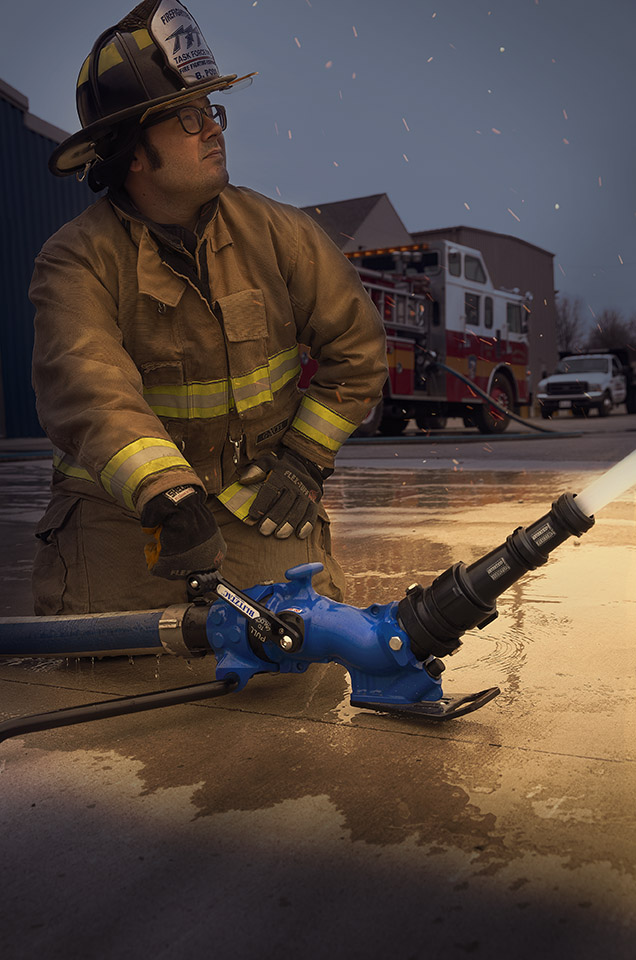
Task Force Tips (TFT) new BLITZTAC portable monitor brings best in class performance to the global fire service once again. From the innovators of the ground-breaking, and still unmatched BLITZFIRE monitor, comes a new lightweight and compact portable monitor that has a standard of safety and is definitely not lacking in tactical ability neither.
Coming in at under 15 lbs (7 kg) it allows for quick advancement with only one firefighter and one hoseline. Aside from the ability for advancing quickly for the attack the size and weight, enable easier storage on any given apparatus. Pre-connected to a hoseline, mounted to the back of the apparatus or kept in a compartment, this compact monitor can be stored anywhere and can always be ready at a moment’s notice.
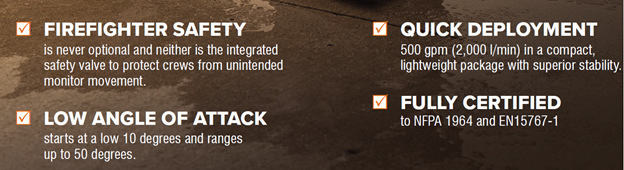
Safety comes standard with the BLITZTAC. The safety gating inlet engages if unintentional movement would ever occur, and once it is engaged, it restricts the flow area about 60 -70%. This restriction adds safety for crewmembers, keeps the delivery of the water to the fire, eliminates water hammer, and gives the firefighter the ability to shut the monitor down, realign the safety-gating inlet, and continue to deliver full flow to the intended target.
Tactical ability remains as a strong asset with the BLITZTAC. TFT innovated the un-assisted low 10 degree attack angle and the BLITZTAC offers a different but similar advantage. The low 10 degree attack angle of the BLITZTAC is assisted and can be held down to 10 degrees for an offensive or defensive fire attack.
With the Safety, Tactical Ability, and its inherently compact and lightweight design, fire crews are taking a closer look at this portable monitor that allows for active offensive or defensive firefighting capabilities. Take a closer look at TFT.com/BLITZTAC.
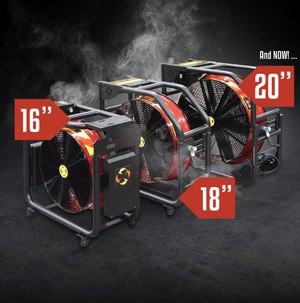
Equipped with DeWalt FLEXVOLT batteries or Milwaukee M18 or M28 REDLITHIUM batteries, these fans deliver some of the industry’s highest battery fan outputs. Moreover, with the introduction of these fans, Super Vac continues to offer the most interchangeable PPV interface on the market, pairing with many departments’ other battery-operated products to simplify battery purchases.
“The addition of these 20” fans delivers on the high output needs of departments looking to ventilate larger structures with a fan that is compatible with their other battery tools, giving you a choice when you look to purchase battery-powered equipment.” Super Vac President Roger Weinmeister said.
Weighing 60 lbs., each fan features a 28.25” x 28.75” x 12.5” (HxWxD) footprint while delivering the same great design of Super Vac’s 18” battery fan, including fold-down ergonomic handle, flat-proof rubber tires and 180-degree tilt for varying angles of attack.
Among the 20” models, the V20-BD runs off dual DeWalt FLEXVOLT 9.0 Ah or 12.0Ah batteries, delivering a 13,000 cfm output and up to 40 minutes of run time. Meanwhile, the V20-BL produces 12,500 cfm and up to 50 minutes of run time on dual Milwaukee M18 batteries. The V20-BW is powered by Milwaukee’s M28 battery; output to be determined.
Adding to the V20’s extreme versatility, the fan also pairs with a wide assortment of Super Vac accessories, including carry strap, apparatus mount, 20” duct, Mountain Mister (for rehab) and high-expansion foam adapter.
Armstrong Fluid Technology has announced that Design Envelope pumps with Permanent Magnet motors are now available NEMA 4X/IP66 rated, for outdoor installation.
Featuring advanced performance mapping technology and load-limiting logic, the new pumps reduce energy consumption by as much as 30% compared to pumps supplied with a loose variable speed drive. Together with new more efficient pump hydraulics, the new 1 to 10hp pumps can save an additional 20% compared to competing integrated products with induction motors.
Other features of the new Design Envelope outdoor pumps include:
• Cover to protect touchscreen user interface from dirt & sunlight
• Overhead weather shield protects motor fan from ice seizures
• Factory-tested NEMA 4X rated controls are TL approved
• Available Parallel Sensorless control provides additional energy savings through best-efficiency staging
• Available Pump Manager service provides pump performance tracking along with alerts, alarms and data storage
“The conventional approach to rooftop and outdoor pumps is to install VFDs in a central, outdoor-rated control panel, separate from the pumps. This adds unnecessary costs and requires a larger footprint” said Zeljko Terzic, Global Offering Manager, Pumps. “Our new Design Envelope pumps feature integrated controls for a reduced footprint and substantially reduced installation costs.”
For more information visit www.armstrongfluidtechnology.com
Modern emergency and safety lighting requires central monitoring and automatic testing of individual luminaires. In the case of existing systems, retrofitting is often difficult as additional wiring is needed for communication. Tridonic can remedy this with its new wireless emergency lighting system. It combines the proven Tridonic technologies of basicDIM Wireless and sceneCOM and is suitable for both renovations and new installations.
In a connected industrial society, a power outage means not only high economic damage but also the risk of accidents. Safety and emergency lighting systems play an important role in building safety. Operating independently of the existing power supply, these systems help people quickly find their way out of the building in an emergency and thus to safety.
Strict maintenance and testing regulations therefore apply to safety and emergency lighting systems: Not only must they be regularly checked by trained specialists, their condition must also be documented in a test log. To make sure that testing and maintenance work is properly documented, thereby increasing building safety, more and more countries require central monitoring and control for the automated testing of single battery powered systems.
For example, German pre-standard DIN VDE V 0108 and Austrian standard OVE E 8101 recommend or require central reporting of operational readiness, operating mode and collective faults of safety lighting systems. This means that in future, emergency luminaires for single battery operation in both countries will have to be equipped for central testing instead of manual testing as before.
Both new regulations apply to new buildings as well as to the renovation of existing installations. As standards and regulations become increasingly international, it is safe to assume that further European countries will adapt the existing directives for emergency and safety lighting systems accordingly.
Standard-compliant retrofitting is difficult in existing buildings
This is putting pressure on many emergency lighting operators. Complying with the requirement for a central test facility calls for intensive planning and involves high costs. In the case of existing systems, central monitoring can only be implemented by installing additional wiring. At best, this is a time-consuming and labour-intensive operation, and at worst may not be possible at all. Alternatives are needed in order to continue to comply with the regulations.
Help is at hand in the form of Tridonic’s new wireless emergency lighting system. It can be integrated into existing installations without the need for additional wiring and conforms to the relevant standards. The wireless system also offers advantages for new buildings. There are overall cost savings as less time and effort is needed for planning and commissioning, and material costs are also reduced.
All the benefits of a central monitoring system – with minimal installation work
For its new emergency lighting system Tridonic combines its user-friendly Casambi-ready basicDIM Wireless control technology with sceneCOM DALI-based lighting control. Tridonic uses the proven basicDIM Wireless system as the backbone of the new solution, providing wireless connectivity for the emergency luminaires via a fail-safe mesh network without any additional cabling or structural changes.
The luminaires are set up via Bluetooth Low Energy (BLE). Existing DALI emergency luminaires with a PRO emergency lighting unit can be easily upgraded and integrated into the wireless network. For this purpose, Tridonic offers the also new, compact basicDIM Wireless G2 module.
A gateway connects all the wireless emergency luminaires to a sceneCOM evo controller. Once commissioned, the controller acts as the “brain” and takes over command of the entire lighting solution – fully automatic and exactly as the user requires. This also applies to the required central monitoring and automatic testing of emergency and safety lighting systems. Tridonic has developed a control logic that enables the controller to automatically test the individual luminaires integrated in the network and to display the system status in real time.
The test and system data is accessed via Ethernet from any web browser. Up to 192 luminaires can be connected to each sceneCOM evo controller.
Automatic testing and log book at the touch of a button
With its wireless emergency lighting system, Tridonic provides building operators and electrical engineers with a simple solution that automatically checks the installation at the prescribed intervals and records the condition of each individual luminaire in the wireless network in real time.
In conventional installations without central monitoring, appropriately qualified personnel must operate each individual emergency luminaire in the building and check it manually. The new Tridonic solution means that the luminaires are now centrally monitored and automatically tested. External access is via a PC, notebook, tablet or other internet-enabled device.
The dashboard provides information at a glance about the current state of the system and the latest test results. And with just a few clicks, you can get detailed information about the status of each luminaire in the network. This includes the condition of the battery as well as the status of the LEDs and associated electronics. At the touch of a button, the system also automatically creates a standard-compliant log book with all the relevant information for downloading as a PDF or XML file. If a fault occurs in the lighting system, it can be seen on the dashboard. On request, a software package can inform the asset manager about faults and errors via email.
Thanks to new em-LINK v2 server application from Tridonic, all of these features are also available for large installations with multiple sceneCOM evo controllers, such as all the buildings on a large campus or retail outlets at different locations. It can connect up to 200 sceneCOM evo controllers and therefore as many as 38,400 individual luminaires.
A web application makes it easy to select the separate installations and check their status. The building managers are thus spared routine travel to the various buildings or branches; they are only required on site in the event of a malfunction or for replacing individual system components. This greatly reduces the time and resources required, and specialist staff can concentrate on their work without unnecessary travel.
Easy retrofitting, easy planning and automatic testing – with no unnecessary effort or materials
The benefits of the wireless emergency lighting system from Tridonic are self-evident. As no additional cabling is needed, electrical engineers benefit from simplified planning. Only the power supply has to be taken into account. That makes installation easier. Thanks to simple cable routing, very little material is required, and the time needed for the job is manageable. However, the system still complies with all current standards relevant to emergency lighting – even in the case of retrofitting in existing buildings.
The wireless system saves time for the electricians responsible for maintaining the installations. Central automatic testing of separate installations and direct access to the system data reduces the workload enormously. Less time is required to test the individual emergency luminaires and less time is spent in the car travelling from installation to installation. With the aid of the web application, the luminaires can be easily assigned to rooms during or after commissioning and can be named accordingly.
Luminaire manufacturers can easily convert standard emergency luminaires equipped with a PRO emergency lighting unit into wireless emergency luminaires with the new Tridonic basicDIM Wireless G2 module. As a space-saving wireless unit, the Casambi-ready module is ideal for installation in the luminaire. It has an integrated DALI supply so no additional device is required. Firmware updates are available wirelessly on any Android or iOS device.
The relevant components of the wireless emergency lighting system are BSI Kitemark™ certified and comply with all standards and regulations relevant to emergency lighting.
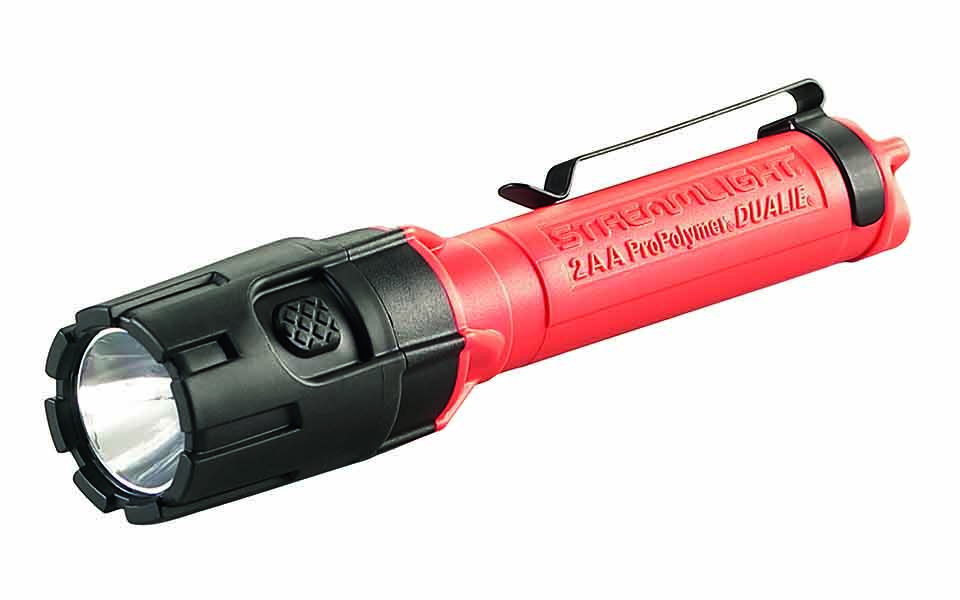
With a history of providing high quality emergency lighting solutions, Streamlight have once again delivered excellence with the Dualie® 2AA flashlight. The multi-functional flashlight allows users to see what’s ahead of them as well as right in front of their feet. Its bright light, which shines both ahead of you and downward, helps you avoid slips, trips and falls.
The Dualie® 2AA is an intrinsically safe, high performance, battery powered multi-function LED flashlight. The flashlight features a forward-facing LED spotbeam and a side facing LED flood light that can be used individually or at the same time for enhanced safety. The flashlight has opposing switches for easy user activation of desired function(s). Includes removable, reversable clip and integrated magnet for hands free use. The light’s spot beam delivers 115 lumens, 3,100 candela over a 111m beam distance; flood light offers 115 lumens, 75 candela and 17m beam distance. The combined spot/flood setting offers 175 lumens and a run time of 15 hours.
The Dualie® 2AA also comes with two white LEDs and three lighting modes, spot, flood and the spot/flood combo. Two beams that intersect for optimum path illumination and no blind spots gives the user a better field of vision.
The flashlight offers dual head switches on either side of the body for easy beam selection and one-handed operation, it is also durable, non-conductive, corrosion-proof polymer resin; rocky stipple texture for a sure grip.
For operations that pose a risk to equipment, the flashlight is built with unbreakable polycarbonate face cap and side lens with scratch-resistant coating, IPX4 water-resistant; 2m impact resistance tested and an unbreakable pocket clip.
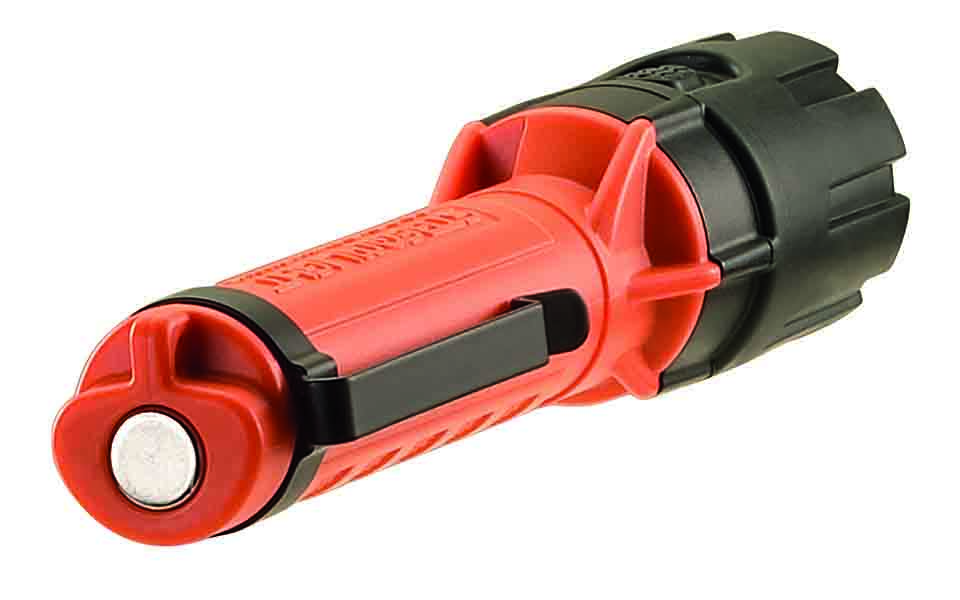
For ease of use the Dualie® 2AA has an integrated magnet on the tail end for hands-free use.
Product specifications
High Lumens – 175 Run Time on High – 15.00 hours Run Time on Low – 24.00 hours Beam Distance – 111 meters Max Candela – 3,100 Battery Type – AA Alkaline Battery Quantity – 2 Length6.10 inches – (15.49 centimeters) Weight – 3.90 ounces (110.56 grams) Colors – Yellow, Black
For more information on the The Dualie 2AA visit the Streamlight website.
C-TEC’s new CAST ZFP fire alarm system is protecting an exciting new hospitality venture in Cheshire
Situated in the beautiful village of Tattenhall, The Bear and Ragged Staff has been radically transformed from a derelict shell into a high-end pub, restaurant and hotel by a team of talented professionals including Brian Mellor, an award-winning chef, and Martin Hilton, an industry-renowned beer sommelier. Featuring a fabulous bar/restaurant, eight ensuite bedrooms and a first-floor function room, the magnificent venue is prominently positioned on the High Street and set not only to become a focal point in the village but also attract clientele from far and wide for celebratory and corporate events.
At the heart of the building’s life-safety systems is a C-TEC CAST ZFP fire panel connected to over 100 CAST detectors, sounders, VADs and ancillary devices spanning over four floors. The master 2-loop ZFP panel is located in a storeroom but relays key system information to a state-of-the-art Compact Controller prominently displayed in the elegant reception area. With its bright easy-to-use touchscreen-control interface, the controller is stylish, highly visible and can be easily accessed by the fire and rescue service and authorised personnel if required.
CAST ZFP chosen for its innovative software
Said John Westerman, Director of Wrexham-based Allied Fire Alarms Ltd, the company that specified, installed and commissioned the system: “We chose CAST ZFP as the cornerstone of The Bear’s L2 BS 5839-1 system as it is powerful, intuitive and has the capacity to connect to multiple intelligent devices. Our client also had some specific requirements for fire detection in certain areas which were facilitated using CAST’s innovative software and extensive programming capabilities.”
“We were delighted to be involved with this project. As an NICEIC-approved specialist fire company, we pride ourselves on delivering top-quality life-safety systems to our client’s satisfaction and the CAST system we designed and installed has certainly exceeded everyone’s expectations.”
CAST is C-TEC’s own UK designed and manufactured ‘distributed intelligence’ addressable fire detection and alarm system. Certified to all relevant EN54 product standards, including EN54-13, CAST is also fully compatible with ENVISION, C-TEC’s powerful new remote access, data management and system testing software.
A new charitable non-profit organisation has started that will make donations of life-saving fire suppression equipment around the globe, initially to police, military, emergency services and firefighters. As contributions build – most expected from support from the property & liability insurance industry and others who want to protect people, pets and property in peril – FR+ will begin making donations to schools, healthcare and religious institutions, the Arts, and more! Equipment has already been donated to the Hartland Wisconsin Fire Department with events being planned for major donations to several large U.S. cities and the U.S. military initially.
FR+ Chairman and President, John Black Sr., CPCU, stated, “The equipment we will donate primarily consists of hand-held emergency fire suppression tools – both aerosol and powder. These tools will help protect people, pets and property. As we begin what will be an incredible journey, we feel humbled and blessed to be allowed to work with so many great people – heroes really – helping and supporting other heroes.”
CEO Faustino Bernabo, of FR+’s strategic partner, Elide Fire USA of New York, New York stated, “Our devices are self-contained generators of fire suppression powder. Our devices have a long “shelf life” – over 7 years – so maintenance is tremendously reduced. Unlike a fire extinguisher, they do not require anyone to fight a fire. After some training – for proper use and deployment – First Responders learn to simply THROW AND GO!™ and get people and pets away from the danger.”
Since first responders are all over the globe, risking their lives to save others, FR+ plans to make donations worldwide. Affiliates, so far, are in over 75 countries, and by partnering with the insurance industry this reach will quickly expand. The equipment is especially useful in areas where water is scarce, or fire suppression infrastructure is lacking.
Steve Franklin, COO of insurance software services provider Sunlight Solutions of Minneapolis, Madison, and Paris, France was so impressed with the new charity his company has joined a small anonymous group to make an initial capital contribution to be used in a matching donation challenge. For the next 30 days Sunlight and Group will match up to $250,000, and plans to make a similar match each year for the next decade. Additionally, the company providing software to manage the charity’s logistics and infrastructure. Mr. Franklin commented, “What FR+ is going to do will simply change the world for the better. And we believe the insurance industry should join us in this effort as all of us will benefit from the fire risk mitigation and overall goodwill!”
Such a donation, with expected matching, will purchase over 3,000 life-saving devices, avoiding hundreds of millions of dollars of insured losses as well as saving thousands of lives.