How to Test Smoke Alarms Properly

A smoke alarm is one of the most important safety devices in the home, yet they’re often overlooked until it’s too late.

If you have one installed, testing your smoke alarm regularly is a simple task that can save lives.

To test a smoke alarm, press and hold the test button on the front panel until you hear a loud, continuous sound.

If the alarm does not sound, replace the battery. If it’s a sealed unit, speak to a specialist to replace the alarm. 

You can also use a smoke detector test spray or safe smoke source to check the sensor, following the manufacturer’s guidance.

Our article explains exactly how to test your smoke alarm properly, how often you should test it, what to look out for, and what to do if something’s not right.

Whether you’re a homeowner, renter, or responsible for a business premises, this guide will leave you better informed and safer.

What is a smoke alarm and do I need one?
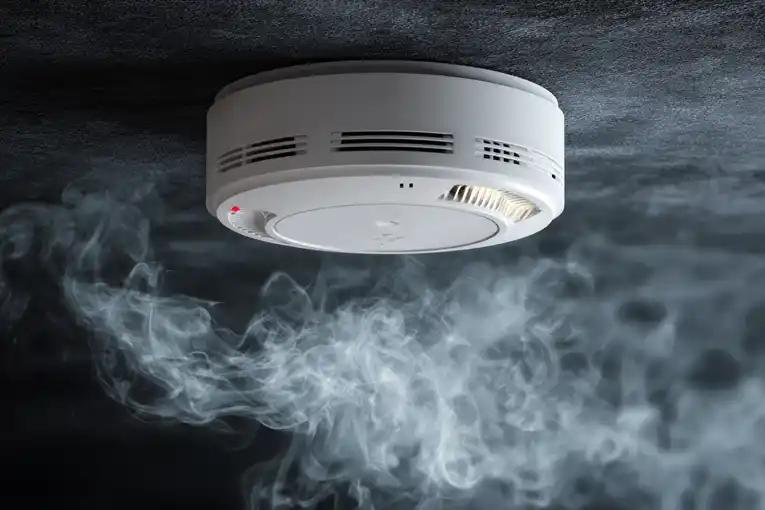
What is a Smoke Alarm

Smoke alarms are devices specifically designed to detect smoke (a primary indicator of fire), and sound an audible warning to alert people in the building.

Most smoke alarms operate using either ionization sensors, which respond to fast, spreading fires, or photoelectric sensors, which are better at detecting slow, smoldering fires. 

Some units combine both technologies for a more comprehensive coverage.

Every single building, residential or commercial, needs a smoke alarm – bar none!

In most countries, having at least one working smoke alarm on every level of a home is a legal requirement.

In the United States for example, the National Fire Protection Association (NFPA) recommends smoke alarms are fitted inside each bedroom, outside each sleeping area, and on every level of the home, including the basement.

In the UK, Australia, and many other countries, similar laws and recommendations also exist.

Why Test Your Smoke Alarms?

Testing your smoke alarm is the only way to know its working properly.

Even if the unit appears in good working order, components inside can degrade over time.

Batteries can die. Dust or insects can clog the sensors. Wiring can loosen.

A malfunctioning smoke alarm is essentially useless in an emergency.

Fire statistics consistently show that the risk of dying in a home fire is cut in half when working smoke alarms are present.

Regular testing ensures you and your family are alerted in time to escape.

How Often Should I Test My Smoke Alarms?

Woman Testing Smoke Alarm

Experts recommend testing your smoke alarms once a month.

This frequency ensures that any battery issues, sensor faults, or connectivity problems are identified before a real emergency happens.

Here’s some additional maintenance recommendations to remember:

  • Battery-powered alarms: Replace batteries at least once a year, unless the alarm uses a 10-year sealed battery.
  • Hardwired alarms: These are connected to your home’s electricity supply but typically still have a backup battery that needs yearly replacement.
  • All smoke alarms: Replace the entire unit every 10 years, or sooner if the manufacturer recommends it or if the unit fails testing.

Marking these tests on your calendar or making them a part of your monthly routine is an easy way to stay safe.

How to Test a Smoke Alarm

Smoke  Detector
Image credit: Pixabay

Testing a smoke alarm is a very straightforward process, but it varies slightly depending on the type of smoke detection unit you have installed.

Battery Units

  1. Locate the test button: This is usually visible on the front face of the alarm.
  2. Press and hold the button: After a few seconds, the alarm should emit a loud, high-pitched sound.
  3. Listen for consistency: The sound should be continuous and strong. If it’s weak or erratic, replace the battery immediately.
  4. No sound? Replace the battery first, then test again. If there’s still no response, replace the entire unit.

Hardwired Units

  1. Locate the test button: Press and hold the test button exactly as you would on a battery-operated alarm.
  2. Interconnected alarms: If your home has interconnected alarms, pressing the test button on one unit should cause all the alarms to sound. This is normal and confirms they’re correctly linked.
  3. Backup battery: Even though these alarms are connected to mains power, always check the battery backup. If the alarm fails the test and replacing the battery doesn’t fix it, call an electrician to inspect the wiring or replace the unit.

Optional Sensor testing

If you want to test the smoke sensor itself (not just the loudspeaker or battery), you can use a smoke detector test spray.

This creates a safe, simulated smoke environment.

Unless advised by the manufacturer, avoid using real smoke such as candles or matches, as this can contaminate and damage the sensor.

Troubleshooting

If your alarm fails the test or behaves strangely, here’s what to do:

  • Weak or chirping sound: This usually indicates a low battery. Replace it and retest.
  • No sound at all: Try a brand new battery. If still silent, the unit may be faulty.
  • Frequent false alarms: Dust, steam, cooking fumes, or insects can all cause false triggers. Clean the alarm with a vacuum cleaner or soft brush. Avoid using sprays or solvents.
  • Random beeps: Some units beep to signal end-of-life, often every 30 to 60 seconds. Check the label on the back for the recommended replacement date.

Safety Tips

  • Always test your alarms after a vacation or extended period away.
  • If you’re hearing impaired, install smoke alarms with strobe lights or vibration alerts.
  • Avoid painting over smoke alarms since this can block sensors.
  • For rental properties, landlords are usually responsible for installing alarms, but tenants should still test them regularly.
  • Don’t ignore chirps or unusual sounds, since they’re indicators telling you something’s wrong.

Key Takeaways

Testing your smoke alarms is one of the simplest ways to protect everyone in your home.

It takes less than a minute, but it could be the difference between life and death in the event of a fire.

Make it a habit, stay informed, and stay safe.

When testing, press and hold the test button monthly to check your smoke alarm’s function.

Replace all batteries at least annually, or sooner as needed.

Alarms should be fully replaced every 10 years, even if they seem to function properly.

Use some test spray for a more thorough check of the smoke sensor if desired.

And address any beeping, silence, or false alarms promptly. Don’t ignore them.

Vietnam’s new fire prevention plan: can technology cut rising fire deaths?

National call for improved fire prevention and rescue

Nhan Dan has reported that Prime Minister Pham Minh Chinh has urged a nationwide effort to strengthen fire prevention, disaster response, and rescue capacity.

The Prime Minister made the call during a dialogue in Ho Chi Minh City on 14 August with businesses and officials, organised by the Ministry of Public Security.

The meeting marked the 80th anniversary of the Vietnam People’s Public Security Force and the 20th anniversary of the All People’s Security Safeguard Festival.

According to Nhan Dan, PM Chinh said that reducing deaths, injuries, and economic losses from fires requires both coordinated leadership and faster implementation of planned schemes.

He noted the long record of service of Vietnam’s firefighting and rescue police, describing them as the main operational force protecting public safety during fire and emergency incidents.

Use of science and technology in fire safety

The Prime Minister said that Vietnam must expand its use of science, technology, and innovation to strengthen firefighting and rescue operations.

He added that big data, artificial intelligence, and smart systems should be developed and applied to improve capacity.

PM Chinh also called for more international partnerships to gain access to advanced equipment and expertise.

He explained that Vietnam should produce its own fire prevention and firefighting technologies and issue manuals and guidance for both fire and disaster response.

According to the Ministry of Public Security, the country recorded more than 17,600 fires over the last five years, resulting in 560 deaths, 606 injuries, and around 4 trillion VND (153.8 million USD) in damages.

Fire and rescue police role recognised

During his remarks, the Prime Minister said that Vietnam’s firefighting and rescue police have made major contributions over the past six decades.

He described them as central to the state’s public security apparatus.

PM Chinh said: “The firefighting and rescue police force is the core force on the front line against the fire enemy and an integral part of the nation’s public security apparatus.”

Secutech+ Vietnam opens in Ho Chi Minh City

On the same day, the Prime Minister attended the opening of Secutech+ Vietnam, described by Nhan Dan as the country’s largest professional security exhibition.

The show featured 480 domestic and international brands from Vietnam, Japan, Singapore, the Republic of Korea, and China.

Exhibitors displayed a wide range of systems and devices including fire pumps, escape equipment, smoke extraction systems, fire alarms, hazardous substance detectors, firefighting robots, and drones.

The exhibition also featured passive fire protection measures such as fire doors and resistant coatings, along with firefighting suits and other protective gear.

Prime minister’s message at security exhibition

In his opening speech, the Prime Minister welcomed the role of the exhibition in aligning Vietnam’s fire prevention and security sectors with current standards.

He said: “The exhibition will raise public awareness, spark practical solutions, and advance Vietnam’s fire and rescue efforts.”

Relevance for fire and safety professionals

The Prime Minister’s call for stronger fire prevention measures demonstrates an official commitment to reducing deaths and economic losses from fire in Vietnam.

For fire safety professionals, the government’s emphasis on science, technology, and international partnerships signals potential opportunities for collaboration and knowledge exchange.

The opening of Secutech+ Vietnam also highlights the importance of exhibitions in showcasing both active and passive fire protection systems, as well as protective equipment, which are relevant to manufacturers, service providers, and training organisations.

Vietnam prime minister calls for stronger fire prevention measures: Summary

Nhan Dan reported that Prime Minister Pham Minh Chinh urged a national effort to strengthen fire prevention, disaster control, and rescue operations.

He made the remarks at a dialogue in Ho Chi Minh City on 14 August, held by the Ministry of Public Security.

The Prime Minister said Vietnam should expand use of science and technology, including AI and big data, for fire safety.

He also called for developing domestic fire prevention and firefighting technologies and publishing guidance documents.

The Ministry of Public Security reported 17,600 fires in five years with 560 deaths, 606 injuries, and 4 trillion VND in damage.

PM Chinh recognised the firefighting and rescue police as central to the country’s public security.

Earlier the same day, he attended the opening of Secutech+ Vietnam, described as the nation’s largest professional security exhibition.

The show included 480 domestic and foreign brands with products such as pumps, smoke extraction, fire doors, robots, drones, and protective gear.

The Prime Minister said the event would help raise public awareness and advance fire and rescue efforts.

Castilla-La Mancha invests €60 million in fire prevention for 2025

Government confirms €60 million fire prevention investment

The Government of Castilla-La Mancha has confirmed an investment of €60 million for fire prevention measures in 2025.

According to a government statement published on 21 July, the funding is part of a €116 million budget dedicated to forest fire prevention and suppression across the region.

Second Vice President José Manuel Caballero announced the investment during a visit to ongoing work on the Camino de Ventillas, a forest access road connecting Solana del Pino and Fuencaliente.

The initiative includes maintenance and adaptation of infrastructure to support wildfire control and emergency evacuation efforts in high-risk areas.

Caballero said the government has increased its budget by €4 million compared to last year’s allocation.

Castilla-La Mancha campaign includes firefighting and awareness efforts

According to the regional government, the full €116 million budget covers both prevention and firefighting.

The government said €56 million of the total amount has been allocated to ongoing suppression efforts during the summer fire season.

Castilla-La Mancha currently has 2,800 personnel assigned to the campaign.

Of these, over 2,000 are forest firefighters employed through GEACAM, supported by environmental agents and staff from the Ministry of Sustainable Development.

The campaign also includes 249 aerial and ground units and 114 fixed surveillance stations distributed across the region.

Camino de Ventillas project supports prevention and evacuation

During his visit to Solana del Pino, José Manuel Caballero reviewed the fire prevention works on the Camino de Ventillas.

The government said this path links the CR5001 road with the N420 and is critical for accessing forest areas around Solana del Pino and Fuencaliente.

The project includes upgrades to improve access for firefighting equipment and evacuation routes for residents.

The government reported a total investment of €1,462,371 into the work, funded 75 percent by European FEADER funds.

The remainder is supported by the regional government through the Ministry of Sustainable Development and the national Ministry of Agriculture, Fisheries and Food.

Local mayors welcome improved access and fire prevention

The mayors of Solana del Pino and Fuencaliente have welcomed the fire prevention project.

Josefa Poyatos and Rubén Paz thanked the regional government for what they described as a commitment to improving local safety and daily infrastructure.

Caballero and Provincial Delegate Casto Sánchez said the works address a long-standing request from residents of both municipalities.

Caballero said: “This was a historical demand that will become a reality by the end of the summer.”

He added: “The regional government is committed to ensuring the well-being of all residents of the region regardless of where they live.”

Infrastructure project replaces previous intergovernmental plan

The Camino de Ventillas upgrade was originally included in an agreement between the Ministry of Sustainable Development and the Provincial Council of Ciudad Real.

The Government of Castilla-La Mancha said the project is now being delivered by the regional authority after receiving no response from the provincial council.

The government said the goal of the works is to protect forest land by providing improved access for emergency responders.

It added that the same infrastructure improvements will help residents evacuate in case of fire and improve daily transport between rural areas.

The government said the dual benefit of land protection and community access was a core part of the planning process.

Castilla-La Mancha invests €60 million in fire prevention for 2025: Summary

The Government of Castilla-La Mancha has allocated €60 million to fire prevention efforts in 2025.

This funding forms part of a wider €116 million campaign budget.

The announcement was made by Second Vice President José Manuel Caballero on 21 July 2025.

The funding includes both preventative work and suppression of active fires.

The government said the budget increased by €4 million compared to 2024.

Castilla-La Mancha’s team includes 2,800 personnel, over 2,000 of whom are GEACAM firefighters.

A total of 249 vehicles and aircraft are supporting the campaign.

The region also operates 114 fixed surveillance points.

A public awareness campaign was launched under the slogan “Nothing happens until it happens.”

Work is ongoing to improve the Camino de Ventillas for fire control access.

The path upgrade project has received €1.46 million in funding.

Seventy-five percent of the project cost comes from European FEADER funds.

The remaining funding is provided by the national and regional governments.

Local mayors supported the project and its benefit for residents’ safety and mobility.

Ranger strengthens fire prevention services with Irish acquisition

Acquisition expands Ranger Group’s Irish fire prevention capabilities

Ranger Fire and Security has announced the acquisition of Aqua Fire Prevention, a Dublin-based company, to enhance its fire prevention services in Ireland.

According to Ranger Fire and Security, the acquisition is its second in the Irish market since its 2024 launch and adds to its previous purchase of KSS Fire Suppression.

Aqua Fire Prevention, established in 1986, provides fire extinguisher installation, maintenance, fire prevention compliance services and fire safety training to more than 3,000 clients across Ireland.

Ranger stated that this move will support group-wide knowledge sharing, service expansion, and create additional cross-selling opportunities within the Irish business portfolio.

Aqua will continue operating under its existing brand name and from its Dublin location.

Aqua to retain leadership while integrating into Ranger platform

Ranger confirmed that Diane Brennan will take on the role of General Manager for Aqua Fire Prevention.

Founder Brendan Mooney will remain in the business during a transitional period to support its integration into the Ranger structure.

According to Ranger, the leadership transition is designed to ensure operational continuity for both existing and new clients.

The company said Aqua’s technicians and operational teams will remain in place following the acquisition.

Aqua’s services will continue under its established brand identity, reflecting its long-standing presence in Ireland’s fire safety sector.

Strategic growth supports Ranger’s wider European ambitions

Ranger Fire and Security stated that the Aqua acquisition marks its tenth overall and third of 2025.

Earlier in the year, the company also acquired IRN Security in Inverness and McGoff & Vickers Fire & Security Systems in the North West of England.

Ranger explained that these acquisitions are part of its broader strategy to offer complete fire and security services through regional operations.

It noted that Aqua’s integration builds on the group’s plans to further expand beyond the UK market.

The company added that future European acquisitions are under consideration.

Leadership comment affirms Aqua’s alignment with group goals

Mark Bridges, CEO of Ranger Fire and Security, said: “Aqua Fire Prevention is a standout addition to Ranger. Its well-earned and long-standing reputation, coupled with a customer-first approach, chimes well with our ethos and makes the team a perfect fit for the Group.”

“Expanding our footprint in Ireland is a major milestone for us, and with Aqua’s leadership, expertise and knowledge, we’re in a strong position to better meet the needs of Irish business, providing the highest quality fire and security services.”

Brendan Mooney, Managing Director of Aqua Fire Prevention, said: “We’ve always been committed to delivering trusted and quality fire and security service across Ireland, and joining the Ranger Group is a huge opportunity for Aqua to take this to the next level for all of our much-valued loyal customers.”

“With the backing of Mark and the Ranger team, we can expand our services and benefit from collaborating with a group of like-minded businesses, all while retaining our values and a commitment to quality that we have become well known for over our 35-year history.

“We will ensure that we continue to build and develop our business, whilst enhancing our offering to all existing and new businesses to come.”

Ranger outlines future service areas and strategic support

Ranger Fire and Security said the Group’s service portfolio includes fire detection systems, alarm servicing, fire extinguisher maintenance and passive fire safety solutions.

According to the company, Aqua’s integration supports the wider objective of delivering comprehensive fire prevention and security solutions to both local and national clients.

The company noted that Aqua had already engaged in service coordination with KSS Fire Suppression prior to the acquisition.

It added that the acquisition strategy is supported by Hyperion Equity Partners, which has backed Ranger since its launch in early 2024.

Ranger concluded that it is continuing to build towards its objective of becoming a one-stop solution for fire and security services.

Ranger strengthens fire prevention services with Irish acquisition: Summary

Ranger Fire and Security has acquired Dublin-based Aqua Fire Prevention.

The acquisition is Ranger’s second in Ireland since its launch in 2024.

Aqua Fire Prevention provides fire prevention compliance services and fire safety training.

The company has more than 3,000 clients across Ireland.

Diane Brennan will lead Aqua as General Manager.

Brendan Mooney will remain during a transition period.

Aqua will continue to operate under its existing name and from its Dublin base.

Ranger has completed ten acquisitions since early 2024.

This is the third acquisition by Ranger in 2025.

The company is backed by Hyperion Equity Partners.

Ranger aims to expand its fire and security operations in Europe.

Ranger stated that the acquisition supports its fire prevention service portfolio.

LIFE and landscape fire project recognised at 2025 LIFE Awards

Nature and climate projects awarded at EU event

Three projects from across Europe have been awarded top honours at the 2025 LIFE Awards, according to the European Climate, Infrastructure and Environment Executive Agency.

The awards were presented during European Green Week, recognising efforts to protect biodiversity, promote circular economy models, and increase climate resilience.

Winners were chosen from nine finalists across three categories: nature protection, circular economy and quality of life, and climate action.

LIFE and landscape fire project highlighted as finalist

The European Climate, Infrastructure and Environment Executive Agency reported that the LIFE LANDSCAPE FIRE project, which focuses on forest fire prevention, was named a finalist in the circular economy and quality of life category.

This project applies traditional fire prevention methods alongside newer strategies to reduce the scale and impact of wildfires in Portugal and Spain.

Although the LIFE LANDSCAPE FIRE project did not win its category, it was highlighted alongside two others, with the top prize going to LIFEPOPWAT for piloting a nature-based water decontamination system in Czechia and Poland.

LIFE Lynx project receives dual recognition

According to the agency, the LIFE Award for Nature went to the LIFE Lynx project, which reversed the decline of the Alpine Lynx in the Dinaric Alps by engaging conservationists, hunters and local communities in Slovenia and Croatia.

The project also received the LIFE Citizens’ Prize following an online public vote.

Other finalists in the nature category included LIFEraisedbogs, which restored over 900 hectares of peatland in Denmark, and LIFE living Natura 2000, which focused on awareness in Germany.

Climate award goes to desertification prevention project

The European Climate, Infrastructure and Environment Executive Agency stated that the LIFE Award for Climate Action went to LIFE DESERT-ADAPT.

The project aims to prevent desertification by improving soil health, increasing water retention, and supporting ecosystems across Italy, Spain and Portugal.

Two other projects were recognised in the climate category: NATURAL HVACR 4 LIFE, which developed alternatives to fluorinated gases for air-conditioning, and LIFE Natur’Adapt, which promoted climate adaptation tools in French nature reserves.

Rising Star category introduced for circular economy innovation

The agency introduced a new “Rising Star Recognition” award in 2025 to spotlight emerging contributions to the circular economy.

The inaugural award was given to LIFE RE-ZIP, a Danish project aiming to replace single-use packaging with reusable solutions in eCommerce.

The project is expected to circulate over 120 million reusable packages by its end in 2026, saving 17,000 tonnes of waste and supporting 300 jobs.

Top LIFE Awards 2025 winners announced for nature, circular economy, and climate action: Summary

Three winning projects were announced at the 2025 LIFE Awards during European Green Week.

The awards are managed by the European Climate, Infrastructure and Environment Executive Agency.

Winners were selected across three categories: nature, circular economy and quality of life, and climate action.

The LIFE Lynx project in Slovenia and Croatia received both the nature award and the Citizens’ Prize.

LIFEPOPWAT won in the circular economy and quality of life category.

LIFE LANDSCAPE FIRE, focused on wildfire prevention in Portugal and Spain, was a finalist in that category.

LIFE DESERT-ADAPT received the award for climate action.

A new Rising Star Recognition was awarded to LIFE RE-ZIP, a Danish packaging reuse initiative.

LIFE Awards are part of the LIFE Programme, the EU’s environmental funding instrument.

Over 6,000 projects have been funded under LIFE since 1992.

The LIFE Programme budget for 2025–2027 is €2.3 billion.

Image credit: LIFE_LANDSCAPE_FIRE_2 © LIFE18 ENV_PT_000361 – All rights reserved. Licensed to the European Union under conditions

Forest fire prevention in Catalonia reinforced through rural agents and Endesa partnership

Catalonia’s forest fire prevention strategy reinforced with renewed agreement

Endesa has reported that the Generalitat de Catalunya and the Rural Agents Corps have reaffirmed their commitment to forest fire prevention through the renewal of their joint action agreement.

The announcement was made during a technical conference held in Igualada on 16 May, marking ten years of collaboration between Endesa and the Rural Agents Corps in Catalonia.

The Generalitat stated that the rise in high-risk fire days, attributed to climate change, has increased the need for consistent coordination to reduce ignition risks from power infrastructure.

Public officials highlight coordination and prevention as core to the strategy

The Regional Minister of the Interior and Public Security, Núria Parlon, said the collaboration “should establish a line of work in emergency management, in all its phases, and also in the prevention phase, which is very important.”

She continued: “The importance of having solid and robust instruments, but also the collaboration and capacity for public-private partnerships to ensure the proper functioning of prevention.”

Director General of the Rural Agents Corps, Elisenda Pérez Esteve, said: “We are strictly complying with this agreement on both sides, and it’s working: the number of fires that could be caused by power lines has been reduced, and effective collaboration has been achieved between all those involved and the Rural Agents Corps.”

Francesc Alemany, Director of Endesa’s Distribution Network in Catalonia, added: “70% of our electrical infrastructure crosses forested areas, which forces us to act with the utmost responsibility to minimise any risk.”

The Alfa Plan becomes a core operational tool

Endesa explained that the Alfa Plan was activated at levels 2, 3, or 4 for 150 days in 2024, reflecting heightened fire risk in Catalonia.

One key measure under the protocol is the deactivation of automatic reconnection for medium- and high-voltage lines when high fire risk levels are active.

The company said that more than 27,000 power lines were affected by this measure in 2024, including 22,130 medium-voltage and 4,892 high-voltage lines.

Endesa confirmed that 246 of these lines required physical inspections before reactivation to ensure safety.

Technical collaboration and response protocols detailed

The company stated that inspection and vegetation management work is carried out before each fire season on lines passing through Priority Protection Perimeters.

It added that this work involves coordination with landowners for felling and pruning to maintain safety corridors.

The updated agreement includes a joint protocol for power restoration during active fires, including on-site support from Rural Agents and defined disconnection steps to ensure firefighter safety.

Training sessions for Rural Agents and Endesa technicians are included in the cooperation framework to improve situational readiness.

Civil Protection and risk mapping integration discussed

Sergio Delgado, Deputy Director of Civil Protection Programmes at the Generalitat, outlined how the Alfa Plan has been incorporated into the INFOCAT emergency framework for 2024.

He said this integration provides enhanced prevention by linking operational responses to evolving fire risk levels.

Xavier Castro from the Forest Fire Risk Analysis Service said: “The hazard map has been updated into a municipal format, allowing for greater detail.”

He added that this tool supports permit decisions for high-risk activities such as debris burning and firecracker use.

The Department of Agriculture is responsible for publishing the fire risk forecast and authorising fire-related activities.

Forest fire prevention in Catalonia reinforced through rural agents and Endesa partnership: Summary

Endesa has confirmed that its agreement with the Rural Agents Corps in Catalonia has been renewed to support forest fire prevention.

The announcement was made on 16 May at a conference in Igualada hosted by the Generalitat de Catalunya.

The Alfa Plan was activated at high levels for 150 days in 2024 due to climate change impacts on fire risk.

Under the agreement, Endesa disables automatic reconnection on power lines during high-risk periods.

Over 27,000 lines were affected by this protocol in 2024, with 246 requiring manual inspection before reactivation.

The Department of Agriculture produces a daily hazard map used to determine activity permits.

Training and information sessions are included in the updated agreement for all involved parties.

The Alfa Plan is now integrated into Catalonia’s INFOCAT emergency plan to align with fire risk phases.

The Generalitat stated that climate change has increased the number of high-risk fire days.

The partnership began in 2015 and was renewed in 2023 to adapt to current environmental challenges.

Public officials and Endesa representatives participated in roundtables and presentations on the fire prevention strategy.

Moorland rewetting efforts slow wildfire damage in Derbyshire

Wildfire response supported by restoration projects in Peak District

According to the BBC, a recent wildfire in the Goyt Valley caused damage equivalent to around 325 football pitches.

The fire, which broke out on 30 April in the Peak District, affected upland moorland in Derbyshire.

Environmental organisation Moors for the Future Partnership said that existing restoration measures helped reduce the spread of the fire.

The organisation had installed a series of small dams over the past two years as part of a rewetting initiative to improve moorland resilience.

Conservation work officer Jim Randle said the presence of additional surface water may have limited the fire’s ability to burn deeply into the peat.

He said: “There are many, many areas where we have put in dams that were holding water that would not have otherwise been there.”

Fire damage restricted to valley zone

The BBC reported that the fire was largely contained within the Goyt Valley and did not reach open moorland between Buxton and Macclesfield.

The Moors for the Future Partnership said its work to block gullies and restore vegetation cover likely contributed to the reduced impact.

The partnership is led by the Peak District National Park Authority and is supported by multiple funders including the Environment Agency and the National Trust.

Randle added: “The fire may well have been worse and buried deeply into the peat in some areas [if it had not been for the dams].”

Recovery expected to take several years

Despite the containment of the fire, the environmental impact will be long-lasting.

Randle explained that the regeneration process would take years, even in areas where mitigation efforts were successful.

He said: “It is grief almost because you know how important this place is to people.”

“It is a very popular spot for lots of people.”

United Utilities, which owns reservoirs and surrounding land in the valley, also commented on the aftermath.

Catchment officer Ed Lawrance said: “It is just an incredibly sad situation.”

Fire service highlights prevention benefits

A spokesperson for Derbyshire Fire and Rescue Service told the BBC that the fire service supports the moorland regeneration efforts.

The spokesperson said: “This vital work to restore the moors includes re-wetting which can help to reduce the risk and severity of wildfires.”

Lawrance added: “We have seen them before, these big moorland fires, and know how devastating they are for the wildlife and the habitat up here, for the people who visit, for the people who work and manage this area.”

“So it is always an awful experience when we get a big wildfire like this.”

Moorland rewetting efforts slow wildfire damage in Derbyshire: Summary

A wildfire broke out in the Goyt Valley, Derbyshire on 30 April.

The affected area was roughly the size of 325 football pitches.

The Moors for the Future Partnership had installed small water dams on the moorland.

These dams were part of a restoration project aimed at rewetting the landscape.

Jim Randle of Moors for the Future said the water helped reduce how deeply the fire burned into peat.

The fire remained contained within the Goyt Valley and did not spread to wider moorland.

The Peak District National Park Authority leads the partnership responsible for the restoration work.

United Utilities owns the land surrounding the reservoirs in the valley.

Ed Lawrance from United Utilities described the fire as “devastating”.

Derbyshire Fire and Rescue Service stated the rewetting work may help lower wildfire risks.

Full recovery of the area is expected to take years.

Wildfire firefighting in Vietnam: Nghe An protects cultural heritage sites

Fire prevention measures intensified during festival season in Nam Dan

Cultura Newspaper has reported that authorities in Nam Dan district, Vietnam, are increasing wildfire firefighting efforts to protect forested heritage areas during the dry season and the Sen Village Festival.

The district includes the tomb site of Hoang Thi Loan, the mother of President Ho Chi Minh, which is located near dense pine forests in Nam Giang commune.

Local authorities are coordinating with the Forestry Protection Department, the Monument Management Board and fire control forces to reduce fire risks during periods of hot weather and high tourist footfall.

Risk mitigation efforts at Hoang Thi Loan tomb site

According to Cultura Newspaper, the Hoang Thi Loan tomb relic covers over 48 hectares, of which 20 hectares are forested, and is considered a high-risk area during the dry season.

The site management board has implemented regular vegetation clearance, enforced no-fire rules for visitors, and upgraded firefighting systems.

Nguyen Thi Kim Chi, Head of the Hoang Thi Loan Tomb Relic Site Management Council, said:
“We consider fire prevention not only our responsibility, but more importantly, the preservation of this sacred cultural space. Therefore, in addition to having a modern equipment system, we also regularly warn and remind visitors not to use fire or throw cigarette butts in the forest area.”

Additional safeguards across Nghe An relic zones

Cultura Newspaper reported that similar fire prevention measures are in place at Chung Mountain in Kim Lien commune and the Mai King Temple site.

Rangers have cleared vegetation over 70 hectares at Chung Mountain.

At Mai King Temple, nearly 10 km of firebreaks have been improved in preparation for high temperatures.

Across Nam Dan district, nearly 40 km of fire roads have been reinforced, and fire response equipment including extinguishers, blowers and mowers has been distributed.

Strategic fire response planning in Nam Dan

Each heritage site and commune in the area has developed detailed fire response maps, Cultura Newspaper stated.

These include fire risk zones, access routes, vehicle staging points, and emergency support areas.

Rescue drills are being held to prepare for potential incidents.

Authorities report that coordinated action by local government, forestry and heritage agencies has increased the capacity to protect both forest ecosystems and cultural assets.

Wildfire firefighting in Vietnam: Nghe An protects cultural heritage sites: Summary

Nam Dan district in Nghe An province, Vietnam, is implementing wildfire prevention measures during the dry season.

The efforts are focused on protecting cultural and historical relics surrounded by forested areas.

These include the tomb of Hoang Thi Loan, the mother of President Ho Chi Minh.

The site is located within over 48 hectares of land, with more than 20 hectares of pine forest.

Fire prevention includes vegetation clearance, visitor education, and upgraded equipment.

The management council has installed water pumps, hoses, and an automatic irrigation system.

Nguyen Thi Kim Chi said warnings are issued to tourists about fire risks.

Other sites, such as Chung Mountain and Mai King Temple, are also implementing fire control efforts.

The forestry sector has cleared vegetation and built firebreaks across large areas.

Nam Dan district has reinforced 40 km of fire roads and supplied equipment.

Operational maps have been created for each commune and relic group.

Authorities are conducting rescue drills and monitoring high-risk areas.

All information is based on a report from Cultura Newspaper.

Forest fire prevention funding announced for Valencian Community environmental volunteers

Generalitat Valenciana commits €455,000 to forest fire prevention efforts

The Oficial de la Generalitat Valenciana has reported that €455,000 will be allocated in 2025 to support environmental volunteer organisations involved in forest fire prevention across the Valencian Community.

The funding announcement was made by Vicente Martínez Mus, Regional Minister of Environment, Infrastructure and Territory, during the opening of the Forest Fire Prevention Volunteer Day at the Environmental Education Centre of the Valencian Community.

The Generalitat explained that the subsidies aim to support groups working on visitor education, environmental surveillance, and awareness activities aimed at reducing the risk of forest fires in natural spaces.

Minister highlights role of volunteers in safeguarding biodiversity

According to the Generalitat Valenciana, Martínez Mus said the funding programme acknowledges the work of volunteers who help protect biodiversity and promote environmental awareness.

Martínez Mus stated: “This line of subsidies recognises and supports the vital work of organisations and entities that dedicate their time and effort to protecting our biodiversity and promoting respect for our environment.”

He added: “They represent the first line of defence against forest fires and act as the best ambassadors for our natural heritage.”

Martínez Mus also invited municipalities and organisations to apply for the funding, describing the programme as an opportunity to “join forces and multiply the impact of actions promoting sustainability and protecting the territory.”

2025 grant initiative to support prevention and education projects

The Generalitat explained that the 2025 grants will assist in the development of environmental volunteer programmes focused on public information, forest monitoring, and environmental education within natural parks and other outdoor spaces.

The funding is designed to support actions such as visitor guidance, deterrent patrols, and educational projects that deepen public understanding of forest environments.

Martínez Mus said: “We reaffirm our unwavering commitment to environmental protection, forest fire prevention, and promoting a culture of respect and care for our natural spaces.”

Stop al Foc 2025 operation prepared for Easter period

The Generalitat stated that the Stop al Foc 2025 campaign will operate during Holy Week and Easter to reduce forest fire risk.

The programme includes a deployment of 1,357 personnel consisting of forest firefighters, ground units, fire engines, and helicopters, alongside units from fire consortiums in the region’s three provinces.

Martínez Mus explained that the operation is focused on preventive surveillance in recreational areas, monitoring the use of fire, and prohibiting fire use in natural parks.

He said: “The objective is to conduct preventive surveillance in recreational areas, supervising the proper use of fire and preventing its use in natural parks, with the aim of protecting natural spaces and reducing the risk of fires.”

Forest fire prevention funding announced for Valencian Community environmental volunteers: Summary

The Oficial de la Generalitat Valenciana has announced €455,000 in funding for environmental volunteer organisations.

The funding will support forest fire prevention and environmental awareness activities in the Valencian Community.

The announcement was made by Regional Minister Vicente Martínez Mus during the Forest Fire Prevention Volunteer Day.

Grants will support projects involving visitor education, forest monitoring, and environmental education.

Municipalities and organisations are encouraged to apply for the funding.

The Stop al Foc 2025 campaign will operate during Easter with 1,357 personnel.

This operation includes firefighters, ground units, helicopters, and provincial fire consortiums.

It aims to prevent fire use in natural parks and reduce the risk of forest fires through surveillance.

The full grant call for 2025 is available via the Generalitat’s official website.