Rosenbauer to present Fireboat for Wildland Firefighting at INTERSCHUTZ

Firefighting vehicle manufacturer Rosenbauer is set to show off its jet-powered rescue and fireboat, developed in collaboration with PALFINGER MARINE, at INTERSCHUTZ in Hannover, Germany later this month.

The boat is designed for fire departments to fight forest fires near the coast or shore from the water, providing an advantage wherever the scene of the fire is difficult to access over land or access with forest fire vehicles is not possible.

It can also serve as a rescue vehicle of choice when people have to be rescued from beaches because a burning forest edge has reached the coast or shore and is blocking the escape route over land.

The fireboat is equipped with the Rosenbauer N55 high-performance pump, which has a capacity of up to 5,500 l/min at 10 bar, and is also suitable for use with seawater due to the robust, corrosion-resistant design.

In addition, the boat can be connected to the Rosenbauer operations management system RDS Connected Command allowing integration into the central mission command and making it visible to all responders, also enabling the boat crew to be provided with mission-relevant information in the same way as their colleagues in the vehicles on land.

The new fireboat from Rosenbauer and PALFINGER  is made of seawater-resistant aluminum (marine grade aluminum), is 8.50 m long and 3.10 m wide and has a jet drive (water jet propulsion) with which it can reach a speed of up to 38 knots (approx. 70 km/h). The jet drive is powered by two 6-cylinder diesel engines, each with an output of 215 kW (292 hp). Three crew members are usually on the boat, up to 12 additional people can be transported.

The vehicle will be presented for the first time at INTERSCHUTZ 2022 from June 20-25 June in Hanover (Hall 27/Booth B58) as part of the Rosenbauer forest fire exhibition alongside various forest fire vehicles and personal protective equipment.

Bollé Safety launches protective eyewear for first responders

In a strategic move, protective eyewear manufacturer Bollé Safety has created a new division dedicated to the tactical market: Bollé Safety Standard Issue. The company is set to present its complete product range adapted to different professions, including first responders and special forces, at Eurostory’s trade show being held in Paris this month.

Bollé Safety has focused its expertise on the development of ballistic glasses and goggles in order to provide first responders and tactical interveners with the eye protection, designed to counter all risks related to the eyes in dangerous situations.

Among the key features of Bollé Safety Standard Issue range is the brand’s Platinum anti-fog and anti-scratch coating, which gives the lens resistance even in the most extreme environments. The coating is applied on both sides of the lens to provide maximum protection for the eyes and ensure clear vision in all conditions. In addition, all lenses are made of polycarbonate, a material of choice for safety glasses because of its resistance to scratches and impact.

The manufacturer has developed a range of sic protective glasses which, depending on the lenses, are suitable for various uses, including smoke lenses which are better at filtering UVA and UVB (99.9%), recommended for professionals who often work outdoors, clear lenses for use indoors and offer a 90% visible light transmission rate, and copper lenses which are suited for all activities requiring alternating exposure to high and low light.

The complete range of protective eyewear is designed for tactical and first responders environments and complies with international safety standards such as ANSI, AS/NZS and the current European standard for eye protection EN166. Each Bollé Safety Standard Issue product is tested and certified by independent laboratories to ensure impeccable quality.

Peter Smith, CEO of Bollé Safety, commented: “With the Bollé Safety Standard Issue brand, our priority is to develop ballistic glasses and goggles that combine comfort, style and protection allowing these professionals to concentrate on their high-risk jobs.”

EPA Issues first test order for Commercial Fire Fighting Foam

As a part of the US Environmental Protection Agency (EPA)’s PFAS Strategic Roadmap, the agency has issued the first in a series of Toxic Substances Control Act (TSCA) test orders to require companies to conduct and submit testing on per- and polyfluoroalkyl substances (PFAS). 

EPA selected 6:2 fluorotelomer sulfonamide betaine (CASRN 34455-29-3) as the first order issued under the National PFAS Testing Strategy. The foam has been manufactured (defined to include importing) in significant quantities (more than 25,000 pounds in a given year) according to TSCA Chemical Data Reporting (CDR) rule reports.

This chemical substance is a surface-active agent used to make commercial fire-fighting foams and may be found in certain floor finishes. CDR data also indicate that at least 500 workers in a given year could be potentially exposed to this chemical. Although there is some hazard and exposure information about this PFAS, EPA said it found insufficient data to determine the effects on human health associated with the inhalation route of exposure. This test order will address this data need.

The Chemours Company, DuPont De Nemours Inc., National Foam Inc., and Johnson Controls Inc. are the recipients of this first test order. The companies subject to the test order have been instructed to conduct the tests as described in the order, including testing of physical-chemical properties and health effects following inhalation, or provide EPA with existing information that they believe EPA did not identify in its search for existing information. EPA said it encourages companies to jointly conduct testing to avoid unnecessary duplication of tests. 

Based on available information and predictive models, testing on 6:2 fluorotelomer sulfonamide betaine will also inform the agency’s understanding of the human health effects of 503 additional PFAS with similar structures as detailed in the Testing Strategy.

“For far too long, families across America, especially those in underserved communities, have suffered from PFAS. High-quality, robust data on PFAS helps EPA to better understand and ultimately reduce the potential risks caused by these chemicals,” said EPA Administrator Michael S. Regan. 

“Our communities deserve transparency from the companies that use or produce these substances about their potential environmental and human health impacts.”

The future of fire detection: greener and smarter

Over three days, from the 17th to the 19th May, FIREX International brought together the entire fire safety supply chain for a unique opportunity to explore innovative products and solutions available for the first time since the pandemic.

Greener life safety products and protecting the UK’s commitment to low carbon energy

For building owners looking to improve their energy consumption or installers looking to offer more environmentally friendly and cost-effective solutions, the Hochiki team will be providing live demonstrations of their power saving and environmentally friendly products they manufacture. Visitors to the Hochiki stand will also get a chance to hear about a recent customer life safety project at one of the UK’s largest offshore windfarms.

FIREscape+ combined fire detection and emergency lighting system, features LED downlighters consuming only 0.1W once fully charged. This low energy consumption directly correlates with lower CO2 emissions, providing building owners with a greener solution.

The system helps improve energy efficiency, as unlike traditional emergency lighting systems, each luminaire and exit sign is only ‘trickle charged’ until the integral batteries are at full capacity.  But the system also helps building owners to reduce costs in other ways.  Because both fire and lighting devices run on low voltage cables from the control panel, a qualified electrician is not required to wire each device, thus drastically reducing labour costs during install and during any ongoing maintenance visits.

Visitors also learned how Hochiki are helping to protect and keep operational one of the UK’s largest offshore windfarms at Margate, critical as thoughts turn to how the UK can start to produce more of its own energy and rely less on foreign sources. For a country once solely reliant on coal to power its homes and businesses, the UK is now the leader in offshore wind energy. Encouragingly, today 44% of the UK’s electricity comes from renewable sources – a figure expected to accelerate given the Government’s April 2022 announcement, committing to “supercharge” clean energy deployment, which would see 95% of Great Britain’s electricity set to be low carbon by 2030.

Operated by London Array and generating about £1million worth of electricity a day when all 175 turbines are in operation, Margate wind farm produces enough electricity to power half a million UK homes a year and reduces harmful CO2 emissions by around 925,000 tons per year.

Hochiki were thrilled to be appointed as the manufacturer of the life safety devices on board the offshore and onshore substations.

Dan Smith, Technical Services Manager for KM Security Solutions explains: “The constant change in weather combined with sea-salt spray makes offshore wind farms an incredibly hostile environment to work in, not only for people but also for the systems, cabling and devices that help to run it and keep it safe. Therefore, it is imperative we install life safety devices that won’t let the teams and premises down in an emergency. We have been using Hochiki products for well over a decade now. Not only do we trust them to work, but we also trust the devices to last.”

Visitors to FIREX will be able to find out more about this exciting and complex project when they visit the Hochiki stand.

Sophisticated design combined with powerful customer insight

Consumer insight can provide a business with the opportunity to better personalise and tailor products to the needs, wants, and demands of their customers. Organisations that leverage their customer behaviour to generate insights outperform their peers by 85% in sales growth, according to Microsoft.

Over the last two years the teams at Hochiki Europe have focused a lot of time and attention into customer insight which in turn has driven product development. The team are excited to be able to demo the new and improved L@titude system. With huge investments made in the research and development of this product, led by customer feedback, this latest model combines the very latest in hardware and software and is the company’s market leading control and indication system.

Sophisticated enough to operate anywhere in the world, in multiple languages, across all manner of applications – from schools and hospitals, city skyscrapers filled with thousands of office workers, apartment blocks and entertainment venues, cultural and commercial spaces as well as international travel ports, manufacturing warehouses and logistics hubs. The system has been designed to be simple to configure and easy to use, utilising touchscreen technology with a graphical user interface to help display vital information in a user-friendly manner. The L@titude system is EN approved and recently DBI certified for the Danish market following its EN54 Part 13 BRE approval.

Hochiki Customer, Jardine Motor Group, commented: “We were absolutely blown away with the professionalism and levels of support shown by Hochiki Europe; both of which were demonstrated from our tour of the manufacturing facility and their ongoing liaison. Having the chance to see the production and design process gave us reassurance in their ability to provide state-of-the-art life safety systems which would meet our needs as a business. This end-to-end support was a truly personalised experience, with Hochiki Europe even taking onboard our suggestions for improvements. Taking such an interest in our needs confirmed our decision in choosing them as our manufacturer and ultimately our trust in their products”.

Demonstrations of the system will be available on the Hochiki stand.

A new generation of Hybrid Wireless Fire Detection is the Waking Watch alternative.

Following the Grenfell Tower disaster, Waking Watch schemes have been used to monitor buildings identified as fire risks, until dangerous cladding is removed. However, these schemes come at a high operational cost, and sadly, human error. Building owners and local authorities are looking to life safety manufacturers, installers, and innovative technology to help with a more cost-effective and more importantly more reliable alternative to these schemes.

One such piece of technology is Hochiki’s next generation of hybrid wireless fire detection product, Ekho. At the core of the system is the wireless Translator module, hard-wired to the existing fire alarm control panel loop which communicates continuously with the wireless devices. Wireless Expander modules are then used to extend the self-healing radio mesh network, increasing the reach and capacity of the overall system. The Expander mesh network guarantees an “always on” connection between the wireless devices and the Translator/fire control panel.

The system can be installed as a temporary solution to continuously monitor individual apartments within a building, as it is easily removed without damage to the structure.  Alternatively, can be installed as a permanent extension of the house fire system. Customers are saying that this hybrid life safety technology helps residents feel safer and building owners reassured, due to the self-configuring mesh network which keeps the devices connected and communicating with the fire panel 24/7.

Commenting on a recent install in a London Borough one Hochiki customer said: “This was an incredibly complex and highly involved project across six buildings each with 16 floors. We worked closely with the team at Hochiki who recommended the Ekho range as it offered a hybrid wireless solution which allowed us to work around issues such as cabling inside private spaces. Ekho being wireless still allowed for early detection but most importantly, detection at windows to monitor for any incident outside of the building, within the problem cladding, for example.

Using the Hochiki technology gave the residents peace of mind that the new system was ‘always on.’  The Ekho range is ultra-dependable, and much more cost effective than the existing Waking Watch scheme.”

Hochiki’s Sales Director, Nathan Hudson said, “I am immensely proud of our teams and how they have continued to develop and bring to market leading products as well as serve our customers especially over the last two years. There is a reason we are the trusted as the leader in fire detection, it is our people and their passion to ensure our customers get the best.”

This article was originally published in the May edition of IFSJ. To read your FREE digital copy, click here

Patol: origins of the business and plans going forward

The company was founded in 1968 with an original focus on alarm annunciation. Back then Patol was heavily involved in supplying alarm solutions for the shipping industry but building on this experience in alarms and employing engineers with specific knowledge of the fire sector enabled the business to move swiftly into wider applications.

Less than a decade later, in association with Sterling Cables, Patol developed and started the manufacture of linear heat detection cables (LHDC) to offer the opportunity for early detection of fire and overheating in applications where other forms of detection were not viable due to the environmental challenges of a given site or the costs being prohibitive.

In fact, the technology is still used today. And its success is illustrated by the fact that LHDC is still manufactured and sold globally by Patol. In the early days it was quickly adopted as a preferred detection method in the new nuclear power stations that were being built. A notable project was its use in protecting the Thames Barrier when it was constructed in 1985 and it has also been used extensively on the London Underground network, particularly on escalators following the Kings Cross fire in 1987.

The technology involved in developing the original cable was sound and while there have inevitably been innovations over the years, we have always looked to build on this solid foundation. We now offer a range of options: analogue, digital and fibre optic. Recognising the different requirements of applications and the temperatures at which detection is required, we have extended the range to offer temperature ratings from 70°C to 240°C.”

Innovations

We recently introduced FibreSense, a Fibre Optic distributed temperature sensing solution.  The Fibre Optic sensing cable is available in two primary forms, Thermoplastic Tube (TT) and Armoured Tube (AT), with both versions providing cost effective fire detection for a wide range of different applications.  The Thermoplastic Tube cable is suited to many environments including those characterised by high levels of electro-magnetic (EMC) activity. The cable is Flame-Retardant Non-Corrosive (FRNC) and Low Smoke Zero Halogen (LSOH), with a Kevlar strength layer protecting a central structure comprising a gel-filled thermoplastic loose tube.  It measures temperature profiles at thousands of points simultaneously along the length of the cable and, given that it is immune to electro-magnetic interference (EMI), signal quality is unaffected in hostile environments.

Other fire safety solutions

Over the years Patol has also moved into different areas of specialised detection, adding IR Infrared Transit Heat and Flame Sensors, Securiton Aspirating Smoke Detection (ASD), and Vision TIR Thermal Imaging Fire Detection to its portfolio. The company has also expanded its role in international markets, including setting up a dedicated sales operation in India which is actively involved in many markets, including the country’s expanding power generation and industrial applications.

In addition to the power generation sector, Patol solutions are being widely adopted in many diverse projects, from waste recycling and petrochemical sites to car parks, tunnels and the food industry.

This article was originally published in the May edition of IFSJ. To read your FREE digital copy, click here

Certags: Cloud-based assets and equipment management for the fire safety industry

Certags is a leading worldwide supplier of heavy-duty identification, inspection, and certification industrial tags, stickers, and labels. This allows businesses offering fire safety services, in door fire inspections, and fire protection equipment to track their assets while maintaining visibility, compliance, and safety.

Certags clientele is rapidly growing across the UK, Europe, USA, and Australia. The company has been helping industries in various sectors since 2001. The firm has been making serious in roads in oil and gas, fire safety and security, lifting and riggings, construction, scaffolding, height safety, manufacturing, warehousing, shipping, engineering, and the entertainment industry.

Despite its successes both recent and past, Certags is aware of the demands of the modern era with a remote working business model taking more prominence following the pandemic. The company has decided to go digital and has recently launched a cloud-based app called ‘Frame’.

Cloud-based Asset Management

We live in a world of mobile and smart working which prompted Certags take the next step in the evolution of asset management through inspection labels, tags, and stickers by launching Frame, a cloud-based smartphone app that allows businesses to manage assets and equipment remotely with accuracy and efficiency.

Certags’ Frame is a multi-feature software solution that is customizable for your fire safety business needs. Promisingly, you can sync this paperless on-the-go asset management app across multiple devices. This will give you complete control over asset management, registration, and maintenance.

The idea behind Frame is to offer a 360-degree view of all water fire system, fire alarms, foam systems, smoke detectors, fire extinguishers, water sprinklers etc to ensure their safety and optimal performance. This can prevent many fire hazards resulting from equipment malfunction or lack of service.

Allowing users the ability to track the inspection and servicing of all water and fire systems, fire extinguishers, fire alarms and smoke detectors in your facility to ensure that your vital operations stay on track.

The workings

Setting up your cloud-based asset management via Frame involves five-steps: Attach Certags RFID/QR code to your assets and equipment; Scan the tag or QR code using Frame; Identify or create your zones; Identify assets type; and complete the schedules checklist for each equipment or asset.

Once Frame has been set up, the app will automatically update the user with real-time inspection data from any location or area. This data can be accessed from a desktop computer or a smartphone. Frame records the data in an easy-to-understand format with details such as what, where, by whom, and when.

This digital solution can also send schedule reminders so your steam will never miss inspection dates and stay on top of compliance.

Framing the benefits

Apart from the safety, visibility, and compliance, Certags industrial tags, labels, stickers, and cloud-based Frame offers several other perks.

Instant Access to Information: The system replaces the need for a field worker to submit an inspection report manually. Enabling employees promptly record all important data into the Frame app according to your scheduled pre-requisites and checklists.

Reporting: Tagging your smoke alarms, fire safety doors, fire extinguishers, water sprinkler systems along with remote access to their performance and condition allows you a holistic overview of your business’s asset portfolio. From general site reporting to individual KPI management, you will be able to view tailored verified reports of each asset, including forklifts, safety doors, fire extinguishers, etc.

Workflow Enhancements: Lack of visibility can lead to missing inspection dates and your sprinklers, carbon monoxide alarms, fire extinguishers, and smoke alarms breaking down due to inadequate maintenance. This type of failure can cause extended downtime. Certags digital tagging and live monitoring and reporting with Frame app allow you to prevent such incidents and escalate any triggered issues right away.

On-Boarding in the Field: You do not need to wait to register an asset onto your system manually. For example, with Frame, you can get a fire extinguisher onboard on the go. All you need to do is simply onboard a fire extinguisher during a routine inspection. Tag or label the new fire extinguisher and other similar equipment during the inspection, scan the tag with Frame, and your onboarding is complete.

Customisation: Certags can offer a customisable solution to ensure assets safety and management. You can create your own checklists, set schedules as per your needs and pull reports with information that you need.

The best part is that all authorised personnel will simultaneously access real-time data and reports. This avoids any incidents caused due to misunderstanding, lack of communication or transparency in sharing information.

Existing software solutions claiming to offer labels and tags for asset management lack efficiency, accuracy, and real-time reporting. That is why Certags decided to take the lead and bridge the gap with a cloud-based solution. Frame app does not require you to be a tech-savvy person. Anyone can operate Certags’ Frame app without the need to hire an IT specialist or Team.

Certags provide end-to-end support throughout the installation and integration process of Frame into your existing infrastructure. The company can also provide staff training in as little as 2 weeks’ time. This will allow your engineers and technical staff to get back to work right away.

The verdict

Fire safety is one of the largest areas of concern for most businesses, especially if operating in fire safety, building security, housing association and facility management sector.

The last couple of years have forced various sectors to adopt modern technology to gain a competitive edge. Therefore, Certags also took a leap and became a cloud-based solution provider for fire safety solutions for asset management.

Due to its impeccable reputation in the industry, businesses are already signing up to utilise Frame for all the benefits it has to offer and more.  If you are interested, please feel free to contact Certags on www.certags.co.uk/contact-us/ and speak to one of our team members.

This article was originally published in the May edition of IFSJ. To read your FREE digital copy, click here

Exclusive: TLX Technologies talk adding value to suppression systems

With an approach towards product development to add value to suppression systems, TLX Technologies highlights some key innovations from the firm

As the fire protection industry gathers this summer for Interschutz 2022 in Germany, it is interesting to look back on how much has changed since the last event was held seven years ago.

While there has been development and growth across all aspects of the industry, TLX Fire & Security, a division of TLX Technologies, has been focused on the changes in standards as well as the adoption of better security features on fire suppression systems worldwide.

In January 2016, shortly after the last Interschutz show, NFPA 2001: Sec. 4.3.4.1 (a standard for supervision on actuation devices for fixed gaseous fire suppression systems) went to effect. The goal behind the introduction of this standard was to provide a means for ensuring that the actuating device would be correctly installed on the system, at both initial installation and also after periodic maintenance, by providing a visible and audible signal at the fire panel when the actuator was either disconnected or not installed properly.   

TLX showcased its first product that met this new standard for supervision at Interschutz 2015. Since that time, system manufacturers across the globe have been adopting this standard for their actuating devices to ensure proper installation, especially for those systems that would be sold into areas where the NFPA guidelines are observed. Additionally, other regions have seen the benefit of updating their own standards in like manner. For example, later this year the European standard (EN 15004) will be changing to require supervision of actuating devices to better align with the NFPA standard that has been in effect for the last six years. While the initial NFPA standard was designated specifically for fixed gaseous fire suppression systems, NFPA recently expanded that standard to water systems with the update to standard NFPA 13: Sec. 8.3.1.2.1 that went into effect in January of last year.

Although TLX has been designing and producing actuation devices for fixed gaseous fire suppression systems for over 20 years, they have seen marked growth since developing their first product that met NFPA standards for supervision. They expect that growth to continue in the coming years as regulatory standards further align globally across the fire suppression industry.

Since their first product introduction, TLX has added several additional actuators to their portfolio to meet the requirements of suppression systems with higher operating pressures. They also added manual actuation and reset options for their actuators along with a pneumatic actuator that pairs with their electric actuators to provide customers with a full system solution. All their electric actuators are UL 864 Recognized and meet the NFPA requirements for supervision. 

New Products Showcased

TLX approaches product development with the goal of giving system manufacturers access to solutions that will add value to their suppression systems. This year TLX Fire & Security will be showcasing their new patented Explosion Proof Actuator with Supervision and their Liquid Level Sensor at both the NFPA and Interschutz shows in June. 

Fire suppression systems for hazardous environments typically rely on an actuation device and additional tubing between the actuation device and the storage tank to route discharge pressure through the system. This creates the potential for a number of leak points. Additionally, such systems require an enclosure so that if flammable gas were to make its way into the actuation device and ignite, any fire would be contained within the enclosure and would not cause combustion of any flammable substances in the atmosphere.

TLX had received numerous inquiries about possible solutions that would satisfy safety requirements for hazardous locations. Their team decided to develop a top-mounted linear actuator that acted as its own enclosure. The result was the Explosion Proof Actuator with Supervision, which is UL HazLoc, ATEX, and IECEx certified for use in hazardous locations and meets NFPA requirements for supervision.

The actuator’s top-mounted design means that it does not act as a pressure vessel on the discharge valve. This eliminates the extra connections that other solutions rely on to connect the actuator to the storage tank and route discharge pressure through the system. As a result, the only potential leak point at the tank is at the top of the discharge valve. Additionally, special design features and material grade selection allow the actuator to act as its own enclosure. All potential flame paths are specifically designed to prevent flame egress in the event a spark were to ignite any gas found in the actuator.

Because every system is unique, the actuator can be customized to fit any system. The internal components can be configured during production to match any operating pressure up to 300 bar. The interface can also be fully customized: mounting thread, connection type (male or female), firing pin stick out, and firing pin geometry can all be configured according to the customer’s specifications.

The Explosion Proof Actuator with Supervision provides an all-in-one solution for hazardous locations that simplifies installation and maintenance and helps improve system reliability.

While TLX has long specialized in producing the most innovative actuation devices, they have taken their technological expertise and applied it to integrated sensing to satisfy other needs in the fire suppression industry. Most recently, they developed a liquid level measuring device that offers a better alternative to current methods of determining the level of extinguishing agent in a system’s storage tanks.

Most solutions for measuring the level of extinguishing agent require a technician to take a manual reading and calculate the weight using a conversion table. Accurately calculating the weight of the extinguishing agent is crucial for keeping the system operating, and manually calculating conversion table data creates the potential for errors.

TLX Fire & Security developed a solution that would eliminate the potential for human error that is inherent in many of the methods currently being used. The Liquid Level Sensor automatically provides a thermally compensated weight reading of the extinguishing agent in the fire suppression system’s storage tanks. The sensor is comprised of a sealed tube with a magnetic float mounted on the outside of the tube. This tube is installed in each tank prior to being filled with the extinguishing agent. There is another magnetic float inside the tube that interlocks with the float outside the tube, providing an accurate measurement of the fluid level inside the tank. At the end of the tube at the top of the tank is a sensor that sends float position and temperature data to a microcontroller that is preprogrammed with a conversion table for that specific tank and extinguishing agent configuration. The microcontroller then automatically calculates the weight of the extinguishing agent inside the storage tank.

The weight of the extinguishing agent can be displayed directly at the tank on a digital display or transmitted to the fire control panel via hardwired or wireless connection. Data can also be accessed remotely or downloaded using a USB connection. Additionally, a simple GO/NO-GO status can be displayed with a green/red LED to indicate the status of the storage tank.

While the Liquid Level Sensor is an ideal solution for many fire suppression systems, some systems require the tanks to be weighed. For such systems, TLX is currently developing the Hanging Weight Sensor and Platform Weighing Sensor. These sensors will feature continuous monitoring, high accuracy (100 g resolution), and 500 kg maximum capacity. These weighing sensors are scheduled to be available to the market in the second half of 2022. 

The Future of the Industry

Data collection and the Internet of Things (IoT) has revolutionized the way businesses operate in nearly every industry. Everything from warehouses to manufacturing has used this technology to add value and improve efficiency. Warehouses have dramatically improved inventory accuracy and pick and ship times. Data can be collected and analyzed on manufacturing equipment for predictive and preventative maintenance, minimizing downtime.

However, the fire suppression industry has been slow to explore the ways that data collection and remote monitoring can improve safety and efficiency and bring value to their fire suppression systems. The changes brought to the world by the COVID-19 pandemic, often resulting in fewer people on-site and the explosion of remote work, has caused the industry to more seriously consider how IoT can be best used.

Data collection and IoT can make fire suppression systems safer and more efficient than they have ever been. Typically, fire suppression systems are only inspected biannually. If there is a fault in the system, it may not be detected until one of these inspections. But with remote monitoring, system faults can be detected almost immediately and addressed in the most efficient manner possible. This makes for a safer, more valuable system.

This technology promises to bring considerable value to all stakeholders. It is critical that the industry begins considering how data collection and IoT can be deployed. As customers begin to realize how this technology is benefitting other systems they rely on, they will look to the fire suppression industry for similar solutions for their fire suppression systems. If the industry fails to seize the opportunity to utilize this technology, another industry may step in and fill the void. The HVAC industry is already using this technology, and they may begin to include fire suppression data collection in their monitoring systems. By investing in this technology, the fire suppression industry can take an important step to ensure its growth and profitability.

This article was originally published in the May edition of IFSJ. To read your FREE digital copy, click here

Survitec launches ‘Head Start’ programme for ship fire safety

Survival Technology specialist Survitec has introduced a new programme to ensure shipowners are fully equipped to protect crews and assets throughout the entire lifetime of their vessels.

The “Head Start” programme is a complete through-life supply and service initiative. Survitec has been working with shipowners, designers and ship builders from first designs to ensure that vessels are protected with the most advanced safety solutions possible and to ensure they can be operated and maintained efficiently throughout the vessel’s lifetime.

Finn Lende-Harung, Commercial Director – Fire Solutions, Survitec, said: “Being involved from the planning phase onwards, we can help to optimise safety system design, installation and commissioning as well as ensuring shipowners benefit from the most cost-effective means of managing their ongoing system training, servicing, and certification requirements.

“From the very beginning of a project, shipowners have immediate access to our global network of experts through a single point of contact. We’re providing a complete one-stop safety shop from the design phase through to ongoing vessel operations. We’re setting shipowners on course for a lifetime of safety at sea.”

Rafal Kolodziejski, Survitec’s Head of Product Support and Development – Fire Systems, cited the increasing number of newbuilds opting to run on alternative fuels as one of the main reasons why the initiative is becoming so appealing.

He said: “The industry is well advanced in fire extinguishing technologies and mediums for gas and methanol fuelled fires. However, li-ion batteries, ammonia, and hydrogen are relatively new marine fuel and powering options, presenting very different challenges for shipowners and operators.

“The risk of fire from these alternative fuels can be substantial, requiring a higher focus on prevention and the monitoring of gas leakage and temperatures. When we are involved in a newbuild project from the beginning, we can better mitigate any risk further down the line through quick-response fire system solutions.”

Lende-Harung added that as the shipping industry moves towards digital technologies and the possibilities of autonomous shipping – accelerated perhaps by current operational and financial challenges: “Remote monitoring, diagnostics and online maintenance will in the future become a major consideration at the design stage.”

Survitec’s fire system experts can monitor system conditions, support ship crew with trouble shooting and adjustment of equipment shoreside without having to physically attend the ship,” said Lende-Harung. “A remote VPN gateway connects to the fire safety system operator panel via an ethernet cable or Wi-Fi through a secure gateway.

“We can connect at short notice in case of issues threatening normal operation or to provide training to ship crews. For example, we can help a system operator tune-up their inert gas system to reduce fuel consumption, reduce maintenance and increase system stability. Remote diagnostics and the monitoring of fire safety equipment will become a major factor in the swing towards autonomous shipping.”

Detection: Evolving to meet the UL 7th edition standard

Underwriters Laboratories (UL) have introduced challenging new requirements for smoke detectors. Apollo have responded by building the most solid, stable, and dependable fire detector yet based on our decades of experience and innovation in fire detection.

The Challenge

We know that one of the biggest challenges our customers face is false alarms. UL know this too, and through research conducted by National Institute of Standards and Technology (NIST) have introduced new requirements on smoke detector manufacturers, like us, to reduce the risk of false alarms. At the same time, UL have responded to the evolution of construction methods and materials that can change how fire behaves in a building. This has led to the introduction of a new fire test that requires faster and earlier detection of flaming fires than ever before.

Solution

We like to get the basics right. To Apollo this starts with the performance characteristics of the smoke sensors.

An optical smoke sensor must be protected from stray light, dust, and insects. These roles are all fulfilled by the enclosure, which we call the optical chamber. Whilst blocking these potential nuisances, the chamber must freely admit smoke allowing it to be measured by the optical sensor. A surprising amount of fluid-dynamics know-how is required to achieve this; since smoke from a fire tends to move relatively slowly with little energy to push it along. This has led to the unique chamber design of Soteria UL that collects smoke form the outer edges of the detector, removing any impediment to airflow, and achieving a particularly fast detection of fires without airflow delays.

Smouldering fires, in particular, tend to generate vast amounts of smoke, but due to the lack of heat in the fire, that smoke doesn’t have the energy to reach the optical chamber; and this problem worsens when the stack effect is introduced. Stack effect is when tiny pressure differentials, between ceiling cavity and a room, cause clean air from the ceiling to be forced through a detector and out of the smoke inlet, preventing smoke from a room fire entering the detector.

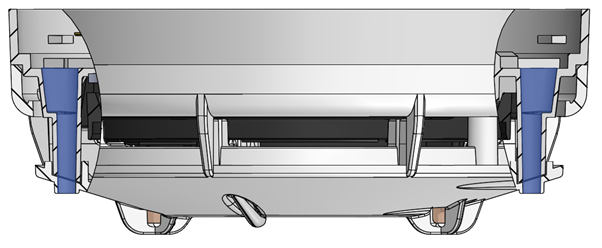
Soteria UL overcomes this issue through its patented vent design. These vents allow pressure differentials to be exhausted through a carefully positioned hole in the lid, so that is does not impede the flow of smoke into the smoke inlet or deeper into the optical chamber. Further, the vents allow any condensation that may occur in the cavity behind the detector, or in cable conduits, to escape without harm.

The drains, highlighted in blue, allow water and air to pass from the rear of the detector without affecting the smoke entry paths.

An often-overlooked characteristic of smoke sensors is their ability to operate uniformly no matter which direction the smoke is coming from. UL test detectors for this parameter in four different orientations and allows a variation of +/-50%. To ensure the most stable operation, we exceed this requirement and measure our detector at 360 orientations and achieve a variation of less than 10%/ft.

Why should a user care that Soteria UL’s directionality is so good? Well, if we had just one angle that was less receptive than others, then we would be forced to increase the overall sensitivity of the detector to ensure it can detect fire when tested in the poor orientation. By avoiding this pitfall, we can offer a detector with a perfectly balanced sensitivity.

Once smoke gets into the chamber, then it’s the job of the optical sensor to measure it, whilst discounting false readings from any foreign materials. The optical sensor consists of an industrially rated InfraRed (IR) light source. When smoke is present, light is scattered onto the light sensor. This sensor is a highly integrated Application Specific Integrated Circuit (ASIC), custom to Apollo, that combines the light sensitive element and electronic amplification.

Smoke is an aerosol – a mixture of air and tiny smoke particles. Because these tiny particles are similar in size to the wavelength of IR light, then they send that light scattering off in many directions via a quantum mechanical process that is described by Mie theory. Smoke from fires have precise characteristics; for example, it tends to scatter most light in the forward direction, rather than ‘reflecting’ it backwards.

We use this knowledge in the design of our optics, positioning the smoke sensor so it is more sensitive to the angles of scattering smoke, than the pattern of aerosols produced by cooking, for example. This is achieved with our unique patented optical sensor design.

The next nuisance that might trick our sensor is dust and insects. Traditional detectors suffer from the IR light source illuminating parts of the optical chamber, rather than just the scattering region in front of the light sensor. Because the light sensor is looking for only a tiny quantity of light to be scattered by smoke, then it can easily be fooled by light reflecting off chamber walls when dust or insects are present in the chamber.

Our first line of defence is stopping such things getting into the chamber. The Soteria UL uses a unique serpentine air inlet to prevent the ingress of dust. A fine nylon mesh prevents insects over a certain size from entering the chamber, but not all can be stopped is we still wish smoke to enter the chamber. Instead, we design the chamber to be robust to these smaller insects and accumulation of dust.

Firstly, a unique patented light absorbing surface of the chamber prevents the IR light being reflected around the chamber. This means that dust and insects on other surfaces of the chamber are less illuminated. Secondly, and this step takes some effort, all possible surfaces where an insect could stand and spread its wings, whilst being in the view of the light sensor, are eliminated. That means that even when an insect smaller than the screen finds its way into the chamber, it is very unlikely to be able to cause a false alarm. The same advantage is experienced when dust accumulates inside the chamber – there are no surfaces where dust can gather to cause stray light and trigger a false alarm.

And it’s not just our lab that this high performance is achieved. Every Soteria UL detector is produced and certified to conform to the same narrow range of sensitivity. This means that every product you install will behave the same as the last, it will not be more sensitive to common nuisances, or less sensitive to the attributes of fire. This is achieved in our factory with a blend of skilled hand assembly and highly automated modern manufacturing processes. Every single product is measured and calibrated for smoke sensitivity.

Once we have crafted the best smoke sensor, our next focus is the intelligent signal processing that determines when there is a real fire. Because the basics are right, we don’t need a highly complex, unpredictable, and opaque artificial intelligence algorithm. We simply add the right amount of smoothing, the right amount of delay, and a little enhanced detection of fast flaming fires. False alarms are avoided, not only by getting the basic smoke sensor right, but by reducing the response to slowly developing nuisance signals like cooking. The detector is constantly processing information, and if it decides there’s a fire, this is signalled to the panel via Core-Protocol with exceptional speed.

Keeping you safe from fire, every second of every day.

For more information on Soteria UL, Apollo’s 268 7th edition solution, contact enquries@apollo-fire.com or visit www.apollo-fire.co.uk/

This article was originally published in the May edition of IFSJ. To read your FREE digital copy, click here

Exclusive: Evac+Chair discuss best evacuation products for all environment

Evac+Chair is the original and global leader in the design, development and manufacture of emergency evacuation chairs. With over 40 years’ experience in the manufacture of life saving solutions Evac+Chair is dedicated to providing the mobility impaired with a safe and quick means of evacuation.

The Evac+Chair was invented by US citizen David Egan following an emergency evacuation in which he and his wife were involved. David’s wife had suffered with polio as a child, which had caused her mobility to be impeded and when they were forced to evacuate from the 38th Floor of a Manhattan building, David had to carry her to safety.  Recognising the need for a product to assist in the quick and safe evacuation of the mobility impaired, David set about designing a solution that would do just that.

Today, the iconic blue and yellow Evac+Chair is recognised worldwide; exported to 70 countries, across 6 continents and has assisted in saving countless lives. The Chair has earned a well-deserved place in the 9/11 memorial museum for assisting in the evacuation of mobility impaired people, during the twin towers attack.

Whilst the fundamental aspects of the design of the Evac+Chair has been unaltered over the past 40 years, customer insight and investment in R&D has led to the product range being expanded and enhanced, providing greater safety and comfort to both the operator and passenger. Independent research carried out by the University of Greenwich concluded that an Evac+Chair provides the safest, quickest means of escape for the mobility impaired, compared with other types of evacuation products.

In 2020, Evac+Chair International moved into a new state-of-the-art headquarters in the West Midlands. The 38,000 square foot purpose-built facility has enabled Evac+Chair to implement enhancements to the productivity and manufacturing processes, however every chair remains hand made.  With ISO 9001 and ISO 13485 accreditations, Evac+Chair prides itself on its superior product quality and every chair undergoes rigorous quality checks, throughout manufacture and before dispatch.

Whilst many consider a mobility impairment to be a permanent disability, it can also be temporary, such as a sporting injury, pregnancy or even panic attack brought about by an emergency evacuation. Therefore, having an evacuation chair is vital for all commercial buildings, to ensure everyone can be safely evacuated in the event of a fire, or other emergency. Evac+Chair products not only provide a safe means of escape for the mobility impaired but protect everyone, as a mobility impaired person evacuating without assistance may impede the whole evacuation process, and as a result put others’ lives along with their own, at risk. 

The Regulatory Form Order for Fire Safety 2005 states, it is no longer the responsibility of the Fire Service to facilitate the evacuation of non-domestic premises.  It is the designated ‘responsible person’ (the person having control of the building, or a degree of control; i.e.  landlords, business owners, employers, facilities managers or risk assessors) who must ensure that everyone can be evacuated quickly and safely in an emergency.

Under the Management of Health and Safety at Work Regulations 1999, employers have a duty of care to assess any risks that affect the health and safety of employees and put in place appropriate procedures to be followed ‘in the event of serious and imminent danger’. The responsible person must carry out a regular review of the risk of fire on the premises and identify any issues, following which a plan must be developed to mitigate these risks, this should include the planning for the evacuation of those with disabilities.

Whilst Evac+Chair products are suitable for all environments including offices, hotels, schools, sports stadia, retail outlets, healthcare and factories, each chair has a unique set of features that make it more suitable for certain environments. To help ensure you select the correct product Evac+Chair offer a FREE evacuation assessment. Conducted by one of their nationwide consultants who will visit your site and make recommendations as to the most suitable evacuation chair for the building type and the most effective installation points. In addition, Evac+Chair offer training courses to ensure operators are confident in the deployment and operation of an evacuation chair, providing a safe and smooth emergency evacuation.

For more information or to book a FREE evacuation assessment, contact Evac+Chair: Telephone: +44 (0)121 706 6744 | Email: enquiries@evacchair.co.uk | Website: evacchair.co.uk

This article was originally published in the May edition of IFSJ. To read your FREE digital copy, click here