Coopers Fire, a British company manufacturing smoke and fire curtain barrier systems in the United Kingdom for installation worldwide, is set to host a seminar on Active Fire Curtain Barriers.
What is a fire curtain?
Coopers Fire invented and patented the Gravity Fail Safe (GFS) Smoke and Fire Curtain, which has become a benchmark for smoke and fire curtain systems sold around the world today.
Due to the high performance and reliability of Coopers Fire products, they have been specified and installed in some of the world’s landmark buildings like The Shard, Dubai Mall and the Sydney Opera House.
Coopers Fire are fully compliant to BS 8524 parts 1 and 2, the only British Standard for fire curtains. Coopers Fire continue to increase our smoke and fire curtain product range for other relevant worldwide standards.
With an increased focus on fire safety it is important that all involved with the built environment are aware of the latest fire protection products and their correct applications as well as how fire protection could be improved throughout the construction cycle.
About the seminar from Coopers Fire
With this in mind, Coopers Fire are offering a FREE RIBA Approved CPD seminar on Active Fire Curtain Barriers.
The CPD will be hosted on Zoom and will be available to anyone who wishes to get a greater understanding of passive fire protection and the wider standards to be aware of as well as how, where and why a fire curtain can be used in a variety of locations within a construction project.
Learning aims
What is passive fire protection
Regulations for passive fire protection
Fire curtains as a solution
Performance classfications
Standards and compliance
Applications
Those interested in attending the seminar can find out more by clicking here.
Fredric Pettersson, Sales Director, Fire Safety Group, Perimeter Solutions looks at the new firefighting foam blending facility in Saudi Arabia
A secure supply chain has always been an important facet of international business, but the pandemic of 2020-2022 taught us all that the unexpected can happen and underscored the importance of close availability of mission critical materials.
Firefighting foam is said to be one of the most mission critical materials we have.
This is particularly true for the petroleum industry whose existence is based on storing and transporting highly flammable raw materials and end products.
As a fire safety company with more than 60 years of experience supplying our products in a timely manner to some of the most remote locations all over the world, Perimeter Solutions has developed a range of delivery and deployment capabilities.
For more than 15 years, as part of our continuing efforts to service our customers, Perimeter Solutions has served different local blending plants with super concentrates to manufacture local firefighting foam concentrates.
There are a number of benefits to local blending, but also concerns with maintaining consistency and quality far away from the quality control programs and procedures employed at a centralised manufacturing facility.
Perimeter Solutions collaborated with fire protection equipment supplier Saudi Sicli to open a new firefighting foam blending plant in Jeddah, Saudi Arabia, to support the Kingdom’s fire safety industry.
Nearly a year after its startup, this project has proven to be highly effective, and the experience can be instructive on how local blending programs can be implemented around the world.
Why local manufacturing of foam concentrates?
A secure supply of mission critical materials is one of the major reasons for local blending of firefighting foam concentrates.
All things being equal, companies around the world prefer to source locally if possible.
Local manufacturing has other benefits.
It builds infrastructure and supports local economic development.
It also has the potential to reduce total costs of goods delivered through enhanced production efficiencies, reduced transportation costs and the possibility of lower import costs.
Sourcing commodities and raw materials locally, while blending key materials at their point of use, is the perfect combination to assure availability of large quantities of product that are delivered to end users more quickly.
A leader in the Saudi Arabian fire safety industry
Headquartered in Jeddah, Saudi Sicli provides mechanical, electrical, and plumbing products and services to various government agencies and companies in the private sector, including railways, airports, seaports, water/electricity, defense, and industrial sectors.
The company specialises in the design, installation, operations and maintenance of firefighting, fire extinguishing and fire detection systems and equipment.
Saudi Sicli was the first company to supply certified premium firefighting foam in Saudi Arabia and has been helping to protect lives and property in the region for over four decades.
Challenges and solutions
Previously, Perimeter Solutions had been supplying Saudi Sicli with firefighting foam and equipment for nearly 15 years from facilities in Norway, the United States and northern Spain.
The overall goal of the new project was to supply a foam super concentrate blended into a standard foam concentrate using water and locally sourced chemicals.
This type of operation requires equipment systems, local expertise and the ability to tightly control finished product while continually monitoring quality.
The blending plant follows a process in which third-party bodies certify and authorise their manufacturing practices.
In 2021, Perimeter introduced a Mobile Blending Plant to accomplish these goals.
The mobile plant consists of two 40’ maritime containers that contain the means to blend, control quality and pack the foam concentrate.
The plant includes a quality control lab to assure the quality of local batches.
It is also fully automatised and can be controlled from Perimeter’s site in Spain.
The automatised system for blending and packing is managed by software that can: issue a work order specifying quantity and product type; add raw materials in the correct sequence and quantity; control the stirring speed and time; support the packaging by controlling recipient filling; and connect with Perimeter Solutions in Spain
All the data generated during the manufacturing process (sensors, video cameras, QC results, etc.) are transferred to Perimeter Solutions in real time.
The control room and quality control lab allow the manufacturing process to carry out quality control analysis.
Equipment includes: pH-meter, refractometer, densimeter, precision scales, surface tension meter, viscosimeter, digital thermometer, crystat, and other standard lab equipment.
At installation, Saudi Sicli personnel were trained by a Perimeter Solutions team in the operation of the facility.
During operation, every facet of the blending process is monitored and information is provided in real-time to Perimeter Solutions in Spain.
The facility allows Perimeter Solutions personnel to troubleshoot should it be necessary, and it can even be run remotely if required.
Once the equipment for the Mobile Blending Plant was delivered to the Saudi Sicli site, it was operational within a few months.
A ceremony to inaugurate the new blending plant was attended by leaders from Saudi Sicli and Perimeter Solutions as well as the Saudi Arabian ambassador of Spain, management from Saudi Aramco, representatives from the Saudi Arabia industry and infrastructure leaders from Modon, GACA, SEC, KAUST, and SAR.
Since operations first started, the plant has produced more than 800,000 liters of Perimeter Solutions firefighting foam products.
Fluorine-free technology leadership
Perimeter Solutions is today’s innovation and market leader in the development and implementation of effective, new fluorine-free firefighting foam technology, serving well-recognised end-users worldwide.
With R&D teams in North America and Europe, Perimeter Solutions is developing the next generation of high-performing fluorine-free Class B firefighting foams with new products introduced on a regular basis.
The Perimeter Solutions fluorine-free line contains foam concentrates suitable for use on most types of applications for both hydrocarbon and polar solvent fuel fires, training foam, specialty foams, and a complete line of Class A foam concentrates.
It includes products with certifications and approvals for commonly used systems and discharge devices.
Fluorine-free foam concentrate for the petroleum industry
In 2022, Perimeter Solutions introduced an alcohol-resistant firefighting foam concentrate developed specifically for the petroleum industry called SOLBERG® VERSAGARD™ 1×3 Multipurpose Fluorine-Free Foam Concentrate.
It is non-persistent, siloxane-free, and contains no intentionally added per- or polyfluoroalkyl substances (PFAS).
The foam concentrate is designed for extinguishing and securing both Class B (hydrocarbon fuel and polar solvent fuel) and deep-seated Class A Fires.
It is ideal for industrial emergency response and is used at multiple facilities that store crude oil on site.
Product testing has shown that SOLBERG VERSAGARD 1×3 foam concentrate performs similarly to AR-FFF products that are currently on the market, and several major multinational oil companies have already signed on to use SOLBERG VERSAGARD 1×3 in their transition programs to fluorine-free foam concentrates.
For a project of this magnitude to run smoothly, it takes a significant amount of technical expertise.
Colleagues from R&D, manufacturing, quality assurance, engineering, and business have to be perfectly synchronised and work together to execute the project successfully.
This is what Perimeter Solutions brings to the market in addition to flexibility and high-quality products.
Deploying new technology
The Perimeter Solutions Mobile Blending Plant currently in use by Saudi Sicli is an example of how the best technology can be delivered globally at the best cost with security of supply.
It is expected that this approach will be used in other countries in the Middle East and around the world.
This exclusive article was originally published in the September 2023 issue of International Fire & Safety Journal. To read your FREE digital copy, click here.
Rafal Kolodziejski, Head of Product Support and Development at Survitec explains how SMARR-TI Enhances Fire Safety in the Maritime Industry
In an era marked by rapid technological advancements and evolving challenges in the maritime industry, ship safety management has never been more vital.
The introduction of new fuels, more complex systems, and the trend towards autonomous shipping has brought about new safety risks and hurdles.
The traditional safety management methods are becoming insufficient, leaving the maritime industry in need of innovative solutions.
Enter the Safety Management and Rapid Response Technology Interface (SMARR-TI), a ground-breaking solution that represents a transformative step forward in fire safety from Survitec.
By integrating fire detection and suppression systems within a single, interactive platform, SMARR-TI offers a comprehensive approach to onboard safety, addressing the contemporary maritime safety challenges.
Rafal Kolodziejski, Head of Product Support and Development at Survitec, reveals the direction of the maritime industry’s safety protocols and provides a closer look at the necessary innovations required to ensure safety at sea.
Can you explain the importance of ship safety management?
This is an exciting time for the maritime industry; we’re in a period of great change. There are key trends such as digitalisation and autonomous shipping driving the development of new and more advanced technologies.
At the same time, there is the drive towards greater sustainability, with the shift towards fuels that are more environmentally friendly, and the introduction of new legislative requirements to help reduce greenhouse emissions.
With new developments come new challenges. Each new or alternative fuel has its own safety risks and challenges.
For example, there is much discussion around effective fire suppression methods for methanol dual-fuelled ships, and for electrical propulsion systems with energy storage spaces.
The safe transportation of electrical vehicles and the risks associated with lithium-ion batteries is another focus area.
Furthermore, with autonomous shipping and the trend towards ships operating with fewer – or no – crew onboard, perhaps with operations being monitored from the shore, this then presents other safety risks and challenges that must be addressed.
Consequently, we see a greater need among ship owners and managers for solutions that can help to support crew with: Effective emergency procedures – i.e., procedures that are transparent and easy to follow; Early detection – to help identify changing conditions as early as possible to prevent a fire from happening; and Rapid response – to support fast and effective decision-making, especially in emergency situations.
How do traditional safety management methods fall short when it comes to contemporary needs of the maritime industry?
With the new fire risks and safety challenges associated with the new fuels and technologies of today, there is a renewed focus on fire prevention, and the possibility of detecting pre-fire conditions that can either allow for suitable preventive measures to be taken to avoid a fire from starting and/or that allows the crew to contain the fire more quickly and minimise damage.
We can also consider the number and complexity of the systems implemented on board a ship today, and the challenges this can present to crew.
A safety management system can potentially integrate different safety subsystems, allowing crew to manage them more easily and efficiently within one control system.
Diagnostics and preventive maintenance are also increasingly important, to ensure that the proper maintenance regimes are observed to keep safety systems running efficiently and to avoid any interruptions to service.
Remote support and monitoring services can also provide crew with fast access to expert technical support.
Systems can be monitored remotely – and even controlled, if required – from the shore, with the potential to log and track faults and analyse the data for insight on faults and/or behaviours.
What is SMARR-TI?
SMARR-TI stands for Safety Management And Rapid Response – Technology Interface. SMARR-TI is an interactive safety management solution that allows crew to monitor and control all their onboard fire safety systems – that is, their fire detection, fire prevention and fire suppression systems – within one integrated and easy-to-use solution.
SMARR-TI is unique in that it integrates both fire detection and fire suppression systems in one solution.
Currently, there is no other digitised safety monitoring solution that does this to such an extent.
How does the integration of fire detection and suppression systems contribute to enhanced safety onboard?
The aim is to give early warning of changes in a quick and effective way, and then to enable swift action to prevent a fire from happening.
A graphical visualisation of the fire systems on board the vessel is paired with real-time status updates and notifications, so crew receive early warning of any changing conditions.
In the event of a fault or alarm, crew has full visibility of the location of the alarm; the equipment at their disposal; and the ability to deploy systems automatically where possible, allowing them to take swift, decisive action to prevent or contain a fire, and protect onboard safety.
Can you talk about the interactive features of SMARR-TI?
In the event of a fire or an alarm, crew can see instantly where the alarm is located, visualised on the ship layout, and also the nature of the alarm (e.g., whether it’s the result of a technical fault or whether there is actually a fire).
Furthermore, they can select the protected space on the ship plan visualisation to see which equipment is available in that space; and then have the capability to activate a firefighting system within SMARR-TI by following the screen prompts.
All of these actions can be performed within SMARR-TI; all the information the crew needs is at their fingertips, thus shortening the time to action.
How does the SMARR-TI system supplement the SOLAS requirements for general arrangement plans onboard?
SOLAS Chapter II-2, Regulation 15.2.4 requires general arrangement plans to be permanently exhibited for the guidance of the ship’s officers.
These plans must show: structural fire prevention measures onboard ship (fire doors, fire zone barriers, etc); location of firefighting equipment; and how to access the different compartments & decks.
These are generally static plans, normally printed/mounted on walls, and supplemented by, e.g. instruction manuals for the different systems/equipment.
SMARR-TI supplements these general arrangement plans by providing a digital, interactive, graphical visualisation of the ship layout and all the structural fire prevention measures on board with Fire Detection & Suppression systems attached plus real-time alerts and notifications to alert crew of any changing conditions.
This means that not only can the crew see instantly where the alarm originates, they can also differentiate between e.g. a technical fault or the presence of smoke or flame.
The operating procedures for deployment of the firefighting systems can then also be displayed on screen, so the crew has all the information they need in one place to support quick and effective decision-making in the event of a fire.
Could you explain the specific role of SMARR-TI during a potential fire hazard?
Within SMARR-TI, crew members can receive instant notifications of technical faults impacting system delivery, such as faulty connections or interruptions to power.
They also receive warnings of pre-alarm conditions, such as temperatures exceeding predefined limits, or the presence of smoke or flame.
SMARR-TI allows them to distinguish immediately between routine maintenance issues and situations requiring an emergency response, so they can manage resources accordingly.
Furthermore, the crew can identify the precise location and exact nature of the alarm instantly on the ship plan visualisation.
They can also integrate and control their CCTV cameras within SMARR-TI, allowing for an immediate view of the affected zone and local areas.
This enables them to mobilise the crew more quickly and efficiently, equipped to take immediate, preventive action to secure the space and protect life.
Should there be a fire, crew members can immediately identify the safety systems at their disposal within the protected space.
They can then select a system within SMARR-TI and follow the step-by-step instructions displayed on screen to proceed towards deployment.
They can sound the alarm, close fire doors and fire dampers, shut down ventilation where necessary, and trigger signals to the public announcement and alarm monitoring systems, all within the same system.
The crew is also able to activate fire suppression systems, such as water mist, automatically, which reduces the time to deployment.
They can follow the operating procedures displayed on screen to guide them through system deployment, support effective decision-making, and reduce the risk of human error in high-stress situations.
The ultimate aim with SMARR-TI is to streamline firefighting operations and save valuable seconds or even minutes in an emergency, to help protect life and minimise damage.
Can you share your experience developing SMARR-TI alongside Turkish shipyard Tersan and Havila Voyages?
SMARR-TI was designed according to the requirements of Havila Shipping ASA, which had experience of similar systems from other suppliers.
The purpose behind building the application was to create a tool that could provide a graphical representation of the text information provided via their dedicated fire detection system.
From the start, it was made clear that this information should be presented clearly and effectively so that it should be immediately apparent to crew when there was an alarm/notification requiring their attention.
SMARR-TI was designed to depict both the location of the fire and the fire extinguishing system available for use, and then also allow for that fire extinguishing system to be released remotely where possible, with crew able to follow operating instructions presented on screen.
Most importantly, the required actions at each stage had to be intuitive and efficient: the application had to be simple and easy to use and to facilitate swift, decisive action.
What are Survitec’s future plans for the expansion of SMARR-TI?
The official launch of SMARR-TI at Nor-shipping in June generated a lot of interest, and we have had many interesting discussions, not only with shipowners and shipyards, but also with other technology providers and suppliers of fire solutions who are interested in the potential of SMARR-TI to support additional safety features and systems.
Today we have SMARR-TI Mark-1, which integrates Fire Detection & Fire Suppression systems, however we have many other ideas on how we can further develop SMARR-TI, to support effective and efficient safety management – for example, the integration of loose fire equipment (information on location and servicing requirements); support for monitoring fire patrols; and, of course, the integration of other safety systems – to highlight just a few of the ideas that are currently on our radar.
This exclusive article was originally published in the September 2023 issue of International Fire & Safety Journal. To read your FREE digital copy, click here.
Fire, in all its elemental splendour, has long been a double-edged sword in human history.
It’s been the beacon that guided our ancestors through dark nights and the hearth around which stories were spun.
Yet, it’s also been the beast that consumed entire cities and forests, leaving destruction in its fiery wake.
In recognising the duality of fire’s nature, we find ourselves face to face with the elemental truth: fire is a force to be reckoned with.
It’s this very duality that underscores the importance of understanding the role of fire safety in our lives.
While fire has been instrumental in shaping our progress and culture, it has equally posed threats to our safety, often when we least expect it.
In this delicate balance between harnessing fire’s potential and protecting ourselves from its destructive tendencies, we find the essence of Fire Prevention Week.
Fire Prevention Week stands as an annual reminder, a beacon of awareness that illuminates the path to safeguarding our homes, families, and communities from the perils of fire.
In the following pages, we’ll delve into the heart of this vital event, exploring its significance, tracing its historical roots, and uncovering why it’s a pivotal moment on the calendar for everyone.
So, let’s embark on this journey to unravel the essence of Fire Prevention Week and discover how it shapes our understanding of fire in the modern world.
What is Fire Prevention Week?
Fire Prevention Week is an annual event that brings together communities and organisations throughout the United States, rallying under the common banner of fire safety.
This crucial week serves as a powerful reminder of the paramount importance of fire prevention and preparedness in our lives.
Promoting fire safety helps the fire service
It’s a time when our collective focus sharpens, and we turn our attention towards understanding the hazards posed by fire and some of the most common causes of fire, and learning how to mitigate them.
Throughout the duration of Fire Prevention Week, an array of activities and educational programs are thoughtfully organised to enlighten people about the ever-present risks of fires and, most importantly, how to actively mitigate these risks.
It’s a concerted effort to ensure that individuals, families, and communities are equipped with the knowledge and tools necessary to protect themselves and their surroundings.
These activities and programs span a wide spectrum, catering to diverse audiences.
For instance, schools often incorporate fire safety lessons into their curricula, ensuring that young minds grasp the fundamentals of fire prevention early on.
Fire departments and local organisations host open houses, where the public is invited to explore fire stations, interact with firefighters, and witness live demonstrations that highlight fire safety techniques.
Furthermore, many local communities conduct fire drills and evacuation exercises, enabling residents to practice their response to potential fire emergencies.
These drills instil a sense of readiness and ensure that everyone knows how to react swiftly and effectively in the event of a fire.
Additionally, fire safety workshops and seminars are commonly held, where experts share invaluable insights on fire prevention strategies, home fire safety, and the proper use of fire extinguishers.
The collective aim during Fire Prevention Week is to foster a culture of fire safety that transcends this specific week and becomes an integral part of our daily lives.
It’s about ingraining the knowledge of fire risks and safety measures into our consciousness, ensuring that fire safety is not just an annual event but a lifelong commitment.
By actively participating in the activities and programs offered during this week, individuals and communities stand better prepared to protect themselves against the devastating impact of fires.
When is Fire Prevention Week?
Fire Prevention Week is observed in the United States and Canada during the week in which October 9th falls.
October 9th holds historical significance as it commemorates the Great Chicago Fire of 1871, one of the most devastating fires in American history.
This tragic event serves as a stark reminder of the destructive power of fires and the need for fire prevention measures.
When is Fire Prevention Week 2023?
Fire Prevention Week is between October 8-14 in 2023.
Promoting fire prevention is in everyone’s best interest
What is the History of Fire Prevention Week?
The origins of Fire Prevention Week are deeply rooted in one of the most tragic and defining events in American history – The Great Chicago Fire of 1871.
This devastating fire, which ignited on the fateful night of October 8 and continued to rage into October 9, marked a turning point in the nation’s understanding of fire safety.
It consumed over 2,000 acres of land, leaving behind a trail of destruction that stretched as far as the eye could see.
The flames roared through the city, devouring everything in their path.
The devastation was not limited to property; it also claimed the lives of hundreds of people and displaced thousands more, rendering them homeless in its wake.
The aftermath of this catastrophic event left a profound impact on the collective consciousness of the nation.
It served as a stark reminder of the destructive force of fire and the imperative need for comprehensive fire prevention measures.
In the wake of this tragedy, the Fire Marshals Association of North America, an organisation that later evolved into the International Fire Marshals Association, took a decisive step to honour the memory of the Great Chicago Fire.
In 1920, they designated October 9 as National Fire Prevention Day, a solemn day to remember the fire’s victims and to reflect on the importance of fire safety.
However, recognizing that a single day of reflection and awareness was insufficient to address the magnitude of the fire safety challenge, the event was expanded.
In 1922, it was transformed into a week-long initiative, evolving into the enduring institution we now know as Fire Prevention Week.
This extension allowed for a more comprehensive approach to fire safety education and outreach, enabling communities to delve deeper into the complexities of fire prevention.
Fire Prevention Week, with its roots firmly embedded in the lessons of the Great Chicago Fire, has since become a poignant annual tribute to the resilience of communities in the face of disaster and a platform for educating generations on the vital importance of fire safety.
It stands as a testament to the enduring commitment to the evolution of fire safety that arose from the ashes of one of the nation’s most devastating fires.
What is the Theme of Fire Prevention Week 2023?
Each year, Fire Prevention Week has a specific theme that guides its educational efforts.
Fire Prevention week for 2023 promotes fire safety in the kitchen
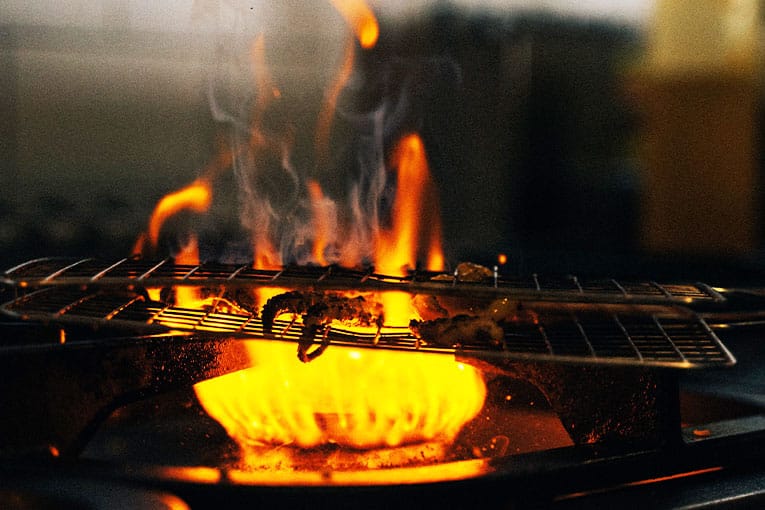
This theme emphasises the importance of fire safety in the kitchen, one of the most common types of fire, where a significant number of fires originate.
It aims to educate people on how to prevent kitchen fires, what to do if one occurs, and how to keep their families safe.
What Were the Themes of Previous Fire Prevention Weeks?
Since its inception, Fire Prevention Week has tackled various fire safety topics, evolving to address contemporary concerns.
Here are some recent themes and their associated messages:
2022: “Fire Won’t Wait, Plan Your Escape”
Theme: Focused on the importance of having an escape plan and practicing it regularly.
Message: Encouraged people to be proactive in fire safety by planning and rehearsing escape routes from their homes. Fire doesn’t wait, and being prepared saves lives.
2021: “Learn the Sounds of Fire Safety”
Theme: Emphasised understanding the different sounds of smoke and carbon monoxide alarms.
Message: Educated people about the significance of smoke alarms and carbon monoxide detectors in early fire detection and prevention.
2020: “Serve Up Fire Safety in the Kitchen”
Theme: Centred on kitchen fire safety and the prevention of cooking-related fires.
Message: Highlighted the importance of safe cooking practices, including attention to stovetop and oven cooking to prevent kitchen fires.
2019: “Not Every Hero Wears a Cape. Plan and Practice Your Escape!”
Theme: Highlighted the importance of fire escape planning.
Message: Encouraged families and individuals to create and practice fire escape plans for their homes. Being prepared can make a life-saving difference in emergencies.
2018: “Look. Listen. Learn. Fire Can Happen Anywhere”
Theme: Focused on the importance of learning fire safety in various settings.
Message: Urged people to understand the basics of fire safety, whether at home, work, or in public spaces.
2017: “Every Second Counts. Plan Two Ways Out”
Theme: Emphasised the need for multiple escape routes in case of fire.
Message: Encouraged households to plan not just one but two ways to exit their homes during a fire. Seconds matter in emergencies.
2016: “Don’t Wait. Check the Date. Replace Smoke Alarms Every 10 Years”
Theme: Highlighted the importance of regularly maintaining and replacing smoke alarms.
Message: Informed people about the necessity of checking the age and condition of smoke alarms and replacing them every decade for reliable fire detection.
2015: “Hear the Beep Where You Sleep. Every Bedroom Needs a Working Smoke Alarm”
Theme: Advocated for smoke alarms in every bedroom.
Message: Promoted installing smoke alarms in all sleeping areas to ensure early warning and escape in case of fire.
2014: “Working Smoke Alarms Save Lives. Test Yours Every Month”
Theme: Focused on the life-saving role of smoke alarms.
Message: Encouraged monthly testing of smoke alarms to ensure they are functioning correctly.
2013: “Prevent Kitchen Fires”
Theme: Centred on kitchen fire prevention.
Message: Raised awareness about the common causes of kitchen fires and promoted safe cooking practices.
2012: “Have 2 Ways Out”
Theme: Stressed the importance of having multiple exit routes.
Message: Reminded people that having two ways out of every room is vital for swift evacuation during a fire.
2011: “Protect Your Family From Fire”
Theme: Focused on overall family fire safety.
Message: Encouraged households to take comprehensive measures to safeguard their loved ones from fire hazards.
2010: “Smoke Alarms: A Sound You Can Live With”
Theme: Emphasised the importance of smoke alarms.
Message: Highlighted the life-saving role of smoke alarms in providing early warning of fires.
These themes illustrate the evolving focus of Fire Prevention Week, aiming to address current fire safety challenges and educate the public on ways to prevent fires and protect lives.
Conclusion
Fire Prevention Week is important. It reminds us that fires are dangerous, both in the past and today.
It started because of the Great Chicago Fire, but it’s not just about that. Fires can hurt anyone, anywhere.
During this week, we learn about fire safety. We should use this knowledge to protect our homes.
This week’s actions should last all year. We need to stay safe from fires, always.
So, during Fire Prevention Week and always, remember to be safe from fires. Teach your family and community about fire safety.
Let’s keep our homes and loved ones safe from fires. Fire Prevention Week is more than just a week; it’s a promise to stay safe.
BIOEX explains how sustainability and efficiency can coexist in the fight against fires
The global emphasis on sustainable practices and environmental preservation is prompting a major paradigm shift across a broad spectrum of industries. Fire safety is no exception to this trend.
The traditional firefighting foams, once considered the industry standard, have now come under scrutiny due to their environmental impact.
This has led to a growing demand for environmentally conscious, sustainable alternatives, marking the advent of a new era in fire safety.
Against this backdrop, pioneering companies like BIOEX are emerging as leaders, showing that it is possible to rethink the status quo and craft innovative solutions that marry effectiveness with sustainability.
From its inception in 1998, BIOEX has championed the cause of environmentally friendly fire safety solutions.
They were among the first to introduce fluorine-free foams in the industrial fire service market, establishing a new standard for fire extinguishment and burnback resistance.
We sat down with Clémence Franclet from BIOEX to understand their journey, the ethos that drives their innovation, and their vision for the future of fire safety.
Franclet talks about the challenges and opportunities that come with a transition to more sustainable fire safety practices, as well as BIOEX’s notable contributions to this cause, including their groundbreaking products ECOPOL 3N and ECOPOL 3 Premium UL.
Can you tell us about BIOEX’s journey in the fire safety industry?
BIOEX was founded in 1998 within the LEADER Group. The name of the company means BIO EXCTINCTION.
From its beginning, BIOEX goal has been to provide efficient, environmentally friendly solutions to extinguish fires to save lives and property.
BIOEX is the pioneer in fluorine-free foams, introducing the first multipurpose fluorine-free foam in the industrial fire service market in 2002: ECOPOL was born.
BIOEX uses its extensive experience and comprehensive long understanding of industrial fire risks, to provide eco-friendly foams for efficient fire extinguishment and burn-back resistance.
Since 2002, we have been developing a wide range of fluorine-free foams effective on class A and class B hydrocarbon and polar solvent fires, are and certified under international standards, such as EN1568, UL162, LASTFIRE, IMO, ICAO and more.
We have helped transition many customers worldwide, including fire brigades and departments, oil companies, chemical industries, airports and military forces, to fluorine free foam.
We have conducted thousands of fire tests on multiple fuels, with different application methods and equipment to prove that our fluorine-free foams can achieve similar or better results than fluorinated foams.
To meet the increasing demands for fluorine-free foams, BIOEX, has expanded, and recently moved into new facilities in France.
Built to the latest standards, the production, lab and storage capacities have been increased.
Fluorinated and non-fluorinated production lines are separated to guarantee environmentally friendly products, free of fluorinated compounds and cross contamination.
Can you explain how your products align with your commitment to ecological responsibility?
BIOEX designs efficient products to control the fire quickly, and limit fire damages and loss.
Additionally, BIOEX range of Per- and Polyfluoroalkyl Substances (PFAS) free products are environmentally friendly.
They are made of bio based raw materials to limit the impact of foam spreading into the environment.
They do not contain fluorinated surfactants, nor siloxane.
Those firefighting foams are biodegradable and do not persist in the environment.
Part of our range of product is GreenScreen certified, the first ecolabel for firefighting foams.
What drove the development of your recent products, ECOPOL 3N and ECOPOL 3 Premium UL?
Our team of engineers and PhDs is constantly developing and improving processes of searching for new raw materials with lower impact on the environment and testing new efficient formulations.
Our latest formulations do not contain fluorinated surfactants.
Our lab team also works on reducing firefighting foam viscosity to optimise foam mixing equipment compatibility and to avoid any issue when mixing the foam.
How do the properties of ECOPOL 3N combat hydrocarbon fires effectively?
ECOPOL 3N forms a foam blanket made of thousands of bubbles, which spread over the flammable liquid.
The foam blanket has enough fluid to seal the fuel on fire.
It makes a physical barrier between the fuel and the surrounding air, enough thickness to block fuel vapours and oxygen supply.
Depending on the nature of the fuel, the foam blanket offers cooling features that also contribute to the extinguishment process.
The firefighting foam is applicable by direct and indirect application, avoiding foam blanket contamination by the fuel fire.
ECOPOL 3N robust foam blanket offers a long drainage time to ensure any residual fuel does not re-ignite.
This class B fluorine-free foam offers similar performances to traditional Aqueous Film-Forming Foam (AFFF) 3%.
How does the compatibility of ECOPOL 3N with existing equipment benefit your customers?
ECOPOL 3N viscosity is like most AFFF 3%, that is to say, liquid.
This requires no change on foam proportioner equipment and settings.
It makes the transition easier from traditional fluorinated foams to fluorine-free foams.
What sets ECOPOL 3 Premium UL apart in its efficiency on different types of fires?
ECOPOL 3 Premium UL is a Synthetic Alcohol Resistant Fluorine-Free Foam (AR-FFF).
This multipurpose foam is efficient on several fuels (alcohol, ethanol, acetone, methanol and so on) and is applicable at 3% on hydrocarbon fire, and 3% polar solvent fires, as well as class A fires.
ECOPOL 3 Premium UL is UL 162 listed.
The formulation of this pseudoplastic foam has low viscosity.
This gives it a significant advantage and makes it easy to mix with most of foam equipment.
What is your vision for the future of firefighting foams, given the trend towards SFFFs?
The fire industry is globally moving towards the transition to Fluorine-Free Foam.
Some in many different fire service industries have already chosen to use environmentally friendly foams and have been using them for their fire protection for decades.
The speed of the global transition mainly depends on the regulation on the country/area and the type of activity.
By doing numerous fire tests and data collection, high quality fluorine-free foams have proven that they are effective on fires, on several fuel types with different discharging and mixing equipment.
They offer similar fire performances as with traditional AFFF foams.
What are your thoughts on the global shift to fluorine-free foam in fire safety practices? How are you helping clients manage the transition to fluorine-free foam?
Since 2002, BIOEX has been supporting its customers with the transition from traditional foams to fluorine-free foams.
We support fire departments and brigades, industries, airports, ships and fire engineers in this transition, worldwide.
The implementation of fluorine-free foam will necessitate careful consideration as a project to undertake.
This process will involve various tasks such as remediation, emptying, cleaning, and disposal.
Adequate time and training will be required to ensure a smooth transition before the regulations enforce its prohibition.
BIOEX gives advice to choose the best product suited to their fire risks and fire equipment.
We also provide service partnership to dispose of AFFF, clean trucks and equipment and fill with fluorine-free foam.
Then, training is also key to master application techniques and firefighting tactics with these F3s.
BIOEX distribution network offers foam availability and stocking locations worldwide.
How do you foresee the balance between environmental responsibility and firefighting effectiveness in the future?
Fluorine-Free Foams can offer similar fire extinguishment performances, and burnback resistance capabilities as traditional AFFF/AFFF-AR foams.
Different application techniques and foam blanket density will be critical in ensuring successful use of these foams. In a nutshell: training and re-training are essential factors with F3s. BIOEX foam performance is certified under international standards (UL, EN, IMO, LASTFIRE, ICAO…).
Fluorine-free foam concentrates are easily biodegradable. GreenScreen ecolabel certified that they are PFAS-free and free of other harmful chemicals.
BIOEX range of fluorine-free foams offer an answer to combine firefighting effectiveness and environmental considerations.
This exclusive article was originally published in the August 2023 issue of International Fire & Safety Journal. To read your FREE digital copy, click here.
Unravelling Ultra Fog’s innovative and sustainable high-pressure water mist fire suppression systems with Marketing Director Mihaiela Bocancea
For over three decades, Ultra Fog has been at the forefront of advancing fire safety technology.
Born in Sweden and now a global entity, the company specialises in the manufacturing of high-pressure water mist fire suppression systems, offering a blend of superior quality, environmental sustainability, and innovative design.
With a rapidly expanding international presence, Ultra Fog is not only changing the way we approach fire safety but is also setting new standards for the sector.
IFSJ spoke to Mihaiela Bocancea, Marketing Director at Ultra Fog, to find out more about the company’s story, unique offerings, commitment to sustainability, and future plans.
Can you provide a brief overview of Ultra Fog, its history and mission?
Ultra Fog holds an esteemed position as one of the trailblazers that catapulted water mist fire protection systems into the realm of industry standards back in 1990.
What began as a humble endeavour has blossomed into a global presence, safeguarding a vast array of environments such as land, offshore, marine, rolling stock, and vehicles with our advanced water mist fire protection systems.
Our unwavering mission is to continuously enhance our products through annual fire tests while ensuring the utmost quality and reliability in everything we offer.
What kind of fire suppression solutions does Ultra Fog offer and how are they developed?
At Ultra Fog, we take pride in producing, installing, and servicing high-pressure water mist fire protection systems.
Our dedicated facilities around the world serve as hubs for the relentless research conducted by our expert team, many of whom have been with Ultra Fog since our inception in 1990.
It is through their tireless efforts and expertise that our exceptional fire suppression solutions come to life.
Can you explain what a high-pressure water mist fire suppression system is and how it works?
Ultra Fog’s water mist fire suppression systems offer robust, effective, and meticulously engineered solutions for applications that demand optimal fire suppression while minimising water consumption.
The magic begins with our high-pressure pumps, which forcefully propel water through our stainless-steel Ultra Fog water mist nozzles.
As a result, the water is transformed into millions of minuscule droplets typically ranging from 30 to 200 μm in diameter.
A single litre of water in this mist form generates around 4 billion droplets, covering a total surface area of 75-sq m.
When the system is activated, this deluge of water mist creates a protective blanket that maximises heat absorption from the fire, while the subsequent evaporation and expansion of the mist into steam effectively displaces oxygen.
Unlike traditional sprinkler systems, our water mist solution leverages the mist’s ability to present a significantly larger water surface area, facilitating rapid heat absorption.
Moreover, the mist remains suspended in the air for an extended duration, granting more time for heat absorption to take effect.
As a result, Ultra Fog systems cool and suppress fires while utilising considerably less water than conventional sprinkler systems.
Ultra Fog conducts yearly fire tests. Can you elaborate on what these tests involve and why they are important?
Our R&D department is bustling with activity, as our brilliant minds continuously develop nozzles that utilise even smaller amounts of water.
We proudly hold the title of the world’s top-performing company in terms of RO/RO garage area coverage.
But it doesn’t stop there: these fire tests are vital as they allow us to ensure that all our products adhere to environmental regulations while providing top-notch performance.
We are dedicated to extinguishing fires and minimising water consumption, all while staying ahead of the curve.
Can you explain how the high-performance nozzle in Ultra Fog’s systems works and what kind of spaces it can protect?
The high-performance wonder, known as our stainless-steel nozzle, is an ingenious piece of engineering that can safeguard spaces of up to 48-sq m.
With wider nozzle spacing, we offer not only superior protection but also reduced installation costs and labour.
What’s more, the patented design of our Ultra Fog nozzle boasts a unique feature—the ability to test the system’s functionality without breaking the frangible glass bulb.
Thanks to our innovative patented nozzle test tool, we’ve made it a breeze to ensure optimal performance without any costly mishaps.
Ultra Fog’s products are known for being eco-friendly. Can you explain what this means and how the systems contribute to protecting the environment?
When we say our products are eco-friendly, we mean business.
By harnessing the power of pure, drinkable water to extinguish fires, we’ve bid farewell to hazardous chemicals.
And here’s the icing on the cake: our high-pressure pumps allow us to use a staggering 90% less water compared to traditional sprinkler systems.
We firmly believe that saving water means saving our precious planet and safeguarding valuable assets.
After all, who wants to survive a fire only to find their valuables soaked beyond repair?
Luckily, with Ultra Fog, we’ve put an end to that soggy nightmare.
What types of industries or sectors typically use Ultra Fog’s fire suppression solutions?
At first, we dipped our toes into the marine field, protecting all types of vessels from fire.
But as time went on, we realised our mission was too grand to be confined to a single industry.
Now, we proudly serve an array of sectors and industries.
Whether it’s safeguarding trains, tunnels, high-rise buildings, aircraft hangars, various vehicles, data centres, offshore, or even cultural heritage sites, Ultra Fog’s fire suppression solutions are ready to rise to the occasion.
Ultra Fog has a strong international presence. How does this global reach impact your service delivery and customer relationships?
Our global reach is a source of great pride for us.
Our expanding footprint year after year allows us to establish meaningful connections with new distributors, agents, and clients worldwide.
It’s the secret ingredient that enhances our service delivery and strengthens our customer relationships.
By being closer to our present and potential clients, we can cater to their unique needs with greater efficiency and understanding.
What does the future hold for Ultra Fog?
We’re thrilled to announce the opening of our grandest headquarters yet, located in the enchanting city of Viareggio, Italy.
This monumental step forward will solidify our commitment to innovation and customer satisfaction.
As visionaries, we see water mist as the undeniable future of the fire protection industry, given its unrivalled eco-friendly nature.
That’s why we’re determined to expand our range of applications and continue blazing trails.
And rest assured, we’re leaving no stone unturned—we’re on a mission to complete all approval fields with esteemed entities like FM and VDS.
Ultra Fog is ready to conquer the fire protection world, one misty innovation at a time.
This exclusive article was originally published in the August 2023 issue of International Fire & Safety Journal. To read your FREE digital copy, click here.
By Alan Brinson, Executive Director of the European Fire Sprinkler Network
Set up in 2003, the European Fire Sprinkler Network campaigns on behalf of its members for the widespread use of properly designed, installed and maintained fire sprinkler and water mist systems across Europe.
We have Country Managers in Belgium, France, Netherlands, Poland, Spain and the UK, and work with others elsewhere.
Today most countries require sprinklers in new shopping centres, high-rise buildings, large warehouses and enclosed car parks. Since 2003 the European market has grown by two-and-a-half times.
There is scope for further growth. We see a trend to require sprinklers in new healthcare and residential buildings and where wood is used in construction.
Belgian and Dutch research has shown that sprinklers help to prevent smoke spread, cooling fire gases and reducing room overpressure so smoke no longer forces its way elsewhere in the building.
French research has shown that sprinklers and water mist enable exposed wood to be used in construction.
Firefighters in several countries demand sprinklers in large buildings to enable them to reach a fire safely.
Sprinkler manufacturers are researching warehouse fire protection for more economic solutions and for roboticised warehouses.
Governments, consultants and insurers are funding research on how to protect electric vehicles with sprinklers.
Meanwhile with cheaper sensors, companies can offer remote system inspection and testing.
Innovations such as these are often not widely accepted until they are incorporated in standards.
Since 2018 EFSN has provided the secretariat to the CEN sprinkler working group, greatly accelerating its work.
About the European Fire Sprinkler Network
With members from 18 countries, the European Fire Sprinkler Network campaigns for the widespread use of high quality fire sprinkler systems across Europe.
It works through its Managers in the largest countries and with others elsewhere. Since it began in 2003 the European sprinkler market has grown by two-and-a-half times.
This exclusive article was originally published in the August 2023 issue of International Fire & Safety Journal. To read your FREE digital copy, click here.
Bettina McDowell, General Manager of the IWMA, looks at the applications, advantages and standards of water mist systems
When it comes to the different classes of fires, water mist ticks more boxes than any other kind of fire suppression system.
This is due to the way smaller droplets interact with fires.
Evidence is the list of applications that – over the years – has grown to considerable length and includes – amongst others – tunnels, cable tunnels, data centres, shopping malls, trains, train stations, hotel rooms, high-rise building, industrial oil cookers, saunas and timber buildings.
Water mist systems use up to 85 per cent less water than traditional sprinkler systems.
The significant reduction of water means water damage is reduced to an absolute minimum.
This also means that after a fire there is less debris that has to be disposed of.
A particular concern are fires in hazardous environments as this can result in the release of many different toxins and chemicals from the fuel of the fire or gases.
The firewater gathers these substances and therefore needs to be picked up and disposed of once the fire is extinguished.
This job is easier the less water there is.
Two additional (environmental) factors: the components – like pipes and tanks – are smaller which means that less material is required and fewer truck loads have to be delivered to the sites.
Other advantages of water mist are the cooling effect that prevents re-ignition, there is no fear factor (water mist does not harm humans) and there is also the room filling effect: due to the size of the droplets water mist is well distributed, fills many nooks and crevices within seconds of activation.
Water mist can be carried around with the air flow and is therefore not depending on hitting the fire directly.
It is therefore able to control or extinguish even concealed fires.
When it comes to smoke control water mist will efficiently cool the smoke layer preventing the hot gas layer to contribute to further fire spread.
Water mist will also cleanout some of the smoke particles.
And: The technology is proven to international standards and guidelines and is therefore ready to use.
The first standards were published in the Mid-1990s (IMO A800 + MSC 265, FM 5560 and NFPA 750). There are also national and regional standards like the Danish guideline and the Nordic Standard.
However, a big step for the water mist industry was indeed the publication of the European Standard EN 14972. The first part (design, installation, inspection, maintenance) was released in late 2020.
Some of the other 17 parts (all test protocols) have also been published.
Experts from all over Europe are working hard to complete the remaining parts.
Although EN 14972 is a European Standard, it could well have a worldwide impact. Based on the Vienna Agreement – which stipulates the exchange of information and increased transparency – standardisation bodies can adopt standards which have been created in other parts of the world which means that the European Standard can be used globally.
About IWMA
The International Water Mist Association (IWMA) supports the development, research and applications engineering of generic water mist systems.
IWMA is involved in the work of CEN TC 191 / WG 10, NFPA 750 and 25, VdS 3188, IMO (International Maritime Organization) and EMSA (European Maritime Safety Agency of the European Commission).
This exclusive article was originally published in the August 2023 issue of International Fire & Safety Journal. To read your FREE digital copy, click here.
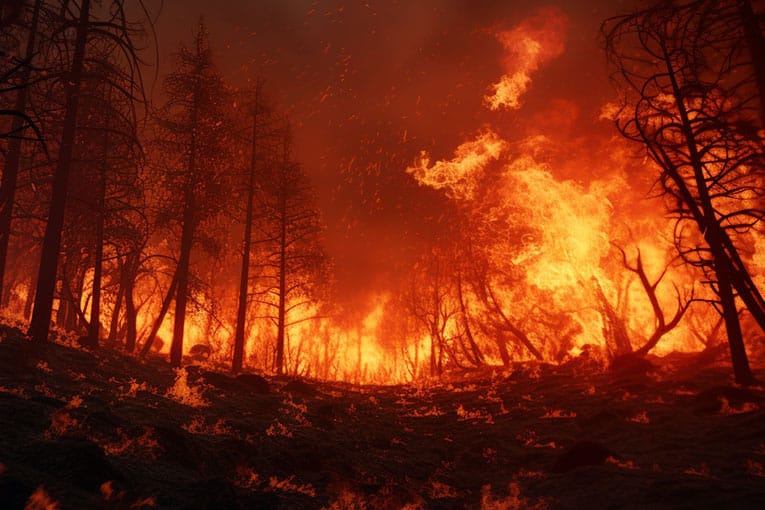
What causes wildfires is a commonly asked question, with wildfires during the summer months being shown almost every day in the news.
Fire only needs three components to thrive: fuel, oxygen, and heat. This is commonly referred to as the fire triangle.
During hot summer days when drought conditions are at their peak, even the tiniest spark can set off a wildfire.
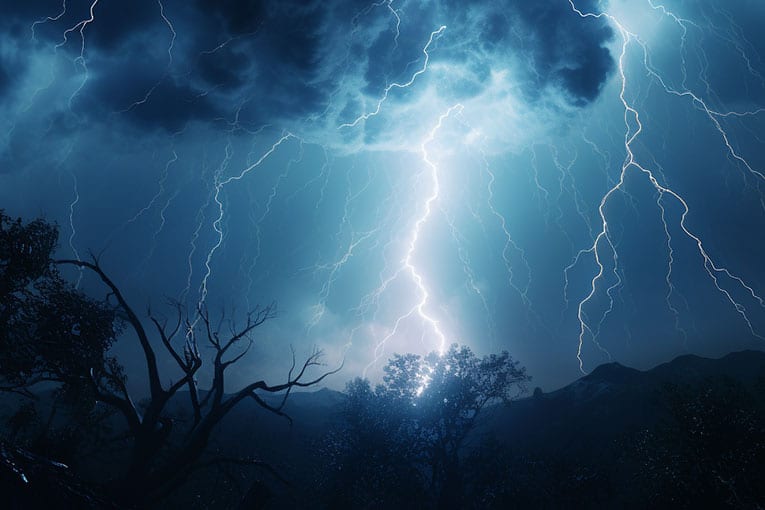
In certain instances, fires occur naturally, sparked by the intense heat of the sun or from lightning strikes.
Unfortunately, similarly to the main causes of fires in general, the majority of wildfires stem from human negligence.
Wildfires can be incredibly destructive
Events such as arson, poorly managed campfires, careless littering of lit cigarettes, improper burning of debris, and playing with matches or fireworks are often held responsible for igniting these devastating blazes.
This article aims to explore what causes wildfires, ranging from natural occurrences to human activities.
By delving into these causes, we can enhance our knowledge and promote responsible behaviour to mitigate the future risks of devastating consequences of wildfires.
What is a Wildfire?
Wildfires are powerful and destructive forces of nature that can cause extensive damage to forests, natural habitats, and communities.
Understanding the common causes of wildfires is crucial for prevention and effective fire management.
By identifying the main causes of wildland fires, we can take proactive measures to reduce the risk of wildfires and protect our natural environment.
What Causes Wildfires?
Wildfires start due to a number of reasons, with 11 of the most common causes being:
Lightning
Lightning is a natural cause of wildfires.
Lightning strikes can ignite dry vegetation, particularly during periods of drought. The heat from a lightning strike can spark flames that spread through the surrounding landscape.
Lightning is one of the main natural causes of wildfires
This can lead to large-scale wildfires, especially in areas with dry and combustible vegetation.
Climate conditions and the frequency of thunderstorms can contribute to wildfires.
Campfires
Improperly managed campfires are a significant cause of wildfires.
Unattended or poorly extinguished campfires can spread to surrounding vegetation and ignite a fire.
Campers should always follow fire safety guidelines, including keeping fires small, using designated fire rings or pits, and ensuring that the fire is completely extinguished before leaving the site.
It is crucial to douse the fire with water, stir the ashes, and repeat the process until the fire is cold to the touch.
Burning Vegetation
Whether intentional or not, burning of vegetation like agricultural burning or land clearing, can lead to wildfires.
When uncontrolled, the spread of fires during vegetation burning can quickly escalate, especially in dry and windy conditions.
Proper permits, monitoring weather conditions, and employing trained workers are essential for safe and controlled burning practices.
It is important to follow local regulations and guidelines to prevent wildfires when conducting any form of vegetation burning.
Fallen Power Lines
Fallen power lines can be a significant cause of wildfires, particularly during windy conditions.
Strong winds can cause power lines to break or come into contact with trees or dry vegetation, resulting in sparks and fires.
Regular maintenance and inspection of power lines, timely tree trimming around power lines, and prompt repair of damaged infrastructure are essential for reducing the risk of wildfires caused by fallen power lines.
Smokers should always use designated ashtrays or fire-safe containers to dispose of cigarette butts.
It is crucial to fully extinguish cigarettes before discarding them and avoid smoking in fire-prone areas, particularly during dry and windy conditions.
Equipment Malfunctions
Equipment malfunctions, such as power tools, chainsaws, or machinery, can lead to wildfires if they generate sparks or excessive heat.
Proper maintenance, regular inspection, and safe equipment operation are essential to prevent equipment-related wildfires.
It is crucial to follow manufacturer guidelines, conduct routine maintenance checks, and promptly address any issues with equipment.
Vehicle Crashes
Vehicle crashes can cause wildfires when sparks or friction from the collision ignite.
The heat generated from the impact, particularly with metal components, can also lead to fire ignition.
Safe driving practices, proper vehicle maintenance, and avoiding off-road driving in fire-prone areas can help minimise the risk of wildfires caused by vehicle crashes.
Arson
Intentional acts of arson, where fires are intentionally set, are a significant cause of wildfires, and can lead to dangerous scenarios, and even loss of life.
Arson can occur due to various motives, including vandalism, revenge, and even pyromania.
It is a criminal offence and poses a serious threat to lives, property, and natural resources.
Public awareness, community vigilance, and reporting suspicious activities can aid in preventing arson-related wildfires.
Controlled Burning
Controlled burning, also known as prescribed burning, is a planned fire management technique used to reduce vegetation fuel loads and promote ecosystem health.
However, if not carefully executed, prescribed burns can escape control and result in wildfires.
Proper planning, comprehensive risk assessments, and skilled personnel are essential for conducting prescribed burns safely.
Adhering to specific weather conditions, monitoring fire behaviour, and having appropriate resources in place helps minimise the risk of prescribed burns turning into uncontrolled wildfires.
Fireworks
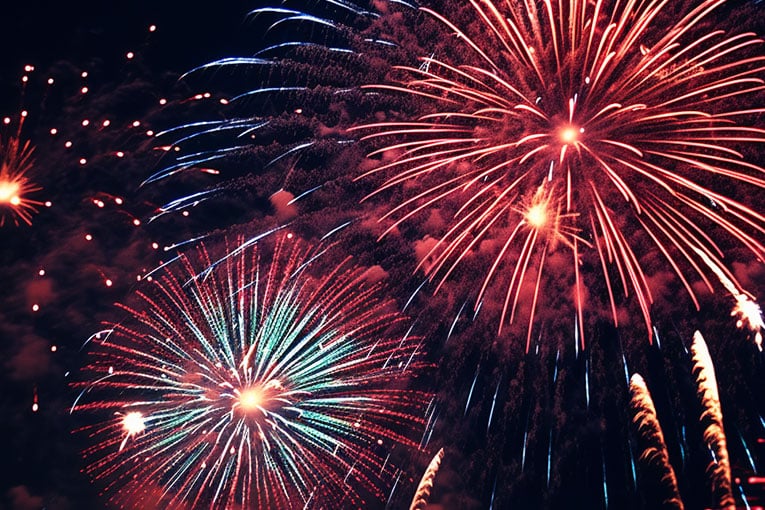
Improper use of fireworks, especially in areas with dry vegetation, can lead to wildfires.
Fireworks produce sparks and embers that can ignite nearby combustible materials, including dry grass or trees.
Even though fireworks can be pretty to look at, they can be a cause of wildfires
Adhering to local laws and upkeep high fire safety standards regarding fireworks, using fireworks in designated areas, and ensuring proper disposal of fireworks debris is crucial to prevent wildfires.
Volcanoes
Volcanic eruptions can cause wildfires, particularly when hot lava or volcanic ash comes into contact with dry vegetation.
Active volcano regions should have comprehensive emergency response plans in place to mitigate the impacts of volcanic-induced wildfires.
How does weather affect wildfires?
Increased temperatures alone do not guarantee a rise in wildfires.
As previously stated, fires need a combination of 3 factors to survive; availability of fuel, fire-friendly conditions (such as dry weather), and the presence of an ignition source, whether human-caused or triggered by lightning strikes.
One small spark can cause wildfires when conditions are dry and arid
The amount and dryness of vegetation are crucial factors since live, moist vegetation is less susceptible to burning compared to dry, dead vegetation, which easily catches fire and aids in the fire’s spread.
This is why areas affected by hot, dry weather and drought are much more likely to have wildfires than areas that are often rainy and cold.
Weather conditions play a critical role in fire behaviour.
Strong winds, like those experienced in the 2022 Colorado wildfires, can accelerate the spread of fires, resulting in unprecedented devastation for the affected communities.
Wildfires become more severe during prolonged periods of hot and dry weather due to higher temperatures leading to increased evaporation, which dries out the vegetation and provides ample fuel for the fires to thrive.
Where do most wildfires occur?
Wildfires happen all over the world. Places like the United States, Canada, Australia, the Western Cape of South Africa, and Southern Europe, especially forested areas, grasslands, and shrublands, are particularly susceptible to these blazes, particularly during extended periods of drought and high temperatures.
The vegetation in this area, comprising pine needles, dry shrubs, and grasses, possesses higher flammability compared to moister trees like maple and beech found in other parts of the country.
The Western US’s mild and arid climate further contributes to the fire risk. California, in particular, experiences long, hot, and dry summers, which lead to the dehydration of vegetation, leaving it highly susceptible to wildfires.
Conclusion
Wildfires can have devastating consequences for ecosystems and communities.
Understanding the common causes of wildfires is necessary to be able to better prevent them.
Whether ignited by natural occurrences or as a result of human negligence, wildfires can be mitigated through responsible behaviour, adherence to fire safety guidelines, and community awareness.
Implementing fire prevention strategies, practising safe habits, and promoting fire education can help minimise the occurrence and severity of wildfires.
By working together, we can reduce the impact of wildfires and protect our environment for future generations.
The upcoming International Water Mist Conference set to commence this October in Copenhagen
The International Water Mist Association (IWMA) has announced that the 22nd International Water Mist Conference will be held in Copenhagen, Denmark.
This prestigious event is scheduled to take place on 11th and 12th October 2023.
The chosen venue for the conference is the reputable Copenhagen Marriott Hotel.
An exhibition is set to run in tandem with the conference. All details of the conference, including the programme, can now be accessed on the official IWMA webpage.
Two-day International Water Mist Conference to focus on systems in practice and research and testing
The first day of the conference, which can be separately booked, will focus on presentations dealing with water mist systems in practice.
The subsequent day will primarily be devoted to research and testing.
Notably, the presentation of the IWMA Young Talent Award winner of the year will also be conducted on the second day.
Variety of presentations at the International Water Mist Conference cover complex water mist system discussions
In total, the conference programme includes twelve presentations and a panel discussion titled “Water Mist Systems – simple or (too) complex?”.
Panelists and speakers come from a diverse range of countries including Chile, The Netherlands, Poland, and Germany.
For those interested in the content of the presentations, the abstracts are available on the IWMA webpage under the section ‘conference papers’.
The early bird period for registrations is open until 15th August. The registration tool will subsequently be closed on 6th October at noon (CEST).
IFSJ Comment
With the annual International Water Mist Conference approaching, there’s an evident buzz within the fire and safety industry.
The conference serves as a key platform for professionals to share and gain insights on the latest advancements in water mist systems, and with the addition of the IWMA Young Talent Award, it also highlights the important role of upcoming professionals in shaping the future of this industry.