A year of firsts: HSE Chair reflects on the past year

As I complete my first year as Chair of the HSE, I have an overriding feeling of pride in the people and achievements of the whole organisation. Our resilience, flexibility and determination to deliver on our mission, values and business plans during these testing times continues to be an inspiration.

HSE stepped up and continues to contribute to the national response to the global pandemic. At the same time, colleagues are taking on significant new responsibilities and expanding others so that we enable more people to be safe and feel safe in their homes, whether houses , apartments or high-rise buildings as well as protecting people and the environment from harmful exposure to chemicals and explosives.

Behind the scenes colleagues have enabled new ways of working, including the continuity of our helplines and an extraordinary growth in our online advice and information communications reach. Right across the organisation there is much learning that is valuable and will inform our new strategy and future business plans.

Many of our partnerships are deeper and stronger than before. The British Occupational Health Society (BOHS) has recognised HSE’s efforts in putting together a unique team of specialists to assist the Government in their efforts in providing frontline health care workers with life-saving personal protective equipment (PPE), as a part of the pandemic response.

The Peter Isaac award recognises “an outstanding initiative that has contributed to the reduction of ill health at work.” The HSE PPE technical team was assembled to respond to unprecedented global demand for equipment, not only to provide NHS workers with access to high-quality PPE, but also to conduct research, provide expertise, and support policy making and practical guidelines across a whole variety of workplaces.

The celebrated team comprised of experts in occupational hygiene, science, microbiology and infection prevention, as well as policy-making experts and support staff, who combined their skills and knowledge across a wide range of interrelated disciplines.

Working closely with the Department of Health and Social Care (DHSC), Public Health England (PHE), Medicines and Healthcare Regulatory Agency (MHRA), the NHS and other government bodies, the HSE team evaluated materials and specifications against relevant PPE requirements, to rapidly provide agreement that new and novel sources of supply had been properly assessed and could be deployed to frontline workers without unnecessary delay.

At the same time, colleagues developed the new Spot Check service that has enabled HSE to support local authorities across GB to support workplaces to be to as Covid secure as possible. Colleagues have completed some complex and significant prosecutions including an NHS Trust, National Gas Grid and an Adventure Theme Park operator. While we remain focused on prevention, it is also essential that we also hold people to account and secure justice.

I am one of many colleagues who joined HSE during the pandemic and while I have valued participating in our virtual events, I am very much looking forward to meeting as many colleagues as possible during the forthcoming ‘One HSE’ events this autumn. These events will provide us all with a good opportunity to appreciate the breadth and depth of our work and think about our shared purpose, values and direction of travel. I am confident and positive about the year ahead and the contribution that HSE will make during these challenging times.

This article was originally featured on the HSE website.

Five killed after fire breaks out at Pemex oil and gas facility

An oil and gas facility run by Mexican state firm firm Petroleos Mexicanos (Pemex) was evacuated on Sunday after a fire broke out broke out according to reports. Early reports have suggested that five people have been and many more have been injured, with an operation in place to search for missing workers.

The blaze took place at the E-Ku-A2 platform at the Ku-Maloob-Zaap oil field in the Bay of Campeche but was brought under control around 4.30 p.m. (2130 GMT), according to a statement released by Pemex. The company also confirmed that the fire caused them to cut about a quarter of Mexico’s oil production, with the platform still out of operation.

The injured were being treated for burns in hospitals, and the cause of the fire at the E-Ku-A2 platform would be investigated, according to Pemex Chief Executive Octavio Romero told a news conference.

Although the cause of the fire is so far unknown, it broke out as workers were carrying out maintenance work on the platform.

Ministers in show of support for opening offshore oil and gas industry

UK Government Ministers have shown support for the offshore oil and gas industry, attending a formal opening of its leading representative body’s new office in Aberdeen.

Rt Hon Anne-Marie Trevelyan, Minister for Energy, Clean Growth and Climate Change, and David Duguid, UK Government Minister for Scotland, today (9 August) attended a ribbon-cutting ceremony for OGUK’s new office in Annan House, located near the Union Square development, as part of a day of visits to companies working in the sector.

The ceremony was followed by a discussion with industry leaders in which Ms Trevelyan reconfirmed her support for the North Sea Transition Deal, agreed between UK Government and industry in March.

The deal will unlock up to £16 billion of investment over the next decade in crucial low carbon solutions like carbon capture and hydrogen, secure up to 40,000 energy jobs in industrial heartlands across the UK and cut UK emissions by 60 million tonnes (the equivalent of taking 2.5 million cars off the road).

It will also ensure energy communities across the UK can successfully transition, retaining jobs and skills and creating a more diverse and inclusive workforce.

OGUK CEO Deirdre Michie said: “We welcome the Ministers today and appreciate this show of support at such a pivotal time for our industry.

“This ceremony marks an era of transformation for our sector as we continue our recovery, working with the UK Government to implement the North Sea Transition Deal, a key catalyst for net zero and the Prime Minister’s ten-point-plan alike.

“We hope to build on this positive relationship with government in the coming years to realise the full potential of our changing sector, supporting jobs and the economy while playing a key role in delivering the government’s net zero targets.”

Energy and Climate Change Minister Anne-Marie Trevelyan said: “It was a privilege to officially open OGUK’s new office in Aberdeen today, and I look forward to continuing to work with the UK’s oil and gas sector to support them in the transition to a cleaner, greener energy future.

“Through our landmark North Sea Transition Deal, we are backing the decarbonisation of the oil and gas industry, while supporting workers both here in Scotland and across the UK, as we work to build back greener and eliminate our contribution to climate change.”

UK Government Minister for Scotland David Duguid said: “It was great to meet representatives from OGUK and see the brilliant new offices at Annan House, marking another step forward in the North Sea Transition Deal.

“The North East of Scotland has a reputation for excellence in the oil and gas industry, and as we move towards a greener future, the UK Government is supporting the area to become a global centre of excellence in the energy transition.

“The Deal will safeguard and create highly-skilled jobs in the North East, boosting the economy while helping us realise our net zero ambitions.”

G3 Systems Fire Protection Services conclude operations at Mazar-e-Sharif Air Base

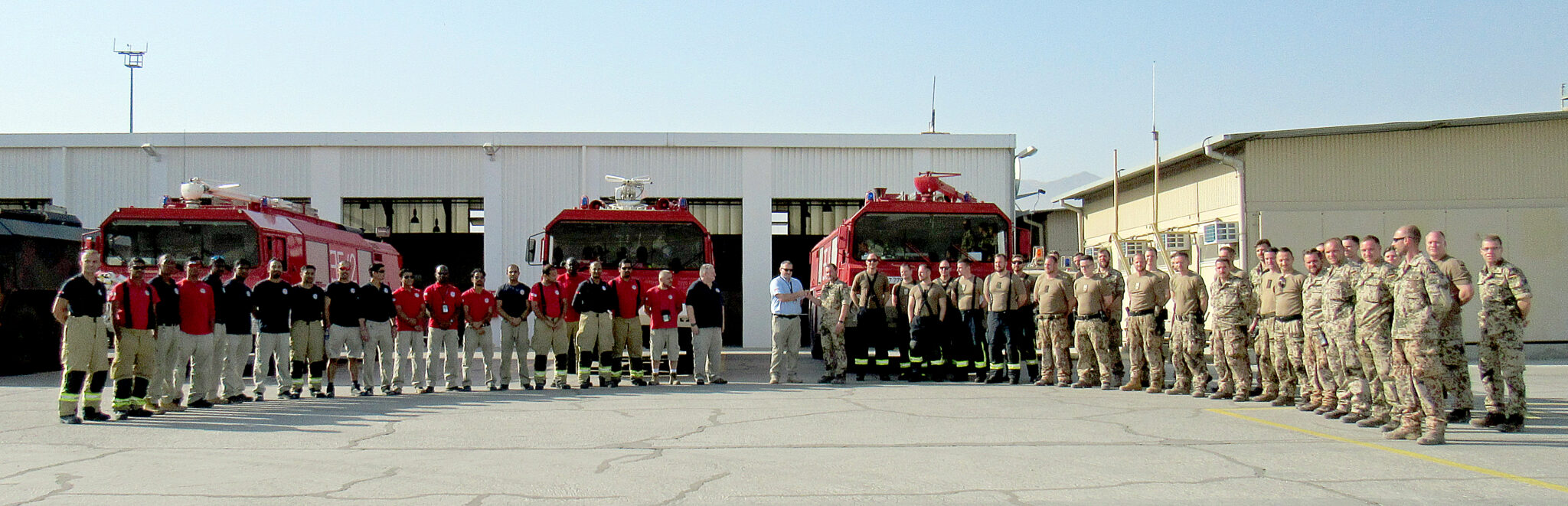
On the 6th June 2021 at 07:30 (AFG Time), G3 Systems handed over its Fire Protection Service (FPS) function to DEU (German Armed Forces) Air Operations Group firefighters, marking the conclusion of a continuous working relationship at the Mazar e Sharif (MeS) airbase which began on 21st November 2014.

During the last 6 and a half years, G3 Systems Limited, working through the NATO Supply & Procurement Agency (NSPA), has successfully provided the DEU at MeS with continuous aviation and structural fire cover, ensuring all airfield emergency responses to ICAO CAT 9 requirements, along with structural firefighting response to all elements of the airbase infrastructure and personnel.

This essential emergency service provision has been achieved with a total of 59 staff delivering ARFF, Structural, Fire Safety and Emergency Vehicle Technician support to fulfil 24-hour coverage for the changing mission requirements, in this austere and often challenging environment.

G3 Systems has also trained 14 Afghanistan Civil Aviation Authority (ACAA) firefighters during an 18 month ‘on the job’ training contract, which resulted in the airport gaining ICAO certified and trained staff, available to provide fire cover for the civilian side of the Mazar e Sharif International Airport. This training comprised Basic Firefighting skills, specialised aircraft firefighting, incident command and management, technical rescue skills, working at height and driver training.

Commenting on the handover, Chief Fire Officer Derek Tomlinson said “I would like to thank everyone who has worked, assisted and been a part of the incredible journey over the G3 Systems MeS FPS contract. I would also like to dedicate this final message to the memory of our colleague Firefighter Myank Mishra, who very sadly lost his life to COVID-19 in India during the demobilization of this contract”.

G3 Systems has also provided the FPS to the airbases in Herat and Kandahar and continues to support NATO and the ACAA in Afghanistan with FPS at Hamid Kharzai International Airport in Kabul.

UL launches building and fire safety management compliance tools

UL have announced the release of a new digital platform and third-party certification scheme to help building safety and fire professionals around the world increase their safety protocols, demonstrate best practice and reassure residents, investors, boards and other stakeholders.  

UL’s Built InForm software tracks and manages certification, testing schedules, professional competencies and other activities across single buildings or whole portfolios, empowering effective safety monitoring and management. Information in Built InForm also is easily accessible to regulators and residents when requested. 

“Digitalisation is an inevitable and powerful way to boost building safety,” said Simon Ince, project engineer at UL. “The use of outdated paper-based methods, such as fire safety logbooks and operations and maintenance manuals, is widespread. But this is no longer enough to satisfy regulators, residents and investors, so we have developed Built InForm to help building and fire safety managers confidently make the digitalisation transition.”

In addition the new Building Safety Management (BSM) Certification Scheme provides independent third-party audit and certification of fire and structural safety management systems, offering confidence in results.

“Third-party audit and certification is essential,” Ince said. “It gives you and others the reassurance that you have the requisite safety systems in place, and it will help to promote that you are doing your utmost to keep occupants safe. The BSM Certification Scheme will help to give everyone peace of mind.”

Learn more about the Built InForm and the BSR Certification Scheme.

Belfast City Airport chooses Dräger’s new PSS AirBoss SCBA to safeguard passengers and staff

The Emergency Fire and Rescue team at George Best Belfast City Airport has become the first in the UK to opt for Dräger’s newly-launched AirBoss self-contained breathing apparatus (SCBA), to provide its firefighters and emergency services teams with the most advanced fire safety protection.

The 34-strong emergency service crew at Belfast City Airport is required by the Civil Aviation Authority (CAA) to deploy and attend any fire safety incident in the airport or on the runway within three minutes of being alerted.

Although a previous user of Dräger’s equipment, the decision to choose AirBoss followed a rigorous review of SCBA systems from different providers and is part of a multi-million pound investment in all aspects of the Airport’s fire safety response. Seamus MacMahon, Chief Fire Officer and Head of Emergency Planning, says he is assured knowing Dräger is the global industry leader, and that they have chosen the most advanced equipment possible:

“By choosing Dräger, we are ensuring the longevity of our investment which is key for continuity. With a strong footprint in Northern Ireland, Dräger’s ability to support its customers with dedicated resource in training, aftercare, spares, service, and maintenance is invaluable and second to none.”

Dräger’s next-generation AirBoss includes a carrying system with pneumatics, monitoring systems, masks and communication technology and numerous accessories such as the ultra-lightweight Type 4 Nano compressed air breathing cylinders and lung demand valves. State-of-the-art ergonomics provide improved wearer comfort and mobility, complemented by a pivoting waist belt and three-step height adjustments.  

Belfast City Airport has opted for the AirBoss Connect as this model provides the most advanced situational awareness.

“We will benefit from Airboss Connect’s digital displays, and the new ‘Buddy Light’ feature – an innovative element allowing immediate and highly-visible signalling amongst our firefighters to alert them on aspects such as cylinder pressures and the physical condition of their colleagues.

“The advanced modular design of AirBoss means we can build in additional functionality as and when required to ensure we stay at the forefront of fire and rescue response capabilities.”

Seamus says that AirBoss’s easily adjustable backplate is a significant benefit: “Emergency Service teams have changed considerably during my career – minimum height requirements, for example, are a thing of the past – and so systems need to be easily borne by different physiques, both male and female.

“Overall, the whole team agreed that the system is very appealing, especially its lightness and ‘snag-proof’ design. Our overriding commitment is to the wellbeing and safety of passengers and staff, it is what underpins every decision in the business and has been the driving force behind this latest investment,” he concludes.

Liz Millward, Marketing Manager Emergency and Rescue Services at Draeger Safety UK, says it is fantastic that AirBoss has been ordered so soon after launch: “It is testament to the forward thinking nature of Belfast City Airport team – and indeed the long-standing relationship and trust that they have in our brand,” she says.

Hochiki Europe roundtable: How can we improve life safety in care homes?

Over the last 12 months, the country has watched COVID-19 tear through care homes and leave devastation in its wake. With the sector experiencing the first major escalation in fatalities due to the close knit and closed off nature of homes, the importance of protecting society’s most vulnerable has been thrust firmly to the top of the nation’s agenda.

As well as the threat of the virus though, care home residents still face the risks they did pre-pandemic from a variety of other factors, including fire. And when it comes to making, installing, maintaining and supplying life safety technology, the care home environment presents a range of unique challenges.

In April 2021, Hochiki Europe hosted a roundtable made up of industry experts focused on the requirements and opportunities around life safety in care homes. The virtual conversation explored how the people responsible for keeping residents and care givers safe can work together, sharing knowledge and ideas to improve standards and best practice.

The Panel

  • Paul Adams, Marketing Manager, Hochiki Europe (Chair)
  • Martin Green, Regional Sales Manager, Hochiki Europe
  • Ian Hill, Emergency Lighting Manager, Hochiki Europe
  • Andy Hollingshead, Health and Safety Manager, Barchester Healthcare & Vice Chair NASHiCS
  • Simon Titley, National Account Manager – Healthcare, Churches Fire & Security
  • Ian Watts, Business Development Manager, Llumarlite Lighting Solutions

How has the pandemic affected the provision of fire safety in the care environment?

The discussion began with a reflection of the last year and how COVID-19 has impacted the delivery of fire safety services within care homes – taking into consideration the battle of controlling infection and reducing visitors, while observing stringent safety standards and maintenance requirements.

“It’s obviously been a very difficult time within the industry, particularly in March and early April last year when people were being discharged from hospital without a test, as testing wasn’t the norm at that time,’ stated Andy Hollingshead – who is part of the H&S Team for one of the country’s largest independent care providers. Like any other business, he stressed that those within the care sector had faced no choice but to adapt almost overnight.

“Fire and evacuation drills are a vital part of any fire safety strategy, but they encourage people to gather together, which is a challenge in the current climate. To combat this, we turned drills into desktop training where scenarios were given and staff had to describe the actions they’d take. This has been extremely well received and we’ll be continuing to run these exercises even after restrictions are lifted.

“We also had a number of fire and rescue crews that were concerned about how they’d know which residents had tested positive/suspected if they arrived to support with an emergency. We overcame this by putting red letter Cs on PEEPS to identify who was high risk, which made things immediately clear to fire fighters.”

On the topic of maintenance, all parties agreed that the legal requirement to inspect and test systems over the last 12 months has been challenging. Simon Titley shared his experience: “By law, risk assessment and method statements (RAMs) must be updated regularly, so we had no choice but to continue. We altered our approach to offer more virtual appointments via WhatsApp video calls to maintenance staff or care home managers to ascertain whether or not a site visit was necessary.

“When they are, all appointments are pre booked and technicians are instructed not to enter a care home until they’ve called from the vehicle to ensure it’s still appropriate to visit. We have put certain protocol in place where contractors can’t enter bedrooms and with smaller properties, we’ve prearranged for the carer to take the patient out into the garden while we are on site. We’ve also produced a letter for staff which states that they provide an essential service to support them with accessing the vaccine as a priority.”

Everyone agreed that new processes are key and looking to how life safety technology itself can support, Hochiki’s Martin Green expanded – “hybrid wireless systems are a great fit as they are designed to reduce installation time, which minimises the time installers need to spend in people’s rooms. The wireless technology that’s on offer now is so much more robust than it was a few years ago – it’s ideal for the care environment.”

Working alongside vulnerable individuals

Albeit obvious, one of the most challenging considerations of providing life safety systems to the care sector is the fact that many residents have poor sight, mobility issues, are hard of hearing or living with dementia – all adding to the complexity of ensuring systems are appropriately designed.

Hollingshead explained that protecting those with bariatric care requirements and reduced mental capacity causes the most issues and in response, Green went on to offer his insight into the technology designed specifically with vulnerable individuals in mind. He said, “In the event of a fire alarm being activated, visual alarm devices – or VADs – complying to BS EN54-23 are required in locations where they are considered to be the primary source of warning to building occupants.

“Within care homes, this is extremely common so we offer devices which flash brightly to serve as a primary indicator of a fire occurrence for those with impairments. More innovative control panels which enable a programmed phased evacuation are also perfectly suited to care environments, as they help to control the evacuation process and minimise confusion and chaos – a must when dealing with people who may not have any comprehension of the danger they’re facing.”

Hollingshead agreed – “People believe the concept of fire evacuation is total evacuation but in the care industry, it’s progressive horizontal evacuation (PHE). Getting people away from the point of a fire and moving them into a point of safety (minimum 2 fires doors away) is the best approach.”

When questioned on the recommended two and a half minute evacuation time, Hollingshead shared some interesting trivia – “the story goes that this originates over 100 years ago from theatres playing the national anthem in the event of a fire, as it typically signalled the end of a performance and encouraged audiences to leave. Whether this is true or not, it makes very little sense to a care worker in an emergency who’s trying to assist a resident that requires a hoist to get out of bed, for example. That’s why we take the simple approach of ‘you do whatever it takes to save a life.’”

Minimising false alarms

Next, the panel discussed the importance of reducing occurrences of false alarms – due to the reoccurring issue of the frailty of care home residents. Simon Titley reminded the group that this can be supported by regular, planned preventative maintenance programmes which extend the life expectancy of equipment, in particular sensors. In addition, visual checks of electrical equipment that come into a premises are vital to monitor for scorched plugs or broken cables.

Andy Hollingshead commented – “Toasters are a huge issue – they usually cause smoke rather than fires, which cause activation of alarms. Halogen floor lights have recently cause problems too, so we only use LED bulbs across our homes now. It’s so important to be smart in order to avoid bad relationships with local fire brigade, as the work they do is incredible and it’s vital to keep them on side.”

Turning to how technology can help avoid false alarms, Hochiki’s Martin Green said: “Investigation delays can be set to give staff a few minutes to respond before the fire brigade is alerted and cause and effect programming in multi-sensors can also help, particularly with common causes such as toasters. For example, you can program the multi-sensor to provide an initial alert at the fire control panel to inform a manager that there is smoke present and then, while also monitoring for the presence of heat, begin to determine whether it’s a real fire and whether a full alarm condition should be initiated.”

When asked what companies can do to improve system design and engineering, Simon Titley stressed that every design should be built around a fire risk assessment (FRA) provided by the owner of the care home – “creating a robust fire safety strategy relies on a partnership between contractor and operator”, he said.

Picking up on a potential design flaw, Hollingshead explained that people living with dementia often set off call points. “We do everything we can to try and stop this with covers and howlers and it still happens. Within BS 5839-1, there’s a proviso that all manual call points are fitted with covers to reduce false alarms but when you’re dealing with people living with dementia, it’s almost impossible to avoid them completely,” he said.

The group were in agreement and FIA trainer, Ian Watts, advised that it’s possible to write something into the care home’s risk assessment to override this issue. He commented – “There’s so much ability to create variations to the BS and this is something that I’m always keen to stress during training courses. Of late, there has been a real uplift in the take-up for training, which is wonderful to see. People are taking their knowledge and applying it to individual buildings successfully – it’s a lovely movement.”

The role of regular risk assessments

Expanding on the subject of risk assessments, all parties agreed that they don’t just offer an understanding of fire safety, but also the people that use a home and the unique difficulties of each care home. “This isn’t often appreciated within the industry. An ex-fire officer isn’t necessarily a risk assessor,” said Hollingshead. “We have a full survey every three years and an additional review annually that looks at the people and the environment, not just the system.”

Under the Regulatory Reform (Fire Safety) Order 2005, the responsible person is required to – following a risk assessment – implement appropriate fire safety measures to minimise the risk to life from fire, and to keep the assessment up to date. However, within the industry, there is often confusion around how a responsible person is defined. Andy continued: “Under legislation, it’s officially the CEO but typically it’s down to managers to make sure remedial work from assessments are carried out.”

Energy efficiency

While it’s clear that fire safety must not be disregarded in the quest for energy efficiency, there is a clear link between the two. The panel discussed ways that new build homes are more energy efficient and fire safe by design – through the use of products such as LED bulbs and USB charger ports. However, when it comes to older buildings it can be more challenging, as it’s hard to put demands on people regarding their own belongings.

Hollingshead said: “We wouldn’t like people to come into our bedrooms and start altering things, so it can be tricky! There are ways to overcome this though, for example, we’ll quite often replace the halogen bulbs in residents’ reading lamps for cooler running LEDs, so you’re not taking someone’s belongings away, just changing them to make them safer and more efficient.”

The benefits of wayfinding technology

At this point, Hochiki’s emergency lighting manager, Ian Hill, raised the topic of wayfinding technology and emergency lighting, which is also now designed to use LED – not only more efficient but also long-lasting, meaning products are much more reliable, reducing the chance of failure and simplifying maintenance.

Ian explained: “The majority of fire risks in care homes are at night, when there’s substantially less staff than during the day and it’s dark, which highlights the importance of designing a fire system with emergency lighting in mind.

“Design is vital here. It’s extremely important to communicate an exit plan right the first time to minimise confusion – especially when dealing with people with dementia. In care homes, there tends to be corridors with lighting signs at each end, so blocking off exits to take choice away makes evacuations safer and quicker. With some intelligent life safety systems that combine emergency lighting and fire detection, at the first instance of a fire, the nearby exit signs will change from a green running man to a red cross to show the exit is compromised. In these instances, there’s no room for ambiguity and it must be totally clear to residents and staff alike.”

Closing the discussion, Paul Adams asked the group for any final advise they’d offer those within the care industry, as well as where they can access support or technical guidance.

Ian Watts suggested the FIA, while Andy Hollingshead praised the HSE and NASHiCS websites. He also urged them to always consider the ‘three c’s’ – communicate, command and control. “We use this motto to train care sector staff and believe that if all these are in place, nobody will lose their life.” Watts echoed this sentiment – “in a similar vein, we use ‘review, refresh, replace’ when referring to the importance of maintaining risk assessments.”

In conclusion, Ian Hill stressed that reading the guidance and keeping abreast of evolving standards and requirement is important, a robust life safety strategy comes down to a successful initial design and the quality of products installed. By working with industry experts, those within the care sector can rest assured that every possible measure is in place to protect residents and staff.

For more information about Hochiki Europe and its range of intelligent life safety devices suitable for the care sector, visit www.hochikieurope.com. To watch the panel discussion, head to www.youtube.com/hochikieurope
Agriculture remains worst performing industrial sector for fatal injuries

HSE has published a report detailing that agriculture has the worst rate of fatal injuries of all the major industrial sectors, around 20 times higher than the average five-year annual rate across all industries. Provisional figures from 1 April 2020 until 31 March 2021 show 41 people were killed in agriculture related activities, almost double the number of deaths in the previous year, which was 23.

The report, Fatal injuries in agriculture, forestry and fishing in Great Britain 2020/21, has been published to coincide with the start of Farm Safety Week (19 – 23 July). 

While the number of people killed fluctuates each year, the five most common causes of fatal injuries over the last five years remain – being struck by moving vehicles, killed by an animal, struck by an object, falling from height and contact with moving machinery. Transport-related incidents, such as overturning vehicles or being struck by moving vehicles were responsible for more deaths than any other cause.

Older workers at higher risk of fatal injuries

Older workers are most at risk, with more than half of victims of fatal injuries aged 60 years or older. When comparing older and younger age groups, the fatal injury rate is more than four times higher for the 65s and over, compared to the 16-24 age group. The youngest person killed was a two-year-old child who died after being overcome by slurry fumes


Acting head of agriculture at HSE Adrian Hodkinson said: “Agriculture is a vital part of our economy and everyone involved is rightly proud of the quality and standard of the food produced. “It is not acceptable that agriculture continues to fail to manage risk in the workplace. We need everyone to play their part to improve their behaviour, do things the right way and ‘call out’ poor practices whenever they are seen.


“Agriculture will continue to be a priority sector for HSE, which will be achieved through the delivery of HSE’s sector plan for tackling the high rates of injury and ill health.” He added: “It is disappointing to be highlighting another high annual fatality rate in the industry when the causes are well known and the precautions to avoid injury are straightforward.


“There are simple safety measures people should follow to reduce injury like remembering to put on handbrakes, fasten lap belts in cabs, make sure anyone operating a quad bike wears a helmet and receives sufficient training, don’t put cows and calves in fields with public footpaths; and make sure to switch off the power to vehicles or machinery before attempting to carry out repairs.”

The full report and more information on working safely in agriculture is available on the HSE website. HSE’s plan for tackling the high rates of injury and ill health is available here: Sector plan for health and safety in the agriculture.

Farm safety week, which shines a light on safety in the sector, is led by the Farm Safety Foundation.

Warehouse company fined after employee killed in electrical incident

A warehouse management solutions company has been fined after an employee was killed in an electrical incident while servicing an air compressor.

Maidstone Magistrates’ Court heard that on 8 December 2017, Andrew Meade was carrying out pre-planned maintenance on an air compressor at a distribution centre in Gravesend, when he was electrocuted. He was not found for more than an hour following the incident. His injuries were fatal.

An investigation by the Health and Safety Executive (HSE) found that the control measures in place to prevent contact with electricity during maintenance activities were not suitable or sufficient. The electrical systems had not been tested or visually inspected since installation, and an incorrect isolating switch had not been identified.

Logistex Limited of Kettering Parkway, Kettering, Northamptonshire pleaded guilty to breaching Section 2(1) of the Health and Safety at Work Act 1974. The company was fined £180,000 and ordered to pay full costs of £23,358.16.

Speaking after the hearing, HSE inspector Joanne Williams said: “Poorly maintained electrical installations and faulty electrical appliances can kill or severely injure people; and cause damage to property.

“This was a wholly avoidable incident, caused by the failure of the company to implement safe systems of work and identify the risks. Had the company identified the correct isolation point for the compressor and ensured that employees were sufficiently trained and supervised in the lock off procedures expected of them then this fatal incident would not have occurred.”

NIOSH offers coal miners free health screenings

In September 2021, the National Institute for Occupational Safety and Health (NIOSH) will offer a series of free, confidential health screenings to coal miners as part of the Coal Workers’ Health Surveillance Program (CWHSP). The screenings are intended to provide early detection of coal workers’ pneumoconiosis (CWP), also known as black lung, a serious but preventable occupational lung disease in coal miners caused by breathing respirable coal mine dust.

The health screenings are provided through the state-of-the-art NIOSH mobile testing units at convenient community and mine locations. This year’s screenings will be held from September 9 through September 24 in areas throughout southern West Virginia.

“Black lung disease can occur in miners who work in mines of all sizes,” said NIOSH Director John Howard, M.D. “Early detection of black lung disease allows underground, surface and contract miners to take the steps needed to keep it from progressing to severe lung disease.”

Screenings include a work history questionnaire, an x-ray, a respiratory assessment questionnaire, and blood pressure screening. The screenings typically take about 15 minutes and each individual miner is provided with their results. By law, each miner’s results are confidential. Individual medical information and test results are protected health information and not publicly disclosed. Spirometry, a common breathing test, will not be conducted during this year’s survey.

Participation in this program provides the coal miner:

  • An easy way of checking on their health
  • A confidential report regarding whether or not they have x-ray evidence of CWP

The NIOSH mobile health unit is considered a “healthcare setting” so COVID-19 prevention strategies will be followed.
Please watch for health screening locations, dates, and additional announcements on the CWHSP web pageCWHSP Facebook, and @NIOSHBreathe on Twitter.  Local and individual outreach will be done in all specific locations.  All coal miners – current, former, underground, surface, and those under contract – are welcome to participate.