Fire doorset testing: Why integrated fire resistance and smoke leakage testing matters

Peter Barker of Element Materials Technology explains how integrated fire doorset testing helps manufacturers demonstrate fire resistance, smoke leakage performance and prepare for future EN classification requirements

Fire-resisting doorsets play an important role in compartmentation, helping to limit the spread of fire and smoke throughout a building. Fire resistance has traditionally been perceived as the primary performance characteristic for fire doors, but smoke control is coming into sharper focus when assessing how a doorset performs as a complete assembly.

The planned withdrawal of BS 476 classifications from Approved Document B in September 2029 and adoption of EN-based classification is prompting manufacturers to review how fire and smoke performance is evidenced and classified.

For many manufacturers, that means taking a more joined-up approach to testing, combining fire resistance and smoke leakage programmes to build a clearer picture of overall doorset performance.

Why fire doorset testing is changing

Smoke leakage testing has traditionally focused on sealing systems fitted to the head and jambs of a doorset.

While that approach remains aligned with the current regulatory guidance for smoke control doors, there is now greater attention on understanding the performance of the complete assembly, including how smoke may pass through gaps at the threshold.

More recent guidance, such as BS 8214:2026 has encouraged wider consideration of threshold sealing and the contribution that the bottom gap can make to smoke leakage.

This reflects a broader move towards assessing the complete doorset rather than individual components and ensuring performance clearly links to realworld applications.

Smoke leakage testing and complete doorset performance

Many organisations still approach smoke leakage testing and fire resistance testing through separate programmes. There can be good reasons for working in this way. Product development rarely follows a straight line and designs can evolve.

However, the risk of working in this way is that important design details may be missed that need to be evaluated for both fire and smoke performance characteristics.

The result is that when smoke leakage testing has been carried out on one design and fire resistance testing on another, additional work may be required to establish how those results apply to the final doorset being offered to the market.

The process can become even more complicated when multiple product variations, sizes or hardware options are involved. Manufacturers may find themselves managing several test reports, assessments and supporting documents to demonstrate that a doorset can deliver both fire resistance and smoke control performance.

Benefits of integrated fire doorset testing

Planning smoke leakage and fire resistance testing together in a coordinated programme reduces duplication, testing schedules and project management activities. It can also help manufacturers build a more coherent technical package while reducing the risk of gaps emerging later in the process.

This becomes particularly valuable when results are intended to support extended field of application reports and classifications using the EN 13501-2 framework for doorsets. Integrated programmes can also provide greater confidence when supporting future product developments, particularly where manufacturers plan to introduce additional sizes, hardware arrangements or design variations.

Integrated testing at Warringtonfire Birchwood

Demand for more joined-up testing programmes is one of the reasons Element has expanded its smoke leakage testing capability at the Warringtonfire Birchwood facility. The facility forms part of Element’s £24 million investment in fire testing infrastructure and was opened in January 2025 to support growing demand for construction product testing.

The site includes an indicative furnace for small-scale rapid testing, as well as two horizontal furnaces, two vertical furnaces and 18 preparation bays including confidentiality shields, providing capacity to support a broad range of testing requirements.

Dedicated witnessing facilities and meeting spaces also allow manufacturers to work closely with technical specialists throughout a programme. It also includes a solution that enables both fire resistance and smoke leakage testing from a single test buildup, providing manufacturers with performance data more efficiently.

The addition of smoke leakage testing allows manufacturers to access both fire and smoke testing for doorsets through a single facility and technical team. Alongside testing, Warringtonfire also provides support with technical assessments, extended field of application reports and classification services, helping manufacturers build a clearer route from testing through to the final evidence package.

Preparing for future fire doorset classification

Establishing the fire resistance performance of doorsets remains fundamental, however organisations are increasingly being asked to demonstrate how complete doorset assemblies perform across a range of characteristics, including smoke control.

Testing is also being considered alongside other conformity assessment activities, including sampling, factory production control and audit testing which are designed to provide added assurance of product performance and form the basis of accredited third-party certification schemes, such as Q-Mark and Certifire.

The Warringtonfire-Birchwood facility provides Fire doorset testing

Manufacturers are being asked not only to demonstrate how products perform, but also how that performance is evidenced and maintained throughout the supply chain. Early engagement with testing specialists is also important.

By discussing intended applications, certification objectives and future product development plans before a programme begins, manufacturers can identify potential limitations and opportunities much earlier in the process.

In many cases, this helps avoid additional cost, project delays and unplanned testing further down the line. By considering fire resistance and smoke leakage together from the outset, organisations can simplify assessment and classification activities while building stronger foundations for future product development.

Supporting manufacturers from fire doorset testing to classification

The Warringtonfire Birchwood facility provides fire resistance testing, smoke leakage testing, technical assessment, extended field of application and classification support from a single location.

Whether the objective is supporting a new product launch, extending an existing product range or preparing for future classification requirements, Warringtonfire’s technical specialists can help develop testing programmes aligned with commercial and compliance objectives.

To find out more about Warringtonfire’s fire resistance and smoke leakage testing services at Birchwood, visit warringtonfire.com to discuss your requirements.

Is the safety of fire suppression systems considered in BESS hazards?

In today’s era of large-scale energy storage deployment, fire safety is no longer simply a matter of “whether a fire can be extinguished.” When a lithium-ion battery goes into thermal runaway, it releases large quantities of flammable gases, including hydrogen, carbon monoxide and methane.

When these gases mix with air and accumulate within confined spaces such as BESS containers, they can reach explosive limits. Once that happens, any ignition source can trigger a violent explosion.

However, one risk that has long been overlooked is that the fire suppression product itself can become the ignition source for an explosion.

Conventional fire suppression systems can become ignition sources

Conventional fire suppression systems—such as gas systems, CO₂ extinguishers and FK-5112 systems—typically contain high-pressure vessels, solenoid actuators and electrical tubing.

In the event of flammable gas accumulation inside an energy storage enclosure, if these devices activate or malfunction, their internal electrical contacts, motor operation and high-pressure discharge can generate electrical arcs, high temperatures or mechanical sparks—potentially igniting the surrounding flammable gas atmosphere.

In other words, a fire suppression system without explosion-proof design can be more dangerous in an energy storage explosion scenario than the fire itself.

Are aerosol fire suppression systems suitable for hazardous BESS environments?

Aerosol fire suppression systems have become one of the commonly used fire protection solutions in BESS due to their non-pressurised design, simple installation and maintenance and environmental benefits. So, the question is: how do aerosol units perform in potentially explosive atmospheres?

If we look at the design standards for aerosol systems, not all aerosol products are automatically suitable for use in hazardous explosive areas:

EN 15276-2:2019—Fixed firefighting systems—Condensed aerosol extinguishing systems—Part 2: Design, installation and maintenance—Clause 4.3 explicitly states: Where aerosol generators are used in potentially explosive atmosphere, the compatibility of the generator to the atmosphere for the determined lifetime should be assessed according to ATEX directive 2014/34/EU[5].

ISO 15779:2011—Condensed aerosol fire extinguishing systems—Requirements and test methods for components and system design, installation and maintenance —General requirements—Clause 4.6 similarly states: Under certain conditions, the potential for explosive atmospheres may exist. Areas where such potential may exist are classified as hazardous. Condensed aerosols may be used in hazardous areas subject to the manufacturer obtaining the specific listings and approvals for such areas from the appropriate authorities.

Only when an aerosol unit has obtained the necessary approval for use in explosive atmospheres can it be installed in BESS. This is likely a design requirement that has been overlooked within the industry.

Explosion-proof fire suppression design is becoming critical for energy storage safety

Energy storage safety is a complete, multi-layered defense: it requires preventing thermal runaway, controlling flammable gas accumulation and—most critically—ensuring that the fire suppression equipment that activates under accident conditions is itself safe and reliable.

With their non-pressurised design, arc-free operation and modular construction, aerosol fire suppression systems—after obtaining explosion-proof certification—are a fire protection solution worth prioritising in energy storage applications.

Energy storage safety is no longer just about “whether the fire can be put out.” Under the most severe accident conditions, whether the fire suppression product itself remains safe and operational is what designers should consider most. An effective system design is one that strictly follows the fire suppression system’s design standards.

Is Hydrogen Flammable?

Hydrogen is one of the most talked-about elements in modern science and energy discussions. 

It plays a vital role in the universe, in industries on Earth, and increasingly in clean energy solutions. 

From rocket fuel to potential uses in powering vehicles and homes, hydrogen is a substance with enormous potential. 

Yet, with all its advantages, there are also concerns, such as ‘is hydrogen flammable’, and around how it behaves in different conditions. 

Understanding hydrogen’s properties is key to using it safely and effectively. 

What is Hydrogen?

image of hydrogen atom
Source: Wikipedia

Hydrogen is the simplest and lightest chemical element, with each atom containing just one proton. 

It is by far the most abundant element in the universe and is found on Earth mostly in compounds. 

Under normal conditions, pure hydrogen exists as a gas composed of two-atom molecules (H₂). 

It is a colourless, odourless, and non-toxic gas, which means humans cannot detect it by smell or sight. 

In industry, hydrogen has been produced and used safely for decades in large quantities, and it has long been used as a rocket fuel. 

Today, hydrogen is also being explored as a clean energy carrier for vehicles and power generation, since burning hydrogen does not produce carbon emissions.

Is Hydrogen Flammable?

is hydrogen flammable image

Yes. 

Hydrogen is a highly flammable substance. 

Hydrogen will combust if it is mixed with oxygen and exposed to an ignition source. 

Hydrogen ignites more readily and over a wider range of conditions than many other fuels. 

Hydrogen can catch fire when as little as about 4% of the air is hydrogen. 

This flammability range (4–75% in air) is much broader than that of most hydrocarbons. 

Moreover, it takes very little energy to set hydrogen gas on fire. 

Even a tiny spark of static electricity is enough to ignite a hydrogen–air mixture. 

This means hydrogen gas can be ignited very easily by a small spark or hot surface. 

Once ignited, it burns quickly and releases a large amount of heat, which makes it a powerful fuel but also means any ignition must be prevented through careful handling.

Why is Hydrogen so Flammable?

Hydrogen’s high flammability comes from both its chemistry and its ignition properties. 

Chemically, hydrogen fuel reacts very easily with oxygen, releasing a lot of energy in the form of heat when it forms water. 

The combustion of hydrogen is a strongly exothermic reaction

Once a hydrogen fire starts, it can sustain itself and spread rapidly because of this energy release.

Low Ignition Energy and Broad Flammability Range

Physically, hydrogen is easier to ignite than most fuels. 

Only a very small amount of energy is needed to ignite hydrogen gas – on the order of 0.02 millijoules for an optimal hydrogen–air mix. 

Such a low ignition threshold means even a tiny static spark or minor heat source can set off hydrogen. 

Moreover, hydrogen can burn across a very broad range of concentrations. 

Heat Intensity and the Need for Oxygen

Hydrogen flames burn extremely hot (roughly 2,000°C in air), which contributes to the rapid release of energy once ignited. 

All these factors explain why hydrogen ignites so readily and burns so vigorously. 

However, it is important to note that hydrogen on its own will not burn unless an oxidiser (like oxygen in air) is present. 

For example, hydrogen stored in a tank cannot ignite by itself.

It needs to leak out and mix with air before combustion can occur.

Why is Hydrogen Used if it is Flammable

image of rocket taking off with hydrogen fuel

If hydrogen can be risky, why do people still use it? 

The answer is that virtually all fuels are flammable.

We use flammable substances all the time, such as petrol, diesel, or natural gas, because they provide useful energy. 

Hydrogen is no different in that regard. 

It is not inherently more dangerous than other common fuels, and in some respects it behaves more safely in open environments. 

With proper precautions, hydrogen can be handled as safely as petrol or other fuels. 

Industry has, in fact, used hydrogen for many decades in large volumes (for instance, in refining and in rocket propulsion) with a strong safety record.

Advantages of Using Hydrogen as a Fuel

We choose to use hydrogen because it offers significant benefits as a fuel and industrial chemical. 

One major advantage is its energy content: hydrogen contains more energy per unit weight than any other common fuel, about three times the energy of petrol by weight. 

This high energy density (by weight) makes hydrogen very powerful.

It’s one reason hydrogen is used as rocket fuel. 

Another advantage is that burning hydrogen produces no carbon dioxide or soot. 

The only by-product of hydrogen combustion is water, so using hydrogen as a fuel can eliminate tailpipe emissions of greenhouse gases and pollutants. 

This clean aspect of hydrogen is very attractive for fighting air pollution and climate change. 

How to Stay Safe When Using Hydrogen

image of safe hydrogen storage

Working safely with hydrogen requires strict adherence to guidelines. Important safety practices include:

Prevent Leaks

Use proper system design, quality components, and regular maintenance to avoid hydrogen leaks. 

Preventing hydrogen from unintentionally escaping is the first and most important step in hydrogen safety.

Provide Ventilation

Any area where hydrogen is stored or used should be well-ventilated. 

Good ventilation will disperse any leaked hydrogen and dilute it below the flammable concentration.

Eliminate Ignition Sources

Keep open flames, sparks, or hot objects away from hydrogen. 

This includes banning smoking and using only spark-proof tools or electronics in hydrogen areas. 

Even static electricity should be controlled by grounding equipment, since hydrogen can be ignited by a tiny spark.

Use Proper Storage

Store hydrogen in approved containers or cylinders equipped with pressure-relief devices. 

These safety valves will release gas if pressure builds up too high, preventing tank ruptures. 

Cylinders should be kept in cool, well-ventilated places.

Install Leak Detectors

Because hydrogen gas has no smell and burns with an almost invisible flame, electronic hydrogen detectors and alarm systems are essential. 

Sensors can alert users to a leak long before it reaches dangerous levels, and specialised flame detectors can help detect hydrogen fires.

Training and Procedures

Anyone handling hydrogen should have training in its properties and emergency procedures. 

Follow all applicable hydrogen safety standards and codes. 

Have clear protocols for how to respond to a suspected hydrogen leak or fire. 

Proper education and planning can make hydrogen as safe to work with as any other fuel.

Hydrogen Flammability Compared to Other Gases

When comparing hydrogen to other fuels like methane (natural gas), propane, or petrol vapour, we find that hydrogen is easier to ignite and burn over a wider range of conditions. 

Hydrogen can burn in air at concentrations from about 4% up to 75%. 

By contrast, methane ignites only between roughly 5% and 15% in air, and petrol (gasoline) vapour between about 1.4% and 7.6%. 

This means hydrogen can catch fire in mixtures that are too lean or too rich for other fuels to burn. 

Hydrogen also requires a much smaller spark to ignite. 

The minimum ignition energy for a hydrogen–air mixture is around 0.02 mJ, whereas methane or petrol vapour need on the order of 0.2–0.3 mJ to ignite. 

A tiny static spark that would ignite hydrogen might not be enough to ignite the other fuels.

Gas Dispersion and Accumulation Differences

Another key difference is how these gases behave when released. 

Hydrogen is far lighter than air (about 14 times lighter), so it rises and disperses quickly. 

If hydrogen leaks outdoors, it will rapidly float up and dilute, making it less likely to accumulate and cause a fire or explosion. 

Methane is also lighter than air (though not as much as hydrogen).

Propane and petrol fumes are heavier than air, so they tend to sink and collect near the ground, which can create a lingering flammable cloud. 

This means a propane leak in a poorly ventilated area can be more dangerous in terms of explosion risk, since the gas can pool in one place, while a hydrogen leak would probably disperse upward.

Flame Characteristics and Heat Radiation

Hydrogen fires have some different characteristics. 

A hydrogen flame is pale blue and almost invisible in daylight, and it radiates less heat than a hydrocarbon fire. 

This lower radiant heat means a hydrogen flame is less likely to ignite nearby materials from a distance. 

By contrast, burning natural gas or petrol produces more visible, yellow-orange flames and a lot of radiant heat (and smoke in the case of petrol). 

The downside is that a hydrogen flame can be hard to see, so detectors are important, but the upside is it doesn’t throw off as much heat to its surroundings.

Key Takeaways

You should now have an answer to the question of ‘is hydrogen flammable?’

Hydrogen is undeniably flammable.

It ignites easily and burns in a wide range of mixtures. 

This means we must treat hydrogen with respect and care to prevent accidents. 

However, hydrogen’s flammability is a hazard that can be managed with the right precautions, just as we manage other flammable fuels safely every day. 

Decades of industrial experience have demonstrated that hydrogen can be produced, stored, and used without incident when proper safety measures are in place.

Hydrogen’s benefits as a clean, high-energy fuel make it an important part of future energy solutions, so understanding its risks is crucial. 

Fortunately, scientists and engineers have developed detailed codes and standards to handle hydrogen safely, and they continue to improve technologies for leak detection, ventilation, and system design. 

While hydrogen is highly flammable, it is not ‘too dangerous’ to use – it simply requires knowledge and caution. 

By respecting hydrogen’s properties, we can safely harness its power as a valuable fuel for a cleaner energy future.

Norfolk council urges government support for fire response at battery farms

Norfolk votes to request government funding for battery fire response

Norfolk County Council has voted to ask the UK government to fund specialist fire service equipment and training for responding to battery energy storage system (BESS) incidents.

According to the BBC, the decision follows an increase in local BESS planning applications, which councillors say has outpaced the emergency services’ capacity to respond to fire risks.

Council leader Kay Mason Billig said BESS installations present a safety challenge and called on the Department for Energy Security and Net Zero to involve fire services in planning decisions.

Mason Billig added that national safety standards should be introduced and that current fire and rescue provision lacks adequate funding and equipment.

The Department for Energy Security and Net Zero responded that battery storage fires are rare and that safety regulations already exist.

Concerns raised about lack of fire service consultation

Kay Mason Billig told councillors she is concerned that there is no legal requirement for fire services to be consulted on BESS proposals.

She said a surge in battery site applications had been observed and warned that the fire service is not being adequately prepared for the associated risks.

Mason Billig said: “They present a real challenge to our fire and rescue services who are expected to respond to these highly complex incidents with no additional funding, training or equipment from the government or developers.”

She added that she wants the government to establish national safety standards for these systems.

Forty councillors supported the motion, with 11 abstaining and none opposing. Mason Billig will now write to Energy Secretary Ed Milliband.

BESS technology described as an emerging fire risk

Battery energy storage systems are used to hold electricity from solar, wind and fossil fuels for later use.

These systems use lithium-ion batteries housed in container-like units. The UK government plans to increase storage capacity from 4.5 GW in 2024 to 27 GW by 2030.

While the Department for Energy Security and Net Zero described BESS fires as rare, Suffolk Fire and Rescue Service has called them “an emerging risk”.

The systems are regulated by the Health and Safety Executive, but no single authority currently sets uniform safety standards.

One proposed site in Rushall, near Diss, was recently put on hold by developers.

Debate over risk level and appropriate response

Catherine Rowett, leader of the Green group on Norfolk County Council, supported tighter controls but warned against overstating the danger.

Rowett said: “We should resist the temptation to overstate the risks from BESS installations because local residents are receiving sensationalist misinformation that are causing many to fear for their lives.”

She added that some fire incidents occurred at sites using outdated technology.

Rowett supported the call for greater fire service funding and clearer planning requirements, but cautioned against “scaremongering”.

Government and fire service respond to council motion

A spokesperson for the Department for Energy Security and Net Zero said: “Battery fires at storage sites are rare in the UK and we already have high safety standards in place to ensure batteries are safe throughout their lifespan.”

They added: “Every battery storage facility we construct helps protect families from future energy shocks.”

A spokesperson for Norfolk Fire and Rescue Service said it supports the move for earlier involvement in planning.

The spokesperson said: “We would welcome closer fire service involvement in these sites as a positive step towards greater public safety in an emerging technology.”

Norfolk council calls for fire service support on battery farm planning: Summary

Norfolk County Council voted to request government support for fire service readiness at BESS sites.

Council leader Kay Mason Billig raised concerns about the lack of fire service consultation on planning decisions.

She said battery farms present complex fire risks without extra funding or equipment for emergency responders.

The council will now write to Energy Secretary Ed Milliband with a formal request.

BESS technology stores energy from renewable and non-renewable sources for later use.

Installations use lithium-ion batteries housed in container-like structures.

Suffolk Fire and Rescue Service described the technology as an emerging fire risk.

Catherine Rowett of the Green group supported safety measures but cautioned against alarmist rhetoric.

The Department for Energy Security and Net Zero said battery fires are rare and existing safety standards are high.

Norfolk Fire and Rescue Service said closer involvement in planning would support public safety.

There is currently no single authority setting nationwide BESS fire safety standards.

North Wales Fire & Rescue voice support for Register My Appliance Week

North Wales Fire and Rescue Service is supporting Register My Appliance Week (20-26 January 2025) and is urging all households to register these machines, small or large, to ensure their brands know where to find them.

Whether machines are newly-purchased, long-installed, have been acquired ‘nearly-new’ or second-hand, registration is needed to help ensure the longest possible safe lifespan.

According to research, households could be missing out on important safety information because they have yet to register over 40 million large appliances in use in their homes.

With an estimated 133 million fridges, washing machines and ovens in use in UK homes, nearly a third of household have never or rarely registered their large appliances, rendering them extremely hard to trace if a safety repair is ever needed.

Survey on household appliances

A new survey by OnePoll for the Association of Manufacturers of Domestic Appliances (AMDEA) found that two thirds (68%) of baby boomers said they could not live without their washing machine, closely followed by Gen X (67%). Millennials differed, however, with 56% valuing equally their washer and fridge.

Inter-generational harmony was shown over the impact washing machines had on domestic life with more than half (58%) agreeing it was significant. High regard was also given to vacuum cleaners, dishwashers, fridges and freezers.

The survey by OnePoll also revealed products once considered luxury items are now regarded as everyday necessities by younger generations. Two thirds of Gen Z considered hair tongs, tumble dryers and air fryers as necessities rather than luxury items. By contrast, however, nearly half (47%) of Gen X (just two ‘generations’ older) consider the trusty tumble dryer an extravagance.

Head of Prevention, North Wales Fire and Rescue, Kevin Jones’ statement

Kevin Jones, Head of Prevention for North Wales Fire and Rescue said : “We all value how appliances have changed our lives and are excited by how smart and efficient tech makes chores easier. However, it’s important to ensure these machines we use everyday are registered. It’s quick as well as absolutely free, and means you will be the first to know if a safety repair is ever needed. Just a few minutes well spent will ensure you can enjoy the machine’s perks without sacrificing safety.”

Recalls on home appliances are rare but issues with the equipment can develop over time and a simple, free in-home adjustment by a qualified engineer can ensure a longer and safer life for machines. But, unlike our cars for which logging details is mandatory, a vast number of these valuable possessions are still untraceable because they are unregistered.

Register My Appliance Week backed by North Wales Fire & Rescue Service: Summary

The North Wales Fire and Rescue Service has announced their support for Register My Appliance Week, taking part over the 20-26 January 2025. Registering your household appliance is necessary for a longer lifespan and to optimise user safety.

Essential Personal Protective Equipment List

Personal Protective Equipment (PPE) plays a crucial role in keeping people safe in various work environments. 

Whether you’re working in construction, healthcare, or manufacturing, the right equipment helps reduce the risk of injury or exposure to hazards. 

This article will walk you through everything you need to know about PPE, including what it is, who needs it, and an essential personal protective equipment list.

What is Personal Protective Equipment?

what is personal protective equipment

Personal Protective Equipment refers to specialised gear and clothing designed to protect individuals from workplace hazards. 

PPE is used to minimise exposure to risks that can cause injury or illness. 

This equipment includes items such as helmets, gloves, goggles, masks, earplugs, and protective clothing, depending on the specific hazards present in a given environment.

PPE is commonly used in industries like construction, manufacturing, healthcare, and laboratories, where workers may be exposed to physical, chemical, or biological dangers. 

The type of PPE required varies based on the job, such as hard hats for construction workers or gloves and masks for healthcare professionals.

The main goal of PPE is to provide a barrier between the individual and potential hazards, ensuring a safer working environment. 

It’s a critical element of workplace safety and is often legally required in high-risk industries.

Who Needs Personal Protective Equipment?

who needs- personal protective equipment

Personal Protective Equipment is essential for anyone working in environments with potential hazards. 

Various industries require different types of PPE to ensure worker safety. 

Here are some key groups that need PPE:

Construction Workers

Construction sites are full of risks, such as falling objects, loud noises, and hazardous materials. 

Workers in this field need hard hats, safety glasses, gloves, and steel-toed boots to protect against injuries.

Healthcare Professionals

Doctors, nurses, and other healthcare workers are exposed to biological hazards, chemicals, and infectious diseases. 

They require gloves, masks, gowns, and face shields to safeguard themselves and their patients.

Manufacturing Workers

In manufacturing environments, workers often operate heavy machinery and handle hazardous substances. 

They need PPE like safety goggles, gloves, and hearing protection to minimise risks associated with machinery and chemicals.

Laboratory Personnel

Chemists and laboratory technicians frequently work with potentially dangerous chemicals and biological materials. 

PPE such as lab coats, safety goggles, and respirators is necessary to protect against spills and inhalation of harmful substances.

Agricultural Workers

Farmworkers face unique hazards, including exposure to pesticides, machinery, and the elements. 

They need gloves, masks, and protective clothing to reduce the risk of exposure to chemicals and injuries.

Emergency Responders

Firefighters, paramedics, and police officers encounter various hazards, including toxic environments and physical dangers. 

They rely on specialised PPE to protect themselves while performing their duties.

Essential Personal Protective Equipment List

This is the essential Personal Protective Equipment List used in various industries. 

Below are the main categories of personal protective equipment:

Head Protection

head personal protective equipment

Head protection is crucial for workers in environments where there is a risk of head injuries from falling objects or bumps.

Hard Hats

Hard hats are designed to protect the head from impacts and penetration. 

They are made of durable materials like high-density polyethylene (HDPE) and come with adjustable straps for a secure fit. 

Hard hats also often have a built-in sweatband for comfort. 

Bump Caps

Bump caps provide limited protection against minor bumps and scrapes. 

They are softer than hard hats and are often used in low-risk environments, such as warehouses or indoor facilities.

Eye Protection

eye personal protective equipment

Eye protection is necessary in jobs where workers are exposed to flying debris, chemicals, or harmful light.

Safety Goggles

Safety goggles protect the eyes from various hazards, including dust, splashes, and chemical fumes. 

They provide a snug fit around the eyes and often have anti-fog and scratch-resistant coatings.

Face Shields

Face shields offer full-face protection and are commonly used in welding, grinding, and chemical handling. 

They are usually worn over safety goggles for additional eye protection.

Ear Protection

ear personal protective equipment

Exposure to loud noises can lead to hearing loss. Ear protection helps minimise this risk.

Earplugs

Earplugs are small devices inserted into the ear canal to block out sound. 

They are effective in reducing noise levels and are often disposable for hygiene.

Earmuffs

Earmuffs cover the entire ear and provide higher noise reduction than earplugs. 

They are ideal for environments with extreme noise levels, such as factories and construction sites.

Respiratory Protective Equipment (RPE)

respiratory personal protective equipment

Respiratory protective equipment is vital in environments where workers may inhale harmful substances, including dust, gases, and vapours.

Dust Masks

Dust masks provide basic protection against dust and non-toxic particles. 

They are lightweight and easy to use, making them suitable for short-term tasks.

Respirators

Respirators offer more robust protection and can filter out specific airborne contaminants. 

They come in two main types: half-mask and full-face. 

Half-mask respirators cover the nose and mouth, while full-face respirators protect the eyes as well. 

Respirators must be fitted correctly to ensure they provide adequate protection.

Hand Protection

hand personal protective equipment

Hand protection is essential in environments where workers may encounter cuts, abrasions, or exposure to chemicals.

Work Gloves

These gloves are designed to protect against cuts, abrasions, and punctures. 

They come in various materials, such as leather, cotton, and synthetic options. 

Different gloves are available for different tasks, so it’s essential to choose the right type for the job.

Chemical-Resistant Gloves

These gloves protect against hazardous substances, including chemicals and solvents. 

They are made from materials like nitrile, neoprene, or latex, depending on the specific chemical hazards present.

Body Protection

body personal protective equipment

Body protection involves clothing designed to shield workers from physical and chemical hazards.

Coveralls

Coveralls provide full-body protection from dirt, abrasions, and chemicals. 

They are often used in manufacturing, automotive, and agricultural settings. 

Some coveralls are flame-resistant or chemical-resistant for added safety.

Aprons

Aprons protect the front of the body from spills and splashes. 

They are commonly used in kitchens, laboratories, and industries dealing with chemicals or hazardous materials.

Foot Protection

foot personal protective equipment

Foot protection is crucial in environments where workers are at risk of foot injuries from heavy objects or slippery surfaces.

Steel-Toed Boots

Steel-toed boots protect the toes from falling objects and punctures. 

They also provide support and insulation for the feet. It’s important to ensure that these boots fit correctly for maximum comfort and protection.

Slip-Resistant Shoes

These shoes have specialised soles that provide grip on slippery surfaces, reducing the risk of slips and falls. 

They are essential for workers in kitchens, restaurants, and outdoor settings.

Is Personal Protective Equipment A Legal Requirement?

is personal protective equipment legal requirement

Yes, in most countries, providing and using PPE is a legal requirement for businesses. 

Employers must assess the risks in the workplace and provide appropriate PPE to their employees. 

For example, the Occupational Safety and Health Administration (OSHA) in the United States mandates that employers ensure workers use PPE when necessary. 

Failure to comply with these regulations can result in fines and legal consequences.

PPE regulations differ between industries, so it’s essential to follow the specific guidelines relevant to your field. 

In most cases, both employers and employees share responsibility for ensuring PPE is used correctly.

How Often Should Personal Protective Equipment be Replaced?

how often personal protective equipment replaced

The frequency of replacing Personal Protective Equipment PPE depends on several factors, including the type of equipment, its usage, and the work environment.

Manufacturer Guidelines

Always refer to the manufacturer’s recommendations for replacement intervals. 

Many PPE items come with guidelines that specify how often they should be replaced.

Wear and Tear

Inspect PPE regularly for signs of wear and damage. 

Equipment that shows signs of deterioration, such as cracks, tears, or faded materials, should be replaced immediately, even if it hasn’t reached the recommended time frame.

Frequency of Use

PPE that is used frequently or in harsh conditions will wear out faster. 

For example, gloves and respirators may need replacement after a specific number of uses, while hard hats may last several years with proper care.

Regulatory Standards

Some industries have strict regulations regarding PPE replacement. 

Be aware of any legal requirements specific to your workplace.

Changes in Workplace Conditions

If the work environment changes, such as increased exposure to hazardous materials, consider replacing PPE to ensure adequate protection.

Does Personal Protective Equipment Require Training?

personal protective equipment require training

Yes, Personal Protective Equipment (PPE) requires training to ensure that employees understand how to use it correctly and safely. 

Proper training is crucial for maximising the effectiveness of PPE and minimising workplace injuries. 

Here are key aspects of PPE training:

Understanding PPE Types

Employees need to know the different types of PPE relevant to their job. 

This includes hard hats, gloves, goggles, and respirators. 

Training helps workers identify which PPE is necessary for specific tasks.

Correct Usage

Training should cover how to wear and adjust PPE properly. 

This includes ensuring a snug fit and understanding how to operate any equipment, such as respirators, correctly.

Maintenance and Inspection

Employees must be trained on how to inspect PPE for signs of wear or damage. 

Knowing when to replace or repair equipment is essential for ongoing safety.

Legal Requirements

Many regulatory bodies require employers to provide PPE training. 

Understanding these regulations helps ensure compliance and promotes a culture of safety in the workplace.

Emergency Procedures

Training should also cover what to do in case of an emergency, including how to remove PPE safely after exposure to hazardous materials.

Conclusion

That was our essential personal protective equipment list.

Personal Protective Equipment is vital for maintaining safety in various industries. 

From head protection to proper footwear, each piece of PPE serves a specific purpose in preventing injury and harm. 

Employers must provide appropriate PPE and ensure workers are trained in its use, care, and maintenance.

Regular inspections and timely replacements ensure that PPE continues to offer adequate protection. 

While PPE is a legal requirement in many workplaces, its importance goes beyond compliance. 

It safeguards lives and helps create a safer work environment for everyone. 

By investing in the right PPE and ensuring it’s used correctly, businesses can minimise risks and keep their workers safe.

Fire Risk Assessment – A Guide for Workplaces

A Fire risk assessment is crucial in ensuring the safety of a workplace. 

They help identify potential fire hazards and create a plan to reduce risks. 

Having an effective fire risk assessment can prevent serious incidents and save lives.

In this article, we will explore what a fire risk assessment is, why it’s necessary, who needs it, how to conduct one, and how often it should be done.

What is a Fire Risk Assessment?

what is fire risk assessment

A fire risk assessment is a process that identifies potential fire hazards in a workplace and evaluates the risk they pose. 

The goal is to prevent fires from starting and to ensure that people can safely evacuate if one occurs. 

The assessment involves looking for sources of ignition, flammable materials, and any risks that could make a fire worse.

It also includes checking if there are enough fire safety measures in place, such as fire alarms, extinguishers, and emergency exits. 

The findings help create an action plan to reduce risks, ensuring the workplace complies with fire safety regulations.

A fire risk assessment isn’t just a one-time task. 

It needs to be reviewed regularly, especially if there are changes in the workplace, like new equipment or staff. 

By conducting regular fire risk assessments, workplaces can minimise the chance of fires, protect lives, and avoid costly damages. 

They’re a legal requirement for most businesses, but more importantly, they ensure a safe environment for everyone in the building.

Why is a Fire Risk Assessment Needed?

why fire risk assessment needed

A fire risk assessment is essential for several reasons. 

Legal Requirements

It ensures that workplaces comply with legal requirements. 
Many countries have laws that mandate regular fire risk assessments for businesses.

Accident Prevention

Fire risk assessments help prevent accidents and injuries. 

Fires can spread quickly, and without proper precautions, they can cause serious damage or even fatalities. 

Identifying fire hazards early allows businesses to put in place measures to prevent fires.

Property Protection

A fire risk assessment helps protect property. 

Fires can cause significant financial losses by damaging buildings, equipment, and inventory. 

By reducing fire risks, businesses can protect their investments and ensure continuity.

Safe Working Environment

Finally, fire risk assessments promote a safe working environment. 

Employees will feel safer knowing that their workplace has taken steps to protect them from potential fire risks. 

This can boost morale and increase productivity.

Who Needs a Fire Risk Assessment?

who needs fire risk assessment

A fire risk assessment is essential for almost all businesses and organisations. 

It is a legal requirement in most countries for any workplace that has more than five employees. 

Whether it’s a small office, a large factory, or a retail store, fire risks exist, and conducting regular fire risk assessments helps minimise them.

Businesses and Offices

Any business, regardless of size or industry, needs a fire risk assessment. 

This includes offices, retail stores, restaurants, and warehouses. 

Even low-risk environments, like small offices, should assess potential fire hazards, such as electrical equipment or paper storage.

Industrial Facilities

Factories and warehouses deal with larger risks, especially when handling hazardous materials, machinery, or chemicals. 

Regular assessments help manage these risks and ensure that proper safety measures, like fire suppression systems and clear evacuation routes, are in place.

Public Buildings

Public spaces, such as schools, healthcare buildings such as hospitals, and care homes, need fire risk assessments to protect large groups of people. 

These places often have vulnerable individuals, such as children, the elderly, or people with disabilities, who require extra safety considerations during evacuation.

Landlords and Property Owners

Landlords and property managers are responsible for ensuring that their properties, particularly multi-occupancy buildings like apartment complexes, are fire-safe. 

Regular fire risk assessments ensure that residents have adequate fire alarms, clear escape routes, and functioning fire doors.

What to do For a Fire Risk Assessment

fire risk assessment what to do

Conducting a fire risk assessment is essential for maintaining workplace safety. 

It involves identifying potential fire hazards, assessing risks, and implementing measures to reduce those risks. 

Below is a step-by-step guide on what to do for a fire risk assessment.

Identify Fire Hazards

The first step in a fire risk assessment is identifying potential fire hazards in the workplace. 

Hazards can include sources of ignition, such as electrical equipment, heaters, or machinery, and combustible materials like paper, fabric, or chemicals. 

Look for areas where heat or sparks could come into contact with flammable items. 

This can be anything from overloaded power outlets to improper chemical storage.

Identify People at Risk

Next, identify who might be at risk in the event of a fire. 

This includes not only employees but also visitors, contractors, or members of the public. 

Consider specific groups that may be more vulnerable, such as the elderly, disabled, or those with mobility issues. 

Make sure that emergency exits and lighting, and evacuation procedures are suitable for everyone, including those who may need assistance during an evacuation.

Evaluate the Risks and Take Action

Once you’ve identified hazards and people at risk, evaluate the level of risk associated with each hazard. 

Ask yourself: How likely is it that a fire could start, and how severe would the consequences be? 

After evaluating the risks, take appropriate actions to eliminate or reduce them. 

This could involve:

  • Removing or reducing fire hazards (e.g., properly storing flammable materials).
  • Installing or improving fire detection systems, such as smoke alarms.
  • Ensuring that fire extinguishers are accessible and maintained.
  • Implementing clear fire safety protocols and ensuring exits are unobstructed.

Record Your Findings and Implement Changes

In businesses with more than five employees, it is a legal requirement to document your findings. 

This documentation should include the hazards identified, the people at risk, and the actions taken to reduce or eliminate risks. 

Keep a detailed log of all fire safety measures in place, such as fire extinguishers, fire exits, and alarms.

Once you have recorded the findings, make sure the necessary changes are implemented. 

Assign responsibilities to individuals, such as fire wardens or fire marshals, who can oversee the implementation of safety measures.

Review and Update Regularly

Fire risk assessments are not a one-time task and should be reviewed regularly.

By keeping your assessment up to date, you ensure that new risks are addressed, and fire safety measures remain effective.

Who Can Do a Fire Risk Assessment?

who can do fire risk assessment

A fire risk assessment can be conducted by a competent person within the workplace. 

This person must have adequate knowledge of fire safety regulations and an understanding of fire hazards. 

Often, businesses will appoint a fire warden or safety officer to conduct these assessments.

For complex buildings or high-risk environments, it may be necessary to hire a professional fire risk assessor. 

A professional will have the expertise and experience to identify risks that might be overlooked by someone with less training.

Some businesses choose to outsource their fire risk assessment entirely to certified professionals. 

This ensures that the assessment is thorough and compliant with legal standards. 

However, even if you hire a professional, the employer is still responsible for ensuring the assessment is carried out properly.

How Often Should a Fire Risk Assessment be Done?

how often fire risk assessment

A fire risk assessment should be conducted regularly to ensure the safety of a workplace and its occupants. 

The frequency of these assessments depends on various factors, such as the type of business, the size of the premises, and the level of fire risk involved.

Annual Reviews

As a general rule, businesses should review their fire risk assessments at least once a year. 

This ensures that any changes in the workplace, such as new equipment or changes in staff, are considered and any new risks are identified and addressed.

After Significant Changes

If there are significant changes in the workplace, such as renovations, new machinery, or changes in the number of employees, a new fire risk assessment should be done immediately. 

These changes can introduce new fire hazards or affect existing safety measures, such as fire exits or alarm systems.

High-Risk Environments

Workplaces with higher fire risks, such as factories, chemical plants, or places that handle flammable materials, may need more frequent fire risk assessments. 

Depending on the level of risk, reviews might be necessary every six months or even quarterly.

After a Fire Incident

If a fire has occurred, an immediate review and reassessment should be conducted. 

This helps identify what went wrong and ensures that additional safety measures are put in place to prevent future incidents.

Conclusion

You should now have the knowledge on exactly what a fire risk assessment is. 

A Fire risk assessment is vital for ensuring workplace safety and preventing devastating incidents. 

They help identify potential hazards, protect employees, and ensure compliance with fire safety regulations. 

Conducting regular fire risk assessments, documenting findings, and acting on identified risks will create a safer environment for everyone. 

Remember, whether your workplace is an office, a factory, or a care home, fire safety is a responsibility that should never be overlooked. 

By following the steps outlined in this guide, you can ensure that your fire risk assessment is thorough, effective, and up to date.

How Long Do Fire Extinguishers Last?

Fire extinguishers are crucial tools for swiftly combating small fires, but do they last forever? 

Understanding their lifespan and exactly how long do fire extinguishers last is vital for ensuring their effectiveness in emergencies. 

In this article, we’ll explore how long different types of fire extinguishers last, when to replace them, and the importance of regular servicing.

How Long Do Fire Extinguishers Last?

how long do fire extinguishers last image

Fire extinguishers are crucial for rapid response in emergencies, but their effectiveness diminishes over time. 

Understanding how long fire extinguishers last is essential for maintaining a safe environment.

Disposable

Disposable fire extinguishers typically have a lifespan of around 10 to 12 years. 

Once they reach this limit or display signs of wear, they should be replaced to ensure optimal performance. 

These extinguishers are designed for single use, emphasising the importance of timely replacements.

Rechargeable

Rechargeable fire extinguishers, designed for multiple uses, have a service life of approximately 6 years. 

After this period, a thorough professional inspection and maintenance are necessary to ensure their continued reliability. 

If any issues are identified during servicing or if the extinguisher reaches the end of its recommended life, it should be replaced promptly.

How Often Should Fire Extinguishers be Serviced?

how often fire extinguishers serviced

Routine maintenance is key to ensuring the reliability of fire extinguishers. 

Different types require distinct servicing intervals to guarantee optimal functionality when facing a fire emergency.

Water, Powder, or Foam

Fire extinguishers containing water, powder, or foam should undergo professional servicing every 5 years. 

This process involves a thorough inspection, testing, and refilling, if necessary. 

Regular servicing helps identify any issues and ensures the extinguisher is fully operational.

CO2

CO2 fire extinguishers, commonly used for electrical fires, have a longer service interval of 10 years. 

These extinguishers should undergo a comprehensive professional service to inspect and maintain their components. 

This ensures that the extinguisher remains effective in suppressing electrical fires.

Where to Find the Fire Extinguisher Manufacture Date?

fire extinguishers manufacture date

Knowing the manufacture date of a fire extinguisher is crucial for determining its lifespan and understanding how long your fire extinguisher will last. 

The location of this information varies based on the type of extinguisher.

Steel Fire Extinguishers

Stamped into the Cylinder

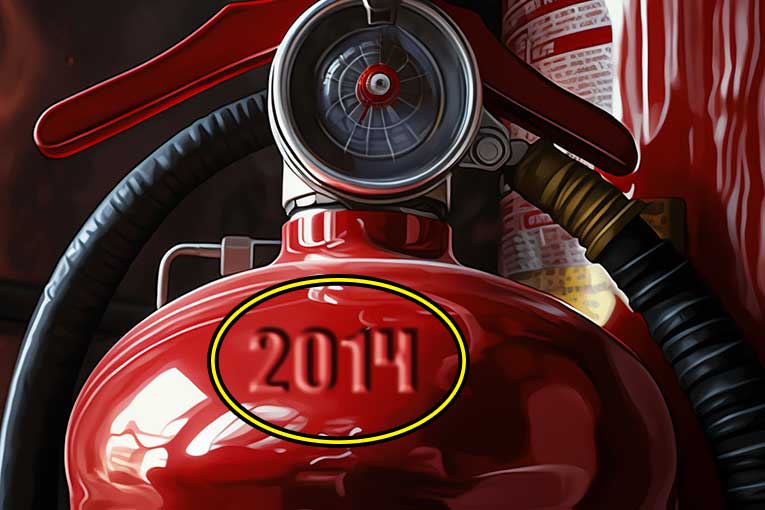
The manufacture date may be physically stamped onto the cylinder of the steel fire extinguisher. 

This stamp provides a clear and permanent indication of when the extinguisher was produced.

On the Label

Alternatively, the manufacture date might be included on the label affixed to the extinguisher. 

This label provides essential information about the extinguisher’s specifications and usage guidelines.

P50 Service-Free Extinguishers

Older Models 

For older P50 fire extinguisher models, the manufacture date is typically printed on the base of the unit.

Newer Models 

Newer P50 models use a coloured pin that correlates to a table printed on the label. 

The pin colour corresponds to the month and year of manufacture, providing a quick reference.

When Should you Replace a Fire Extinguisher Early?

replace fire extinguishers early

While fire extinguishers have defined lifespans, certain circumstances may warrant early replacement to ensure optimal performance in emergencies. 

Here are key indicators that suggest an extinguisher should be replaced ahead of schedule:

Cracked Nozzle or Hose

Issue

Physical damage like cracks compromises the structural integrity of the nozzle or hose.

Effect

The crack can lead to leaks or difficulties in delivering the extinguishing agent during a fire, rendering the extinguisher less effective.

Blocked Nozzle or Hose

Issue

Obstructions in the nozzle or hose can hinder the discharge of the extinguishing agent.

Effect

A blocked nozzle or hose reduces the extinguisher’s ability to control a fire, diminishing its overall performance.

Broken Handle

Issue

A broken handle makes it challenging to operate the extinguisher efficiently.

Effect

In an emergency, a broken handle may impede the user from effectively using the extinguisher, delaying response time.

Missing Locking Pin

Issue

The locking pin is crucial for preventing accidental discharges and maintaining the extinguisher’s readiness.

Effect

Without the locking pin, there’s a risk of unintentional discharges, and the extinguisher may not be securely stored or easily accessible.

Missing Inspection Sticker

Issue

An extinguisher without an updated inspection sticker may not have undergone required maintenance.

Effect

Missing inspection documentation indicates a lack of regular checks, raising concerns about the extinguisher’s reliability and adherence to safety standards.

Corrosion

Issue

Corrosion on the cylinder or other parts compromises the structural integrity of the extinguisher.

Effect

Corrosion weakens the extinguisher, making it more susceptible to damage and reducing its ability to withstand the pressure needed for proper discharge.

Suspected of Leaking

Issue 

Evidence of leaking substances suggests a loss of pressure and potential malfunction.

Effect

A leaking extinguisher may fail to discharge its contents effectively during a fire, necessitating immediate replacement to ensure reliability in an emergency.

How Often Should Fire Extinguishers be Inspected?

how often fire extinguishers inspected

Routine inspections are crucial to maintaining the reliability of fire extinguishers, ensuring they function correctly when needed. 

The inspection frequency can be categorised into two intervals:

Monthly Checks

Regular, brief checks by designated personnel.

This is to verify that the extinguisher is in its designated place, the pressure gauge shows adequate pressure, and there is no visible damage or tampering.

Monthly checks help identify immediate issues and ensure that the extinguisher is accessible and operational.

Yearly Inspections by a Fire Extinguisher Engineer

In-depth inspections conducted by a certified fire extinguisher engineer, for example those found in the Institution of Fire Engineers.

This will be a comprehensive examination of the extinguisher’s internal and external components, including pressure tests, to ensure it meets safety standards.

Yearly inspections are critical for identifying potential internal issues, such as corrosion or leaks, which might not be evident during routine checks.

What are the Risks of Using an Older Fire Extinguisher?

older fire extinguishers risks

Using an older fire extinguisher poses various risks, potentially compromising its effectiveness when faced with a fire emergency. 

Here are the key risks associated with relying on an aged fire extinguisher:

Decreased Pressure

Over time, fire extinguishers may experience a gradual loss of pressure, reducing their ability to discharge the extinguishing agent effectively. 

This decline can result from factors like gas leakage or gradual deterioration of internal components.

Corrosion

The internal components of a fire extinguisher, especially the cylinder, are susceptible to corrosion over an extended period. 

Corrosion weakens the structural integrity, making the extinguisher more prone to failure or rupture during use.

Deterioration of Seals and Valves

Seals and valves play a crucial role in maintaining the pressure and integrity of the extinguishing agent. 

As a fire extinguisher ages, these seals and valves can deteriorate, leading to potential leaks and a loss of pressure.

Reduced Extinguishing Agent Efficiency

The extinguishing agent within the fire extinguisher can degrade over time, diminishing its effectiveness. 

This reduction in efficiency may result from factors like exposure to temperature variations or chemical changes within the agent.

Outdated Technology

Older fire extinguishers may use outdated technology compared to more modern counterparts. 

Advances in fire safety technology have led to the development of extinguishers with enhanced features and improved extinguishing agents, providing better protection against various fire types.

Non-compliance with Standards

Fire safety standards and regulations evolve over time, introducing new requirements for equipment.

Older fire extinguishers may not comply with the latest standards, potentially leading to regulatory non-compliance and inadequate fire protection.

How to Dispose of a Fire Extinguisher?

dispose of fire extinguishers

Disposing of a fire extinguisher requires careful consideration to ensure the safe handling of potentially hazardous materials. 

Here’s a guide on how to appropriately dispose of a fire extinguisher:

Check the Extinguisher Type

Identify the type of fire extinguisher, as different extinguishing agents have specific disposal methods. 

Common types include water, powder, foam and CO2.

Contact Local Authorities

Check with your local fire department or waste disposal facility regarding their specific regulations for fire extinguisher disposal. 

Some municipalities organise special collection events or have designated drop-off locations.

Recycling Centres

Certain recycling centres may accept fire extinguishers, as many of the components are fully recyclable. 

Remember to follow local guidelines.

Professional Disposal Services

In some cases, professional hazardous waste disposal services may be necessary for extinguishers containing certain chemicals, such as older foam fire extinguishers. 

Contact local environmental agencies for advice on proper disposal methods.

Conclusion

Knowing how long fire extinguishers last and understanding when to replace them is vital for maintaining a safe environment. 

Regular inspections, proper servicing, and early replacement when necessary ensure that these essential firefighting tools remain effective when needed most. 

Prioritising the longevity and functionality of fire extinguishers is a proactive step towards enhancing overall safety and preparedness in various settings.

Europe to suffer as Freeport LNG extends outage predications after fire

Freeport LNG, operator of one of the largest US export plants producing liquefied natural gas (LNG), which initially said it would be shut for at least three weeks following an explosion at its Texas Gulf Coast facility, raising the risk of shortages especially in Europe, now expects to see a delays of up to six months until full operation resumes.

The explosion occurred from a breach in pressurized pipes that transfer LNG from storage tanks to nearby dock facilities, the company said. The incident is being investigated by the company, US energy and pipeline regulators, and the US Coast Guard. A company spokesperson declined to comment on whether investigators are looking at potential design or structural flaws.

The extended delay of about six months in the return to full operation is an indication that investigators want to understand the cause of the explosion to avoid another fire, according to outside experts said.

Natural gas prices slumped in the United States and soared in Europe on news of an extended shutdown. The facility accounts for about 20% of US LNG exports and has been a major supplier to European buyers seeking alternatives to Russian gas since its invasion of Ukraine. US natural gas markets have fallen as traders anticipated the outage would lower domestic demand.

“This is a significant production outage at a major US facility,” said Alex Munton, director of global gas and LNG at research firm Rapidan Energy. Freeport LNG ships about four cargoes per week and a three-week shutdown will take at least 1 million tonnes of LNG off the market, he said. “It’s going to mean one thing: shortages. The competition for spot LNG is going to drive global LNG prices higher.”

The Freeport facility can process 2.1 billion cubic feet per day of natural gas into a supercooled liquid for shipping, and had been running near capacity in recent months, according to consultancy Rystad Energy.

“It’s very serious,” said Alex Munton, director of natural gas and LNG at consultants Rapidan Energy. “We now have a much larger and much more extensive outage at Freeport LNG that will remove more supply from the market than was anticipated.”

“We expect Europe will be the region most impacted by this incident,” analysts at Rystad Energy said this week. The loss of production through September will remove another 2.8 million tonnes from the market, said Alex Froley, LNG analyst at ICIS.

MoviTHERM’s IoT tech enables early fire detection applications

MoviTHERM has launched iEFD Cloud – a secure cloud-based software application to support its iEFD Early Fire Detection series of solutions. The iEFD solution leverages the industrial internet of things (IIoT) to connect thermal imaging cameras, heat and smoke sensors to detect early fire formation at various stages and conditions.

The new cloud application provides real-time situational awareness to facility operators, employees, and first responders. The IoT solution alerts users of potential fire formation, helping prevent disasters.

The iEFD Cloud software has many built-in features that provide situational awareness to anyone who works in a high fire risk environment.

Markus Tarin, President and CEO, MoviTHERM said: “The days of expensive and overly complicated fire detection systems are over. Our iEFD solution provides optimal situational awareness that benefits both operators and first responders.”