The world is making significant investments to rise to the challenge of managing and responding to deadly wildfires. Not only has the US federal government expanded budgets to prevent and defend against wildfires, but it is also evaluating the organisation of its federal wildfire agencies.
Likewise, state and local governments and utility companies are increasing their investments in wildfire prevention, mitigation and suppression.
IDGA’s Wildfire Technology Summit, taking place on April 21-22, 2026, at the Kona Kai Hotel in San Diego, CA, convenes senior decision-makers from across the wildfire ecosystem to tackle real-world challenges, accelerate modernisation efforts and shape the next phase of wildfire resilience, prevention, and suppression.
IDGA’s Wildfire Technology Summit agenda
Here’s a sneak peek at what you’ll find in the agenda:
✔️ Timely and high-priority sessions, such as the role of the brand-new U.S. Wildland Fire Service, advancing wildfire capabilities, AI and its role in wildfire intelligence, management strategies, and more!
✔️ Recently confirmed speakers, including Dirk Giles and Jessica Haas from the U.S. Forest Service, Sean Triplett and Mike Falkowski from Earth Fire Alliance and Brian D’Agostino from San Diego Gas and Electric, alongside many new additions
✔️ Networking opportunities with more than 300 senior wildfire experts, all focused on exploring solutions for the prediction, prevention, detection, suppression, and mitigation of destructive wildland fires
Capitol Counsel expanded its wildfire-related policy work through a merger with Collective Strategies & Communications that was announced in September 2025.
Capitol Counsel said the deal brings together Collective’s work in wildfire prevention, response and land management with Capitol Counsel’s broader legislative and regulatory practice in Washington, D.C.
Collective Strategies & Communications had represented clients involved in aerial firefighting, remote sensing and fire-intelligence technologies.
The firm had focused on policy frameworks tied to technology use, federal funding and legislative engagement aimed at reducing wildfire risk and improving forest health.
People joining the expanded wildfire team
The announcement also brings Phil Hardy, founder and former president & CEO of Collective Strategies & Communications, into Capitol Counsel’s expanded practice.
Hardy has more than 25 years of experience in strategic communications, government relations and public affairs, with work focused on wildfire intelligence, mitigation strategies and technologies including aerial firefighting assets and AI-driven forest-management platforms.
Matt Gall also joins the combined practice with more than 15 years of policy and advocacy experience tied to natural resources, energy, public lands and environmental issues.
Before joining Collective, Gall spent a decade at Strategies 360 and also worked on the House Natural Resources Committee on federal policy covering water rights, hydropower and endangered species.
Within Capitol Counsel, partner Brad Mollett adds experience in legislative advocacy across the House, Senate and private sector, with work spanning environment, agriculture and appropriations.
Principal Samantha Barnett adds Capitol Hill experience with a policy background in forestry, wildfire, agriculture, energy and working-forest issues.
The merged firm said Barnett has advocated for forest-health and wildfire risk-reduction policies before Congress and federal agencies.
Broader access for federal and state advocacy
Capitol Counsel described the merger as an expansion of its federal- and state-level advocacy capacity on wildfire and natural-resources issues.
The combined practice links Collective’s subject focus with Capitol Counsel’s wider access across Congress and federal agencies.
The announcement frames that combined capability around policymaking on prevention, response and funding as federal and state decision-makers consider future wildfire measures.
Coordinated autonomous system ordered for Colorado wildfire response
Aspen Fire Protection District is set to receive a coordinated autonomous wildfire suppression system from Seneca in summer 2026.
Seneca announced the five-year, multi-million dollar partnership in a PRNewswire release.
The Seneca Strike Team will comprise five autonomous suppression aircraft, a mobile operations base and five years of software, connectivity and maintenance.
Each strike team has a capacity of approximately 500 gallons of finished foam per sortie.
A single pilot can operate multiple aircraft due to the system’s artificial intelligence and autonomy capabilities.
The system is intended to support operations in the wildland – urban interface (WUI).
Funding, intended uses and training timeline
According to the PRNewswire release, the aircraft system acquisition was supported through public private partnerships involving Aspen Fire Protection District (AFPD), the Aspen Fire Foundation and local donors.
Over the coming years, Seneca and AFPD aim to deploy additional autonomous aerial response bases.
Those bases are designed to respond within seconds of detection to reach new starts earlier.
The system is intended to help with starts in inaccessible areas, support night operations, maintain the safety of pile and prescribed burns and carry equipment on incidents in complex terrain.
Stuart Landesberg, Founder and CEO of Seneca, said: “Aspen has a unique blend of high-risk terrain, exceptional collaboration across their valley, and a highly skilled and forward-thinking team.
“They understand the importance of modernizing wildfire response to safeguard communities across the American West.”
Chief Jake Andersen, Fire Chief and CEO of Aspen Fire, said: “We are partnering with Seneca because this technology will help us save homes and save lives.
“Wildfires in our region are moving faster and growing more complex every year.
“Stu and the full Seneca team have listened to firefighters and built a system designed for the realities we face on the ground.
“This gives us another critical tool to protect our community before small starts become major incidents.
“We are grateful to the donors who partnered with Aspen Fire to make this possible, and we are proud to bring this capability to Aspen this summer.”
Aspen Fire expects training to begin in the early summer, with firefighters integrating Seneca into their core operations as fire season intensifies.
Fires can spread quickly, especially in remote and hard-to-reach areas.
Over time, firefighting has adapted to meet these challenges, using a mix of tools, teams, and technology.
Aircraft have become a familiar sight during major fire seasons, often seen moving across the sky as part of a wider response effort.
These flying resources work alongside crews on the ground and play a key role in modern wildfire management. U
Understanding the different fire fighting aircraft involved helps explain how large fires are tackled from multiple angles.
Key Takeaways
Aircraft (planes and helicopters) drop water or retardant to slow wildfires and scout from above.
Air Attack planes (air tactical aircraft) coordinate aerial operations and choose drop targets.
Fixed-wing airtankers carry retardant by size: Type I (3,000 – 5,000 gal), Type II (1,800 – 3,000), Type III (800 – 1,799). Very Large Air Tankers (VLATs) like DC-10s carry >8,000 gal.
Helicopters also have types I to III. Heavy Type I helos (~700 gal buckets) carry large loads, while Type II (~300 gal) and Type III (~100–180 gal) are smaller and quicker.
Military and converted aircraft provide extra capacity (~3,000 gal) and speed. A MAFFS C-130 can dump 3,000 gal in under 5 second.
What is Aircraft Fire Fighting?
Aerial firefighting (or aircraft firefighting) is the use of aircraft vehicles to suppress wildfires.
It involves fixed-wing airtankers (airplanes) that carry water or fire retardant and drop it on or ahead of a fire.
Helicopters are also used, either dropping water with a bucket or the transport of crews.
Aircraft may carry buckets, tanks, or sling loads of water.
Air attack aircraft (small fixed-wing spotter planes) provide overhead reconnaissance and direct the tanker drops.
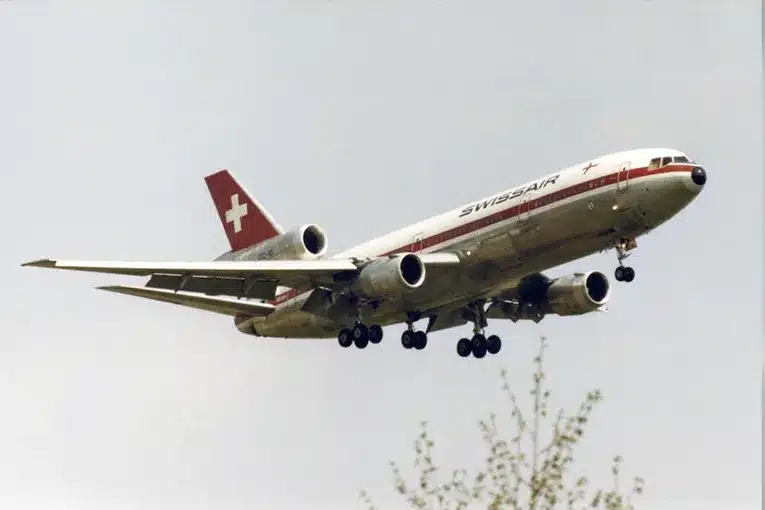
For example, wide-body jets like the DC-10 are outfitted with 12,000-gallon retardant tanks for big fires, while helicopters like the UH-60 Black Hawk (Firehawk) insert firefighters or drop several hundred gallons at precise spots.
These flying machines extend firefighting reach into rugged areas, deliver large drops quickly, and act as flying lookout posts to support ground teams.
Why is Aircraft Fire Fighting Used?
Aircraft vastly improve wildland fire response speed and effectiveness.
Ground crews can take hours to reach a remote ridge, but planes can fly over terrain.
By dropping water or retardant early, aircraft help contain fires when they are small.
A swift initial attack from the air can keep a fire to mere acres (California’s goal is to keep 95% of fires under 10 acres).
Aircraft are used because they can access fires rapidly, cover wide areas with retardant or water, and support ground crews with real-time intelligence, saving time and lives compared to relying on ground crews alone.
10 Types of Aircraft Fire Fighting
The 10 types of fire fighting aircraft are Air Tactical Aircraft, Fixed Wing Aerial Tankers (type I to III, VLAT and military) and helicopters (type I to III and military).
Type II airtankers are medium-sized tankers carrying about 1,800 – 3,000 gallons.
They include turboprop airliners and converted executive jets.
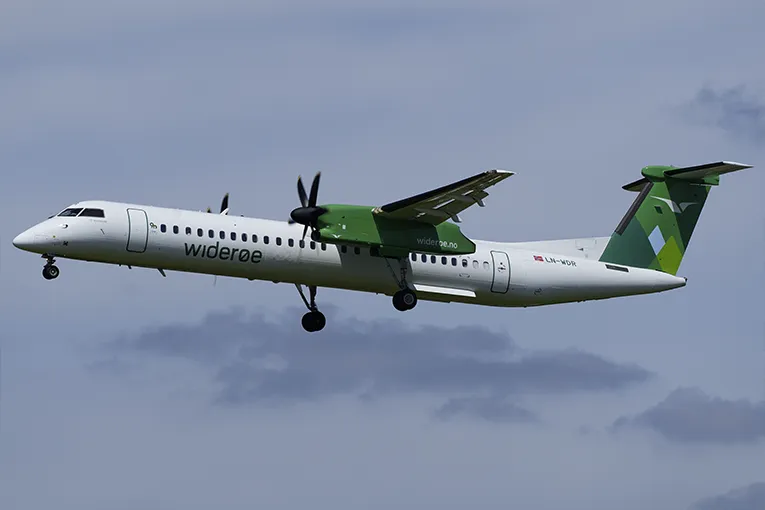
For example, the Bombardier Dash 8 Q400 (a Canadair airliner) drops around 2,600 gal, and older warbirds like the Douglas DC-6 or C-130 derivatives are in this class.
Type II tankers balance capacity with flexibility.
They are faster and more fuel-efficient than single-engine tankers yet can still operate from many airports.
Multiple Type II drops can cover a large area while using smaller airfields.
Aviation contractors combine Type II tankers for broad coverage.
For instance, three Q400s might deliver a combined load equivalent to one Type I tanker, but with quicker turnaround from multiple bases.
Examples are the Air Tractor AT-802 (about 800 gal) and light amphibious planes like the Canadair CL-215 (~1,300 gal).
Type III tankers are nimble and can use very short or unimproved runways close to fires.
They are ideal for initial attack on new wildfires.
They arrive quickly, make short drops, and return for more.
Their advantage is agility and responsiveness.
Because they operate from small airports, they can reach remote incidents faster, and their shorter water lines can get into steep or confined terrain.
Airtankers like the S-2 Tracker have stout landing gear and torpedo bays made for retardant tanks, allowing them to basing at small fields with short runways.
Type III tankers sacrifice drop volume for speed and access to work effectively in the early stages of a fire.
Very Large Air Tankers (VLATs) represent the largest class of fixed-wing firefighting aircraft and are deployed when massive fire coverage is needed quickly.
This can carry upwards of 9,400 gallons of fire retardant in one load, released in just a few seconds to lay down long, continuous lines ahead of advancing flames.
A single VLAT drop can cover a fireline hundreds of feet wide and miles long, making it much more efficient at slowing fire spread than smaller tankers.
Other legacy VLAT projects, such as the Boeing 747 Supertanker, were designed to carry nearly 20,000 gallons, demonstrating just how much retardant can be delivered from the air.
Newer programmes are now developing Boeing 767-based VLATs with even greater capacity and modern systems.
The main advantages of VLATs are their high payloads and long-reach retardant delivery, which are particularly valuable on very large or fast-moving wildfires where quick, broad coverage is crucial.
Military Aerial Tankers
C-130 Hercules equipped with MAFFS / Source: Wikipedia
Military transport aircraft are also used in firefighting when available.
For example, two MAFFS C-130s were sent to help Colorado fires in 2025.
A MAFFS unit can discharge 3,000 gal of retardant in under five second.
In addition, very large military or former military jets have been converted to airtankers.
These military-type planes cover enormous areas.
The key advantage is volume and reach.
Such planes can fight high-intensity fires or provide surge capacity when multiple air drops are needed.
They do require specially equipped bases to refill, but in return they extend the firefighting fleet’s capability by an order of magnitude compared to smaller tankers.
Helicopters
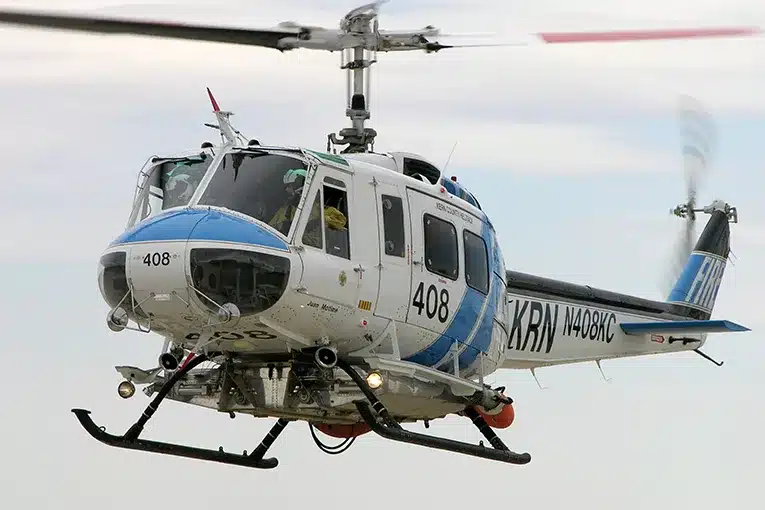
Helicopters are highly versatile firefighting aircraft.
They can rapidly drop water or retardant on fires, ferry firefighters and equipment, perform aerial ignition, or conduct search and fire rescue.
They operate closer to the fireline than fixed-wing tankers.
Helicopters are also classified by type based on size and capacity.
Heavy helitankers are Type I, medium helis Type II, and light ones Type III.
These categories guide their deployment, as we describe below.
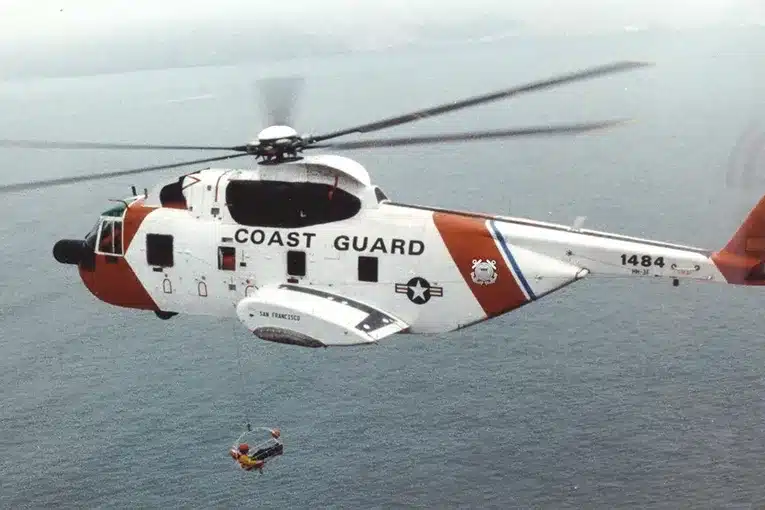
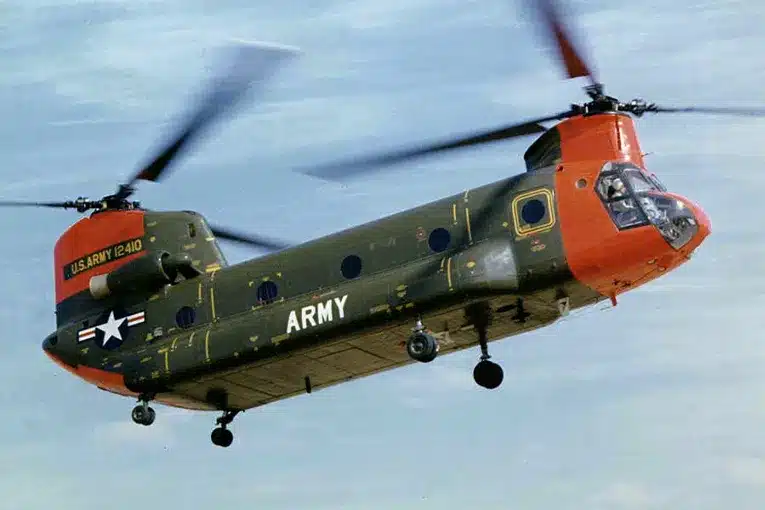
Military helicopters, especially heavy transports, have been adapted as ‘helitankers’ with enormous capacity.
The Boeing CH-47 Chinook (used by Southern California’s Quick Reaction Force) is the largest firefighting helicopter in the world.
Chinooks carry an internal 3,000-gallon tank and can hover-fill from a source in 90 seconds.
Another is the Sikorsky CH-53 Sea Stallion/CH-53K, with roughly 2,200 gal capacity, and the CH-54 ‘Helitanker’ Pelican (also ~2,200 gal).
These military helos are also fast; for example, the Chinook cruises at 160 kt.
Their advantage is clear.
They deliver far more water than civilian helicopters.
A single Chinook drop equals multiple drops by Type I helos.
Additionally, many are night-capable and can transport many troops or load heavier gear.
Military helitankers combine high volume, speed, and durability, making them formidable tools for large-scale firefighting operations
Final Thoughts
Aerial fire fighting brings together a diverse fleet of aircraft, each with a specialized role.
Air attack planes guide the operation, fixed-wing tankers blanket fires with retardant, and helicopters provide agile support.
Each type has advantages – from the enormous drops of DC-10s to the nimble bucket work of small helicopters.
Used together, these aircraft help contain wildfires that would otherwise spread.
Modern firefighting continuously evolves (new tankers, night-ops, and even drones), but the core remains.
Different flying machines are tools in the sky fighting fires.
By rapidly reaching remote fires, delivering huge volumes of water, and coordinating efforts, these aircraft types save land and lives, proving that the sky is an invaluable front line in wildfire suppression.
Wildfire aviation training academy begins in Arizona
Wildland firefighters specialising in aerial supervision and airtanker operations are convening in Arizona over the next month to prepare for a potentially busy 2026 Fire Year.
The National Interagency Fire Center (NIFC) stated that the National Aerial Supervision Training Academy (NASTA) will run primarily at the Phoenix Interagency Fire Center at Mesa Gateway Airport in Mesa, Arizona, and at Fort Huachuca in Sierra Vista, Arizona.
The academy is described as an umbrella for about a dozen aerial firefighting and support courses for personnel from numerous agencies.
The course areas described include aerial supervision, helicopter coordination, ground-based operations and aircraft dispatching.
The training is described as standardised across federal, state and local agencies to support a single approach to aviation operations during wildfires on any jurisdiction.
Courses, partners and coordination requirements
Airspace over wildfires is described as tightly controlled and requiring close coordination.
NIFC stated that the US Department of Agriculture’s Forest Service hosts the training and is joined by personnel from the US Wildland Fire Service, CAL FIRE, the State of Alaska and four military airlift wings that are part of the Modular Airborne Firefighting Systems program (MAFFS).
NIFC described this as the 12th annual academy and said it is expected to be among the largest.
Chris Tipton, fixed wing operations branch chief for the U.S. Forest Service, Fire and Aviation Management, said: “This is truly a team effort.
“We couldn’t do it without the cooperation of our other federal, state, local and military partners.”
Tipton said: “The courses offered as part of the academy are all geared towards attaining qualifications that will better prepare each firefighter for the season ahead”
Public aircraft activity and training schedule
Members of the public may see aircraft conducting practice water drops in remote locations on the Tonto and Coronado National Forests and other areas.
Arizona is described as an ideal location for aerial fire training due to weather, topography and access.
Clear skies are described as reducing the chance for lost training time due to inclement weather.
NIFC stated that the Phoenix Interagency Fire Center can accommodate the number of enrolled students and the aircraft used for the training.
A peer reviewed paper describes a six-drone UAV swarm framework for firefighting operations that aims to maintain mission continuity while reducing exposure to cyberattacks on inter-drone communications.
The study is titled “A Cyber-Resilient UAV Swarm Framework for Fire-Fighting with AI-Based In-Flight Defect Inspection”, authored by Ahad Alotaibi and Abdullah Alrasheedi of the Department of Advanced Technology, Canadian College of Kuwait, Al Jahra, Kuwait, and published in the Journal of Computer and Communications, Vol.14 No.1 (January 2026).
The proposed architecture uses five operational drones assigned mission roles such as thermal observation, environmental sensing, close-range visual assessment, payload support and communications extension.
It also adds one Inspector/Commander drone positioned to supervise, capture inspection imagery and act as a coordination node linking the swarm to the Ground Control Station (GCS).
The paper frames the approach around two risk areas in swarm missions, physical degradation in fire-ground environments and cyber threats exploiting wireless coordination traffic.
AI inspection and cyber-resilient communications approach
The framework includes a mobile application called Drone Inspector that manages pre-processing, cloud submission and alerting for in-flight defect inspection imagery.
The workflow described has the Inspector/Commander UAV capturing high-resolution images of neighbouring operational drones at defined intervals and sending them through the swarm communications layer to the Drone Inspector application.
The application then submits images to Amazon Rekognition Custom Labels via API and receives defect labels with confidence scores.
The paper describes defect categories including exposed wiring, landing gear damage, landing gear misalignment and deformation of landing components.
Inspection frequency is described as adaptive, with inspections every two minutes under nominal conditions and every 30 seconds in higher risk areas linked to gas sensor readings indicating proximity to an active fire zone.
In the implementation described, the application triggers a critical alert to the Ground Control Station when confidence exceeds a defined threshold, with the paper describing a threshold of 80%.
For communications security, the paper proposes subnet segmentation and Route Optimization for Autonomous Systems (ROAS) to reduce the feasibility of Man-in-the-Middle (MITM) and traffic manipulation attacks.
Subnet segmentation is described as dividing the swarm network into role-based subnetworks with routing policies controlling inter-subnet communication.
ROAS is described as a dynamic routing approach intended to adjust paths based on network conditions and topology changes to reduce persistent interception points.
Evaluation approach and reported results
The paper describes evaluation across physical deployment feasibility, AI inspection workflow performance and cybersecurity simulation.
It describes a six-UAV deployment consistent with the proposed architecture, with the Inspector/Commander UAV maintaining a supervisory position to capture imagery and support communication.
Example UAV platforms named include DJI Matrice series platforms and an Autel EVO Max model, with additional roles described for payload delivery and communications relay.
Live fire was not used for safety reasons.
The paper describes using manoeuvres, formation flight and environmental stressors such as wind variability to emulate operational challenges relevant to emergency response.
For AI defect detection, it describes Amazon Rekognition Custom Labels trained on a labelled dataset including normal conditions and representative defect scenarios, with reported classification metrics including precision, recall and F1-score.
For cybersecurity simulation, it describes a network emulation environment built in GNS3, using a Kali Linux attacker node and Ettercap for adversarial traffic injection, with a comparison between a baseline flat network and a secured configuration applying segmentation and ROAS.
The paper references EtherApe traffic visualisation and describes figures intended to show traffic concentration through the attacker node under baseline conditions, followed by more balanced traffic patterns after defences are applied.
Across these experiments, the authors report reduced attack success rates, early detection of defects and improved operational reliability within the combined inspection and network defence framework.
The paper presents the system as a hierarchical swarm design that links physical integrity monitoring and cybersecurity measures within a single operational framework.
FireDrone built for live data capture in high-risk heat and smoke
The Federal Laboratory for Materials Testing and Research has announced a new generation of FireDrone for firefighting and high-temperature industrial inspections.
The drone is presented as a way to provide real-time information from areas considered too dangerous for people and conventional drones.
The press release from the Laboratory says the technology was developed at Empa and is now being further developed by an Empa and EPFL spin-off.
Fabian Wiesemüller, Empa researcher and co-founder of the FireDrone start-up, said: “Today, firefighters have to physically enter burning buildings to locate hazardous materials or missing persons.
“With the FireDrone, we can now send a drone into hazardous areas to do just that – significantly minimizing the risk during operations.”
The release frames the drone’s intended use around large and complex structures such as industrial halls, parking garages and tunnels.
David Häusermann, Empa researcher and co-founder of the FireDrone start-up, said: “A drone that can fly over such areas quickly and without damage offers clear added value.”
FireDrone insulation, sensors and indoor operation
The organisation set out FireDrone’s heat resistance, insulation approach and payload options.
Conventional drones are described as reaching their limits at around 40 degrees Celsius when frames deform and electronics fail.
FireDrone is stated as being able to fly at temperatures of up to 200 degrees Celsius.
The insulation is described as a patented, ultra-light aerogel with air-filled pores enclosed in heat-resistant plastic.
The release states that earlier insulation relied on a glass fiber-reinforced composite structure made of polyimide and silica, and that the new version uses a pure polyimide aerogel.
Häusermann said: “We can cast the aerogel in three-dimensional shapes and tailor it to the drone.”
The release states that the drone includes an internal temperature management system designed to cool and monitor the electronics continuously.
An infrared camera is described as transmitting high-resolution thermal images in real time to a large screen on the remote control.
Häusermann said: “Today, often only the first firefighters inside the building can see what it looks like inside.
“With the drone, the incident commander can get an overview of the situation before anyone enters the building.”
Optional payloads mentioned include additional cameras and sensors, including tools to measure outside temperatures and detect gases produced by fires.
Indoor flight is described as a core requirement, with development work focused on pilot assistance and localisation systems for environments where satellite navigation is unavailable.
Wiesemüller said: “GPS is not available in many of our operational scenarios.
“That’s why we are developing pilot assistance and localization systems that function reliably even without a satellite signal.”
Testing, funding support and FireDrone Nest plans
The organisation outlined testing activity and the spin-off’s next development steps.
FireDrone is described as the result of several years of research in Empa’s Sustainability Robotics and Building Energy Materials and Components laboratories.
The spin-off is described as having tested the drone at the training ground of the Andelfingen training center and at the Holcim cement plant in Siggenthal.
Häusermann said: “Tests are crucial for making the transition from the laboratory to practical application.
“In future, pilots should be able to use these drones safely in extreme situations with minimal training.”
Support named in the release includes Venture Kick, the Gebert Rüf Foundation and the Innovation Booster Robotics.
A related project described is FireDrone Nest, a mobile, thermally insulated docking and maintenance station intended to enable automatic landing after a mission, secure the drone and prepare it for the next flight.
Wiesemüller said: “The transition from research project to practical application would not have been possible without Empa’s years of support.
“Now it’s a matter of putting the technology to use in real-world applications.”
The release also references a longer-term aim for a mobile docking and maintenance station that can be integrated into fire trucks or modern fire protection systems.
TracPlus executive Todd O’Hara discusses the major challenges highlighted at UAFA 2025 and outlines how agencies are using data, technology and modernised systems to improve aerial wildfire response
The United Aerial Firefighters Association (UAFA) held its 2025 Annual Conference in Boise, Idaho, bringing together aerial firefighting operators, agency leaders and technology providers to examine the state of aerial wildfire operations in the United States.
The programme focused on operational readiness, technology modernisation, workforce issues and the rapid evolution of mission intelligence solutions shaping the sector’s future.
Following the event, International Fire and Safety Journal spoke with Todd O’Hara, Chief Product and Revenue Officer at TracPlus, about the themes that dominated this year’s discussions and the role of integrated, real-time data during complex wildfire response.
What are the key themes or challenges that shaped discussions at this year’s UAFA Conference, particularly around aerial firefighting operations?
One major theme is the reality that a lot of aviation and aerial firefighting systems are decades old.
In many cases, the people who built them are no longer around, and the institutional knowledge has gone with them.
That contributes to inefficiencies, data gaps and weaker mission outcomes.
A second theme is the need for real-time operational intelligence.
Agencies need cleaner, more actionable data so they can coordinate better, reduce waste and respond more effectively in high-stakes environments.
Safety and accident prevention is another big focus.
Accidents almost never happen “out of the blue”, there is usually a pattern or chain of events leading up to them.
With the right tools, you can surface non-compliant behaviour before something goes wrong, and that safety lens is part of a lot of discussions.
How is TracPlus evolving its platform to support decision-making and crew safety during complex wildfire response efforts?
We have evolved from our roots as a hardware tracking provider to a SaaS-first company focused on delivering operational intelligence at scale.
A key step in that evolution is FireFlyte, our enterprise platform for aerial firefighting agencies and operators.
It turns raw operational data into actionable insights across four areas: Aerial Firefighting, Safety and Risk Management, Operations and Finance.
A concrete example is CAL FIRE’s new Aviation Tracking and Information System (CATIS), powered by FireFlyte.
CATIS replaces their legacy internal system and the support risks that go along with it.
It gives them faster access to critical information, more efficient aircraft deployment and mission insights and analytics with greater speed and accuracy.
Underpinning it with FireFlyte also provides a platform for more connected processes internally across pre-, during and post-mission activities, where training connects to operations and learning from every mission.
Overall, the goal is real-time, integrated operational intelligence that improves decision-making and safety during complex incidents.
Are there any updates or developments in your US strategy?
Our work with CAL FIRE is proof for us that we are making a meaningful difference where it matters.
They are a flagship customer in the US and a major endorsement of our approach.
CAL FIRE’s CATIS programme shows our ability to replace ageing, home-grown systems with modern, scalable cloud software tailored to aerial firefighting.
We can support fire management operations of all sizes around the world, but FireFlyte, the underlying platform that drives CATIS, positions us to work effectively with large, complex US agencies in a few specific ways.
It helps move them off legacy systems and manual processes.
It supports standardisation on a cloud-based platform.
It enables mission-critical operations to scale across multiple bases and fleets.
Thinking about the conversations we had at UAFA, there’s a general agreement that this is the direction everyone wants to go. Everyone wants to find ways to achieve better outcomes, and we can see a path forward where a foundation based on FireFlyte can modernise other US programmes over time.
From your perspective, where are agencies and operators seeing the most value from real-time tracking and mission intelligence data?
There are a few clear areas where value shows up quickly.
One is operational coordination and efficiency, because cleaner, more actionable data improves coordination, reduces waste and makes resource deployment more effective.
Another is visibility into operations and outcomes.
A lot of the market has historically been “dots on a map”, but the bigger shift is towards understanding mission outcomes, resource utilisation and operational patterns.
Safety is also a major value area.
Using data to identify non-compliant behaviour and risk indicators before they lead to incidents is where data becomes genuinely lifesaving.
Finally, there is proactive decision-making.
With the depth of historical and real-time data we have, agencies can start to anticipate resource needs and optimise deployments based on how a mission is evolving, not just what has already happened.
In short, the most value is where data directly supports coordination, safety and faster, better decisions in the field.
What emerging operational or technological trends should wildfire agencies be preparing for over the next few seasons?
One trend is the shift from basic tracking to full operational intelligence.
The move is from “where is the aircraft?” to “how effective are we being?”, with an emphasis on mission effectiveness, patterns and utilisation, not just positions.
A second trend is proactive mission planning.
Using historical and real-time data, plus machine learning and AI, agencies can move from reactive to proactive operations by anticipating resource requirements, optimising deployment strategies and identifying challenges before they affect the mission.
Integrated safety and compliance tools are also becoming more important, including real-time safety monitoring, automated compliance reporting and stronger documentation for operational accountability and regulatory requirements.
There is also the continued modernisation of legacy systems.
Many agencies will need to replace decades-old, manually driven systems with modern, cloud-based platforms
The overarching theme is that the agencies who will lead over the next few seasons are the ones that treat technology and data as the foundation of operational excellence, not just as a supporting tool.
Washington bill on Wildland Firefighter Safety backs aerial fire retardant use
The Office of Congressman Doug LaMalfa said the Forest Protection and Wildland Firefighter Safety Act passed the US House as part of a wider permitting reform package, the PERMIT Act, in Washington, D.C.
The office said the bill was introduced by Congressman Doug LaMalfa (R-Richvale).
It said the bill is intended to keep aerial fire retardant available for wildfire response without Clean Water Act permitting delays.
Wildland Firefighter Safety and fire retardant use
The office said a 2023 federal court ruling imposed additional requirements linked to the use of aerial fire retardant by the U.S. Forest Service and other firefighting entities.
It said those restrictions risk slowing response times during wildfire incidents.
The office said the bill would clarify that a National Pollutant Discharge Elimination System (NPDES) permit is not required for the Forest Service to apply fire retardants from planes or helicopters to combat wildfires, if the retardants are on the current applicable Qualified Products List maintained by the Forest Service.
It said the provisions build on existing permitting exemptions for firefighting activities already in law.
Lawsuit background and permit timelines
The office said Forest Service Employees for Environmental Ethics sued the U.S. Forest Service in 2022 over the absence of an NPDES permit for aerially discharged fire retardant.
It said a federal court ruled in 2023 that the Forest Service must obtain an NPDES permit from the Environmental Protection Agency (EPA) for aerial application of fire retardants.
It said the court did not grant the request for an injunction to block the Forest Service’s use of these products.
The office said Forest Service testimony to the House Natural Resources Committee in 2023 stated the agency believes an NPDES permit is not needed based on EPA guidance issued in 2003.
It said the Forest Service’s 2011 Nationwide Aerial Application of Fire Retardant on National Forest System Land Record of Decision prohibits discharge into bodies of water and buffer areas around those waters.
It said the Forest Service stated that, over the past 10 years, less than 1% of retardant drops impacted American waterways.
It said the Forest Service stated the EPA could take up to three years to issue an NPDES permit, followed by state permitting across 47 states.
Comments from LaMalfa and the Forest Service
Rep. Doug LaMalfa said: “With wildfire season now practically year-round and more destructive than ever, preventing or limiting the use of any fire retardant because someone insists on a permit first is completely backwards.
“Aerial fire retardant has been used safely for decades and is already highly regulated.
“These lawsuits don’t protect the environment; they tie firefighters’ hands while fires race through forests and towards homes. I’m glad to see the PERMIT Act passed the House with my bill included. It ensures our crews can act quickly, without being tripped up by fringe litigation or years of paperwork.”
Tom Schultz, U.S. Forest Service Chief, said: “Aerially delivered long-term fire retardant is an essential tool the Forest Service and the interagency wildfire response community use in support of ground-based firefighting resources.
“We thank Chairman LaMalfa for leading legislation to ensure retardant remains a tool in the wildland firefighting toolbox to protect homes and communities from the devastating impacts of catastrophic wildland fire.”
What this could change for incident planning
Fire Chiefs and senior officers with responsibility for wildfire operations may track this measure because it focuses on continued access to aerial fire retardant as part of interagency response planning.
Government departments and emergency and disaster response managers may review how the bill’s approach aligns with existing Clean Water Act exemptions for firefighting runoff described in the source material.
Training officers and instructors involved in wildland tactics may also monitor the outcome because the Forest Service position in the material describes long-term retardant as supporting ground-based resources by altering how wildfire burns and slowing fire spread after water evaporates.
Fire engineering consultants and risk assessors working with public agencies may pay attention to the permitting timeline claims in the material, including the stated three-year federal process and additional state permits, when considering operational continuity and contingency planning.






.jpg)

.jpg)

.jpg)
.jpg)
.jpg)
