De-Wipe kits added to Belfast Airport airside procedures
Belfast International Airport has incorporated De-Wipe Airside contamination kits into updated procedures aimed at improving health and safety for its fire-fighters.
A case study published by De-Wipe describes the kits as part of a contaminant cleaning protocol used during and after every response, with the same products also used during training exercises.
All fire-fighters at Belfast International follow the updated cleaning protocol to reduce exposure to substances encountered in fire fighting environments.
The case study also notes that airports including Belfast and Manchester use De-Wipe Airside Decontamination kits for their fire and rescue teams.
Exposure risks and decontamination practice
The De-Wipe case study links the use of decontamination procedures to research indicating that airside personnel working near aircraft refuelling areas face exposure to harmful toxins.
It references research describing increased cancer risk among fire-fighters linked to repeated exposure during incidents.
The case study explains that extreme heat can make skin up to 400% more absorbent for every five degree rise in temperature, allowing carcinogens to embed more deeply.
It also cites survey data indicating that more than 4% of firefighters had a cancer diagnosis, with an age-specific cancer rate up to 323% higher among people aged 35 to 39 than the general population.
Firefighters who had served 15 years or more were described as 1.7 times more likely to develop cancer than those with shorter service.
Decontamination bags and equipment storage
De-Wipe also describes its Airside decontamination bags as storage for equipment used in the cleaning process.
The bags are designed to hold items including wipes and hair and body wash.
Equipment wash and equipment wipes are also listed among the products stored in the kits.
Ballyclare Xenon kit rollout across North West fire services
Firefighters across the North West of England and Northern Ireland will be issued Xenon technical rescue kit supplied by Ballyclare under a joint procurement contract.
The company announced that fire and rescue services from Greater Manchester, Cheshire, Cumbria, Lancashire, Merseyside, the Isle of Man and Northern Ireland worked together on the initiative.
The collaboration represents more than 5,800 firefighters.
The specialist kit is intended for non-structural incidents such as road traffic collisions, medical emergencies and natural disasters.
Certification standards and tender specifications
The Xenon technical rescue jacket and trousers are certified to BS EN 16689 for protective clothing used in technical rescue.
The garments also meet EN ISO 15384 for wildland firefighter clothing and EN ISO 20471 for high-visibility clothing.
The ensemble uses fabrics designed to be lightweight and breathable.
The material is inherently flame retardant and resistant to repeated washing.
It also provides waterproof protection against blood pathogens, chemicals and particulates.
This version of the Xenon kit was adapted to meet the tender requirements, including the use of a bright yellow outer fabric to increase visibility during road traffic incidents.
Procurement process and supplier selection
Ballyclare was selected as the preferred supplier following a tender process that included practical user trials last year.
Fire and rescue services in the region are already familiar with the Xenon range through existing use of Xenon structural kit and a previous version of the Xenon technical rescue jacket.
Philip Tasker, Global Sales Lead for Fire and Security at Ballyclare, said: “Increasingly, fire and rescue services across the UK and Europe are investing in dedicated technical rescue kit which better suits the everyday incidents they face and prolongs the life of their structural gear.
“It’s great to see our innovative Xenon technical rescue design being put to good use by fire and rescue services across the North West and Northern Ireland.
“We’re pleased to be able to support these crews with the protection they need to carry out their operations safely.”
The contract covers the supply of technical rescue PPE to the participating services across the region.
Air Systems announces new AQM monitor for breathing air equipment
Air Systems International has introduced a new Air Quality Monitor (AQM) for its Breather Box portable filtration units, filtration panels, breathing air monitoring products and high-pressure compressors.
Air Systems described the AQM as a monitor designed to help ensure Grade-D breathing air delivery through measurement of carbon monoxide (CO), oxygen (O2) and dew point levels.
The monitor includes a 3-inch colour digital resistive touchscreen that guides users through monitoring, maintenance and calibration steps.
Features include automatic calibration with guided on-screen instructions, service icons for calibration reminders, sensor replacement and battery life, and a built-in instruction manual accessible through the display.
The system also includes a 120 dBA audible and visual alarm, multi-language support in English, Spanish and French and a universal power supply rated 110 – 230 VAC and 12-20 VDC.
Product specifications, options and transition from legacy monitors
Air Systems confirmed that the standard AQM version is currently available and that an intrinsically safe version has been submitted for review and certification.
From January 1, 2026, all new orders and some back orders are expected to include the new AQM monitor due to a back-order consuming existing legacy monitors.
Legacy monitors are defined as units in a black metal case, with model examples including CO-91, CO2-91, CO91-14LAC, CO-91 PM and CO-91IS series products.
The CO sensor and alarm cannot be disabled, while the O2 alarm can be enabled or disabled and the humidity sensor – dew point – can also be enabled or disabled.
Six AA batteries provide approximately 40 hours of operation, with power options including 12-12 VDC input from vehicles or commonly used cordless tool batteries.
The company is also working on retrofit logistics to install the AQM monitor into existing equipment in the field, including a process allowing products to be sent to the factory in Chesapeake, Virginia for modification.
A limited number of parts will remain available for legacy monitors in the near future, and the O2 sensor supply for legacy models has already been exhausted.
An adaptor – O2-NS-ADPT – is now being used to allow a new sensor – O2-NS – to be fitted in legacy models.
South Korea SK Group orders Pierce high flow industrial pumper via MS Trade Company
SK Group has ordered a Pierce High Flow Industrial Pumper through Pierce dealer MS Trade Company.
Pierce Manufacturing said the apparatus will be the first Pierce High Flow Industrial Pumper in service outside of the United States.
Hwang YoonSeong, General Foreman, Safety Team, SK Group, said: “Our recent tank fire incidents made it clear we needed a higher-performance solution, and the Pierce High Flow Industrial Pumper stood out immediately.
“After reviewing multiple global options, Pierce delivered an exceptional combination of performance, mobility and maintainability.
“Since 2018, every one of our seven new fire trucks has been a Pierce, supported reliably by MS Trade Company.
“Seeing the High Flow Industrial Pumper firsthand during testing and hearing strong feedback from current Pierce industrial apparatus customers gave us full confidence to move forward. Pierce has become our trusted partner for critical emergency response.”
South Korea apparatus configuration and specifications
Pierce said the truck was engineered for SK Group facilities where narrow roadways and access points can limit apparatus positioning.
The company described the configuration as shaped through evaluation and engagement among Pierce, MS Trade Company and SK Group safety personnel.
The specified build includes a Velocity custom chassis and a Cummins ISX15 600 hp engine.
It also includes a 5,500 GPM Darley 2ZSM pump, with up to 10,000 GPM using a pressurised supply.
The truck is specified with an 8,000 GPM deck gun and a 1,000-gallon foam tank.
The specification also lists a rear collision avoidance system, side and backup cameras and an alarm system.
The intake and plumbing configuration includes a 6-inch front inlet with 4-inch plumbing and a 6-inch rear inlet with 5-inch plumbing, described as supporting flexible positioning around narrow refinery roads.
Kristopher Zweiger, Product Manager, Pierce Manufacturing, said: “SK Group’s refineries operate across large-scale, high-risk environments where response performance, reach and reliability are critical.”
FFE Ltd, a specialist manufacturer of fire detection solutions, has announced that Fireray One beam smoke detector and Fireray Hub Reflective have achieved FM Approval, supporting specification and use across the USA, Middle East & Africa (MEA), Australia and New Zealand.
Large-volume environments can present challenging detection conditions, where smoke may dilute, stratify or drift with airflows. FM Approval provides added confidence for stakeholders specifying fire detection solutions for applications where reliability, compliance and continuity of operation matter.
Fireray One is designed for beam smoke detection in large open areas, providing long-distance coverage suited to high-ceiling environments. Fireray Hub Reflective complements Fireray One by combining the same beam detection capability with a low-level controller, enabling a more system-based approach to installation and oversight, and supporting up to three detector heads from a single control point, helping simplify commissioning, verification and ongoing maintenance.
FM Approval an ‘important milestone’ for FFE
“FM Approval is an important milestone for Fireray One and Fireray Hub Reflective,” said Luke Brittany, Product Manager, Fireray Product Range, FFE Ltd. “It gives specifiers and project teams added confidence when selecting an approved beam detection solution for large, open areas, supporting reliable performance and clearer system oversight.”
Fires can spread quickly, especially in remote and hard-to-reach areas.
Over time, firefighting has adapted to meet these challenges, using a mix of tools, teams, and technology.
Aircraft have become a familiar sight during major fire seasons, often seen moving across the sky as part of a wider response effort.
These flying resources work alongside crews on the ground and play a key role in modern wildfire management. U
Understanding the different fire fighting aircraft involved helps explain how large fires are tackled from multiple angles.
Key Takeaways
Aircraft (planes and helicopters) drop water or retardant to slow wildfires and scout from above.
Air Attack planes (air tactical aircraft) coordinate aerial operations and choose drop targets.
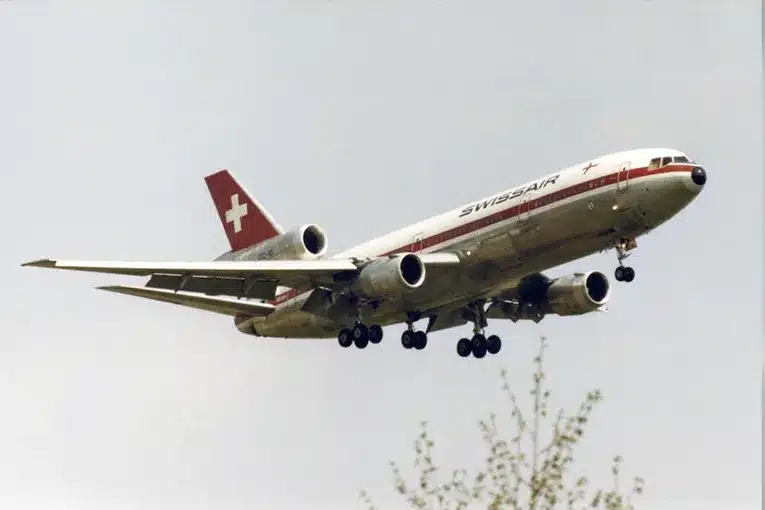
Fixed-wing airtankers carry retardant by size: Type I (3,000 – 5,000 gal), Type II (1,800 – 3,000), Type III (800 – 1,799). Very Large Air Tankers (VLATs) like DC-10s carry >8,000 gal.
Helicopters also have types I to III. Heavy Type I helos (~700 gal buckets) carry large loads, while Type II (~300 gal) and Type III (~100–180 gal) are smaller and quicker.
Military and converted aircraft provide extra capacity (~3,000 gal) and speed. A MAFFS C-130 can dump 3,000 gal in under 5 second.
What is Aircraft Fire Fighting?
Aerial firefighting (or aircraft firefighting) is the use of aircraft vehicles to suppress wildfires.
It involves fixed-wing airtankers (airplanes) that carry water or fire retardant and drop it on or ahead of a fire.
Helicopters are also used, either dropping water with a bucket or the transport of crews.
Aircraft may carry buckets, tanks, or sling loads of water.
Air attack aircraft (small fixed-wing spotter planes) provide overhead reconnaissance and direct the tanker drops.
For example, wide-body jets like the DC-10 are outfitted with 12,000-gallon retardant tanks for big fires, while helicopters like the UH-60 Black Hawk (Firehawk) insert firefighters or drop several hundred gallons at precise spots.
These flying machines extend firefighting reach into rugged areas, deliver large drops quickly, and act as flying lookout posts to support ground teams.
Why is Aircraft Fire Fighting Used?
Aircraft vastly improve wildland fire response speed and effectiveness.
Ground crews can take hours to reach a remote ridge, but planes can fly over terrain.
By dropping water or retardant early, aircraft help contain fires when they are small.
A swift initial attack from the air can keep a fire to mere acres (California’s goal is to keep 95% of fires under 10 acres).
Aircraft are used because they can access fires rapidly, cover wide areas with retardant or water, and support ground crews with real-time intelligence, saving time and lives compared to relying on ground crews alone.
10 Types of Aircraft Fire Fighting
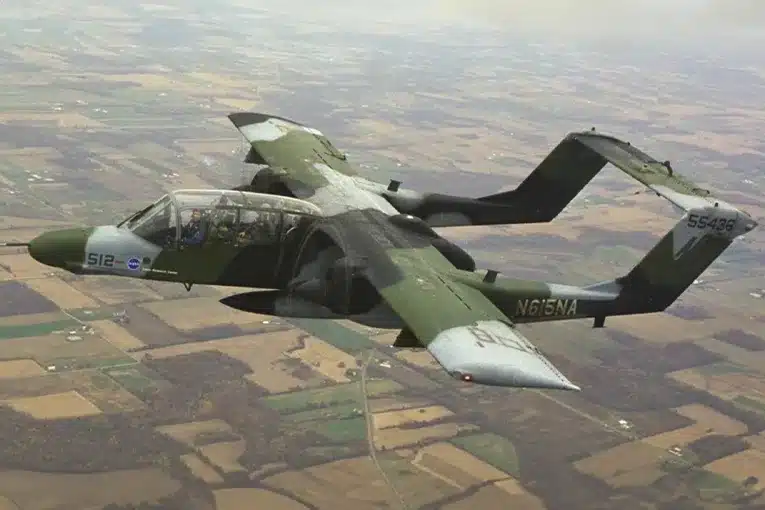
The 10 types of fire fighting aircraft are Air Tactical Aircraft, Fixed Wing Aerial Tankers (type I to III, VLAT and military) and helicopters (type I to III and military).
Type II airtankers are medium-sized tankers carrying about 1,800 – 3,000 gallons.
They include turboprop airliners and converted executive jets.
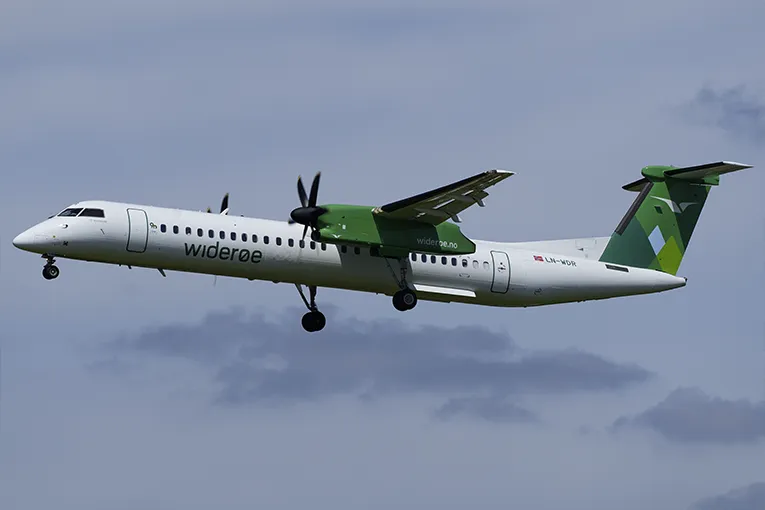
For example, the Bombardier Dash 8 Q400 (a Canadair airliner) drops around 2,600 gal, and older warbirds like the Douglas DC-6 or C-130 derivatives are in this class.
Type II tankers balance capacity with flexibility.
They are faster and more fuel-efficient than single-engine tankers yet can still operate from many airports.
Multiple Type II drops can cover a large area while using smaller airfields.
Aviation contractors combine Type II tankers for broad coverage.
For instance, three Q400s might deliver a combined load equivalent to one Type I tanker, but with quicker turnaround from multiple bases.
Examples are the Air Tractor AT-802 (about 800 gal) and light amphibious planes like the Canadair CL-215 (~1,300 gal).
Type III tankers are nimble and can use very short or unimproved runways close to fires.
They are ideal for initial attack on new wildfires.
They arrive quickly, make short drops, and return for more.
Their advantage is agility and responsiveness.
Because they operate from small airports, they can reach remote incidents faster, and their shorter water lines can get into steep or confined terrain.
Airtankers like the S-2 Tracker have stout landing gear and torpedo bays made for retardant tanks, allowing them to basing at small fields with short runways.
Type III tankers sacrifice drop volume for speed and access to work effectively in the early stages of a fire.
Very Large Air Tankers (VLATs) represent the largest class of fixed-wing firefighting aircraft and are deployed when massive fire coverage is needed quickly.
This can carry upwards of 9,400 gallons of fire retardant in one load, released in just a few seconds to lay down long, continuous lines ahead of advancing flames.
A single VLAT drop can cover a fireline hundreds of feet wide and miles long, making it much more efficient at slowing fire spread than smaller tankers.
Other legacy VLAT projects, such as the Boeing 747 Supertanker, were designed to carry nearly 20,000 gallons, demonstrating just how much retardant can be delivered from the air.
Newer programmes are now developing Boeing 767-based VLATs with even greater capacity and modern systems.
The main advantages of VLATs are their high payloads and long-reach retardant delivery, which are particularly valuable on very large or fast-moving wildfires where quick, broad coverage is crucial.
Military Aerial Tankers
C-130 Hercules equipped with MAFFS / Source: Wikipedia
Military transport aircraft are also used in firefighting when available.
For example, two MAFFS C-130s were sent to help Colorado fires in 2025.
A MAFFS unit can discharge 3,000 gal of retardant in under five second.
In addition, very large military or former military jets have been converted to airtankers.
These military-type planes cover enormous areas.
The key advantage is volume and reach.
Such planes can fight high-intensity fires or provide surge capacity when multiple air drops are needed.
They do require specially equipped bases to refill, but in return they extend the firefighting fleet’s capability by an order of magnitude compared to smaller tankers.
Helicopters
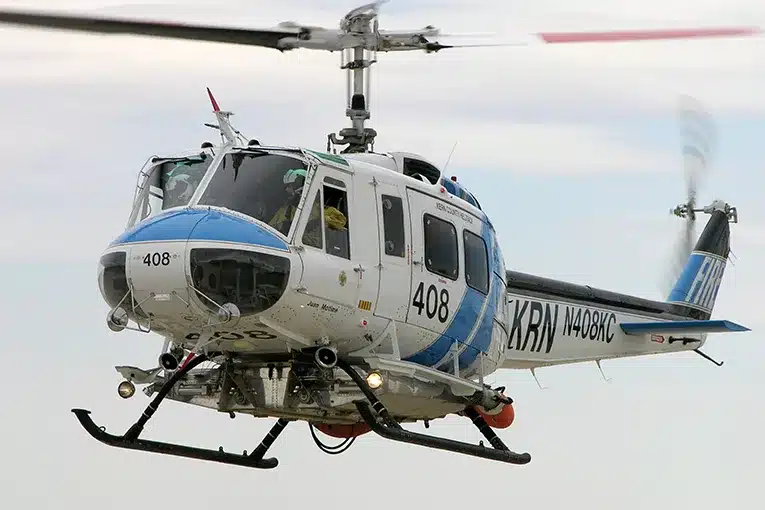
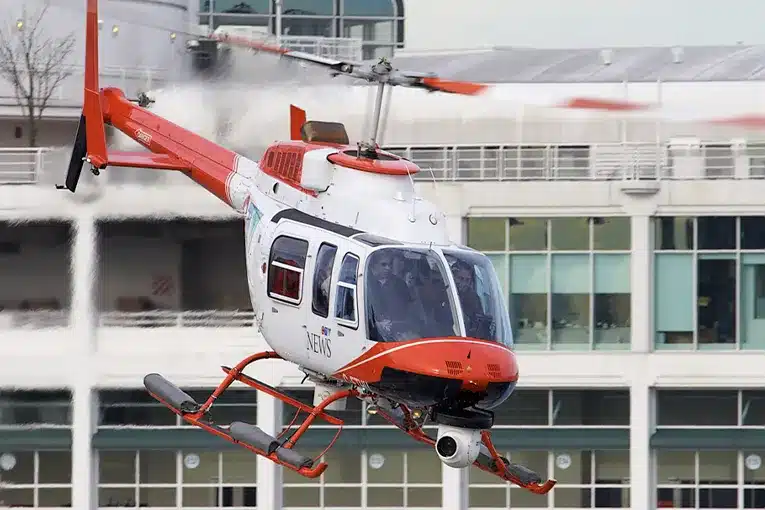
Helicopters are highly versatile firefighting aircraft.
They can rapidly drop water or retardant on fires, ferry firefighters and equipment, perform aerial ignition, or conduct search and fire rescue.
They operate closer to the fireline than fixed-wing tankers.
Helicopters are also classified by type based on size and capacity.
Heavy helitankers are Type I, medium helis Type II, and light ones Type III.
These categories guide their deployment, as we describe below.
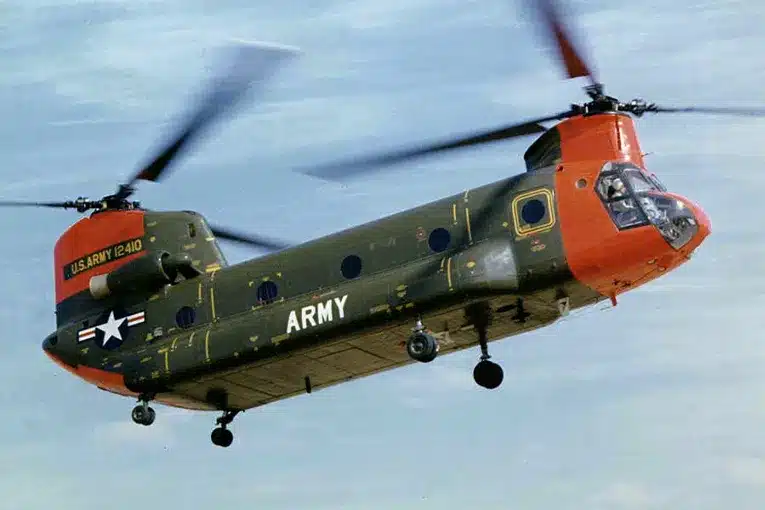
Military helicopters, especially heavy transports, have been adapted as ‘helitankers’ with enormous capacity.
The Boeing CH-47 Chinook (used by Southern California’s Quick Reaction Force) is the largest firefighting helicopter in the world.
Chinooks carry an internal 3,000-gallon tank and can hover-fill from a source in 90 seconds.
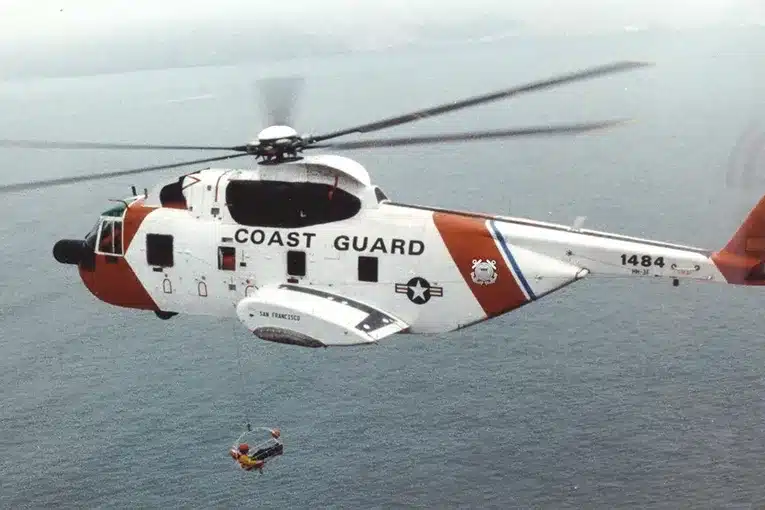
Another is the Sikorsky CH-53 Sea Stallion/CH-53K, with roughly 2,200 gal capacity, and the CH-54 ‘Helitanker’ Pelican (also ~2,200 gal).
These military helos are also fast; for example, the Chinook cruises at 160 kt.
Their advantage is clear.
They deliver far more water than civilian helicopters.
A single Chinook drop equals multiple drops by Type I helos.
Additionally, many are night-capable and can transport many troops or load heavier gear.
Military helitankers combine high volume, speed, and durability, making them formidable tools for large-scale firefighting operations
Final Thoughts
Aerial fire fighting brings together a diverse fleet of aircraft, each with a specialized role.
Air attack planes guide the operation, fixed-wing tankers blanket fires with retardant, and helicopters provide agile support.
Each type has advantages – from the enormous drops of DC-10s to the nimble bucket work of small helicopters.
Used together, these aircraft help contain wildfires that would otherwise spread.
Modern firefighting continuously evolves (new tankers, night-ops, and even drones), but the core remains.
Different flying machines are tools in the sky fighting fires.
By rapidly reaching remote fires, delivering huge volumes of water, and coordinating efforts, these aircraft types save land and lives, proving that the sky is an invaluable front line in wildfire suppression.
The 2026 application period is now open for MSA’s Globe Gear Giveaway, which will award new Globe turnout gear and MSA Cairns helmets to selected volunteer fire departments in the US and Canada.
The National Volunteer Fire Council (NVFC) said the annual programme enables eligible departments in need to apply for four sets of turnout jackets, pants and helmets.
The application period is open through noon ET on June 1.
Eligibility, awards and programme track record
The programme is in its 15th year and has provided 186 departments with 819 sets of turnouts and 364 helmets.
In 2026, 52 sets of gear will be awarded to 13 departments.
To be eligible, a department must be over 50% volunteer.
A department must serve a population of 25,000 or less.
A department must be located in the United States or Canada and be legally organised under state or province law.
The criteria states that Indian or tribal entities not organised under state or province law are eligible.
A department must have at least one active NVFC member.
To help departments meet the NVFC membership requirement, MSA will provide one year individual NVFC memberships to the first 500 applicants.
Applicants must also demonstrate a need for the gear.
NVFC Chair Steve Hirsch said: “Turnout gear is critical to the health, safety, and effectiveness of firefighters, yet there are many volunteer fire departments across the U.S. and Canada that struggle to find funding for the gear they need.
“For 15 years, this program has helped address that need and ensure more firefighters are properly equipped to serve their communities.
“We thank MSA Safety for this ongoing partnership and their commitment to supporting the volunteer fire service.”
Joann Serakowski, MSA Safety Vice President of United States and Canada Fire Business, said: “We’re proud to support firefighters who are dedicated to protecting their communities.
“Through our long-standing partnership with this program, we remain committed to helping keep firefighters safe by providing safety gear to those who need it most.
“We’re grateful for the opportunity to help enhance the safety of those who serve on the front lines every day.”
John Denison, DuPont Personal Protection Market Leader, said: “Our partnership with the NVFC and MSA remains incredibly important to us, as both organizations share our passion for equipping front-line volunteers with cutting-edge gear, research-driven solutions, and ongoing education.
“DuPont proudly supports the Globe Gear Giveaway each year as part of our focused mission in the emergency response market – to develop innovative Nomex and Kevlar fibers designed to help protect firefighters who work tirelessly to keep our communities safe.
“Through this program, we are able to turn that mission into action by delivering gear directly to the departments that need it most.”
The NVFC said full criteria and the application form are available at www.nvfc.org/gear.
Air sampling detection filter for dusty environments
Bisson has launched a new Dust Filter designed to safeguard air sampling detection (ASD) systems operating in dusty conditions.
The company said the Dust Filter is intended to act as a protective barrier by removing contaminants before they can enter the air sampling unit or clog first-stage filters.
Air sampling detection – also known as aspirating smoke detection – is described as delivering early warnings of fire by continuously sampling air throughout a structure, with the capability to detect fire before visible smoke or flames appear.
Product design and intended performance claims
Steve Davis, General Manager of Bisson, said: “From industrial facilities to manufacturing plants, dust and particulates can quickly accumulate, reducing the sensitivity of aspirating smoke detection systems.
“With our new purpose-built ASD Dust Filter, systems operating in harsh environments can continue to deliver consistent, accurate and efficient fire detection”.
Bisson said the Dust Filter is designed to reduce maintenance requirements and extend the lifespan of the detector’s primary filter, with the aim of lowering long-term operating costs.
The company said the Dust Filter has been engineered to withstand exposure to chemicals and fuels, and to be tear-resistant.
Davis added: “Aspirating smoke detection systems are the best safety solution for high-risk and hazardous settings, thanks to their exceptional sensitivity and ability to provide the earliest possible warning.
“However, these systems are only as effective as their network of air-sampling pipework.
“Our pipes and fittings are purpose-built to perform in the harsh conditions these systems operate in and we are confident our new Dust Filter will be a key product in our range”.
LION Safety Solutions, a business unit of LION Group, has announced a partnership with Decontex Holding to deliver SuperCritical CO2 personal protective equipment (PPE) cleaning technology through LION TotalCare across the United States.
LION Safety Solutions said the technology will be deployed across its facilities nationwide over the next year, with installations, servicing and ongoing support managed locally through LION TotalCare in partnership with Decontex.
The company said the SuperCritical CO2 process was invented by NASA and developed by Decontex.
It added that the technology exceeds National Fire Protection Association (NFPA) 1850 cleaning standards, based on verification by an independent US laboratory.
Decontex has refined the process over the past decade with academic partners, according to the announcement.
The company said the system has been used to clean more than one million pieces of PPE across 16 countries to date.
Rollout and customer support details
LION said the partnership is intended to widen access to the cleaning technology through its existing PPE care and maintenance network.
The announcement states that fire departments will be able to access the system through LION TotalCare locations nationwide.
Mark Smith, CEO of LION Safety Solutions, said: “We are always seeking ways to improve how we serve our customers.
“That means developing and delivering the best technologies available and deploying them in ways that make our solutions safer, more sustainable, and more effective.
“This partnership allows us to do exactly that — combining advanced innovation with the trusted expertise and support our fire service customers rely on.”
Tommy Verminck, CEO of Decontex Holding, said: “LION’s operational excellence, deep experience and expertise and commitment to the fire service, makes this partnership truly values-aligned.
“We couldn’t think of a better partner with who to deliver our technology at scale.”
LION said the partnership is the next step in its TotalCare programme and its wider PPE cleaning and maintenance work.
Battery storage range expands with Green Battery Store
S Jones Conversions has developed an entry-level battery storage solution called the Green Battery Store as part of its battery storage range.
The company said the unit is intended for lower-risk applications to house batteries categorised as ‘green’ or low risk by the Dangerous Substances and Explosive Atmospheres Regulations (DSEAR) assessment.
It is described as providing environmental protection and basic electrical safety for storing smaller quantities of batteries in lower-risk scenarios.
The Green Battery Store is available in sizes from 8’6″ to 40ft.
The unit’s listed features include aluminium louvre vents, fire-resistant board linings, an HVAC system and an anti-vandal multi-locking personnel door.
It is described as suited to use where risk assessments identify minimal fire and explosion hazard or where facilities have existing safety infrastructure.
How the tiered range is described
The Green Battery Store is described as the latest addition to a tiered range with units categorised by the level of safety features required.
Alongside Green, the tiers are described as Bronze for moderate-risk applications, Silver for higher-risk applications and Gold for the most demanding scenarios including destructive battery testing.
The company said selecting the most appropriate solution depends on the DSEAR assessment and considerations including property insurer requirements, local fire authority guidance, battery chemistry and volume, proximity to other infrastructure and risk tolerance of third parties.
Andrew Nicholls, Head of Conversions at S Jones Containers commented: “Over the last few years we’ve established our reputation as a ‘go to’ partner for containerised battery storage and testing units.
“Our new tiered approach to the range is an important development – making it even easier for our customers to choose the solution that best meets their specific project needs including budget requirements.
“The new Green Battery Store provides an affordable solution that still puts safety first for peace of mind.”
Features described for Bronze, Silver and Gold tiers
S Jones Containers’ Bronze Battery Store is described as combining fire-retardant passive protection with active environmental controls as well as explosion venting and thermal management.
It is described as intended to contain and mitigate hazards during normal operation and minor thermal events.
Silver is described as building on Bronze with 60-minute fire-rated compartmentalisation, automated fire detection and integrated sprinkler capability.
Gold is described as featuring independent gas detection, temperature monitoring and automated mechanical ventilation response as well as fire and explosion risk reduction features.
It is also described as including hermetically sealed access doors and gas detection systems.
The Gold tier is described as designed for high-risk applications including ultra-high-density storage and lithium-ion battery cell destructive testing, with a design intended to reduce exposure to toxic gases that may be released during the testing process.






.jpg)

.jpg)

.jpg)
.jpg)
.jpg)
