New European cladding fire test standard to take effect in 2026

Introduction of revised European cladding testing standard

A revised European standard for cladding fire testing will come into force on 31 January 2026.

According to DBI – The Danish Institute of Fire and Security, the updated method replaces the existing system of visual fire test assessments with a temperature-based approach.

DBI explained that cladding products such as plasterboards and wooden panels must protect underlying materials during fire exposure.

The organisation said current testing relies on visual observation of whether underlying materials, such as particleboard, show signs of charring.

It added that this can lead to inconsistent results between laboratories.

Jeanne B. Kirk, Resistance to Fire Engineer at DBI, said: “It can be a bit subjective and cause variations from lab to lab. Disagreements often arise in borderline cases.”

Temperature-based pass or fail system

DBI confirmed that the new system will determine pass or fail based on measured temperatures.

The standard will use a threshold of whether recorded temperatures rise more than 270°C.

DBI has been directly involved in designing sensor placement for testing to ensure accurate assessment of whether underlying materials risk becoming charred.

Kirk said: “It’s about getting data sets that show how the material actually performs.

“If the temperature exceeds the limit, it automatically fails.

“This makes the conclusion much more objective.”

Adjustments to European classification system

DBI noted that cladding in Europe is classified with K1 10 and K2 30 standards, which indicate protection for 10 and 30 minutes.

It said the revision expands how these classes are documented to prevent products being approved for applications they are not suited for.

The organisation confirmed that the revised rules redefine application areas, ensuring results reflect intended use.

It added that three test substrates will now be used – expanded polystyrene (EPS), low-density materials such as insulation, and particleboard.

Kirk explained: “If you test on EPS, which is considered the worst-case scenario, you are allowed to install your cladding on anything.

“But if you test on insulation, you can only install it on similar low-density materials.

“In both cases, the installation method must be the same as in the test.”

Flexibility for manufacturers in testing

DBI stated that manufacturers will have clearer options under the new approach.

It gave the example of plasterboard producers, who previously needed separate tests for each substrate type.

DBI confirmed that a single test on EPS will now cover multiple substrate types including cellulose, seagrass, PIR, and PUR.

The organisation said this will simplify testing and reduce duplication.

It added that the revision introduces flexibility in fastening methods.

Kirk said: “A lot of people ask why they can’t just test it as a wall – because that’s how it’s actually installed in practice.

“Now this will be possible, but then of course it can only be used as wall cladding.”

She added: “If you test with nails, you will in the future be allowed to use screws in practice – something that was previously not possible without a separate test or an assessment in the European classification system.”

Incorporating bio-based materials

DBI explained that the revision makes it easier to use bio-based materials in construction.

It said the current system requires testing for each product and manufacturer individually.

Under the new method, switching between suppliers will be permitted if the materials are of the same type and have equivalent properties.

Kirk said: “As it stands, you can’t change anything – not thickness, not density, not manufacturer.

“Now we’ll have a standard method that allows switching within the same type.”

Timeline and industry preparation

DBI stated that the revised standard has been in development for seven years.

It confirmed the changes will take effect on 31 January 2026.

The institute recommended that manufacturers begin preparing test procedures now to ensure compliance.

Kirk said: “When you plan a fire test, it typically takes several months.

“So if you start now, you’ll be ready when the standard will come into effect.

“And you already know what you need to test for.”

Relevance for fire and safety professionals

The new cladding fire test standard affects how materials are assessed for fire protection across Europe.

Fire engineers will need to understand the implications of moving from visual to temperature-based assessments.

Regulators and testing bodies will apply the revised classification system when approving cladding products.

Fire safety professionals involved in specification and inspection will need to consider the new substrate-based testing approach and documentation requirements.

New European cladding fire test standard to take effect in 2026: Summary

A revised European cladding fire test standard will come into force on 31 January 2026.

DBI – The Danish Institute of Fire and Security reported that the new system replaces visual assessments with a temperature-based method.

Pass or fail will be determined by whether recorded temperatures exceed 270°C.

DBI contributed to sensor placement design in the testing setup.

Cladding classifications K1 10 and K2 30 will have updated documentation rules.

Three new standard test substrates will be used – EPS, low-density insulation, and particleboard.

A single EPS test will apply to multiple substrate types.

Wall-mounted testing will be allowed if cladding is intended for vertical use.

Flexibility in fastening methods will be introduced.

Bio-based materials will be easier to incorporate under the revised standard.

Switching between suppliers of equivalent bio-based products will be permitted.

The standard has been in development for seven years.

It will take effect on 31 January 2026.

DBI advises manufacturers to begin testing preparations immediately.

How to Create a Fire Emergency Evacuation Plan

A fire can break out with little warning, whether you are at home, at work, or in a public place. 

In those critical moments, having a clear fire emergency evacuation plan can save lives by telling everyone exactly how to escape quickly and safely. 

This article will explain what a fire emergency evacuation plan is, when to use it, how to create one step by step, and key tips for making it effective. 

By planning ahead and practising, you can help ensure that if a fire ever happens, you and the people around you can get to safety without panic.

What is a Fire Emergency Evacuation Plan?

what is fire emergency evacuation plan

A fire emergency evacuation plan is a written document or set of instructions that outlines how to get everyone out of a building safely if there is a fire. 

In short, it’s a guide for a quick and orderly escape during a fire emergency. 

A good plan will typically detail the designated escape routes and emergency exits, where people should assemble outside (a safe meeting point), and how to raise the alarm (for example, activating the fire alarm or shouting to alert others), as well as who will contact the fire service. 

It may also assign special roles or responsibilities – for instance, a fire marshal in a workplace might check that everyone is evacuated, or one family member might be in charge of calling the fire service. 

The purpose of a fire emergency evacuation plan is to ensure everyone knows what to do immediately if a fire breaks out, so there’s no confusion or delay when every second counts.

When is a Fire Emergency Evacuation Plan Used?

what is fire emergency evacuation plan used for

A fire emergency evacuation plan is used whenever there is a fire emergency that requires people to evacuate. 

The moment someone discovers a fire or the fire alarm sounds, everyone should follow the plan and start leaving the building to reach safety. 

This applies in all settings, workplaces, schools, shops, healthcare, and even in your own home. 

In an office or school, for example, the plan is often practised during regular fire drills so that if a real fire happens, people are prepared to act quickly and calmly. 

Essentially, any time you need to get out of a building due to a fire (or suspected fire, such as smelling smoke), you will be using your fire emergency evacuation plan. 

It’s the procedure that guides occupants to safety during those critical moments.

How to Create a Fire Emergency Evacuation Plan

Creating a fire emergency evacuation plan involves carefully thinking through how people will escape a fire safely and writing down the procedure. 

Here are the key things your plan should include and consider:

What Should Your Fire Emergency Evacuation Plan Cover?

Your fire evacuation plan should cover all the essential elements needed for a safe escape. 

Important points to include are:

Fire Detection and Alarm

Clearly state the fire detection and how people will be alerted. 

For example, note that there are smoke alarms or a fire alarm system in place and explain how to trigger the alarm (or yell “Fire!”) if someone discovers a fire. 

Also specify who will call the fire service to ensure help is on the way.

Escape Routes and Exits

Identify all the safe ways out and keep them unobstructed. 

Emergency exits should open easily. 

Provide exit signs and, if needed, emergency lighting so people can find their way even in the dark.

Assembly Point

Choose a safe spot outside (such as the far end of the car park or across the street) where everyone will meet. 

Make sure everyone knows where this assembly point is.

Training and Information

Make sure everyone in the building knows what to do. 

Employees should have training on the plan, and household members or roommates should talk through the escape steps. 

People need to be familiar with the plan ahead of time rather than trying to figure it out during an emergency.

Special Assistance

Include provisions for anyone who might need help during evacuation. 

For example, assign someone to assist individuals with limited mobility (such as using an evacuation chair for a wheelchair user), plan how to alert anyone with hearing or vision impairments, and decide who will help young children or the elderly. 

The plan should ensure no one is forgotten or left behind.

What Else Should You Consider?

Beyond the basics above, consider these additional factors to make your evacuation plan as effective as possible:

Action on Discovering a Fire

The plan should state that if anyone discovers a fire, they must immediately raise the alarm and start the evacuation. 

If the fire is very small and a person is trained to use a fire extinguisher, they can attempt to put it out only if it is safe to do so – otherwise, evacuate immediately. 

Remember that getting everyone out safely is the top priority.

Roll Call and Headcount

Your plan should include taking a headcount once everyone is at the assembly point. 

Use a staff register or headcount list to quickly see if everyone is out or if someone might still be inside. 

If anyone is unaccounted for, that information must be given to the fire service immediately when they arrive.

Liaison and Responsibilities

Assign one person to meet the firefighters when they arrive and inform them of crucial details (like if anyone is missing or where the fire is). 

Also, make sure all key roles are decided in advance – for example, who calls 911, who checks various areas, who assists people in need, and who takes the roll call. 

These clear assignments prevent confusion during an evacuation.

Fire Emergency Evacuation Plan Template

While each evacuation plan will be tailored to its location, most plans cover similar ground. 

Here is a simple outline of what a fire emergency evacuation plan document might include:

  • Introduction:  A brief description of the premises and the purpose of the plan (to ensure everyone’s safety during a fire).
  • Alarm and Emergency Contacts: How to raise the alarm and who to call in an emergency (include the fire service number and any key internal contacts).
  • Evacuation Procedures: Step-by-step instructions of what to do when the alarm sounds or a fire is discovered (for example: leave immediately by the nearest exit, do not use lifts, and close doors behind you).
  • Escape Routes and Exits: Details of primary and secondary escape routes for the building (and where maps or exit signs are posted, if applicable).
  • Assembly Point: The specific safe location outside where everyone will gather after evacuating.
  • Roles and Responsibilities: Who does what during the evacuation (for example, who calls 911, who guides people out, who takes attendance at the assembly point).
  • Assisting Vulnerable Persons: How to assist anyone who needs extra help (e.g. people with disabilities, children).
  • Post-Evacuation Actions: For example, note that a roll call will be done at the assembly point and any missing persons will be reported to the fire brigade.

How Often Should You Review Your Fire Emergency Evacuation Plan?

how often review fire emergency evacuation plan

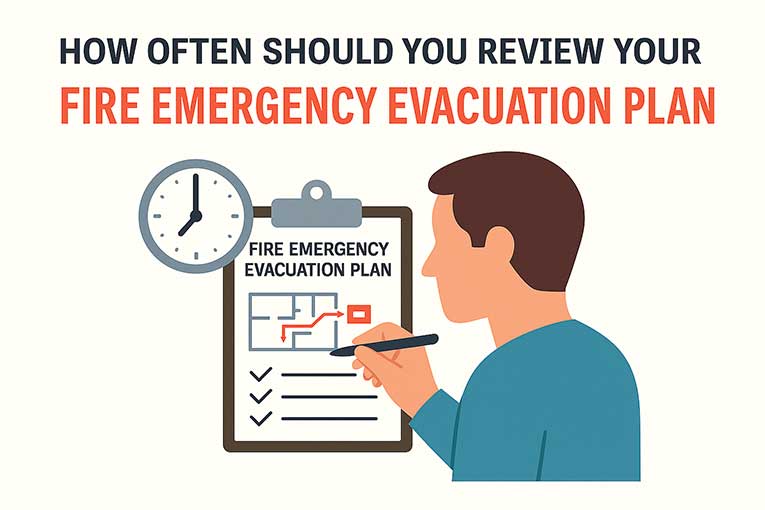
You should review your fire emergency evacuation plan regularly to keep it up to date – at least once a year is a good guideline. 

Over time, things can change that might affect your plan. 

For example, you might renovate or rearrange the space, or new people might join (employees, residents, etc.) who have different needs. 

After any such changes, update the evacuation plan accordingly. 

It’s also wise to review the plan after any fire drill or actual emergency. 

If a drill showed confusion about a particular exit or if an alarm wasn’t heard in some area, you should fix those issues and adjust the plan. 

Regular reviews ensure that escape routes are still clear, contact information is current, and everyone remains familiar with what to do if a fire occurs.

Is a Fire Emergency Evacuation Plan a Legal Requirement?

is fire emergency evacuation plan legal requirement

Yes, in most workplaces and public buildings a fire emergency evacuation plan is a legal requirement. 

Employers and building owners are legally obliged to implement and communicate these plans. 

If you have five or more employees, you are typically expected to have the plan written down as part of your fire risk assessment duties. 

Failing to do so can lead to enforcement actions or fines because it puts people at risk. 

For private homes, a written fire evacuation plan is not required by law, but it’s strongly recommended for your safety.

Fire authorities often encourage families to discuss and practise a home escape plan because it greatly increases the chance of everyone getting out safely. 

So, while you might not be legally required to have a formal fire plan in your house, the law does mandate it for most other settings where people live or work. 

Ultimately, beyond legal compliance, having a fire emergency evacuation plan is a responsible step that protects lives.

Conclusion

You should now have an understanding of how to create a fire emergency evacuation plan

A fire emergency evacuation plan is an essential part of keeping people safe from fire. 

In an emergency, a well-prepared plan can make the difference between a quick, orderly evacuation and dangerous chaos. 

By clearly outlining how to raise the alarm, the nearest exits to use, where to assemble, and who will call for help, it removes uncertainty and panic. 

Remember that for a plan to be effective, everyone needs to know it and it should be kept up to date. 

Whether at your workplace or in your home, taking the time to create and practise a fire evacuation plan can save lives. 

Fires are unpredictable and frightening, but when everyone knows what to do and where to go, the situation becomes much more manageable. 

Being prepared is not only a legal or moral responsibility – it’s also a practical way to protect yourself and others from harm.

New Zealand building code to undergo fire safety updates

Public feedback prompts review of New Zealand building code fire safety rules

New Zealand’s Ministry of Business, Innovation and Employment (MBIE) has reported that the government will amend building code fire safety provisions following public consultation in late 2024.

The ministry stated that the review was initiated after the Loafers Lodge fire in Wellington in May 2023, which caused five fatalities and prompted renewed attention on building safety.

The consultation ran from 23 October to 24 December 2024 and received 112 submissions, the highest number for a fire safety consultation in the past decade.

Submissions were made by architects, engineers, building consent authorities, product suppliers, building owners and occupants, disabled persons’ organisations and Fire and Emergency New Zealand.

MBIE said the review sought feedback on the clarity, effectiveness and modern relevance of the fire safety rules in the building code, without proposing specific changes at the time.

Concerns over complexity and clarity in current fire safety rules

According to MBIE, many submitters said the current framework is overly complex, with confusing building classifications and unclear language.

The ministry stated that these factors were causing inconsistent compliance decisions, delays in consenting processes and difficulties for owners in maintaining buildings.

Feedback indicated that building code requirements need to be clear on protection levels according to building types and users.

Respondents also said the rules must address specific fire hazards to ensure they are fit for purpose and cost-effective.

MBIE noted that several submissions highlighted the need to minimise gaps and inconsistencies to provide greater certainty and consistency in the system.

Changing building use and modern construction methods

MBIE reported that many submissions emphasised the need for fire safety rules to reflect changes in urban design, building use and construction practices since the last major update in 2012.

The ministry stated that evolving building technology, materials and construction methods have introduced new complexities to both fire safety and firefighting operations.

Respondents agreed that fire safety provisions must keep pace with these developments to remain effective.

There was also support for aligning building code requirements with the operational realities of modern-day firefighting.

MBIE said this would ensure the rules continue to protect building occupants and firefighters during emergency situations.

Accessibility and evacuation requirements

According to MBIE, a recurring theme in the submissions was the need to ensure safe evacuation for all building occupants, including people with disabilities.

The ministry stated that particular attention was given to larger residential accommodation such as hotels, motels and boarding houses.

Respondents agreed that evacuation requirements should consider diverse occupant needs and building uses.

Feedback also indicated support for targeted fire hazard management in these settings.

Government response and next steps

Building and Construction Minister Chris Penk said: “The Ministry of Business, Innovation and Employment (MBIE) has today released the summary of submissions from last year’s consultation on fire safety regulations in the Building Code.

“The review was launched following the devastating fire at Loafers Lodge in Wellington, which sadly claimed the lives of five people in May 2023.

“The recent tragedy here and similar incidents overseas have made it clear we need to look closely at how safe our buildings are, especially larger residential accommodation.

“More than 100 organisations, businesses, and individuals across New Zealand shared their insights during the consultation. I want to thank everyone who took the time to make a submission.

“Since the last update of the Building Code fire safety regulations in 2012, building uses, technology, materials and construction methods have evolved rapidly – adding new complexities to fire safety in our buildings and to firefighting.

“Many submitters agreed that the current framework is overly complex, with confusing building classifications and unclear language.

“These issues are causing inconsistent compliance decisions, consenting delays and challenges for owners trying to maintain buildings.

“Respondents agreed that it is essential for all building occupants to be able to evacuate safely, including people with disabilities and those in accommodation like hotels, motels and boarding houses.

“Others agreed the rules should target specific fire hazards to ensure requirements are fit-for-purpose and cost-effective.

“There was also support for ensuring fire safety provisions in the Building Code align with the realities of modern-day firefighting to protect firefighters while doing their jobs. Submitters agreed that New Zealand’s rules need to keep pace with new technologies and construction methods.

“We have a clear mandate to strengthen protections for New Zealanders by updating our fire safety requirements for buildings.

“I have instructed the Ministry of Business, Innovation and Employment to incorporate this feedback into proposed Building Code changes for Cabinet to consider early next year.”

Relevance for fire and safety professionals

The proposed amendments to New Zealand’s building code fire safety provisions will impact how building designs, construction methods and safety systems are assessed for compliance.

Fire engineers, building consent authorities and safety consultants will need to account for any updated requirements in their work once the changes are enacted.

The emphasis on accessibility, hazard targeting and alignment with modern firefighting will require sector professionals to adapt designs and strategies to meet revised standards.

Ongoing awareness of regulatory developments will be essential to ensure compliance and operational readiness in both new projects and existing buildings.

New Zealand to amend building code fire safety rules: Summary

The Ministry of Business, Innovation and Employment (MBIE) has released a summary of submissions from its 2024 public consultation on fire safety provisions in the building code.

The consultation followed the Loafers Lodge fire in Wellington in May 2023.

The consultation received 112 submissions between 23 October and 24 December 2024.

Participants included industry professionals, building owners, occupants, and Fire and Emergency New Zealand.

Many submissions said the current framework is complex and unclear.

Concerns were raised about inconsistent compliance decisions and delays.

Respondents called for clear requirements based on building types and users.

Submissions supported aligning rules with modern construction and firefighting practices.

Accessibility and safe evacuation for all occupants were identified as priorities.

The government will propose building code changes for Cabinet consideration in early 2026.

Quietly under control: How a 573-room hotel upgraded fire safety without service impact

Frederic Lafon, Senior Manager of Hospitality, Building Automation at Honeywell, explains how Atrium Hotel modernised fire safety without compromising guest experience or regulatory compliance

Ensuring fire safety in a hotel setting presents a distinct set of logistical and operational challenges.

Systems must be kept fully functional at all times, yet maintenance cannot interfere with guests or interrupt service.

Access to rooms may be limited, inspections must be discreet, and any fault resolution needs to be tightly coordinated across departments already focused on delivering a smooth hospitality experience.

The Atrium Hotel near Heathrow, with over 570 rooms and a consistently high occupancy rate, encountered these challenges directly.

Its leadership team recognised that maintaining a conventional, manually serviced fire alarm system risked delays, incomplete data, and avoidable disruption.

At the same time, regulatory responsibilities remained unchanged – with inspections, audits, and fault response all requiring clear documentation and traceability.

To resolve this, the hotel adopted a cloud-connected approach using Honeywell’s Connected Life Safety Services (CLSS) platform, installed and integrated by Amthal Fire and Security.

This made it possible to monitor and maintain the system remotely, respond to incidents in real time, and access a complete record of fire safety activity – all while continuing to operate at full capacity.

Frederic Lafon, Senior Manager of Hospitality for Building Automation at Honeywell, works closely with hotel operators to modernise life safety systems in ways that support both regulatory compliance and operational priorities.

His focus is on helping hospitality teams implement fire safety solutions that function reliably without disrupting service or diminishing the guest experience.

In this discussion, Frederic Lafon, Senior Manager of Hospitality, Building Automation at Honeywell, outlines how the project was delivered, what it has changed for the hotel’s operations, and how this model can inform future approaches to life safety in the hospitality sector.

For those unfamiliar, what is the CLSS platform and how does it work in a hotel environment?

Connected Life Safety Services (CLSS) is our cloud-based life safety platform, designed to simplify and modernise fire system management.

Its ability to provide real-time visibility, automated reporting, and a centralised dashboard, replacing manual checks and siloed documentation, sets it apart.

In line with BS8644-1, this outlines best practices for the digital management of fire safety information across all stages of a building’s lifecycle.

For hotels, facilities and maintenance teams can remotely monitor the fire system and receive instant notifications for any faults or changes in device status.

This allows them to be better informed without disrupting guests or scheduling intrusive room access.

CLSS can also improve coordination between staff and external service providers.

With access to a single source of real-time data, teams can better plan and execute maintenance, moving from reactive tasks to a more proactive approach.

What challenges were the Atrium Hotel facing that led them to adopt this system?

Hotels present some of the most demanding environments to safeguard.

They run continuously, host a high volume of guests and any disruption, no matter how minor, can affect both service delivery and the overall guest experience.

At the Atrium Hotel, one of the largest independent hotels near Heathrow with 573 rooms and steady footfall, these challenges were especially pronounced.

Our task was to support the hotel in upgrading its fire safety systems without interfering with day-to-day operations.

In a high-occupancy setting like this, taking spaces out of use or requiring access to guest rooms wasn’t a practical option.

To address this, we collaborated with Amthal, a trusted Honeywell Gent integrator, to deliver a solution that was technically advanced and carefully managed to avoid disruption.

Integrating CLSS across the hotel’s fire detection systems delivered a connected, cloud-based life safety solution that functions seamlessly behind the scenes.

The result is a hotel that remains focused on the guest experience while having confidence in the reliability and responsiveness of its safety infrastructure.

How did CLSS help the hotel maintain safety without disturbing guests?

At Honeywell, we always emphasise that fire safety isn’t a one-time installation; it’s a continuous responsibility.

While getting the system in place is an essential first step, what matters is how reliably and efficiently it can be maintained over time.

Hotels rarely have quiet periods or planned shutdowns that allow routine maintenance without affecting guests.

That makes traditional methods, such as room-by-room detector testing, difficult to carry out without causing inconvenience.

That’s where platforms like CLSS offer a real advantage.

At the Atrium Hotel, the team could remotely check system status, identify specific issues and prioritise maintenance accordingly.

Rather than checking every device manually, they could target the areas that needed attention most, which supported the hotel’s goal of delivering a seamless guest experience.

What role did remote access and real-time alerts play in day-to-day operations?

CLSS provides facilities teams with a live view of system performance, whether they’re on or off-site.

This continuous access allowed staff to detect and respond to issues before they escalated, and schedule fixes during low-traffic times to avoid disruption.

Real-time alerts also helped improve communications across departments.

Instead of waiting for manual checks or reports, teams could see what needed attention instantly and act quickly, keeping operations smooth and service uninterrupted.

How does the platform simplify compliance tasks like audits and inspections?

Compliance is a constant priority for facilities leaders, particularly in the hospitality sector, where fire safety standards are rigorous and reputational stakes are high.

We often hear from hotel operators how time-consuming and stressful it can be to prepare for an inspection.

That is why we built CLSS with compliance in mind.

Every test, inspection, and maintenance event is automatically logged in the Atrium Hotel system.

Reports could be generated on demand, giving teams immediate access to all the documentation needed for regulatory checks across the entire site.

The benefit of having this level of transparency and organisation shouldn’t be underestimated.

Instead of manually compiling spreadsheets or trawling through logbooks, the team had a live view of their compliance status and could demonstrate it confidently to inspectors at any time.

Do you see this type of cloud-based solution becoming more common across the hospitality sector?

The hospitality sector is becoming increasingly digitised, with guest expectations evolving in parallel.

From automated check-ins to personalised room settings, the technology behind the scenes needs to be just as responsive, and that includes life safety systems.

We see platforms like CLSS becoming an integral part of modern hotel operations.

Beyond core fire system functionality, they can integrate with other building services, helping enable more coordinated maintenance, improved energy use and better overall performance management.

Energy management is also a growing priority.

Digital tools that help reduce the need for on-site interventions can help limit unnecessary travel and contribute to wider ESG efforts, something increasingly important for operators and stakeholders alike.

Ultimately, we expect cloud-connected life safety to become the standard in hospitality.

The Atrium Hotel is a strong example of what’s possible, and we’re seeing growing momentum across the sector to follow suit.

This was originally published in the August 2025 Edition of International Fire & Safety Journal. To read your FREE copy, click here.

UK Government appoints expert panel for building regulation review

Panel formed to review statutory building regulation guidance

The UK’s Ministry of Housing, Communities and Local Government has announced the appointment of six members to the Fundamental Review of Building Regulations Guidance panel.

The government said the panel will support its response to the Phase 2 recommendations from the Grenfell Tower Public Inquiry, specifically the need to review statutory guidance that supports compliance with Building Regulations.

The panel will provide expert input into the structure, production and presentation of the Approved Documents, which set out examples and explanations to support compliance with functional requirements.

According to the Ministry, the Building Safety Regulator was commissioned in December 2024 to lead the fundamental review.

The new panel will provide an interim update in early 2026 and a final report by summer 2026.

Building Safety Minister outlines goals of review

Minister for Building Safety Alex Norris said the panel was central to ensuring guidance remains clear and effective.

Norris said: “The appointment of this panel is an important step in our response to the Grenfell Tower Inquiry. Guidance which supports compliance with Building Regulations must be clear, accurate, and practical, and subject to regular updates to ensure it remains effective.

“The work of the panel will support our delivery of 1.5 million new homes, by making compliance easier, improving safety and quality in construction, and ensuring greater confidence in the building safety system.

“I look forward to receiving the panel’s recommendations.”

The Ministry confirmed that the panel will operate in an advisory capacity.

It added that further updates, including the Terms of Reference, will be published in due course.

Approved Documents under scrutiny after Grenfell

The Ministry stated that Building Regulations set the minimum legal standards for construction work in England and are supported by Approved Documents which give guidance on compliance.

Following concerns raised by the Grenfell Inquiry about the clarity and adequacy of this guidance, responsibility for reviewing and updating the documents was transferred to the Building Safety Regulator in April 2023.

This transfer was made in line with the Building Safety Act 2022, which mandates the Regulator to monitor safety and standards across the built environment.

The December 2024 commissioning of the fundamental review followed a call for urgent reform by the Inquiry.

The newly appointed panel has been established to inform the review process.

Backgrounds of appointed panel members

The panel includes six members with expertise across planning, architecture, digital standards, housebuilding and fire safety.

Dinah Bornat, architect and Director of ZCD, brings experience in people-centred development and urban design.

Dan Rossiter, Built Environment Sector Lead at the British Standards Institute, has worked extensively in technical documentation and digital information management.

Danielle Michalska-Morris, Director of Research and Technical Innovation at Taylor Wimpey, will contribute knowledge in low carbon design and building services.

Rachel Ferguson, Senior Development Manager at Pocket Living, has experience in affordable housing, planning policy and estate regeneration.

Professor Luke Bisby, Chair of Fire and Structures at the University of Edinburgh, was an expert witness in the Grenfell Inquiry and provides insight on structural fire safety.

Dr Hywel Davies, former Technical Director of CIBSE, previously chaired the Building Regulations Advisory Committee and brings broad technical experience.

Timelines and next steps for the review

According to the Ministry, the panel is expected to deliver an interim update in early 2026.

A final report is scheduled for publication in summer 2026.

The review is expected to influence how future guidance is written, structured and applied across sectors.

The panel’s work forms part of a wider effort to improve safety, clarity and accountability in the UK building regulation system.

Further announcements will include the panel’s full terms and working approach.

Government appoints expert panel for building regulation review: Summary

The UK government has appointed a six-member panel to support a review of guidance linked to Building Regulations.

The panel was formed in response to the Grenfell Tower Public Inquiry Phase 2 recommendations.

The Building Safety Regulator will lead the review.

The review focuses on how statutory guidance, known as Approved Documents, is produced and structured.

An interim update is expected in early 2026.

A final report is scheduled for summer 2026.

Minister Alex Norris said the panel supports efforts to build 1.5 million new homes.

Dinah Bornat, Dan Rossiter, Danielle Michalska-Morris, Rachel Ferguson, Professor Luke Bisby and Dr Hywel Davies were named to the panel.

The panel will serve in an advisory capacity.

Johnson Controls completes HVAC business sale to Bosch

Johnson Controls confirms $8.1 billion HVAC divestment

Johnson Controls has announced the completion of its sale of the Residential and Light Commercial HVAC business to the Bosch Group.

According to Johnson Controls, the all-cash transaction is valued at $8.1 billion.

The company confirmed that it has received approximately $5 billion in net cash proceeds after taxes and transaction-related expenses.

Johnson Controls said the deal includes its North America ducted business and its global residential joint venture with Hitachi, while certain Hitachi ductless HVAC assets in Japan remain with Hitachi.

The company added that the divestment aligns with its strategy to focus on building technologies and services.

CEO comments on transition

Joakim Weidemanis, CEO of Johnson Controls, said: “The completion of this transaction is an important milestone for Johnson Controls and positions our company as a leading pure-play provider of innovative building solutions.

“Johnson Controls is embarking on its next era, and I’m confident in our ability to reach our full potential as a faster-growing, more profitable, technology-based and service-enabled company.

“I look forward to the journey ahead as we transform our industry for years to come and work together to deliver even greater value for our customers, team members and shareholders.

Weidemanis added: “I want to thank the Residential and Light Commercial HVAC team for their service and dedication and wish them the best of success as they join the Bosch Group.”

Transaction details

Johnson Controls said its portion of the consideration amounts to approximately $6.7 billion.

The transaction was initially announced earlier this year as part of a broader restructuring strategy.

The company stated that the agreement is part of its focus on building management systems and services.

According to Johnson Controls, the deal strengthens its balance sheet and creates additional capital return opportunities for shareholders.

The company confirmed that Bosch will now oversee the R&LC HVAC operations and integration.

Capital return plans

Johnson Controls said it will implement a $5 billion accelerated share repurchase program.

This repurchase initiative is part of its existing share buyback authorisation, which currently has $9.8 billion available.

The company expects the program to begin in the coming weeks.

According to Johnson Controls, the repurchase will be funded from the proceeds of the HVAC sale.

The company added that the transaction provides resources to drive long-term growth and shareholder value.

Market outlook

Johnson Controls explained that its exit from the residential HVAC segment allows greater focus on core building solutions.

The company noted that it aims to expand its offerings in automation, energy efficiency, and integrated services.

Industry observers, as reported by Johnson Controls, have indicated that the Bosch acquisition strengthens Bosch’s HVAC presence in North America and Asia.

The company said that it expects its remaining operations to achieve stronger margins and improved growth trajectories.

Johnson Controls stated that it remains committed to technology-based building management solutions.

Johnson Controls completes HVAC business sale to Bosch: summary

Johnson Controls has completed the sale of its Residential and Light Commercial HVAC business to the Bosch Group.

The all-cash transaction is valued at $8.1 billion.

Johnson Controls’ portion of the consideration is approximately $6.7 billion.

Net cash proceeds to Johnson Controls after tax and expenses are around $5 billion.

The deal includes the North America ducted business and the global residential joint venture with Hitachi.

Hitachi has retained certain ductless HVAC assets in Shimizu, Japan.

Johnson Controls plans to return a portion of the proceeds through a $5 billion accelerated share repurchase program.

The program is expected to begin in the coming weeks.

The transaction was previously announced earlier this year.

Johnson Controls confirmed the sale aligns with its strategy to focus on building technologies and services.

UK building engineering workers to receive phased pay increase

Industry pay deal confirmed for UK operatives

Unite the union and UK building engineering services employers have agreed a three-year pay deal starting 6 October 2025, according to the Building Engineering Services Association (BESA).

The association said the agreement includes a 3.7% increase for hourly paid, site-based operatives this year, followed by 3% increases in both 2026 and 2027.

It stated the increases apply to the industry’s hourly grade rates and allowances.

BESA confirmed the offer had been accepted by Unite members following a ballot held in July 2025.

The association described the agreement as the result of a “best and final offer” from employers.

Wage negotiations followed extended discussions

According to BESA, the negotiation process was lengthy and included discussions around increasing business costs.

It highlighted the added pressure of rising employer National Insurance contributions since April 2025.

The organisation said these increases had already started to impact business operations and staffing budgets.

BESA reported that its Employment Policy Committee played a central role in shaping the offer.

It said input from association members also contributed to finalising the proposal.

Union and employers aimed for shared outcomes

BESA’s head of employment affairs, Paula Samuels, said the negotiations had been shaped by a collaborative approach.

Samuels said: “However, thanks to the efforts of the BESA Employment Policy Committee, the flexibility of the wider Association membership, and the constructive relationship we have with the union, we have managed to reach a fair and workable outcome for both employers and employees.”

She added: “Everyone involved in the negotiations was mindful of the additional pressures on employers during this very difficult trading period for our industry.
“We are grateful to our counterparts at Unite for showing consideration for employers’ concerns while, obviously, working hard to get the best possible outcome for their members.
“This agreement provides a measure of long-term security to employees while also allowing employers to plan with more confidence and continue to invest in recruitment and training for the long-term benefit of the whole sector and its clients.”

Deal covers hourly workers across the UK

BESA confirmed that the deal applies to hourly paid, site-based operatives employed across the UK.

The increases relate to industry-standard hourly grade rates and associated allowances.

Unite members were balloted on the final offer during July 2025.

The union voted to accept the deal, allowing it to proceed with implementation from October.

BESA said the agreement is designed to provide stability for both workers and employers.

Long-term planning supported by agreement

According to BESA, the deal enables employers to plan ahead with greater confidence.

It said the three-year term provides a clear wage trajectory until 2027.

The association also said it hopes the agreement will support ongoing recruitment efforts.

It believes predictable wage increases can help improve industry retention.

BESA added that it sees the deal as contributing to wider investment in skills and training.

UK building engineering workers to receive phased pay increase: Summary

Unite and BESA have agreed a three-year pay deal for UK building engineering workers.

The agreement begins on 6 October 2025.

Workers will receive a 3.7% pay rise in October 2025.

Further increases of 3% will follow in 2026 and 2027.

The deal covers hourly paid, site-based operatives.

It was accepted by Unite members after a July 2025 ballot.

BESA said rising National Insurance costs affected the negotiations.

The association described the offer as a final proposal from employers.

The deal is intended to provide wage security through 2027.

BESA said it will help employers plan recruitment and training.

10 Most Common Flammable Solids

Flammable solids are materials that ignite easily and burn quickly when they come into contact with heat, sparks, or open flames. 

These materials pose a significant fire hazard because once they catch fire, the flames can spread rapidly and be difficult to control. 

From everyday items like matches and firelighters to more industrial materials like metal powders and phosphorus, these solids are present in many aspects of life. 

That’s why it is essential to understand how they behave, how to store them safely, and what to do in an emergency.

This article explores the definition of a flammable solid, introduces ten of the most common examples, and offers practical safety tips to help reduce fire risks at home and in the workplace.

What is a Flammable Solid?

A flammable solid is a material that can easily catch fire and burn rapidly when exposed to heat, sparks, friction, or an open flame. 

These substances are classified as Class 4 hazardous materials under international transport and safety guidelines because of their high risk of ignition and fire spread.

Flammable solids can be found in many forms, powders, granules, sheets, or even everyday products like matches and firelighters. 

Some are naturally combustible, while others become dangerous when exposed to air, moisture, or certain chemicals. 

They are often used in industrial processes, laboratories, manufacturing, and even in household products, making them more common than many people realise.

The main danger with flammable solids lies in how quickly they can ignite and how fiercely they can burn. 

For example, powdered metals like aluminium or magnesium can burn extremely fast and even explode when airborne. 

Others, like phosphorus or alkali metals, can self-ignite when exposed to air or water.

Flammable solids are grouped into three categories for safety purposes:

  • Division 4.1: Flammable solids (e.g. matches, sulphur)
  • Division 4.2: Substances liable to spontaneous combustion (e.g. phosphorus)
  • Division 4.3: Substances that emit flammable gas when in contact with water (e.g. sodium)

Because of their fire risk, these materials must be stored, handled, and transported with extreme care. 

Understanding what flammable solids are, and how they behave, is key to preventing dangerous fires and accidents.

10 Most Common Flammable Solids

Flammable solids are materials that catch fire easily and burn rapidly. 

They are found in homes, workplaces, and industries, and can become extremely dangerous if handled carelessly. 

Below are ten of the most common flammable solids, including how they behave and why they require careful attention.

Alkali Metals

sodium alkali metal
Source: Wikipedia

Alkali metals include elements such as lithium, sodium, potassium, and rubidium. 

These metals are highly reactive and are known to ignite spontaneously in air or explode on contact with water.

When exposed to moisture, alkali metals produce hydrogen gas and heat, which can cause immediate ignition. 

For example, a small piece of sodium dropped into water will fizz, spark, and potentially explode. 

These reactions are not just spectacular, they are highly dangerous.

Alkali metals are used in batteries, research labs, and chemical manufacturing. 

Because of their reactivity, they are stored under oil or in sealed containers to prevent exposure to air or water.

Celluloid

celluloid film
Source: Wikipedia

Celluloid is one of the earliest types of plastic, made by combining nitrocellulose with camphor. 

It was once used widely in film reels, combs, toys, and even dentures. 

However, celluloid is highly flammable and can ignite from just a small amount of heat or friction.

When it burns, it produces a fast, intense flame that is difficult to control. 

Early cinema fires were often caused by celluloid film catching fire under the heat of a projector bulb.

Today, celluloid has been largely replaced by safer materials, but it still appears in some vintage items. 

It should always be kept away from heat and stored in well-ventilated areas.

Coal

coal

Coal is a black or brownish-black rock made of carbon-rich material. 

It has been used as a fuel source for centuries, particularly in power stations, homes, and industrial processes.

Although solid coal is relatively stable, coal dust is extremely flammable. 

Fine coal particles suspended in air can create explosive mixtures, especially in enclosed spaces like mines or silos.

Fires involving coal are hard to extinguish once started. 

They can smoulder deep within coal piles for days or weeks. 

Good ventilation and dust control are essential in environments where coal is stored or used.

Firelighters

firelighter
Source: Wikipedia

Firelighters are small blocks or cubes made from flammable substances such as paraffin wax, kerosene, or compressed wood and oil. 

They are designed to catch fire easily and help light barbecues, wood burners, or campfires.

While firelighters are very useful, they must be handled with care. 

Storing them near open flames or in high temperatures can lead to accidental fires. 

Some types release flammable vapours that can ignite suddenly.

Always store firelighters in a cool, dry place and use them as instructed. 

Keep them out of reach of children and never use them to revive a dying fire, they can flash back dangerously.

Matches

burning match
Source: Wikipedia

Matches are perhaps the most familiar flammable solid. 

They consist of a small wooden or cardboard stick tipped with chemicals that ignite when struck.

The match head typically contains potassium chlorate, sulphur, and other substances. 

When struck against the matchbox surface, friction produces enough heat to ignite the chemicals and start a flame.

Because they are so easy to light, matches are considered hazardous goods. 

They should be kept in their original packaging, stored away from heat, and handled responsibly. 

Used matches should be fully extinguished and disposed of safely.

Metal Powders

metal powder

Fine metal powders such as aluminium, magnesium, titanium, and zirconium are highly flammable, especially when dispersed in air.

These powders are used in fireworks, pyrotechnics, welding, and metal finishing. 

When airborne, they can form explosive mixtures that ignite with a single spark. 

Magnesium powder, for example, burns at extremely high temperatures and can cause severe burns or fires.

To reduce the risk of explosions, metal powders must be stored in tightly sealed containers in non-sparking environments. 

Dust should be cleaned using specialised vacuum systems, and equipment should be grounded to prevent static electricity.

Phosphorus

black phosphorus
Source: Wikipedia

Phosphorus exists in several forms, but white phosphorus is the most flammable. 

It ignites spontaneously in air and burns with a bright, white flame. 

Because of this, white phosphorus is stored underwater or in sealed containers to prevent exposure to oxygen.

Phosphorus is used in military applications, chemical manufacturing, and fertilisers. 

It’s also found in small amounts in some matches and fireworks.

Even brief contact with white phosphorus can cause serious burns. 

It also releases toxic fumes when it burns, making it dangerous to inhale. 

Red phosphorus is more stable but can still ignite under friction or heat.

Seed Cake

seed cake
Source: Wikipedia

Seed cake is the solid by-product left after oil is extracted from oil-rich seeds, such as linseed, sunflower, or cottonseed. 

Although it may look harmless, seed cake can catch fire spontaneously during storage.

Residual oils within the cake can oxidise over time, generating heat. 

If the heat isn’t allowed to escape, due to poor ventilation or compact storage, it can build up until the seed cake catches fire on its own.

Seed cake is often used as animal feed or fertiliser. 

It must be stored in cool, dry conditions and checked regularly for signs of heating or smoke. 

Fires in seed cake storage can spread quickly once started.

Sodium Batteries

sodium batteries
Source: Wikipedia

Sodium batteries are known for high energy storage but also come with fire risks. 

They contain sodium metal, which reacts violently with water and moisture.

If the battery casing is damaged or the battery overheats, the sodium can ignite, causing intense fires. 

In worst cases, the battery may explode or leak hot, flammable materials.

Sodium batteries are used in large-scale energy storage and some newer electric vehicle concepts. 

Because of their high energy and fire potential, they require robust safety systems, temperature controls, and fire-resistant housing.

Sulphur

sulphur
Source: Wikipedia

Sulphur is a yellow, non-metallic element found in nature and used in many industrial processes, including the production of sulphuric acid, fertilisers, and matches.

When heated, sulphur melts into a reddish liquid and eventually ignites, burning with a blue flame and producing sulphur dioxide gas. 

This gas is toxic and irritating to the eyes, nose, and throat.

Sulphur fires can be difficult to put out and produce large amounts of smoke. 

In powder form, it poses an even greater fire risk, as it can ignite easily and burn rapidly.

To handle sulphur safely, store it in well-ventilated areas away from heat or open flames, and avoid creating dust clouds when moving or processing the material.

How to Protect Yourself from Common Flammable Solids

Flammable solids can pose serious fire hazards if not handled with care. 

Whether you’re working with these materials in an industrial setting or storing them at home, following simple safety steps can reduce the risk of accidents.

Store Properly

Keep flammable solids in cool, dry, and well-ventilated areas. 

Avoid places with direct sunlight, heat sources, or open flames. 

Always store materials in containers specifically designed for hazardous goods, and ensure lids are sealed tightly to prevent spills and contamination.

Use the Right Equipment

When handling flammable solids, wear appropriate personal protective equipment (PPE)

This includes gloves, eye protection, flame-resistant clothing, and sometimes respirators if there is dust or fumes. 

Using the right tools, such as non-sparking scoops or containers, can also help prevent accidental ignition.

Separate Incompatible Materials

Some flammable solids react dangerously with other substances, including water or certain chemicals. 

Keep incompatible materials stored separately and clearly label all containers. 

Consult safety data sheets (SDS) for guidance on proper segregation.

Prevent Dust Buildup

Fine powders like metal dust or coal can ignite easily when dispersed in air. 

Regularly clean work areas to prevent dust accumulation, and avoid sweeping, which can stir up particles – use a vacuum with a HEPA filter instead.

Train and Educate

Make sure everyone handling these materials receives proper training

Staff should know how to store, handle, and dispose of flammable solids safely. 

Emergency procedures should be clearly displayed, and fire extinguishers or other firefighting tools should be easily accessible.

Conclusion

You should now have more of an understanding of common flammable solids. 

Flammable solids present serious fire risks, especially when they are mishandled, stored incorrectly, or exposed to heat, sparks, or open flames. 

Each flammable solid has unique properties, ignition points, and hazards. 

Some, like celluloid or metal powders, can ignite with friction or static discharge. 

Others, such as seed cake or coal, may combust spontaneously under the right conditions. 

Being aware of these differences helps individuals and businesses store and handle these substances more responsibly.

By respecting the dangers and taking the right precautions, we can use these materials safely and avoid potentially life-threatening incidents.

Training launched to support resident directors in building safety roles

Free digital course available for RTM and RMC directors

The Leasehold Advisory Service (LEASE) has announced a new free training programme aimed at improving building safety understanding among resident directors in England.

According to LEASE, the digital training was developed in collaboration with the Building Safety Regulator (BSR) to help directors of Right to Manage (RTM) and Resident Management Companies (RMCs) meet their legal duties under the Building Safety Act 2022.

The initiative is designed to help non-professionals understand their responsibilities for managing fire and structural risks in residential buildings over 18 metres in height.

LEASE stated that more than 3,500 RTMs, RMCs and Commonhold Associations operate across England, many of which rely on unpaid resident volunteers to manage safety obligations.

The training aims to simplify complex legal requirements, whether duties are undertaken directly or delegated, and equips directors to assess the quality of services they receive.

Legal context under the Building Safety Act 2022

The Building Safety Act 2022 introduced new regulatory duties following the Grenfell Tower fire.

LEASE explained that individuals who manage buildings above 18 metres must now take on formal roles as Accountable Persons (APs) or Principal Accountable Persons (PAPs), even if operational tasks are outsourced.

The advisory body said that volunteer directors must remain legally responsible, regardless of whether external managing agents or third parties are involved.

The training addresses how to remain compliant within these roles and what directors should know when commissioning professional advice or services.

LEASE added that the training builds confidence in making informed decisions that affect safety and compliance.

Course structure and topics

LEASE said the training comprises four 30-minute eLearning modules.

Module 1 covers preparation for the new safety regime, including the Golden Thread requirement.

Module 2 addresses managing building safety risks and preparing the Safety Case Report.

Module 3 focuses on resident engagement, mandatory occurrence reporting, and complaint handling.

Module 4 outlines the Building Assessment Certificate process and regulatory interactions.

The course uses practical examples and plain language to make the regulatory framework easier to understand.

Applicability across the housing sector

LEASE stated that while the course is targeted at RTM and RMC directors, it is also relevant for others involved in managing residential buildings.

This includes freeholders, housing associations, local authorities, and professional building safety managers.

Managing agents and leaseholders are also encouraged to complete the training to better understand obligations and financial charges.

According to LEASE, the course aims to support everyone involved in building management, not just those with formal legal duties.

The organisation emphasised the importance of shared understanding across all stakeholders.

Joint statement from LEASE and the Building Safety Regulator

Ella Norman, Senior Legal Advisor at LEASE, said: “The new Building Safety eLearning programme fills a critical knowledge gap in building safety guidance.

“Many leaseholders that have volunteered, unpaid, to help manage their high-rise residential buildings often have limited formal training yet now carry significantly more legal responsibility.

“This training will ensure that residents involved in managing high-rise residential buildings have access to the knowledge they need to carry out their legal duties confidently and competently.

“In collaboration with the Building Safety Regulator, we created this free online course to empower and protect both residents and resident directors.”

Andy McGrory, Policy Lead for resident matters at the Building Safety Regulator, said: “We are delighted to have worked with LEASE to make this invaluable training openly available to the directors of thousands of high-rise Resident Management Companies.

“Their role is critical in upholding the highest standards of building safety for high-rise residents across England.

“This programme provides RMCs with the information needed to understand their responsibilities, to work towards implementing robust building safety measures, to be intelligent customers where they secure assistance from third-party providers and to ensure residents feel safe and are safe in their own homes.”

Resident directors, leaseholders and housing professionals can access the Building Safety eLearning via the LEASE website.

Building safety training launched for resident directors in England: Summary

LEASE and the Building Safety Regulator have released a free online training course.

The training targets directors of Right to Manage and Resident Management Companies in England.

It addresses legal duties introduced by the Building Safety Act 2022.

The course includes four interactive 30-minute modules.

Topics include risk management, resident engagement, and safety certification.

The course is also relevant for freeholders, housing associations, and managing agents.

The aim is to help directors understand their roles and legal responsibilities.

It uses clear language and real-life examples.

LEASE said over 3,500 such resident-led groups exist across England.

Ella Norman of LEASE said the training fills a gap in formal safety education.

Andy McGrory of BSR said the training supports consistent standards in high-rise buildings.

The Building Safety eLearning course is now publicly available.

New BSI evacuation standard outlines accessible lift use

New lift rules address disability evacuation in the UK

BSI Group has published BS EN 81-76:2025, a revised standard addressing the use of lifts for the evacuation of persons with disabilities in the UK.

The organisation said the new standard updates previous guidance and introduces three operational modes to support different building types and evacuation strategies.

BSI said the standard applies to new passenger and goods passenger lifts and forms part of the wider BS EN 81 series that sets out safety rules for lift design and installation.

The 2025 edition replaces CEN/TS 81-76:2011 and reflects updated approaches to accessibility, evacuation planning, and fire safety in the built environment.

According to BSI, professionals involved in lift design, installation and facility management are encouraged to review the standard to support compliance and safe evacuation planning.

Standard outlines where evacuation lifts apply

BSI said the standard specifies additional requirements to EN 81-20:2020 for passenger and goods passenger lifts that may be used during evacuation.

The organisation explained that the guidance supports evacuation during a fire alarm but does not apply to emergency conditions such as flooding, earthquakes, or chemical attacks.

In these cases, BSI said further risk assessment measures would be needed beyond those covered in the standard.

It added that BS EN 81-76:2025 also does not apply to lifts manufactured before its publication date.

According to the organisation, the standard excludes scenarios involving fire or smoke in lift wells, water ingress, entrapment in waiting areas, structural failure, and harmful atmospheres.

BSI noted that the document is a type-C standard under EN ISO 12100, and therefore takes precedence where its requirements differ from type-A or type-B machinery safety standards.

Three modes of evacuation operation included

The new standard defines three optional modes for evacuation lift operation: driver assisted, automatic, and remote assisted.

According to BSI, “driver assisted evacuation operation” refers to a trained assistant manually controlling the evacuation lift, a model previously outlined in the 2011 technical specification.

The “automatic evacuation operation” option, the organisation said, supports independent evacuation by individuals with disabilities, provided a suitable fire alarm and lift system are in place.

“Remote assisted evacuation operation” allows the lift to be operated externally from outside the lift car, ideally within the same building, BSI added.

These modes are intended to accommodate a range of evacuation needs depending on building type, layout, staffing, and system complexity.

Class A and Class B lift categories introduced

BSI said the standard introduces two categories of evacuation lifts: Class A and Class B.

Class A lifts are intended for simpler building types, such as residential structures where firefighter lifts are not required and where only one evacuation floor is designated.

BSI stated that these lifts do not require secondary power supply or prioritised landing service and can include automatic rescue operation if needed.

Class B lifts, by contrast, include additional control and size requirements, BSI explained.

These lifts may be used in buildings with more complex evacuation strategies and allow for remote assisted evacuation mode where specified.

The organisation said car size, power backup, and landing service requirements differ between the two classes to match evacuation demands.

Applicability and stakeholder relevance

BSI stated that the document is particularly relevant for manufacturers, health and safety regulators, and market surveillance bodies.

It said the drafting process involved stakeholders across industry, safety bodies, and user groups, including organisations representing persons with disabilities.

According to the organisation, machine users, employers, trade unions, and service providers are also affected by the safety levels described.

BSI said the document includes Annexes B, C and D covering the concept of evacuation lifts, information for use based on building-specific conditions, and listed hazards respectively.

The organisation emphasised that building owners and facility managers should familiarise themselves with the guidance, especially where occupants include people requiring assistance in emergencies.

New BSI evacuation standard outlines accessible lift use: Summary

BSI Group has published BS EN 81-76:2025.

The standard applies to new passenger and goods passenger lifts.

It is intended to support evacuation of persons with disabilities.

The document outlines three evacuation lift operation modes.

These include driver assisted, automatic, and remote assisted.

It defines two classes of lifts: Class A and Class B.

Class A lifts are for simple building evacuation needs.

Class B lifts are for complex settings and offer more features.

The standard excludes use during chemical, flood or seismic emergencies.

It does not apply to lifts built before its publication.

It is a type-C standard and overrides conflicting type-A or type-B guidance.

Stakeholders involved in drafting included regulators and disability organisations.

The standard is part of the wider BS EN 81 lift safety series.