Ferry fire in Indonesia leaves three dead and over 560 rescued

Ferry fire in North Sulawesi prompts major sea rescue operation

More than 560 people were rescued after a ferry caught fire en route to Manado, Indonesia, according to AP News.

The incident occurred around midday on Sunday, 20 July 2025, when the KM Barcelona 5 was travelling from Melonguane port in Talaud Islands district to North Sulawesi’s provincial capital.

First Admiral Franky Pasuna Sihombing, head of the Manado navy base, confirmed the vessel caught fire near the stern and was extinguished within an hour.

Three fatalities have been confirmed by Indonesia’s National Search and Rescue Agency, including a pregnant woman.

An initial passenger manifest recorded only 295 people aboard, but rescuers reported a total of 568 survivors recovered from the sea and surrounding islands.

Search effort involved coast guard, navy, and civilians

Sihombing stated that the response involved six rescue boats, one coast guard vessel and several inflatable craft.

Local fishermen helped recover passengers who had jumped into the sea.

Visuals shared on social media showed people leaping into the water while flames and smoke engulfed the vessel.

Rescue personnel transported survivors to nearby islands for medical care and shelter.

Some survivors, including a two-month-old infant, were hospitalised after inhaling seawater but were later confirmed alive.

Official manifest did not match actual passenger numbers

The ferry’s registered manifest recorded 280 passengers and 15 crew members.

The National Search and Rescue Agency later reported 568 people rescued and three confirmed dead.

According to Sihombing, discrepancies between manifests and actual passenger counts are frequent in Indonesia.

He said this issue often complicates search operations and poses safety risks.

The KM Barcelona 5 has a certified capacity of 600 people.

Ferry fire follows multiple maritime incidents this month

The fire is the third serious ferry or boat incident in Indonesia in July 2025.

On 14 July, a speedboat with 18 people capsized during a storm. All were rescued by the following day.

Earlier in the month, a separate ferry sank near Bali, causing 19 deaths and leaving 16 missing.

That operation lasted two weeks and involved navy ships, boats, a helicopter and over 600 personnel.

Authorities continue to investigate the KM Barcelona 5 incident.

Maritime travel remains common and risky across Indonesia

Ferries are a main mode of transport across Indonesia’s 17,000 islands.

According to AP News, accidents are frequent, often attributed to poor enforcement of safety regulations.

Overcrowding, irregular maintenance, and inaccurate manifests are recurring problems in maritime travel.

Government officials have acknowledged these gaps and say investigations are ongoing.

The latest incident highlights the persistent challenge of ferry safety in the region.

Ferry fire in Indonesia leaves three dead and over 560 rescued: Summary

A ferry fire occurred on 20 July 2025 during a journey from Melonguane to Manado, Indonesia.

The KM Barcelona 5 caught fire at sea and over 560 people were rescued.

The National Search and Rescue Agency confirmed three people died.

Initial reports mistakenly stated five deaths.

A two-month-old infant and one other passenger initially reported dead were found alive in hospital.

Rescue operations involved coast guard ships, six rescue vessels, and inflatable boats.

Local fishermen assisted by saving drifting passengers.

The ferry’s registered manifest listed 295 people aboard.

The final confirmed number of rescued passengers and crew was 568.

Discrepancies in passenger records are common in Indonesia.

The vessel’s certified capacity is 600 people.

This was the third maritime incident in Indonesia in July 2025.

Ferries are widely used due to Indonesia’s geography.

Weak enforcement of safety standards is often cited as a cause of such accidents.

Investigations into the KM Barcelona 5 fire are ongoing.

Arizona wildfire destroys Grand Canyon North Rim lodge and closes national park access

Wildfire damages historic lodge and forces North Rim closure

A wildfire has destroyed the Grand Canyon Lodge and dozens of other structures on the North Rim of Grand Canyon National Park, according to AP News.

The Dragon Bravo Fire, one of two wildfires burning in the area, grew rapidly following a lightning strike on 4 July 2025.

Park Superintendent Ed Keable confirmed the destruction during a meeting with staff and residents.

The park said between 50 and 80 buildings were lost, including the visitor centre, gas station, waste water treatment plant, and some employee residences.

The North Rim, which was evacuated last Thursday, will remain closed for the rest of the season, the National Park Service confirmed.

Arizona Governor requests federal inquiry into response

Arizona Governor Katie Hobbs has called for an investigation into the National Park Service’s handling of the Dragon Bravo Fire.

In a statement on X, Governor Hobbs said: “They must first take aggressive action to end the wildfire and prevent further damage.

“Arizonans deserve answers for how this fire was allowed to decimate the Grand Canyon National Park.”

The fire had initially been managed using a “confine and contain” strategy, but suppression tactics were escalated when the fire grew to over 7.8 square miles due to wind, heat and low humidity.

No injuries have been reported.

Evacuations and chemical safety warnings issued

Firefighters and hikers in the Grand Canyon area were evacuated over the weekend due to ongoing fire risks and potential chemical hazards.

The park reported that chlorine gas may have been released after the treatment plant was destroyed.

According to the US Centers for Disease Control and Prevention, chlorine gas can cause respiratory issues, blurred vision and irritation when inhaled.

Rafters on the Colorado River were advised to avoid Phantom Ranch due to the hazards.

Historic lodge destroyed by Dragon Bravo Fire

The Grand Canyon Lodge was the only lodging available on the North Rim.

Originally constructed in the 1920s, the current structure was rebuilt in 1937 following a fire in 1932.

The lodge was known for its stonework, timber features, and a panoramic canyon view from the Sun Room.

Tim Allen, a Flagstaff resident and regular visitor, said: “It just feels like you’re a pioneer when you walk through there (the lodge).

“It really felt like you were in a time gone by. It’s heartbreaking.”

Fire containment progress in Arizona and Colorado

Park officials reported progress on the White Sage Fire, which is burning north of the Grand Canyon and threatening the community of Jacob Lake.

By Sunday afternoon, the fire had covered 63 square miles.

Crews were working to contain the blaze on multiple fronts, with some areas showing minimal spread.

The fire’s advance continued in the east and north, where standing dead trees and dry grass accelerated its movement.

In Colorado, a separate lightning-caused wildfire has forced evacuations and led to the closure of Black Canyon of the Gunnison National Park.

Governor Jared Polis issued a disaster declaration on Sunday, confirming that multiple fires in the western part of the state began during the same storm.

Another fire near the Colorado-Utah border, also caused by lightning, has burned approximately 14 square miles.

Arizona wildfire destroys Grand Canyon North Rim lodge and closes national park access: Summary

A wildfire has destroyed the Grand Canyon Lodge on the North Rim of Grand Canyon National Park.

The Dragon Bravo Fire was caused by lightning on 4 July 2025.

It grew rapidly due to weather conditions.

Between 50 and 80 buildings were lost.

The North Rim is closed for the season.

Arizona Governor Katie Hobbs called for a federal investigation.

No injuries have been reported.

Chlorine gas exposure was reported after a treatment plant was damaged.

Rafters were advised to avoid Phantom Ranch.

The original lodge burned down in 1932 and was rebuilt in 1937.

The current lodge included historic materials and a bronze statue.

Progress has been reported on the nearby White Sage Fire.

Crews are working to contain fires using hand tools and bulldozers.

In Colorado, a wildfire has closed another national park.

The fires in Colorado also began on 4 July due to lightning.

A disaster declaration has been issued in Colorado.

How Do Wildfires Start?

Wildfires are one of the most powerful and destructive natural events on Earth. 

They can sweep through forests, grasslands, and even towns with alarming speed, leaving devastation behind. 

While wildfires are often seen in news headlines, many people don’t fully understand how they begin or why they spread so quickly. 

So how do wildfires start?

Some start naturally, while others are caused by human activity. 

In recent years, rising global temperatures and longer dry seasons have made these fires more frequent and harder to control. 

This article will explain what wildfires are, how they start, why they’re so dangerous, and how we can help prevent them.

What is a Wildfire?

what are wildfires

In simple terms, a wildfire is an out-of-control fire in forests, grasslands, brush or moorland. 

Depending on where they happen, they might also be called forest fires or bushfires. 

Unlike a campfire or a planned garden bonfire, a wildfire spreads through natural landscapes without deliberate management. 

Once ignited, a wildfire can quickly burn trees, shrubs, grass and the organic litter on the forest floor if dry fuel and wind are present. 

While the word ‘wildfire’ sounds threatening, it’s important to know that fires can be a natural part of many ecosystems. 

In small doses, fires can clear away old vegetation, kill disease-carrying insects, and help new plants grow. 

In fact, some forests and grasslands rely on occasional fires to stay healthy. 

However, today’s major wildfires are often larger and faster-spreading than the fires of the past. 

They can burn over huge areas of land before they finally stop. 

Such large fires can cause severe damage to wildlife and habitats and take decades for the land to recover.

How Do Wildfires Start?

Wildfires can be started by either natural or human causes:

Natural Causes

how do natural wildfires start

Natural events can trigger wildfires. 

The most common natural cause is lightning strikes. 

When a lightning bolt hits a tree, dry grass or the ground, it can instantly ignite a fire.

For example, during a single week in August 2020, more than 12,000 lightning strikes caused over 650 separate wildfires in California, burning more than 1.5 million acres. 

Other natural ignitions are less common but still possible. 

Volcanic eruptions can start wildfires: when lava flows over forested land, it sets vegetation alight. 

Another rare cause is spontaneous combustion in piles of dry leaves or compost. 

As rotting plant material breaks down, it can heat up and if a pile of leaves or manure gets hot enough, it can burst into flames without any spark. 

These natural causes do happen, but compared to human-related starts they account for only a small fraction of wildfires.

Human Causes

how do man made wildfires start

Humans are responsible for most wildfires. 

Careless or malicious actions can provide the spark that ignites dry vegetation. 

Key human causes include:

Arson

Sadly, some fires are set on purpose. 

People may set fires for various motives, such as land clearing or vandalism. 

In the United States alone, a study found over 52,000 intentional wildfires between 2014 and 2018

These arson fires led to an estimated 400 deaths, 950 injuries and about $815 million in damage every year.

Campfires and Barbecues

An unattended or poorly extinguished fire at a campsite or picnic can easily grow into a wildfire. 

For example, the 2007 Ham Lake fire in Minnesota (USA) was traced to a campfire left burning on the Gunflint Trail. 

It ended up burning 75,000 acres of forest and destroying hundreds of properties. 

Always make sure any outdoor fire is completely out before you leave it.

Burning Debris

People sometimes burn garden waste or bonfire piles. 

If conditions are windy or dry, the fire can escape. 

Sparks or embers from a debris burn may drift into nearby fields or forests and ignite new fires. 

Even if a fire looks like it’s out, smoldering embers can be carried by wind to start a new blaze.

Equipment and Machinery

Sparks from equipment can start fires. 

Faulty power lines cause many wildfires. 

In California, broken power wires are linked to about 10% of wildfires each year

Farm machines, chain saws or car brakes can also throw off sparks. 

For instance, the 2007 Zaca Fire (California) began when a metal grinder hit a rock and sent a spark into dry grass. 

Discarded Cigarettes and Matches

A lit cigarette butt tossed from a car window or from a building can land on dry grass and start a fire. 

Even small careless acts like this add up.

Other Causes

Fireworks, sky lanterns, or even broken glass bottles can focus sunlight and ignite grass. 

Anything that produces heat or sparks in a dry environment can become the start of a wildfire.

Why are Wildfires so Dangerous?

why are wildfires dangerous

Wildfires can grow extremely fast and spread over wide areas, making them very dangerous to people and nature. 

Even trained firefighters can be overwhelmed by the speed of a wildfire. 

Such fires can force evacuations of whole villages and towns, destroying homes and property in their path. 

Environment

Wildfires also have terrible effects on the environment. 

They can kill animals and destroy habitats. 

Entire forests can be turned to ash, and recovering from this damage can take decades. 

Many plants and animals lose their homes and food sources. 

Fires also release pollution and carbon dioxide. 

Trees normally store carbon from the air, but when they burn that carbon goes back into the atmosphere. 

A single large fire can emit as much carbon as many years of a city’s car traffic. 

In fact, studies have shown wildfires can release huge amounts of greenhouse gases, making climate change worse. 

This creates a feedback loop: hotter climate increases fire risk, and fires in turn boost the climate problem. 

Smoke

One of the most serious dangers is wildfire smoke. 

Smoke carries tiny particles of ash and chemicals that can travel long distances on the wind. 

It can make the air unsafe to breathe, even in places far from the fire itself. 

For example, smoke from North American wildfires in 2024 drifted across the Atlantic and reddened skies in the UK

Locally, smoke causes serious health problems: it aggravates asthma, heart disease and other conditions, and can trigger hospital admissions. 

Economy

Wildfires also have a large economic cost. 

The effort of firefighting can run into the hundreds of millions. 

Rebuilding after a fire, repairing homes, clearing burnt trees, restoring utilities, costs even more. 

Worldwide, the annual economic losses due to wildfires are in the tens of billions of pounds. 

Flooding and Landslides

Finally, wildfires can increase risk of flooding and landslides after they are out. 

The heat often soaks into soil and makes it hard for rain to seep in. 

Then heavy rains can wash ash, mud and debris downhill very quickly, causing flash floods or landslides. 

In this way, wildfires can trigger new hazards even after the flames are gone.

Can Weather Affect Wildfires?

Weather and climate have a huge impact on wildfires. 

Droughts & Heatwaves

In general, hot, dry and windy conditions make wildfires more likely and more severe. 

Droughts and heat waves dry out trees, grass and soil, turning once-green vegetation into brown tinder. 

Heatwaves in Europe or North America have repeatedly led to record-breaking fires. 

Scientists have linked this to climate change: by making heatwaves hotter and droughts longer, climate change is lengthening the fire season. 

On the other hand, cold or rainy weather helps to prevent fires; a period of heavy rain will soak vegetation and greatly reduce fire risk. 

Wind

Wind deserves special mention. 

Strong winds can carry burning embers miles ahead of the main fire, starting spot-fires that are very hard to contain. 

Winds also fan flames, supplying them with oxygen and pushing the fire front forward rapidly. 

Even gentle breezes on a very dry day can make a fire spread much faster. 

By contrast, still, humid air is much less favourable to fire growth. 

Recent weather patterns have already increased wildfire risk. 

How to Help Prevent Wildfires

how to prevent wildfires

Preventing wildfires is something everyone can help with. 

Most wildfires could be avoided if people behaved responsibly when using fire outdoors. 

The key is to avoid providing sparks or flames when conditions are dry. 

For example:

Be Careful With Open Flames

Never leave a campfire, bonfire or barbecue unattended. 

Keep them small, use a proper fire ring or container if available, and always have a bucket of water or a hose nearby. 

When you’re done, douse the fire completely with water and stir the ashes until no smoke or heat remains. 

This ensures hidden embers don’t flare up later.

Dispose of Smoking Materials Safely

Do not drop cigarette butts, matches or lighters onto the ground. 

A lit cigarette can smoulder unseen and ignite dry grass. 

Always put out cigarettes fully in a stubber or an ashtray, and never throw them out of car windows.

Avoid Fire in High Risk Areas

In hot, dry weather do not light any kind of flame in parks, forests or open countryside. 

That includes barbecues, as they can easily start grass fires. 

Equally, say no to fireworks or sky lanterns on dry days. 

These may seem harmless, but any spark they produce in a dry field can ignite a wildfire.

Position Equipment Safely 

If you barbecue, place the grill on a flat non-flammable surface (not on grass or decking). 

Keep it well away from hedges, fences or trees, and have water handy. 

Never use petrol or other flammable accelerants. 

When you finish cooking, make sure the fire is fully out and cool before disposing of ashes.

Follow Local Guidance

Many areas issue fire danger warnings or total fire bans during very dry spells. 

Check local advice and follow any restrictions. 

If a ban is in place, do not light even a small fire. 

Also clear leaf litter and long grass from around homes and outbuildings to create a safety zone – this ‘defensible space’ can stop fires from reaching buildings.

In forest areas, leaving dead wood on the ground or allowing undergrowth to build up can turn small sparks into major fires, so controlled clearing can help. 

Report Fires Quickly

If you see a fire starting, do not assume someone else will call for help. 

Call the emergency services immediately with the location. 

Give clear information about where the fire is, what it looks like, and if it is spreading. 

Early reporting allows firefighters to respond fast before the fire grows out of control.

Conclusion 

You should now have more of an understanding of how wildfires start.

Wildfires are complex natural disasters with many causes, but with awareness and care we can reduce their impact. 

We have seen that wildfires can start from nature or human actions. 

Weather and climate play a key role with hot, dry, windy conditions making fires far more likely. 

However, each of us can help prevent them. 

By following simple precautions – never leaving fires unattended, disposing of cigarettes safely, heeding fire bans and clearing dry vegetation.

Understanding wildfires helps us live more safely with them. 

Although wildfires will never disappear entirely, training people to act responsibly and learning about wildfire causes and fire weather can greatly reduce the risk. 

After all, it only takes one spark to start a wildfire, but many small actions to prevent one.

When waste sites watch themselves: FireVu brings cloud intelligence to high-risk waste sites

Mike Newton, CTO and founder of NetVu, explains how cloud connected systems like FireVu help waste sites respond faster to growing detection and verification challenge

As high-risk industries like waste and recycling evolve, so must their approach to fire safety.

The sector continues to grapple with a range of deepening challenges – growing volumes of combustible materials, the threat of lithium-ion battery fires, and increasingly remote or minimum staffed sites.

In this context, a new generation of cloud connected fire prevention technologies are coming to the market to meet these demands, promising speed, intelligence, and reliability.

At the heart of this evolution is a concept I’ve believed in and developed for over 40 years: remote access.

From the early days of Dedicated Micros through to today at NetVu, I’ve worked to make security systems smarter, more resilient, and accessible from anywhere.

The same thinking underpins fire detection and verification through our FireVu solution– bringing together real-time monitoring, intelligent analysis, and integrated suppression through strategic partners into one cohesive solution.

The core of this shift is about integration; fire detection systems provide local onsite standalone detection that is augmented by a broader digital infrastructure, combining sensors, video analytics, thermal imaging, and cloud access to create proactive, adaptive safety platforms.

These systems aren’t just detecting fires, they are verifying them, responding in real time, and offering stakeholders full situational awareness from anywhere in the world.

In a sector where every second counts, the ability to act early and with confidence is critical.

The challenges and changes in the waste and recycling sector

Waste and recycling facilities are among the most fire-prone industrial environments.

Daily operations involve sorting and processing large quantities of combustible materials.

Add to that the rising use and disposal of lithium ion batteries in the waste stream – often damaged or improperly disposed of – and the risk profile intensifies significantly.

Dust, vapours, and airborne particles complicate detection further.

Traditional fire alarms may fail or give false alerts in these conditions, and manual inspections are not fast or reliable enough to detect smouldering fires before they escalate.

Many facilities operate with minimal staff overnight or over weekends.

This has made remote monitoring and instant verification essential.

It’s no longer sufficient to simply trigger an alarm, operators need to see, evaluate, and respond to an event in real time.

Cloud-connected edge-based detection systems address these specific market needs by offering:

  • Remote access to live video and alerts: enabling faster responses from off-site teams or emergency services.
  • Layered detection methods: smoke, flame, and thermal, backed by AI analytics to reduce false alarms.
  • Integration with automated suppression systems: ensuring fires are not only detected, but extinguished quickly and appropriately

The value of resilience and remote access

Over the past four decades, I’ve seen firsthand how remote access and digital resilience have revolutionised the security and fire safety sectors.

My journey began with the invention of the time-division multiplexer and early networked video recording – technologies that laid the foundation for what we now consider the modern surveillance industry.

That same thinking powers fire prevention.

Today’s cloud connected systems continue this legacy, giving users around the-clock access to critical footage and system health, no matter where they are.

For industries like waste management, where the risks are high and the stakes even higher, including risk to life, such resilience is essential.

Sites can’t afford downtime in detection systems.

They need reliable, tamper-proof solutions that can function through smoke, vibration, or network fluctuations, that can be supported remotely.

Real-time response in action

Effective fire prevention isn’t just about having better sensors, it’s also about having better insight.

Another critical component in this ecosystem is metadata – the contextual information generated alongside video and sensor data.

Metadata includes time stamps, sensor types, detection zones, and event classifications, all of which enhance situational awareness and streamline incident response.

In surveillance and fire prevention, metadata enables faster search and retrieval of relevant footage, supports automated decision making, and allows systems to distinguish between routine activity and potential threats.

By embedding metadata into cloud connected platforms, operators gain a powerful tool for forensic analysis, compliance reporting, and continuous system learning.

Cloud platforms give facility managers, insurers, and emergency services instant access to critical data: live video, thermal heat maps, and historical analysis.

This not only enables fast decisions during an incident but also supports investigation, training, and risk mitigation afterward.

The integration of video based detection systems with automated suppression technology is becoming the gold standard.

FireVu’s visual verification capabilities are compatible with suppression technologies – whether water, foam, or inert gas – allowing sites to precisely target and contain fires in the very early stages.

Our strategic partnerships create a comprehensive ecosystem for fire prevention and suppression, providing facilities with a seamless, reliable solution that covers all stages of fire risk management; from early detection to containment and resolution.

This shift is not just about technology for technology’s sake.

It’s about meeting the evolving demands of insurers, regulators, and communities who expect better safeguards around fire-prone operations.

Whether dealing with the sudden ignition of flammable waste or the long-smouldering threat of hidden hotspots, cloud-enabled platforms offer a smarter, more accountable approach.

Driving smarter fire safety

The convergence of cloud computing, AI-powered analytics, and real-time verification has reshaped what’s possible in fire prevention.

No longer reactive, systems can now predict, detect, and respond with unprecedented precision.

For the waste and recycling industry, this is not a luxury, it’s an imperative.

As waste streams diversify and operational models shift, having intelligent, connected fire detection and suppression systems is critical to keeping people, property, and the environment safe.

Ultimately, the conversation must move beyond simple compliance.

Fire prevention is becoming a strategic pillar of business continuity and operational excellence.

Cloud managed systems that offer remote oversight, integrated response, and trusted resilience are no longer the future, they’re the standard we must build upon.

What the industry is talking about: Top 3 trends in fire prevention

Across the fire safety and waste management sectors, three clear priorities are shaping procurement and innovation strategies:

1. Cloud-connected and remote monitoring solutions

There is increasing pressure to monitor and manage fire risks across multiple locations with fewer staff.

Cloud-connected platforms make this possible, offering mobile visibility, incident archiving, and remote diagnostics that help teams act fast without having to be physically present.

2. False alarm reduction through AI and multi-sensor verification

Advanced detection platforms are now combining different sensing technologies, such as thermal cameras and flame analytics, with AI pattern recognition to exclude known heat sources including people and vehicles.

3. Integrated detection and suppression systems

A growing number of operators are turning to full-circle fire safety solutions.

One of our key strategic partners, Fire Shield combines FireVu with high performance dynamic suppression solutions which can cut response times dramatically and improve safety compliance.

Central to FireVu’s approach is its proprietary VSD (Visual Smoke Detection) and VFD (Visual Flame Detection) technologies.

Unlike traditional sensors, these systems use advanced video analytics to identify smoke and flame signatures visually, enabling earlier and more accurate detection, minimising false alarms and maximising response speed.

Why fire safety in recycling matters

Cory Environmental, London

The Smugglers Way site in London experienced a number of significant incidents within an 18-month period which caused substantial damage and shut downs.

This was identified as a growing problem, with a pending risk of a site destroying fire.

The speed of development and rising rates of damage were a particular concern.

In 2016, a new solution was deployed using FireVu detectors.

This has resulted in incidents being detected quickly, and addressed before the fire could spread to other areas of the site.

The FireVu solution proved highly effective and is now considered the default solution when there have been further expansions on the site.

Since the installation there have been no major incidents resulting in significant damage or extended shutdowns.

This was originally published in the July 2025 Edition of International Fire & Safety Journal. To read your FREE copy, click here. 

What really caused the Heathrow blackout? NESO’s North Hyde Substation report reveals overlooked warning

Incident at North Hyde Substation caused widespread disruption in March

The National Energy System Operator (NESO) has published its final report on the North Hyde Substation fire, confirming that a transformer fault at the 275kV site led to a major outage on 20 March.

According to NESO, the failure resulted in the loss of all electricity supply from the substation, directly affecting 66,919 customers and causing operational disruptions at Heathrow Airport and other critical services.

The outage also impacted road and rail networks, Hillingdon Hospital, three data centres and thousands of homes and businesses across the area.

Residents living near the site were evacuated, with some requiring alternative accommodation during emergency response efforts.

NESO stated that power restoration for affected domestic and commercial customers supplied by SSEN Distribution occurred within expected timeframes.

Forensic analysis identified cause of fire at 275kV site

NESO reported that a forensic investigation by National Grid Electricity Transmission and the London Fire Brigade identified a transformer fire as the source of the incident.

According to the report, the fire originated from a high voltage bushing failure, which was most likely caused by moisture ingress leading to an electrical fault.

Elevated moisture levels had been recorded in the bushing oil sample in July 2018, but NESO noted that mitigating measures were not implemented in response to the finding.

National Grid Electricity Transmission has since committed to a full review of its oil sampling procedures and is reviewing all historical oil sample records for appropriate follow-up actions.

The organisation stated that it aims to ensure the robustness of its asset condition monitoring practices.

Heathrow Airport’s internal network limitations extended power loss

NESO’s report concluded that the configuration of Heathrow Airport’s internal electrical network contributed to extended disruption at the site following the loss of one of its three supply points.

Heathrow Airport Limited’s contingency plan involves switching to the two other operational supply points, a process estimated to take 10 to 12 hours.

This plan was not widely known outside of the airport’s technical team and had not been communicated to energy providers.

The airport was closed for most of 21 March to complete the reconfiguration and safety checks.

It reopened later that day for limited flights and resumed full operations on 22 March.

Energy sector lacks visibility of critical infrastructure links

The review found that energy network operators are generally unaware of whether customers on their systems qualify as Critical National Infrastructure (CNI).

NESO reported that there is no requirement in the current regulatory framework for CNI operators to confirm continuity arrangements in the event of a power failure.

It also stated that CNI customers do not receive priority status under existing electricity regulations.

The government is leading a programme of work to map and analyse CNI interdependencies across sectors.

NESO said the findings point to a need for improved collaboration and data sharing between infrastructure operators and electricity networks.

Twelve recommendations issued to support future energy resilience

NESO set out 12 recommendations aimed at reducing the risk and impact of similar incidents in future.

The recommendations cover a range of themes including asset management systems, maintenance action protocols and fire risk assessment processes.

Other areas include accessibility for emergency responders, resilience of sites with multiple power sources, and updates to Electricity Safety, Quality and Continuity Regulations (ESQCR).

Additional recommendations address incident management, visibility of site-wide risk, and the resilience of Critical National Infrastructure.

NESO Chief Executive Officer Fintan Slye said: “NESO’s final report into the North Hyde Substation outage sets out the root cause and a clear set of recommendations to further improve the resilience of Great Britain’s energy system, and the resilience of its critical national infrastructure.

“The power outage and closure of Heathrow airport were hugely disruptive and our report seeks to improve the way parties plan for and respond to these incidents, building on the underlying resilience of our energy system.

“All parties involved are focussed on working together to deliver these important recommendations and much of this work is already underway with NESO’s full support.

“I would like to thank all the organisations who have provided evidence to the review for their cooperation.”

North Hyde Substation fire triggers national energy resilience review: Summary

NESO published its final report on the North Hyde Substation outage on 7 July 2025.

The incident occurred on 20 March 2025 and resulted in the loss of power from the 275kV substation.

Heathrow Airport and other critical services were affected.

A total of 66,919 customers were impacted, according to SSEN Distribution.

Residents near the site were evacuated during the response.

Forensic analysis attributed the fire to a transformer bushing failure.

Moisture ingress caused an electrical fault that triggered the fire.

Elevated moisture levels were previously detected in 2018.

National Grid Electricity Transmission has launched a review of its sampling process.

NESO found limitations in Heathrow Airport’s internal power network design.

The airport was closed for most of 21 March to reconfigure its power supply.

NESO highlighted a lack of awareness around CNI status among energy providers.

Twelve recommendations have been made to support future energy resilience.

Augwind unveils commercial AirBattery in Germany

Israel-based Augwind to deploy energy storage system in Germany

CleanTechnica has reported that Israel’s Augwind Energy will construct the world’s first commercial-scale AirBattery energy storage system in Germany.

The project will use compressed air stored in underground salt caverns to provide electricity during periods of low renewable generation.

This type of long-duration energy storage is designed to complement intermittent energy sources like wind and solar.

The compressed air will be generated using surplus renewable energy from the grid.

Or Yogev, Founder and CEO of Augwind Energy, discussed the initiative with CleanTechnica in a recent interview.

The system will store energy for several months

The company explained that the AirBattery will be able to store compressed air for up to several months.

Yogev said: “We can store energy for up to several months – a game-changing capability for addressing Germany’s ‘Dunkelflaute’ periods when solar and wind output is low.

“Our system has unlimited duration potential, limited only by the volume of the cavern itself.

“This long-duration storage capability is exactly what Europe needs as renewable energy penetration exceeds 50%.”

The compressed air is stored in solution-mined salt caverns, which are naturally airtight due to their density and pressure.

Yogev said: “The salt in the deep underground is highly condensed and pressurised by the weight above it.

“It is so dense that it is completely airtight.

“This unique characteristic has led to the use of solution mined salt caverns for safely storing compressed natural gas for over half a century.”

Installation timeline and turbine generation capacity

The AirBattery system will require between 9–12 months for installation and an additional 3–6 months for commissioning once permitting is finalised.

The facility will include 3 or 4 turbines, capable of generating between 3–10 MW of electricity on average.

Yogev said: “The turbines will be similar to the highly efficient Voith Hydro turbine currently operating in our demonstration site.”

To improve power quality and responsiveness, the system will be integrated with lithium-ion batteries.

Yogev added: “We couple the system with short-duration lithium-ion batteries for ancillary services and to provide a high-quality power profile.”

While the startup speed is slower than lithium-ion, the integration allows rapid deployment when needed.

Commercial model and system costs

The total cost of the first module will depend on the specific cavern selected and is expected to range between €7 million and €15 million.

AirBattery’s projected cost per kilowatt-hour for multiweek storage is estimated at 10–15 USD.

Yogev said: “Our AirBattery technology offers exceptionally competitive economics at 10–15 USD per kWh for multiweek duration storage.

“This cost-effectiveness, combined with our minimal environmental footprint and use of locally sourced materials rather than critical minerals, makes AirBattery the clear choice for Germany’s energy transition needs.”

The system is designed to work with wind and solar electricity that would otherwise be curtailed due to grid oversupply.

Augwind intends for this approach to reduce reliance on imported energy sources.

Yogev explained: “We’re taking excess renewable electricity that would otherwise be wasted during periods of oversupply and storing it for when Germany needs it most.”

Deployment partners and market role

The company is currently finalising partnerships with various stakeholders including energy traders, utilities, cavern owners, and industrial customers.

Although the names of participating partners have not yet been confirmed, Augwind says that demand from the German energy market has been strong.

Yogev said: “Our goal is to become Europe’s preferred partner for multiweek storage solutions, and this German launch will demonstrate that long-term energy storage is not only technically feasible but economically sound.”

The project’s final capacity will depend on the specific geological site selected.

Each AirBattery cavern could store compressed air equivalent to 3–8 GWh of electrical output, according to the company.

The exact figure for the first site has not yet been confirmed.

Germany to install first commercial AirBattery system: Summary

Augwind Energy has announced plans to build a commercial AirBattery system in Germany.

The system will store compressed air in underground salt caverns to generate electricity.

Air will be compressed using surplus wind and solar energy.

The company said each unit may store 3–8 GWh depending on site conditions.

Compressed air can be stored for several months.

The project cost will range between €7 million and €15 million.

The installation phase will last 9–12 months, followed by 3–6 months for commissioning.

The system will use 3 or 4 turbines generating 3–10 MW.

Lithium-ion batteries will support the system for ancillary services.

Projected storage cost is 10–15 USD per kWh.

No specific customers have yet been named.

The project aims to support Germany’s long-duration storage needs.

India factory fire kills 39 as Sigachi shuts plant operations

Fire kills at least 39 at Indian pharmaceutical supplier

At least 39 people have died following a fire and explosion at a chemical manufacturing site operated by Sigachi Industries in southern India, according to CNN and Reuters.

The incident occurred on Monday at the company’s plant in Telangana and left 34 people injured.

Local officials reported that more than 140 workers were present when the explosion occurred.

District administrative official P. Pravinya said 25 of the deceased remained unidentified as of Tuesday.

Operations at the facility have been suspended for 90 days, Sigachi Industries confirmed.

Investigation launched by Telangana government

The Telangana state government has announced the formation of a five-member committee to examine the cause of the explosion.

The company has not yet disclosed the cause of the incident.

GV Narayana Rao, director of Telangana fire disaster response service, told Reuters that the building was completely destroyed.

Rao said: “We are still clearing the debris.

“Once we are all done with the clearing, only then we will be able to assess if any other body is still remaining under the debris or if it is all clear.”

According to the fire department, recovery efforts are ongoing at the site.

Sigachi employee recounts incident

Factory worker Chandan Gound described the explosion in an interview with Reuters.

Gound said: “I came out (of the plant) to use the restroom and heard a loud blast. It sounded like a bomb blast. I came out and saw fire. A part of the fire also spread towards me. I jumped the wall and escaped.

“Many of them (those inside) managed to escape, but a large number were trapped and could not come out.”

Gound had been employed at the site for six months.

Authorities have not released the full list of those affected by the fire.

Company shuts plant and initiates claims

Sigachi Industries has confirmed that it has halted operations at the Telangana site for 90 days, citing structural and equipment damage.

The company said the facility is fully insured and it is in the process of submitting insurance claims.

Sigachi’s Telangana plant contributes over a quarter of its total annual production capacity, which is 21,700 million metric tons.

Following news of the incident, Sigachi’s stock fell by approximately 8 percent on Tuesday.

The company reported that this represented its steepest two-day decline on record.

Separate factory fire kills five in Tamil Nadu

CNN and Reuters also reported a separate incident on Tuesday in Tamil Nadu state.

A fire at a crackers factory in the Sivakasi region killed five people and injured four others.

A fire department official confirmed the deaths.

Sivakasi is a known hub for fireworks manufacturing and has seen multiple fire incidents in the past.

No link has been reported between the two fires.

India factory fire kills 39 as Sigachi shuts plant operations: Summary

At least 39 people have died after a fire and explosion at a Sigachi Industries plant in Telangana, India.

The incident occurred on Monday while over 140 people were reportedly inside the facility.

Telangana state officials confirmed that 34 people were injured and 25 of the deceased remain unidentified.

The Telangana government has set up a five-member committee to investigate the cause.

The cause of the fire has not been disclosed by the company.

GV Narayana Rao of the fire disaster response service said the building was destroyed.

Recovery operations are ongoing to clear debris and confirm the final death toll.

Sigachi Industries said it is halting operations at the site for 90 days due to damage.

The company noted that the plant is fully insured and it is filing claims.

The Telangana facility accounts for over a quarter of the company’s total capacity.

Sigachi shares fell by around 8 percent following the incident.

In a separate fire, five people died in Tamil Nadu at a fireworks factory.

That fire occurred in Sivakasi, a major crackers production region.

Authorities have not linked the two incidents.

Consilium strengthens Türkiye presence with Ares Marine acquisition

Consilium acquisition targets Turkish shipbuilding market

Consilium Safety Group has expanded its operations in Türkiye by acquiring marine safety company Ares Marine.

According to Consilium, the acquisition will support its strategic goal to increase service availability in key maritime regions.

The company stated that the deal enables 24/7 support and access to a local sales operation in a market that includes more than 70 shipyards.

Consilium said that the move enhances its ability to serve shipbuilders and owners across the region, with access to its complete product range.

The announcement was made in a company release published on 3 July 2025.

Local sales and support services to be expanded

The company explained that the Ares Marine acquisition enables more direct support for shipbuilders in the area.

Consilium added that it will now be able to provide local aftermarket and upgrade services, aiming to maximise operational uptime for shipowners.

Philip Isell Lind af Hageby, Chief Executive Officer of Consilium Safety Group, said: “I am delighted that Ares Marine is joining Consilium. We know that our customers around the world appreciate our strong physical presence, which enables us to provide fast and reliable service 24 hours a day, 7 days a week.

“With the acquisition of Ares Marine, we are strengthening our position in the region, not only by providing enhanced support to the shipbuilders, but also by offering local aftermarket and upgrade services to shipowners, ensuring maximum uptime in their operations.”

Ares Marine brings local experience and market knowledge

Ares Marine was founded in 2016 and is based in Tuzla Bay, Istanbul.

Consilium stated that the location gives the company direct access to Türkiye’s shipbuilding industry, where the majority of the country’s shipyards are located.

The firm added that Ares Marine has built a strong customer base and offers fire and gas detection, cargo control, monitoring systems, instrumentation and marine electronics.

These capabilities are expected to support Consilium’s efforts to provide integrated safety solutions for both new builds and existing vessels.

Co-founder of Ares Marine supports move

Mustafa Özler, Co-Founder of Ares Marine, said: “This is the right time for Ares Marine to become part of a larger organisation. With Consilium’s full product range and extensive experience behind us, we can now take the next big step in our growth plan and join the global expansion journey.

“We have strong expertise and a deep understanding of our market, so this acquisition truly has the potential to be a win-win, especially for our local customers in Türkiye.

“Having known Consilium for many years, we highly value their business model, which means there will be no ramp-up period, our collaboration will be fully operational from day one.”

Türkiye identified as strategic region for growth

Consilium explained that Türkiye is a priority region due to its high concentration of shipyards and ongoing shipbuilding activity.

The company stated that establishing a local presence was important to improve access for existing customers and respond to regional demand.

It added that this step reflects its wider growth strategy to offer more regional support and reduce service response times.

The expansion in Türkiye is part of Consilium’s broader plans to grow its presence in international maritime markets.

The company also indicated that further developments in the region may follow as part of this long-term plan.

Consilium strengthens Türkiye presence with Ares Marine acquisition: Summary

Consilium Safety Group has acquired Ares Marine.

The acquisition expands Consilium’s operations in Türkiye.

Consilium reported that the move supports 24/7 service and local sales operations.

Türkiye has over 70 shipyards, according to Consilium.

Ares Marine is based in Tuzla Bay, Istanbul.

The company was founded in 2016.

It provides fire and gas detection, cargo control, instrumentation and marine electronics.

Philip Isell Lind af Hageby is the CEO of Consilium Safety Group.

He said the acquisition strengthens regional support and improves customer service.

Mustafa Özler is Co-Founder of Ares Marine.

He said the deal supports growth and enables full integration with Consilium’s operations.

Consilium identified Türkiye as a strategic market.

It said the deal supports its international growth strategy.

IAFC calls for responder feedback on hazmat rail incidents in the United States

IAFC begins data collection from responders to improve hazmat rail incident response

The International Association of Fire Chiefs (IAFC) has launched a nationwide request for input from emergency responders who have dealt with hazardous materials (hazmat) rail incidents.

According to the IAFC, the insights will contribute to its ongoing Significant Rail Incident Study, which is being developed with national partners to improve hazmat preparedness and training programmes.

The organisation confirmed that the study’s initial framework has been developed by a national control group, which identified five key focus areas. It now seeks operational feedback from those with firsthand response experience.

Participants are invited to complete an initial form, with select responders to be contacted by IAFC for further follow-up as part of a detailed assessment.

The IAFC stated that input collected may inform future protocols and improve nationwide response systems for major hazmat rail incidents.

U.S. study follows earlier IAFC rail safety research

The IAFC said the responder feedback component builds on its prior research publication Considerations For Ensuring The Effectiveness of U.S. Railroad Hazardous Materials Training, Preparedness, And Community Outreach Programs.

That earlier work focused on improving rail hazmat training and outreach efforts across the country.

The new phase aims to document operational practices and lessons learned directly from significant rail incident response events.

The IAFC noted that the current study is designed to connect high-level priorities with practical, on-the-ground responder experience.

It added that this process will help refine policy recommendations through a more applied evidence base.

Partners include rail industry and federal bodies

The IAFC reported that the study is being undertaken in collaboration with the Association of American Railroads, the Shortline Safety Institute, and additional industry and federal agencies.

These partners are working with hazmat response stakeholders to ensure findings reflect operational needs and challenges.

The IAFC said that cooperation across these sectors is essential to capture a full range of technical, procedural, and policy considerations.

It added that the involvement of responders is a critical part of validating and contextualising the study’s findings.

The association said the study aligns with broader national safety goals and will contribute to ongoing risk reduction strategies in rail operations.

Call for U.S. responder participation remains open

The IAFC has invited all U.S.-based personnel who have responded to hazmat rail incidents to take part in the study.

Participation involves completing a short form, with follow-up contact from the IAFC if criteria are met.

The association said that all data collected will be used to shape future hazmat rail preparedness and response policies.

It added that responder feedback is particularly valuable in assessing what procedures work in practice, and where gaps may exist.

The IAFC encouraged eligible responders to engage with the study, stating that their perspectives can contribute directly to national safety improvements.

Study targets applied learning from incident response

According to the IAFC, the project aims to capture “Smart Practices and Lessons Learned” from real-world incidents.

The organisation stated that grounding the study in actual responder experience will support a more accurate understanding of current capabilities and shortfalls.

It also said that this phase of the research focuses on operational relevance, rather than theoretical planning or policy assessment.

The IAFC explained that volunteer participants will be contributing to a shared national learning process.

It emphasised that participation from diverse response contexts is encouraged, including urban, rural, and specialist units.

IAFC calls for responder feedback on hazmat rail incidents in the United States: Summary

The International Association of Fire Chiefs (IAFC) has launched a national data collection initiative.

The goal is to gather feedback from U.S. emergency responders who have dealt with hazmat rail incidents.

The study follows a prior IAFC publication on hazmat rail safety and outreach.

A national control group has outlined five key study priorities.

The IAFC is now seeking practical feedback to validate and extend that framework.

Responder input will help identify operational lessons and effective practices.

Participants must complete an online form to register interest.

Selected responders will be contacted for follow-up interviews.

The study is being conducted with the Association of American Railroads and the Shortline Safety Institute.

It also involves federal agencies and hazmat response networks.

All data collected will be used to support future rail incident protocols.

The IAFC stated that participation will inform national preparedness improvements.

The feedback gathered will focus on applied operational experiences.

Responders from all geographic and service contexts are encouraged to apply.

The IAFC confirmed the opportunity remains open for eligible responders.

What is a Fourth Degree Burn?

Burn injuries are among the most painful and complex wounds a person can experience. 

They are classified by degrees of severity, from minor first degree burns that affect only the outer layer of the skin, to life-threatening fourth degree burns that damage deeper tissues beneath the skin. 

While most people are familiar with first, second, and third degree burns, fourth degree burns are far less common and far more serious.

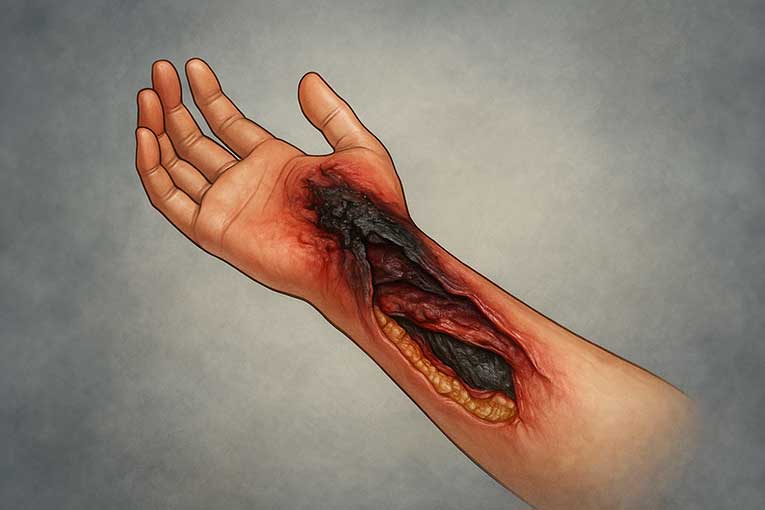
A fourth degree burn goes beyond the skin’s surface, destroying the underlying fat, muscle, and even bone. 

Understanding the nature of a fourth degree burn is vital, not just for medical professionals, but for the general public as well. 

Quick action can be the difference between life and death. 

In this article, we will explore what exactly a fourth degree burn is, how it differs from other types of burns, what causes it, how it’s treated, and what recovery looks like.

What is a Fourth Degree Burn?

what is fourth degree burn

A fourth degree burn is the most severe type of burn injury. 

It goes beyond damaging just the skin and affects deeper layers of tissue, including fat, muscles, tendons, and even bone. 

At this level, the burn completely destroys both the outer (epidermis) and inner (dermis) layers of skin, leaving the affected area blackened, charred, or dry and white in appearance.

Because fourth degree burns damage nerves, the injured area may not be painful at first. This absence of pain does not mean the injury is minor, it is often a sign that the nerve endings have been destroyed. 

These burns are usually caused by prolonged exposure to intense heat, open flames, electricity, or strong chemicals.

Due to the depth of tissue damage, fourth degree burns can lead to serious complications, such as infection, fluid loss, shock, and organ failure. 

Immediate medical treatment is essential. 

These burns often require surgery, including skin grafts or even amputation in severe cases.

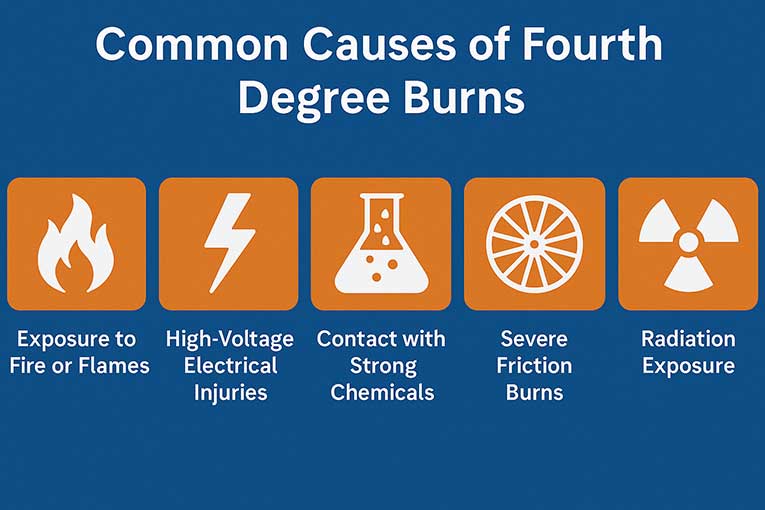
What Are The Most Common Causes of a Fourth Degree Burn?

fourth degree burn causes

Fourth degree burns are serious injuries that occur when the body is exposed to extreme heat or harmful substances for a prolonged period. 

These burns go beyond the skin and affect deeper tissues, such as fat, muscle, and bone. Below are the most common causes.

Prolonged Exposure to Fire or Flames

One of the leading causes of fourth degree burns is prolonged contact with open flames. 

This often occurs in house fires, vehicle accidents, or industrial incidents where escape is delayed. 

Clothing can catch fire, holding heat against the skin and allowing the burn to penetrate deep into the body.

High-Voltage Electrical Injuries

Electrical burns, especially from high-voltage sources, can cause fourth degree burns. 

Electricity generates intense heat as it travels through the body, burning internal tissues even if the skin appears only mildly affected. 

This type of injury is common in construction sites, industrial settings, and electrical accidents.

Contact with Strong Chemicals

Exposure to strong acids or alkalis, such as industrial cleaning agents or corrosive substances, can lead to deep tissue burns. 

Chemical burns can continue to damage the skin and tissue long after the initial contact if not washed off quickly and thoroughly.

Severe Friction Burns

Friction burns occur when the skin rubs against a rough surface at high speed, such as in motorcycle accidents or being dragged across a hard surface. 

If the contact is strong and long enough, it can lead to fourth degree burns that extend into muscle and bone.

Radiation Exposure

Though less common, extremely high doses of radiation, such as in industrial accidents or overexposure during radiation therapy, can damage tissue layers beyond the skin, resulting in deep burns.

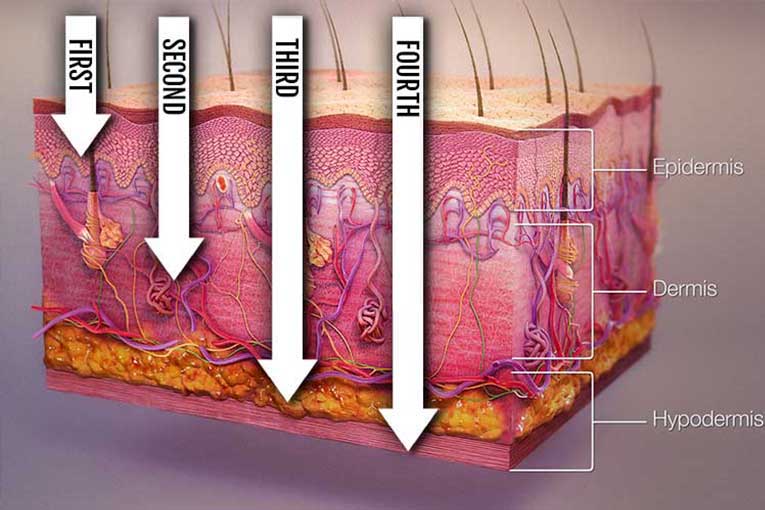
How Is a Fourth Degree Burn Different to Other Types of Burns?

classifications of burns
Source: Wikipedia

There are different classifications of burns, based on their severity. 

Fourth degree burns are the most severe, causing destruction far beyond what is seen in first, second, or even third degree burns.

Here’s how fourth degree burns compare to other burn types:

First  Degree Burns

First degree burns affect only the outermost layer of skin, known as the epidermis.

The area becomes red, sore, and dry, with mild swelling.

Pain is usually present, but the burn typically heals within a week without scarring.

Second Degree Burns

Second degree burns reach into the second skin layer, the dermis.

They cause blisters, intense pain, and swelling.

Healing may take several weeks, and scarring is possible, depending on the depth.

Third Degree Burns

Third degree burns destroy both the epidermis and dermis.

The skin may appear white, blackened, or leathery.

Because nerve endings are damaged, the area may feel numb.

These burns often require skin grafts and leave permanent scars.

Fourth Degree Burns

Fourth degree burns extend through all layers of skin and into the underlying fat, muscle, and bone.

These burns are usually painless at the site due to complete nerve destruction.

The affected area may look charred, blackened, or dry and white.

They require immediate emergency treatment, often involve surgery or amputation, and result in long-term disability, permanent scarring, and significant functional loss.

How is a Fourth Degree Burn Treated?

fourth degree burn treatments

Treating a fourth degree burn is a complex and urgent medical task. 

Because these burns affect all layers of skin and deeper tissues such as fat, muscle, and even bone, they require immediate and specialist care. 

Treatment usually begins in an emergency department or burn unit.

The first step is to stabilise the patient. 

Doctors will assess the extent of the burn, manage pain, and prevent or treat shock. 

Intravenous fluids are given to prevent dehydration and maintain blood pressure. 

Antibiotics may also be used to prevent infection, which is a major risk with deep burns.

Next, dead or damaged tissue must be removed through a process called debridement. 

This helps the wound heal and reduces the chance of infection. 

Skin grafts are often needed to replace damaged tissue. 

In very severe cases, amputation of affected limbs may be necessary.

Ongoing treatment may include reconstructive surgery, physical therapy, and occupational therapy to restore movement and strength. 

Due to the trauma of the injury, psychological support is also a vital part of recovery.

Patients with fourth degree burns typically require long-term hospital care, including time in an intensive care or specialist burn unit. 

Early and aggressive treatment at a healthcare facility is essential for improving survival and long-term outcomes. 

Without it, fourth degree burns can lead to life-threatening complications and permanent disability.

How Long Does a Fourth Degree Burn Take to Heal?

Healing from a fourth degree burn is a long and complex process. 

These burns destroy all layers of the skin and reach into deeper tissues such as fat, muscle, and even bone. 

Because of this severe damage, the body cannot heal on its own without major medical intervention.

The initial hospital stay can last several weeks to months, depending on the size and location of the burn and whether complications arise. 

During this time, the patient may undergo multiple surgeries, such as debridement (removal of dead tissue) and skin grafts. 

In some cases, amputations or reconstructive surgery may also be required.

Even after leaving the hospital, long-term recovery continues. 

Physical therapy is often needed to regain movement, particularly if joints or muscles are affected. 

Patients may also need occupational therapy, psychological support, and regular check-ups to monitor healing.

Full recovery can take many months or even years. 

The exact timeline varies depending on the person’s age, overall health, and how quickly they respond to treatment. 

Some people may face lifelong challenges, including scarring, reduced mobility, or chronic pain.

Does a Fourth Degree Burn Scar?

Yes, a fourth degree burn almost always leaves significant scarring. 

Because this type of burn destroys all layers of the skin and extends into underlying tissues such as fat, muscle, and bone, the damage is permanent and severe. 

As the skin cannot heal naturally in these cases, scarring is an unavoidable part of the recovery process.

The scars from fourth degree burns are often deep, large, and discoloured. 

They may appear raised, tight, or shiny, and can be either lighter or darker than the surrounding skin. 

Common types of scarring include hypertrophic scars, which are thick and red but remain within the wound area, and keloid scars, which grow beyond the boundaries of the original injury.

In addition to scarring, many patients develop contractures, where the skin and underlying tissues tighten and restrict movement, especially when burns are near joints. 

This can affect mobility and lead to long-term physical difficulties.

To manage scarring, patients may undergo treatments such as pressure garments, silicone gel sheets, steroid injections, and in some cases, reconstructive surgery. 

While these methods can reduce the appearance and discomfort of scars, they cannot remove them entirely.

Emotional and psychological support is also important, as scarring can impact confidence and mental wellbeing.

Conclusion

You should now have an understanding of what a fourth degree burn is. 

Fourth degree burns are among the most devastating and life-threatening injuries a person can suffer. 

This level of damage can result in permanent disability, disfigurement, and, in the most severe cases, death. 

Recovery is rarely straightforward and often requires months or even years of intensive medical care, surgeries, and physical rehabilitation.

Immediate medical intervention is essential. 

The faster a patient receives professional care, the better the chances of stabilising their condition, preventing infections, and beginning the long road to recovery. 

Fire safety education, use of protective gear, and better awareness of hazards can all play a role in prevention.