Alaska Marine Lines has confirmed it will no longer transport electric vehicles or plug-in hybrids to Alaska and Hawaii.
Blackline Safety Wins ADNOC Order for 28,000 Devices
ADNOC has placed its first order with Blackline Safety under a multi-year agreement, beginning with 1,000 gas detectors and 1,200 location beacons
Zelim partners with US Navy on AI detection research
Agreement enables joint trials with US Navy
Zelim has announced a Cooperative Research and Development Agreement (CRADA) with the US Navy’s Naval Undersea Warfare Center (NUWC) Division Newport to test its AI detection system, ZOE Shield.
According to Zelim, the agreement allows the company to participate in BlueTIDE 2025, a demonstration event organised by 401 Tech Bridge, NavalX and the Northeast Tech Bridge.
The company explained that the event will conclude with a full-scale in-water trial on 28 August in Narragansett Bay, Rhode Island.
Zelim said it is one of a small number of international companies selected for the 2025 BlueTIDE Prize Challenge following a competitive review process.
The company stated that this year’s mission scenario focuses on protecting subsea infrastructure from threats posed by small crewed and uncrewed autonomous systems.
ZOE Shield trial and operational role
Zelim reported that its role in the scenario is to detect small remotely operated surface vessels operating covertly in sensitive areas.
It said these craft may present a potential threat to subsea infrastructure by serving as a precursor to sabotage.
The company explained that its ZOE Shield system is based on the same AI engine used in its ZOE man overboard system, which is deployed in the cruise and offshore sectors.
It added that ZOE Shield extends these functions by providing situational awareness of small surface craft not using AIS.
The developer outlined that the system introduces automated classification and alerting, helping operators with early detection and response measures.
Features of the AI detection system
According to Zelim, ZOE Shield is designed to function in environments where GPS denial or radar jamming could limit conventional surveillance methods.
It stated that this makes the system relevant for security operations requiring layered detection and resilience against interference.
The company noted that the US Navy is evaluating the system as part of its assessment of intelligent surveillance technologies.
Zelim explained that this evaluation will take place in live operational scenarios during BlueTIDE.
It added that the data will be used to support the Navy’s capability review and potential future development.
CEO comments on defence scenario
Sam Mayall, CEO and co-founder of Zelim, said: “This agreement gives us a unique opportunity to trial ZOE Shield in an operational defence scenario at a US Navy facility, where multiple assets, including USVs will be deployed on the mission.
“This is about closing the gap between detection and decision, especially in domains where the threat is small, fast-moving and unpredictable.
“Our mission is to help operators identify anomalous behaviour earlier, whether the goal is rescue or protection.
“This demo is a vital step toward deploying ZOE for real-world defence scenarios.”
Role of CRADAs in research collaboration
Zelim stated that CRADAs enable non-federal organisations to work directly with US Navy personnel and facilities.
It said this framework allows research partners to collaborate outside of federal acquisition rules.
The company explained that the structure also protects intellectual property and proprietary data.
According to Zelim, this mechanism is being used to facilitate the ZOE Shield trial in Rhode Island.
It added that further information will be released in line with CRADA requirements after the demonstration.
Relevance for fire and safety professionals
AI detection technologies such as ZOE Shield have potential applications in safety-critical fields beyond defence.
The system’s ability to function without reliance on radar or GPS may inform the design of fire and rescue monitoring technologies in environments subject to interference.
The early classification and alerting features under test may also have relevance to operators seeking to improve situational awareness in complex emergency scenarios.
Zelim partners with US Navy on AI detection research: Summary
Zelim has signed a CRADA with the US Navy’s NUWC Division Newport to test its AI detection system ZOE Shield.
The agreement enables Zelim’s participation in BlueTIDE 2025, a demonstration event scheduled to conclude on 28 August in Narragansett Bay, Rhode Island.
Zelim is one of a small number of international companies selected for the 2025 BlueTIDE Prize Challenge.
The company will trial ZOE Shield to detect small surface vessels operating covertly near subsea infrastructure.
The AI engine used in ZOE Shield is also employed in Zelim’s ZOE man overboard system, which is already deployed in maritime industries.
ZOE Shield provides automated classification and alerting functions and is resistant to GPS denial and radar jamming.
The system is being evaluated by the US Navy for its role in layered maritime surveillance and response.
Sam Mayall, CEO and co-founder of Zelim, said the demonstration is an opportunity to test ZOE Shield in a live defence scenario.
CRADAs enable collaboration with the US Navy while protecting intellectual property and removing federal acquisition requirements.
Further details will be made available after the demonstration in line with the CRADA framework.
What firefighters learned inside London’s historic Royal Academy of Music during an emergency rescue drill
Fires at historic buildings in London
London Fire Brigade has reported that 282 fires occurred at historic buildings in the capital between July 2024 and June 2025.
The Brigade said the figures show why heritage sites must maintain current salvage plans to protect buildings and collections during emergencies.
In 2024, Somerset House was affected by a fire, and crews carried out life-saving procedures before moving to protect the building’s cultural assets.
The Brigade explained that this incident highlights the importance of rehearsed salvage planning alongside firefighting operations.
It added that protecting lives remains the top priority, followed by preserving the building and its contents where possible.
Training exercise at the Royal Academy of Music
London Fire Brigade firefighters recently trained at the Royal Academy of Music in Marylebone to practise emergency rescue and salvage operations.
The exercise involved crews from Hendon, Kentish Town and West Hampstead Fire Stations, with a Command Unit from Park Royal Fire Station.
The Brigade confirmed that the mock incident took place at the Grade II listed building near Regent’s Park.
It said the aim was to test the joint response between firefighters and the Academy’s collections team during a simulated 999 call.
The Brigade added that staff and firefighters practised how to remove or protect historic artefacts safely.
Salvage planning and priorities
London Fire Brigade’s Heritage Co-ordinator, Sub Officer Mark Huntington said: “As London’s rescue service our priority is always to preserve life, then the building and its contents.
“If you have pre-prepared plans, and know your building, you’ll protect lives, utilise valuable time and save more of your building and its contents.
“These plans are vital as they detail not only actions that should be implemented by site staff, but also clearly identify priority items which need to be removed from the building or left protected, in situ, which the Brigade can assist with.”
The Brigade explained that these plans are intended to streamline operations during emergencies.
It added that such preparation allows crews to act faster and more effectively.
Firefighting tactics and preparedness
Station Commander Adam Lawson said: “This exercise with the Royal Academy of Music was an excellent opportunity to ensure we can effectively preserve items of historical significance.
“Crews practised firefighting tactics and put plans into practical use to ensure procedures were effective in the event of a fire, ensuring that firefighters and The Academy are now fully prepared should the worst happen.”
The Brigade confirmed that training exercises of this type form part of its wider preparedness strategy.
It said drills allow operational procedures to be tested before real incidents occur.
Collaboration with the Academy
Dean of Students at the Academy, Elizabeth Kenny, said: “Our Collections Team, led by Head of Collections Susana Caldeira, worked closely with the Brigade on this practical exercise, testing and sense-checking our emergency salvage procedures.
“We found the collaboration very productive and valuable, from first contact to preparing and delivering the exercise across our heritage site.”
The Academy said it intends to use the outcomes of the exercise to strengthen internal salvage procedures.
It added that working directly with the Brigade gave staff greater awareness of their roles during emergencies.
Relevance for fire and safety professionals
The Brigade’s report highlights the number of fires at historic buildings in London and underlines the importance of planning for both life safety and cultural preservation.
Fire safety professionals can see from this case how pre-prepared salvage plans can be integrated into emergency response.
The training also shows the value of close cooperation between building staff and firefighters in protecting heritage assets.
Emergency rescue training at Royal Academy of Music: Summary
London Fire Brigade reported 282 fires at historic buildings in London between July 2024 and June 2025.
The Brigade said the figures show the importance of salvage planning at heritage sites.
In 2024, Somerset House was affected by fire and salvage operations protected cultural assets.
The Brigade confirmed it carried out a training exercise at the Royal Academy of Music in Marylebone.
Crews from Hendon, Kentish Town, West Hampstead and Park Royal stations attended the drill.
The exercise simulated a 999 call at the Grade II listed building near Regent’s Park.
The Brigade said firefighters worked with the Academy’s collections team on artefact preservation.
Sub Officer Mark Huntington said prepared plans save lives, time and heritage items.
Station Commander Adam Lawson said the exercise improved salvage preparedness.
Dean of Students Elizabeth Kenny said the collaboration tested the Academy’s salvage procedures.
How to Create a Fire Emergency Evacuation Plan
A fire can break out with little warning, whether you are at home, at work, or in a public place.
In those critical moments, having a clear fire emergency evacuation plan can save lives by telling everyone exactly how to escape quickly and safely.
This article will explain what a fire emergency evacuation plan is, when to use it, how to create one step by step, and key tips for making it effective.
By planning ahead and practising, you can help ensure that if a fire ever happens, you and the people around you can get to safety without panic.
What is a Fire Emergency Evacuation Plan?

A fire emergency evacuation plan is a written document or set of instructions that outlines how to get everyone out of a building safely if there is a fire.
In short, it’s a guide for a quick and orderly escape during a fire emergency.
A good plan will typically detail the designated escape routes and emergency exits, where people should assemble outside (a safe meeting point), and how to raise the alarm (for example, activating the fire alarm or shouting to alert others), as well as who will contact the fire service.
It may also assign special roles or responsibilities – for instance, a fire marshal in a workplace might check that everyone is evacuated, or one family member might be in charge of calling the fire service.
The purpose of a fire emergency evacuation plan is to ensure everyone knows what to do immediately if a fire breaks out, so there’s no confusion or delay when every second counts.
When is a Fire Emergency Evacuation Plan Used?

A fire emergency evacuation plan is used whenever there is a fire emergency that requires people to evacuate.
The moment someone discovers a fire or the fire alarm sounds, everyone should follow the plan and start leaving the building to reach safety.
This applies in all settings, workplaces, schools, shops, healthcare, and even in your own home.
In an office or school, for example, the plan is often practised during regular fire drills so that if a real fire happens, people are prepared to act quickly and calmly.
Essentially, any time you need to get out of a building due to a fire (or suspected fire, such as smelling smoke), you will be using your fire emergency evacuation plan.
It’s the procedure that guides occupants to safety during those critical moments.
How to Create a Fire Emergency Evacuation Plan
Creating a fire emergency evacuation plan involves carefully thinking through how people will escape a fire safely and writing down the procedure.
Here are the key things your plan should include and consider:
What Should Your Fire Emergency Evacuation Plan Cover?
Your fire evacuation plan should cover all the essential elements needed for a safe escape.
Important points to include are:
Fire Detection and Alarm
Clearly state the fire detection and how people will be alerted.
For example, note that there are smoke alarms or a fire alarm system in place and explain how to trigger the alarm (or yell “Fire!”) if someone discovers a fire.
Also specify who will call the fire service to ensure help is on the way.
Escape Routes and Exits
Identify all the safe ways out and keep them unobstructed.
Emergency exits should open easily.
Provide exit signs and, if needed, emergency lighting so people can find their way even in the dark.
Assembly Point
Choose a safe spot outside (such as the far end of the car park or across the street) where everyone will meet.
Make sure everyone knows where this assembly point is.
Training and Information
Make sure everyone in the building knows what to do.
Employees should have training on the plan, and household members or roommates should talk through the escape steps.
People need to be familiar with the plan ahead of time rather than trying to figure it out during an emergency.
Special Assistance
Include provisions for anyone who might need help during evacuation.
For example, assign someone to assist individuals with limited mobility (such as using an evacuation chair for a wheelchair user), plan how to alert anyone with hearing or vision impairments, and decide who will help young children or the elderly.
The plan should ensure no one is forgotten or left behind.
What Else Should You Consider?
Beyond the basics above, consider these additional factors to make your evacuation plan as effective as possible:
Action on Discovering a Fire
The plan should state that if anyone discovers a fire, they must immediately raise the alarm and start the evacuation.
If the fire is very small and a person is trained to use a fire extinguisher, they can attempt to put it out only if it is safe to do so – otherwise, evacuate immediately.
Remember that getting everyone out safely is the top priority.
Roll Call and Headcount
Your plan should include taking a headcount once everyone is at the assembly point.
Use a staff register or headcount list to quickly see if everyone is out or if someone might still be inside.
If anyone is unaccounted for, that information must be given to the fire service immediately when they arrive.
Liaison and Responsibilities
Assign one person to meet the firefighters when they arrive and inform them of crucial details (like if anyone is missing or where the fire is).
Also, make sure all key roles are decided in advance – for example, who calls 911, who checks various areas, who assists people in need, and who takes the roll call.
These clear assignments prevent confusion during an evacuation.
Fire Emergency Evacuation Plan Template
While each evacuation plan will be tailored to its location, most plans cover similar ground.
Here is a simple outline of what a fire emergency evacuation plan document might include:
- Introduction: A brief description of the premises and the purpose of the plan (to ensure everyone’s safety during a fire).
- Alarm and Emergency Contacts: How to raise the alarm and who to call in an emergency (include the fire service number and any key internal contacts).
- Evacuation Procedures: Step-by-step instructions of what to do when the alarm sounds or a fire is discovered (for example: leave immediately by the nearest exit, do not use lifts, and close doors behind you).
- Escape Routes and Exits: Details of primary and secondary escape routes for the building (and where maps or exit signs are posted, if applicable).
- Assembly Point: The specific safe location outside where everyone will gather after evacuating.
- Roles and Responsibilities: Who does what during the evacuation (for example, who calls 911, who guides people out, who takes attendance at the assembly point).
- Assisting Vulnerable Persons: How to assist anyone who needs extra help (e.g. people with disabilities, children).
- Post-Evacuation Actions: For example, note that a roll call will be done at the assembly point and any missing persons will be reported to the fire brigade.
How Often Should You Review Your Fire Emergency Evacuation Plan?
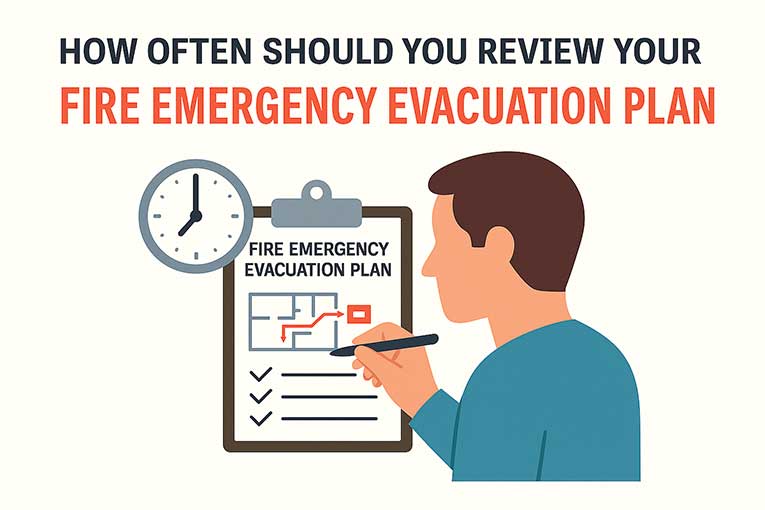
You should review your fire emergency evacuation plan regularly to keep it up to date – at least once a year is a good guideline.
Over time, things can change that might affect your plan.
For example, you might renovate or rearrange the space, or new people might join (employees, residents, etc.) who have different needs.
After any such changes, update the evacuation plan accordingly.
It’s also wise to review the plan after any fire drill or actual emergency.
If a drill showed confusion about a particular exit or if an alarm wasn’t heard in some area, you should fix those issues and adjust the plan.
Regular reviews ensure that escape routes are still clear, contact information is current, and everyone remains familiar with what to do if a fire occurs.
Is a Fire Emergency Evacuation Plan a Legal Requirement?

Yes, in most workplaces and public buildings a fire emergency evacuation plan is a legal requirement.
Employers and building owners are legally obliged to implement and communicate these plans.
If you have five or more employees, you are typically expected to have the plan written down as part of your fire risk assessment duties.
Failing to do so can lead to enforcement actions or fines because it puts people at risk.
For private homes, a written fire evacuation plan is not required by law, but it’s strongly recommended for your safety.
Fire authorities often encourage families to discuss and practise a home escape plan because it greatly increases the chance of everyone getting out safely.
So, while you might not be legally required to have a formal fire plan in your house, the law does mandate it for most other settings where people live or work.
Ultimately, beyond legal compliance, having a fire emergency evacuation plan is a responsible step that protects lives.
Conclusion
You should now have an understanding of how to create a fire emergency evacuation plan
A fire emergency evacuation plan is an essential part of keeping people safe from fire.
In an emergency, a well-prepared plan can make the difference between a quick, orderly evacuation and dangerous chaos.
By clearly outlining how to raise the alarm, the nearest exits to use, where to assemble, and who will call for help, it removes uncertainty and panic.
Remember that for a plan to be effective, everyone needs to know it and it should be kept up to date.
Whether at your workplace or in your home, taking the time to create and practise a fire evacuation plan can save lives.
Fires are unpredictable and frightening, but when everyone knows what to do and where to go, the situation becomes much more manageable.
Being prepared is not only a legal or moral responsibility – it’s also a practical way to protect yourself and others from harm.
Peru strengthens disaster response capacity in protected natural areas
Agreement to improve forest fire response in Machu Picchu
The government of Peru is expanding disaster response and prevention measures for the country’s most emblematic protected natural areas.
According to the Ministry of the Environment’s agency Sernanp, the move follows an inter-institutional agreement with the District Municipality of San Jerónimo in the Cusco region.
The government said the agreement aims to protect the Historic Sanctuary of Machu Picchu and improve local capacity to respond to environmental emergencies.
Sernanp executive president José Carlos Nieto Navarrete said: “Sernanp has become the country’s best-prepared first-response force to combat forest fires.
“But we must also focus on prevention. Today, we are joining forces with the local government to protect lives, forests, and Peru’s natural heritage.”
The plan includes training community brigades, providing specialised equipment, and offering technical courses to improve readiness in an area identified as highly vulnerable due to biodiversity and terrain.
Training and equipment plans
The Peruvian government stated that one of the first measures will be a basic forestry backpack course.
This will be followed by a forest firefighter training course starting on 8 August, involving 30 people selected by the municipality.
The participants will receive personal protective equipment.
Sernanp said the training will be delivered directly by its instructors.
The government added that the programme is designed to build practical firefighting skills tailored to local environmental conditions.
Use of new firefighting technology
Nieto said that Sernanp personnel have recently received training in Brazil on new firefighting technologies.
He stated that this includes the use of blowers to enhance local teams’ effectiveness.
According to Sernanp, this technology will be deployed in the San Jerónimo region.
The government added that this will form part of the broader plan to strengthen regional firefighting capabilities.
It stated that the technology transfer is intended to give local brigades more effective tools for rapid intervention.
Local government collaboration
Nieto said: “We are keeping our promise. This alliance was born from direct dialogue with the mayor of San Jerónimo, and today it translates into real actions, trained teams, and strengthened communities to protect our protected natural areas.”
The Ministry of the Environment said the signing ceremony included representatives from the Machu Picchu Historic Sanctuary and Manu National Park.
Also present were council members, firefighters, technical staff, and local authorities.
The government stated that this participation reflects a coordinated approach between national and local agencies.
It said this approach is designed to align operational objectives for environmental protection.
Commitment to prevention network
Sernanp stated that this collaboration is part of a wider strategy to promote a national prevention network.
The organisation said the network prioritises human life and natural heritage.
It added that the effort supports climate change mitigation.
The Ministry of the Environment said this national network approach will encourage local governments to adopt similar agreements.
The government stated that the prevention network is intended to reduce the impact of environmental emergencies across Peru.
Relevance for fire and safety professionals
This agreement provides an example of integrated national and municipal cooperation on disaster response.
It demonstrates the use of targeted training, technology transfer, and equipment provision for wildfire preparedness.
The plan highlights the importance of adapting training to regional risks and environmental conditions.
It also shows how international training exchanges can introduce new operational tools to local brigades.
Peru strengthens disaster response capacity in protected natural areas: Summary
The government of Peru has announced a plan to strengthen disaster response in protected natural areas.
The Ministry of the Environment’s agency Sernanp signed an agreement with the District Municipality of San Jerónimo in Cusco.
The agreement focuses on protecting the Historic Sanctuary of Machu Picchu and improving emergency response.
Sernanp executive president José Carlos Nieto Navarrete said the plan combines prevention with rapid response measures.
Initial actions include a basic forestry backpack course and a forest firefighter training programme.
The training will start on 8 August with 30 participants selected by the municipality.
Participants will receive personal protective equipment and instruction from Sernanp trainers.
Sernanp personnel recently trained in Brazil in new firefighting technologies, including the use of blowers.
The government said the new technology will be used in San Jerónimo.
Officials from national parks, local government, and emergency services attended the signing ceremony.
Sernanp said the project is part of a wider prevention network to protect human life and natural heritage.
The Ministry of the Environment stated that the prevention network supports climate change mitigation.
Offshore safety enhanced by AI detection system from Zelim
AI-based tracking system installed on second offshore rig
Zelim has reported that its AI detection and tracking system, ZOE, has been deployed on a second offshore jack-up rig to support safety efforts in man overboard incidents.
The company said the installation follows more than a year of operation on a North Sea rig managed by an offshore drilling contractor.
ZOE combines onboard camera hardware with machine learning software to detect and monitor man overboard events in real time.
According to Zelim, the system identifies a person entering the water and continuously tracks their position, assisting response teams with faster localisation and retrieval.
The company said the second deployment marks a shift from fixed-site use to more variable environments, where the rig regularly relocates and encounters a range of lighting and sea conditions.
System trained using bespoke maritime visual data
Zelim said ZOE is trained using a proprietary dataset built specifically for maritime detection.
The dataset was first developed in 2020 while Zelim was working on its Guardian unmanned rescue vessel.
Drone-mounted cameras were used to gather images of people in the water under different angles, lighting, and sea conditions.
According to Zelim, these visuals were manually annotated to help teach the system how people appear in non-ideal maritime environments.
The company said the dataset now contains over 7 million labelled images and is one of the most extensive of its kind in maritime safety applications.
Zelim CEO and founder Sam Mayall said: “A person in the water may be wearing dark clothing, face down, partially submerged, or obscured by foam or spray.
“AThese aren’t fixed profiles.
“We had to ensure the system could recognise a human target from a range of angles and distances, under real-world conditions.
“That meant building a dataset that reflected how people actually appear in the water, not how they’re modelled in ideal circumstances.”
Detection module supports other safety operations
Zelim said ZOE integrates with existing onboard systems including navigation and emergency response tools.
The company stated that its detection and alerting process is handled locally, without reliance on remote cloud services.
ZOE is also part of a wider software platform.
Zelim said other modules include Watchkeeper, which identifies navigational hazards, and Shield, which monitors restricted areas for intrusions or unplanned vessel activity.
All modules are based on the same core AI system and have been developed for different safety and operational scenarios.
Mayall said: “If you can reliably detect a person in the water, you can also detect other objects or risks.
“The same system can support navigation, perimeter monitoring, or safety watchkeeping.
“That’s where we see this technology heading – not just detection, but situational understanding.”
System tested in collaboration with US Coast Guard
Zelim has worked with the US Coast Guard to test and validate the AI system.
According to the company, one driver for the partnership was Coast Guard research showing that visual detection by human crews can be inconsistent.
Mayall said: “AI doesn’t fatigue, doesn’t blink, and doesn’t overlook what’s in plain sight.
“That consistency makes it a reliable component in a broader safety system.”
The company said the aim is not to replace human judgement but to support it through faster detection and real-time awareness.
Coast Guard studies cited by Zelim found that visual identification rates for people in the water can fall below 20 percent depending on environmental conditions.
Offshore operators now investing in consistent monitoring
Zelim stated that uptake of the system across offshore platforms reflects a wider shift toward integrated monitoring.
The company said intelligent detection tools are increasingly seen as part of routine safety assurance, not just emergency tools.
Operators are reportedly investing in systems that reduce the time needed to identify and respond to incidents.
Zelim said its long-term development has focused on combining automation with on-site responsiveness.
The company said the use of onboard AI improves both personnel safety and asset awareness, especially in high-risk maritime settings.
Offshore safety enhanced by AI detection system from Zelim: Summary
Zelim has installed its ZOE AI detection system on a second offshore jack-up rig.
The system detects and tracks man overboard incidents in real time.
Its first installation was on a North Sea rig managed by an offshore drilling company.
Zelim said ZOE was designed specifically for maritime safety conditions.
The system uses visual data collected from drone cameras during earlier product development.
This dataset includes over 7 million manually annotated images.
ZOE integrates with onboard infrastructure to function without cloud connectivity.
Other modules, Watchkeeper and Shield, use the same detection engine for separate monitoring tasks.
Zelim collaborated with the US Coast Guard to test the technology.
The company said AI can detect people and hazards with more consistency than human crews.
According to Zelim, detection systems reduce response time and improve operational oversight.
Operators are beginning to adopt such systems as part of their standard safety equipment.
10 Most Common Flammable Solids
Building ManagementBuilding ManagementConstructionHealth and SafetyHealthcareHospitalityIndustrialPorts & MaritimeTransportWarehouse
Flammable solids are materials that ignite easily and burn quickly when they come into contact with heat, sparks, or open flames.
These materials pose a significant fire hazard because once they catch fire, the flames can spread rapidly and be difficult to control.
From everyday items like matches and firelighters to more industrial materials like metal powders and phosphorus, these solids are present in many aspects of life.
That’s why it is essential to understand how they behave, how to store them safely, and what to do in an emergency.
This article explores the definition of a flammable solid, introduces ten of the most common examples, and offers practical safety tips to help reduce fire risks at home and in the workplace.
What is a Flammable Solid?
A flammable solid is a material that can easily catch fire and burn rapidly when exposed to heat, sparks, friction, or an open flame.
These substances are classified as Class 4 hazardous materials under international transport and safety guidelines because of their high risk of ignition and fire spread.
Flammable solids can be found in many forms, powders, granules, sheets, or even everyday products like matches and firelighters.
Some are naturally combustible, while others become dangerous when exposed to air, moisture, or certain chemicals.
They are often used in industrial processes, laboratories, manufacturing, and even in household products, making them more common than many people realise.
The main danger with flammable solids lies in how quickly they can ignite and how fiercely they can burn.
For example, powdered metals like aluminium or magnesium can burn extremely fast and even explode when airborne.
Others, like phosphorus or alkali metals, can self-ignite when exposed to air or water.
Flammable solids are grouped into three categories for safety purposes:
- Division 4.1: Flammable solids (e.g. matches, sulphur)
- Division 4.2: Substances liable to spontaneous combustion (e.g. phosphorus)
- Division 4.3: Substances that emit flammable gas when in contact with water (e.g. sodium)
Because of their fire risk, these materials must be stored, handled, and transported with extreme care.
Understanding what flammable solids are, and how they behave, is key to preventing dangerous fires and accidents.
10 Most Common Flammable Solids
Flammable solids are materials that catch fire easily and burn rapidly.
They are found in homes, workplaces, and industries, and can become extremely dangerous if handled carelessly.
Below are ten of the most common flammable solids, including how they behave and why they require careful attention.
Alkali Metals

.jpg)
Alkali metals include elements such as lithium, sodium, potassium, and rubidium.
These metals are highly reactive and are known to ignite spontaneously in air or explode on contact with water.
When exposed to moisture, alkali metals produce hydrogen gas and heat, which can cause immediate ignition.
For example, a small piece of sodium dropped into water will fizz, spark, and potentially explode.
These reactions are not just spectacular, they are highly dangerous.
Alkali metals are used in batteries, research labs, and chemical manufacturing.
Because of their reactivity, they are stored under oil or in sealed containers to prevent exposure to air or water.
Celluloid

.jpg)
Celluloid is one of the earliest types of plastic, made by combining nitrocellulose with camphor.
It was once used widely in film reels, combs, toys, and even dentures.
However, celluloid is highly flammable and can ignite from just a small amount of heat or friction.
When it burns, it produces a fast, intense flame that is difficult to control.
Early cinema fires were often caused by celluloid film catching fire under the heat of a projector bulb.
Today, celluloid has been largely replaced by safer materials, but it still appears in some vintage items.
It should always be kept away from heat and stored in well-ventilated areas.
Coal

Coal is a black or brownish-black rock made of carbon-rich material.
It has been used as a fuel source for centuries, particularly in power stations, homes, and industrial processes.
Although solid coal is relatively stable, coal dust is extremely flammable.
Fine coal particles suspended in air can create explosive mixtures, especially in enclosed spaces like mines or silos.
Fires involving coal are hard to extinguish once started.
They can smoulder deep within coal piles for days or weeks.
Good ventilation and dust control are essential in environments where coal is stored or used.
Firelighters


Firelighters are small blocks or cubes made from flammable substances such as paraffin wax, kerosene, or compressed wood and oil.
They are designed to catch fire easily and help light barbecues, wood burners, or campfires.
While firelighters are very useful, they must be handled with care.
Storing them near open flames or in high temperatures can lead to accidental fires.
Some types release flammable vapours that can ignite suddenly.
Always store firelighters in a cool, dry place and use them as instructed.
Keep them out of reach of children and never use them to revive a dying fire, they can flash back dangerously.
Matches


Matches are perhaps the most familiar flammable solid.
They consist of a small wooden or cardboard stick tipped with chemicals that ignite when struck.
The match head typically contains potassium chlorate, sulphur, and other substances.
When struck against the matchbox surface, friction produces enough heat to ignite the chemicals and start a flame.
Because they are so easy to light, matches are considered hazardous goods.
They should be kept in their original packaging, stored away from heat, and handled responsibly.
Used matches should be fully extinguished and disposed of safely.
Metal Powders

Fine metal powders such as aluminium, magnesium, titanium, and zirconium are highly flammable, especially when dispersed in air.
These powders are used in fireworks, pyrotechnics, welding, and metal finishing.
When airborne, they can form explosive mixtures that ignite with a single spark.
Magnesium powder, for example, burns at extremely high temperatures and can cause severe burns or fires.
To reduce the risk of explosions, metal powders must be stored in tightly sealed containers in non-sparking environments.
Dust should be cleaned using specialised vacuum systems, and equipment should be grounded to prevent static electricity.
Phosphorus


Phosphorus exists in several forms, but white phosphorus is the most flammable.
It ignites spontaneously in air and burns with a bright, white flame.
Because of this, white phosphorus is stored underwater or in sealed containers to prevent exposure to oxygen.
Phosphorus is used in military applications, chemical manufacturing, and fertilisers.
It’s also found in small amounts in some matches and fireworks.
Even brief contact with white phosphorus can cause serious burns.
It also releases toxic fumes when it burns, making it dangerous to inhale.
Red phosphorus is more stable but can still ignite under friction or heat.
Seed Cake


Seed cake is the solid by-product left after oil is extracted from oil-rich seeds, such as linseed, sunflower, or cottonseed.
Although it may look harmless, seed cake can catch fire spontaneously during storage.
Residual oils within the cake can oxidise over time, generating heat.
If the heat isn’t allowed to escape, due to poor ventilation or compact storage, it can build up until the seed cake catches fire on its own.
Seed cake is often used as animal feed or fertiliser.
It must be stored in cool, dry conditions and checked regularly for signs of heating or smoke.
Fires in seed cake storage can spread quickly once started.
Sodium Batteries

.jpg)
Sodium batteries are known for high energy storage but also come with fire risks.
They contain sodium metal, which reacts violently with water and moisture.
If the battery casing is damaged or the battery overheats, the sodium can ignite, causing intense fires.
In worst cases, the battery may explode or leak hot, flammable materials.
Sodium batteries are used in large-scale energy storage and some newer electric vehicle concepts.
Because of their high energy and fire potential, they require robust safety systems, temperature controls, and fire-resistant housing.
Sulphur


Sulphur is a yellow, non-metallic element found in nature and used in many industrial processes, including the production of sulphuric acid, fertilisers, and matches.
When heated, sulphur melts into a reddish liquid and eventually ignites, burning with a blue flame and producing sulphur dioxide gas.
This gas is toxic and irritating to the eyes, nose, and throat.
Sulphur fires can be difficult to put out and produce large amounts of smoke.
In powder form, it poses an even greater fire risk, as it can ignite easily and burn rapidly.
To handle sulphur safely, store it in well-ventilated areas away from heat or open flames, and avoid creating dust clouds when moving or processing the material.
How to Protect Yourself from Common Flammable Solids
Flammable solids can pose serious fire hazards if not handled with care.
Whether you’re working with these materials in an industrial setting or storing them at home, following simple safety steps can reduce the risk of accidents.
Store Properly
Keep flammable solids in cool, dry, and well-ventilated areas.
Avoid places with direct sunlight, heat sources, or open flames.
Always store materials in containers specifically designed for hazardous goods, and ensure lids are sealed tightly to prevent spills and contamination.
Use the Right Equipment
When handling flammable solids, wear appropriate personal protective equipment (PPE).
This includes gloves, eye protection, flame-resistant clothing, and sometimes respirators if there is dust or fumes.
Using the right tools, such as non-sparking scoops or containers, can also help prevent accidental ignition.
Separate Incompatible Materials
Some flammable solids react dangerously with other substances, including water or certain chemicals.
Keep incompatible materials stored separately and clearly label all containers.
Consult safety data sheets (SDS) for guidance on proper segregation.
Prevent Dust Buildup
Fine powders like metal dust or coal can ignite easily when dispersed in air.
Regularly clean work areas to prevent dust accumulation, and avoid sweeping, which can stir up particles – use a vacuum with a HEPA filter instead.
Train and Educate
Make sure everyone handling these materials receives proper training.
Staff should know how to store, handle, and dispose of flammable solids safely.
Emergency procedures should be clearly displayed, and fire extinguishers or other firefighting tools should be easily accessible.
Conclusion
You should now have more of an understanding of common flammable solids.
Flammable solids present serious fire risks, especially when they are mishandled, stored incorrectly, or exposed to heat, sparks, or open flames.
Each flammable solid has unique properties, ignition points, and hazards.
Some, like celluloid or metal powders, can ignite with friction or static discharge.
Others, such as seed cake or coal, may combust spontaneously under the right conditions.
Being aware of these differences helps individuals and businesses store and handle these substances more responsibly.
By respecting the dangers and taking the right precautions, we can use these materials safely and avoid potentially life-threatening incidents.
Norfolk council urges government support for fire response at battery farms
Norfolk votes to request government funding for battery fire response
Norfolk County Council has voted to ask the UK government to fund specialist fire service equipment and training for responding to battery energy storage system (BESS) incidents.
According to the BBC, the decision follows an increase in local BESS planning applications, which councillors say has outpaced the emergency services’ capacity to respond to fire risks.
Council leader Kay Mason Billig said BESS installations present a safety challenge and called on the Department for Energy Security and Net Zero to involve fire services in planning decisions.
Mason Billig added that national safety standards should be introduced and that current fire and rescue provision lacks adequate funding and equipment.
The Department for Energy Security and Net Zero responded that battery storage fires are rare and that safety regulations already exist.
Concerns raised about lack of fire service consultation
Kay Mason Billig told councillors she is concerned that there is no legal requirement for fire services to be consulted on BESS proposals.
She said a surge in battery site applications had been observed and warned that the fire service is not being adequately prepared for the associated risks.
Mason Billig said: “They present a real challenge to our fire and rescue services who are expected to respond to these highly complex incidents with no additional funding, training or equipment from the government or developers.”
She added that she wants the government to establish national safety standards for these systems.
Forty councillors supported the motion, with 11 abstaining and none opposing. Mason Billig will now write to Energy Secretary Ed Milliband.
BESS technology described as an emerging fire risk
Battery energy storage systems are used to hold electricity from solar, wind and fossil fuels for later use.
These systems use lithium-ion batteries housed in container-like units. The UK government plans to increase storage capacity from 4.5 GW in 2024 to 27 GW by 2030.
While the Department for Energy Security and Net Zero described BESS fires as rare, Suffolk Fire and Rescue Service has called them “an emerging risk”.
The systems are regulated by the Health and Safety Executive, but no single authority currently sets uniform safety standards.
One proposed site in Rushall, near Diss, was recently put on hold by developers.
Debate over risk level and appropriate response
Catherine Rowett, leader of the Green group on Norfolk County Council, supported tighter controls but warned against overstating the danger.
Rowett said: “We should resist the temptation to overstate the risks from BESS installations because local residents are receiving sensationalist misinformation that are causing many to fear for their lives.”
She added that some fire incidents occurred at sites using outdated technology.
Rowett supported the call for greater fire service funding and clearer planning requirements, but cautioned against “scaremongering”.
Government and fire service respond to council motion
A spokesperson for the Department for Energy Security and Net Zero said: “Battery fires at storage sites are rare in the UK and we already have high safety standards in place to ensure batteries are safe throughout their lifespan.”
They added: “Every battery storage facility we construct helps protect families from future energy shocks.”
A spokesperson for Norfolk Fire and Rescue Service said it supports the move for earlier involvement in planning.
The spokesperson said: “We would welcome closer fire service involvement in these sites as a positive step towards greater public safety in an emerging technology.”
Norfolk council calls for fire service support on battery farm planning: Summary
Norfolk County Council voted to request government support for fire service readiness at BESS sites.
Council leader Kay Mason Billig raised concerns about the lack of fire service consultation on planning decisions.
She said battery farms present complex fire risks without extra funding or equipment for emergency responders.
The council will now write to Energy Secretary Ed Milliband with a formal request.
BESS technology stores energy from renewable and non-renewable sources for later use.
Installations use lithium-ion batteries housed in container-like structures.
Suffolk Fire and Rescue Service described the technology as an emerging fire risk.
Catherine Rowett of the Green group supported safety measures but cautioned against alarmist rhetoric.
The Department for Energy Security and Net Zero said battery fires are rare and existing safety standards are high.
Norfolk Fire and Rescue Service said closer involvement in planning would support public safety.
There is currently no single authority setting nationwide BESS fire safety standards.
Zelim’s SWIFT conveyor system improves airport water rescue capabilities
Water rescue conveyor installed at Southeast Asian airport
A Southeast Asian airport has adopted Zelim’s SWIFT Rapid Man Overboard Rescue Conveyor to strengthen its water rescue response.
The new conveyor system has been installed on the airport’s latest high-speed maritime rescue vessel.
Zelim said the airport commissioned the 40kt vessel in September 2024 and confirmed its operational readiness during live rescue drills in October.
The company said the SWIFT system was chosen to improve casualty recovery during aircraft ditching or runway overrun scenarios where rescue operations take place in water.
According to Zelim, the decision followed an innovation challenge launched by the airport’s emergency services team to identify safer and faster rescue solutions.
Exercises confirm conveyor improves speed of rescue
Zelim said that during the live drills, the SWIFT system enabled the airport’s rescue team to recover multiple simulated casualties from the water within minutes.
Zelim CEO Sam Mayall said: “Airports situated close to water have a responsibility to be prepared for the unthinkable.
“The SWIFT system presents an effective and proven solution to the challenges airports face following an aviation incident in the maritime environment.”
Mayall added: “SWIFT’s performance in exercise drills was truly remarkable.
“We were able to recover a significant number of ‘casualties’ from the water in a matter of minutes, mitigating the risk of rescuer fatigue and casualty injury.
“We are confident that this project will lead to other partnerships with airports around the world as they look to ramp up airport safety.”
SWIFT conveyor designed to reduce rescuer fatigue
The SWIFT system replaces manual lifting with a mechanical conveyor to reduce physical strain and injury risk.
Zelim said the system can be operated manually or remotely and is designed to function in both calm and rough sea conditions.
The company said that it is capable of recovering both conscious and unconscious casualties in less than one minute.
Traditional rescue methods often rely on direct physical lifting, which can be slower and more dangerous during large-scale or high-sea rescues.
The airport identified rescuer fatigue and casualty handling injuries as primary concerns when reviewing its legacy response systems.
Broader airport interest and future technologies
Zelim said the SWIFT system has attracted attention from other airports and that the company is now in final negotiations with a major European airport.
The firm said the Southeast Asian airport is also assessing its ZOE Intelligent Detection system for future deployment.
ZOE is designed to support real-time situational awareness and assist in coordinating emergency operations.
Zelim’s Chief Operating Officer Stewart Gregory said: “While emergency water landings are exceptionally rare, incidents such as the successful water landing of US Airways Flight 1549 on the Hudson River in 2009 highlight the importance of well-equipped and well-trained rescue teams in ensuring positive outcomes.
“By integrating SWIFT technology into its operations, the airport sets a new benchmark for emergency preparedness and response across the aviation sector.”
Project linked to emergency services innovation challenge
The airport’s decision to adopt the system followed a structured innovation challenge.
Zelim said this initiative was focused on identifying technologies that could enhance the efficiency and safety of mass casualty recovery in water.
According to the company, the challenge prioritised solutions that addressed manual handling risks and reduced responder burden.
The airport’s maritime rescue fleet is managed by its emergency services division and supports operational response in rare aviation water incidents.
The project timeline began with commissioning in September 2024 and included validation through live drills one month later.
Zelim’s SWIFT conveyor system improves airport water rescue capabilities: Summary
A Southeast Asian airport has installed Zelim’s SWIFT Rapid Man Overboard Rescue Conveyor on its latest fast maritime rescue vessel.
The project began with the commissioning of a 40kt vessel in September 2024.
Live rescue drills in October 2024 validated the system’s ability to recover multiple casualties in minutes.
The SWIFT system is designed to reduce physical strain by mechanically lifting people from water.
It can be operated manually or remotely and functions in various sea conditions.
Zelim CEO Sam Mayall and COO Stewart Gregory both described the system as effective in simulated rescue drills.
The airport selected the system through an innovation challenge focused on responder fatigue and injury risk.
Zelim said it is in discussions with a major European airport for a similar installation.
The airport is also reviewing Zelim’s ZOE Intelligent Detection system for future integration.
The installation forms part of broader upgrades to emergency preparedness at the facility.