Innovation award recognises Chester Rows fire detection project
Cheshire Fire and Rescue Service and Cheshire West and Chester Council have won Gold in the Innovation in Public Sector Award at the IESE Public Sector Transformation Awards in Westminster for a fire protection system installed on Chester’s historic Rows.
Cheshire Fire and Rescue Service reported that the project installed an aspirating smoke detection system across the outdoor heritage site, marking the first use of this type of early warning technology at an outdoor historic site in the UK.
The work involved collaboration between the council, heritage specialists and the Protection Department at Cheshire Fire and Rescue Service.
In January, the system detected smoke from a fire at a commercial premises on Music Hall Passage more than 100 metres away.
The blaze had also been reported through a 999 call.
The early alert demonstrated how the system could provide warning if a fire occurred at night, when the Rows are more exposed.
Project partners and national recognition
The installation was carried out with Charles Thomas Heritage Fire Protection Specialists, Donald Insall Associates, Recclesia and specialist consultants, with part funding from the UK Shared Prosperity Fund.
Steve McCormick, Head of Prevention and Protection at Cheshire Fire and Rescue Service, said: “We are incredibly proud to see this innovative project recognised on a national stage.
“The system installed on the Rows brings together cutting edge technology and expert heritage protection, providing a level of early warning fire detection never before achieved on a historic site like this.
“This award is a testament to the dedication of all partners involved, including our Technical Fire Safety Heritage Officer, James Scott, whose work has been fundamental to the project’s success.”
Councillor Louise Gittins, Leader of Cheshire West and Chester Council, said: “I’m delighted that the introduction of our Aspirating Smoke Detection system is not only helping to protect the Chester Rows, but the technology and innovation could play a part in protecting many more heritage sites across the country.
“The new system plays a vital role in our fire protection action plan.
“Winning this gold award will help to showcase the system to far more sites. Congratulations to the many people involved in developing, installing and running the new system.”
The system is now being considered by councils and conservation bodies as a possible approach for heritage fire protection at other sites.
Firefighters respond to Union Street blaze in Glasgow
A major fire near Glasgow Central Station forced the closure of the station and the suspension of rail services after a blaze broke out in a commercial building on Union Street in Glasgow city centre on Sunday 8 March.
Media reporting and statements from Scottish Fire and Rescue Service indicate the alarm was raised at about 15:45 after a fire was reported in a shop within the building, which forms part of a block of multi-storey Victorian commercial properties close to the entrance of the station.
Firefighters attended the incident with 15 appliances, including three high-reach vehicles, while crews pumped water from the River Clyde as the fire developed during the afternoon and evening.
Reports indicated the fire was first reported in a vape shop on Union Street near Glasgow Central Station after emergency services were alerted to the incident at about 15:45.
Images and aerial footage from the area showed flames spreading through the structure as fire spread across the building during the incident.
Fire damage was visible across several floors of the property as firefighters continued working to control the blaze.
Large-scale fire service response mounted
Scottish Fire and Rescue Service said 15 appliances were deployed to tackle the fire, including three high-reach vehicles used by firefighters operating above street level.
Firefighters used aerial platforms to direct water onto the upper sections of the building while crews at street level worked to contain the flames.
Water supply operations included pumping water from the River Clyde as crews continued the firefighting operation.
Fire spread through historic city centre buildings
The fire affected a row of Victorian buildings around Union Street and Renfield Street in Glasgow city centre.
Drone images from the scene showed the building’s roof had collapsed and that the fire had spread through the structure.
Several sections of the building appeared to be heavily damaged as the incident continued.
Structural damage and fire development
A structural collapse was reported during the firefighting operation as the fire progressed through the building.
BBC Scotland journalist Paul Ward reported from the scene: “I’ve just watched the dome on the building next to Central Station fall in the fire.
“Four floors of the building are still standing from what I can see on Renfield Street.
“Two firefighters on height appliances are dampening down flames.
“Embers can still be seen burning in the lower levels of the building.”
Impact on transport and city infrastructure
The incident resulted in the closure of Glasgow Central Station and the suspension of rail services through the station.
ScotRail said the closure would continue into Monday morning while passengers were advised to check travel updates with their operators.
Network Rail said: “Glasgow Central Station has been closed until further notice, and will not reopen on Monday morning, following a fire at a vape shop on Union Street this afternoon.
“Emergency services, including Police Scotland and the Scottish Fire and Rescue Service, are on site and managing the incident. As a precaution, all services through Glasgow Central have been suspended and passengers are advised to seek alternative travel arrangements.
“We will provide further updates as soon as more information becomes available.”
Bus operators said some services would accept train tickets for affected passengers as disruption continued in the city centre.
Public safety response
Police urged members of the public to stay away from the area around the fire as crowds gathered near cordons around Union Street and Gordon Street.
Journalist Jamie McIvor reported from the area that the fire was “one of the biggest – and most visible – in the city centre for many years”, adding that “Central Staton is closed and bus routes are disrupted.”
First Minister John Swinney said he was “deeply concerned” about the fire near Glasgow Central Station and was “very grateful to all of the emergency services who are responding.”
He added: “Please continue to follow travel guidance, avoid the area and stay safe.”
Businesses describe damage after blaze
Several businesses based in the affected building posted statements on social media following the fire.
Sexy Coffee said it was “devastated” that its Union Street branch had been destroyed, describing the situation as “heartbreaking” and adding that it would “rebuild, revamp the shop and reopen”.
Lucky in Love tattooing said it was “devastated”, adding that the business was in “complete shock”.
Nail salon Amore said it was “absolutely heartbroken”, describing the situation as “horrendous”.
The owner of Willow hair salon said her business had been “burned to the ground”.
Firefighters remained at the scene as crews continued working to extinguish the fire and secure the building.
Pentre Awel is the first development of its scope and size in Wales and one of the highest-valued schemes Carmarthenshire County Council has undertaken. This £84 million project covers 83 acres and has created an estimated 1,800 jobs.
The scheme provides medical research and health care, encouraging individuals to lead active lifestyles. Pentre Awel also includes integrated care and physical rehabilitation facilities and hopes to boost the local economy by £467 million over the next 15 years.
As the chosen passive fire protection system manufacturer, Quelfire worked alongside the main contractor, Bouygues Construction Ltd and all the relevant parties to deliver this project.
The main objective was to incorporate an early engagement approach to design and build Pentre Awel around the tested details available, creating safe and compliant buildings.
Challenges of the project
As this was one of Bouygues UK’s first early engagement projects utilising a new approach and systems, the initial cooperation of relevant parties proved to be the main challenge.
This later led to the coordination of service spacings being problematic due to the large number of services used on the project, steel beams and restricted space available.
Solutions to the issue
Bouygues UK’s initiative to implement a new system called Morta ensured Bouygues completed work in line with the Building Safety Act and built the Golden Thread of Information to hand over to the building owner on completion of the project. It also guaranteed they met Building Regulation 38 requirements.
The Morta system ensured that all service penetrations were covered. If critical information was not provided, the schedule would go back to the responsible person to collate and send over.
The idea of a clear ‘Builder’s Work in Connection’ (BWIC) opening schedule is to make sure all parties work together, take responsibility, and understand what is required.
To provide the most relevant firestopping tested solutions from Quelfire’s extensive library, Quelfire required a detailed schedule with specific information about the project’s service penetration applications.
This included information about the wall or floor construction, the required fire rating, and the dimensions of structural openings.
Additionally, they needed to know if the application involved a head-of-wall scenario, whether any movement was required, and details about the services – such as their type, material, size, and any insulation requirements, including thickness.
However, receiving the information and getting everyone on the same page proved to be quite challenging as, for many, this was a brand-new approach to building construction. Luckily, Pentre Awel discussions began in 2022, leading to the first early engagement meeting in January 2023.
After this, Quelfire had regular project meetings and workshops to discuss the firestopping package, BWIC openings and any non-standard details. This ensured all parties were on the same page and could provide the correct information, minimising confusion.
Senior BIM Coordinator, Bouygues, Tom Marsh’s statement
Tom Marsh, Senior BIM Coordinator at Bouygues, stated: “Quelfire have been very proactive in supporting our Golden Thread initiative via our Information Management platforms.
They have also provided a lot of technical insight which we have used to improve on Pentre Awel processes, as well as other projects moving forward.”
Design Manager, Bouygues, Matthew John’s statement
Matthew John, Design Manager at Bouygues, said: “Quelfire’s Technical Manager, Alec, has supported the Pentre Awel design team throughout the detailed design stage, giving pragmatic guidance on tested passive fire stopping solutions.
“This support has been invaluable in assisting Bouygues in delivering our Golden Thread builders work approval process.”
Quelfire provide technical solutions to Wales health and research hub: Summary
Pentre Awel is the first development of its size in Wales and it hopes to boost the local economy by £467 million over the next 15 years. Quelfire worked alongside Bouygues Construction Ltd to complete the project.
Bouygues Design Manager said that the support and advice from Quelfire has been invaluable.
Fires can spread quickly, especially in remote and hard-to-reach areas.
Over time, firefighting has adapted to meet these challenges, using a mix of tools, teams, and technology.
Aircraft have become a familiar sight during major fire seasons, often seen moving across the sky as part of a wider response effort.
These flying resources work alongside crews on the ground and play a key role in modern wildfire management. U
Understanding the different fire fighting aircraft involved helps explain how large fires are tackled from multiple angles.
Key Takeaways
Aircraft (planes and helicopters) drop water or retardant to slow wildfires and scout from above.
Air Attack planes (air tactical aircraft) coordinate aerial operations and choose drop targets.
Fixed-wing airtankers carry retardant by size: Type I (3,000 – 5,000 gal), Type II (1,800 – 3,000), Type III (800 – 1,799). Very Large Air Tankers (VLATs) like DC-10s carry >8,000 gal.
Helicopters also have types I to III. Heavy Type I helos (~700 gal buckets) carry large loads, while Type II (~300 gal) and Type III (~100–180 gal) are smaller and quicker.
Military and converted aircraft provide extra capacity (~3,000 gal) and speed. A MAFFS C-130 can dump 3,000 gal in under 5 second.
What is Aircraft Fire Fighting?
Aerial firefighting (or aircraft firefighting) is the use of aircraft vehicles to suppress wildfires.
It involves fixed-wing airtankers (airplanes) that carry water or fire retardant and drop it on or ahead of a fire.
Helicopters are also used, either dropping water with a bucket or the transport of crews.
Aircraft may carry buckets, tanks, or sling loads of water.
Air attack aircraft (small fixed-wing spotter planes) provide overhead reconnaissance and direct the tanker drops.
For example, wide-body jets like the DC-10 are outfitted with 12,000-gallon retardant tanks for big fires, while helicopters like the UH-60 Black Hawk (Firehawk) insert firefighters or drop several hundred gallons at precise spots.
These flying machines extend firefighting reach into rugged areas, deliver large drops quickly, and act as flying lookout posts to support ground teams.
Why is Aircraft Fire Fighting Used?
Aircraft vastly improve wildland fire response speed and effectiveness.
Ground crews can take hours to reach a remote ridge, but planes can fly over terrain.
By dropping water or retardant early, aircraft help contain fires when they are small.
A swift initial attack from the air can keep a fire to mere acres (California’s goal is to keep 95% of fires under 10 acres).
Aircraft are used because they can access fires rapidly, cover wide areas with retardant or water, and support ground crews with real-time intelligence, saving time and lives compared to relying on ground crews alone.
10 Types of Aircraft Fire Fighting
The 10 types of fire fighting aircraft are Air Tactical Aircraft, Fixed Wing Aerial Tankers (type I to III, VLAT and military) and helicopters (type I to III and military).
Type II airtankers are medium-sized tankers carrying about 1,800 – 3,000 gallons.
They include turboprop airliners and converted executive jets.
For example, the Bombardier Dash 8 Q400 (a Canadair airliner) drops around 2,600 gal, and older warbirds like the Douglas DC-6 or C-130 derivatives are in this class.
Type II tankers balance capacity with flexibility.
They are faster and more fuel-efficient than single-engine tankers yet can still operate from many airports.
Multiple Type II drops can cover a large area while using smaller airfields.
Aviation contractors combine Type II tankers for broad coverage.
For instance, three Q400s might deliver a combined load equivalent to one Type I tanker, but with quicker turnaround from multiple bases.
Examples are the Air Tractor AT-802 (about 800 gal) and light amphibious planes like the Canadair CL-215 (~1,300 gal).
Type III tankers are nimble and can use very short or unimproved runways close to fires.
They are ideal for initial attack on new wildfires.
They arrive quickly, make short drops, and return for more.
Their advantage is agility and responsiveness.
Because they operate from small airports, they can reach remote incidents faster, and their shorter water lines can get into steep or confined terrain.
Airtankers like the S-2 Tracker have stout landing gear and torpedo bays made for retardant tanks, allowing them to basing at small fields with short runways.
Type III tankers sacrifice drop volume for speed and access to work effectively in the early stages of a fire.
Very Large Air Tankers (VLATs) represent the largest class of fixed-wing firefighting aircraft and are deployed when massive fire coverage is needed quickly.
This can carry upwards of 9,400 gallons of fire retardant in one load, released in just a few seconds to lay down long, continuous lines ahead of advancing flames.
A single VLAT drop can cover a fireline hundreds of feet wide and miles long, making it much more efficient at slowing fire spread than smaller tankers.
Other legacy VLAT projects, such as the Boeing 747 Supertanker, were designed to carry nearly 20,000 gallons, demonstrating just how much retardant can be delivered from the air.
Newer programmes are now developing Boeing 767-based VLATs with even greater capacity and modern systems.
The main advantages of VLATs are their high payloads and long-reach retardant delivery, which are particularly valuable on very large or fast-moving wildfires where quick, broad coverage is crucial.
Military Aerial Tankers
C-130 Hercules equipped with MAFFS / Source: Wikipedia
Military transport aircraft are also used in firefighting when available.
For example, two MAFFS C-130s were sent to help Colorado fires in 2025.
A MAFFS unit can discharge 3,000 gal of retardant in under five second.
In addition, very large military or former military jets have been converted to airtankers.
These military-type planes cover enormous areas.
The key advantage is volume and reach.
Such planes can fight high-intensity fires or provide surge capacity when multiple air drops are needed.
They do require specially equipped bases to refill, but in return they extend the firefighting fleet’s capability by an order of magnitude compared to smaller tankers.
Helicopters
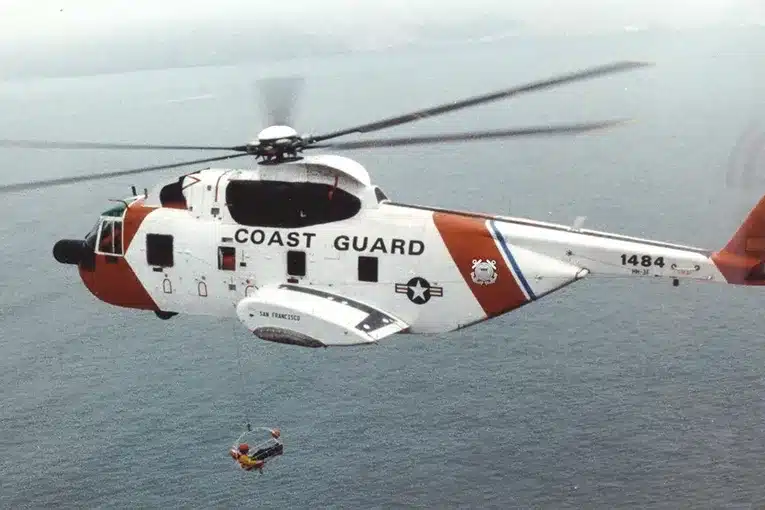
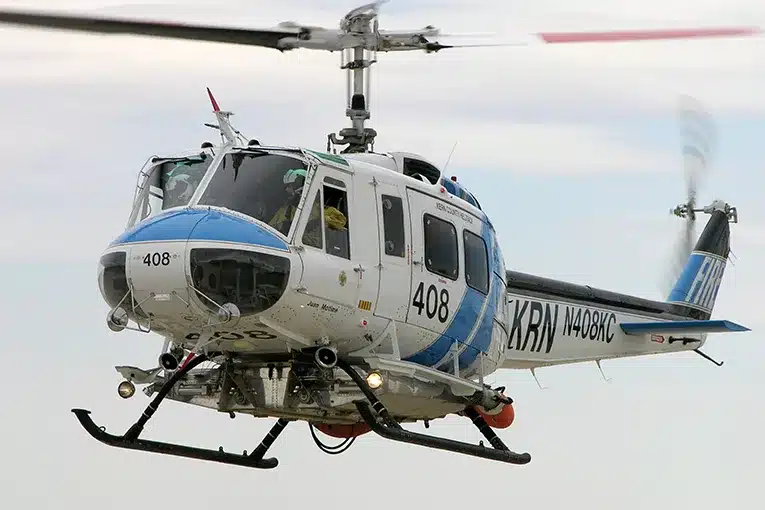
Helicopters are highly versatile firefighting aircraft.
They can rapidly drop water or retardant on fires, ferry firefighters and equipment, perform aerial ignition, or conduct search and fire rescue.
They operate closer to the fireline than fixed-wing tankers.
Helicopters are also classified by type based on size and capacity.
Heavy helitankers are Type I, medium helis Type II, and light ones Type III.
These categories guide their deployment, as we describe below.
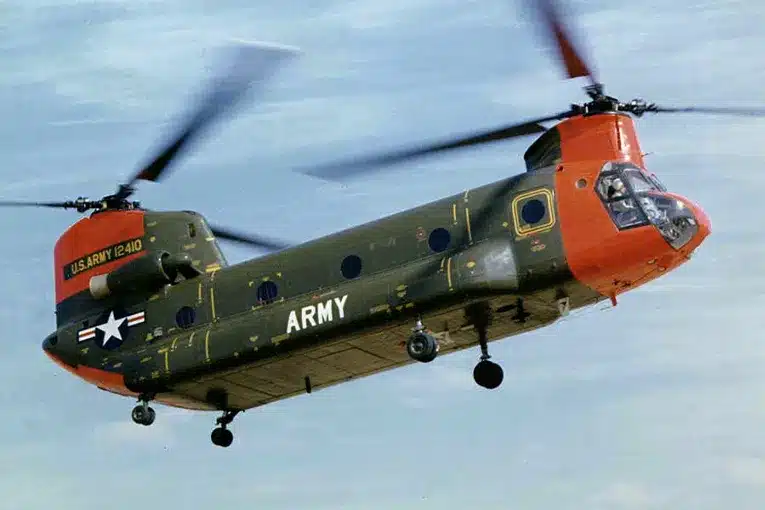
Military helicopters, especially heavy transports, have been adapted as ‘helitankers’ with enormous capacity.
The Boeing CH-47 Chinook (used by Southern California’s Quick Reaction Force) is the largest firefighting helicopter in the world.
Chinooks carry an internal 3,000-gallon tank and can hover-fill from a source in 90 seconds.
Another is the Sikorsky CH-53 Sea Stallion/CH-53K, with roughly 2,200 gal capacity, and the CH-54 ‘Helitanker’ Pelican (also ~2,200 gal).
These military helos are also fast; for example, the Chinook cruises at 160 kt.
Their advantage is clear.
They deliver far more water than civilian helicopters.
A single Chinook drop equals multiple drops by Type I helos.
Additionally, many are night-capable and can transport many troops or load heavier gear.
Military helitankers combine high volume, speed, and durability, making them formidable tools for large-scale firefighting operations
Final Thoughts
Aerial fire fighting brings together a diverse fleet of aircraft, each with a specialized role.
Air attack planes guide the operation, fixed-wing tankers blanket fires with retardant, and helicopters provide agile support.
Each type has advantages – from the enormous drops of DC-10s to the nimble bucket work of small helicopters.
Used together, these aircraft help contain wildfires that would otherwise spread.
Modern firefighting continuously evolves (new tankers, night-ops, and even drones), but the core remains.
Different flying machines are tools in the sky fighting fires.
By rapidly reaching remote fires, delivering huge volumes of water, and coordinating efforts, these aircraft types save land and lives, proving that the sky is an invaluable front line in wildfire suppression.
LGM to present marine fire detection systems in Singapore
LGM Productswill exhibit its marine fire detection systems at the Asia Pacific Maritime exhibition taking place in Singapore between 25 and 27 March 2026.
The company confirmed its participation in the biennial Asia Pacific Maritime (APM) event, which brings together more than 20,000 maritime professionals, 750 exhibitors and over 150 speakers.
The exhibition focuses on shipbuilding, marine technology, offshore systems and port operations, along with electric and hybrid marine systems.
The event also addresses operational themes including zero emission vessels, autonomous ship technologies and digital vessel systems.
LGM marine detection systems to be displayed at exhibition stand
LGM stated that visitors can view its marine-approved fire detection systems at stand F-D19 during the exhibition.
The company’s WES3 wireless marine products are designed to provide fire detection coverage for marine environments.
The Esento Marine Conventional Fire Detection System is also part of the range being presented, alongside FireFinder Marine addressable fire detection technology designed to support system monitoring and control in marine installations.
The exhibition provides an opportunity for attendees to view these marine fire detection systems as part of the wider Asia Pacific Maritime conference and exhibition programme.
Battery storage range expands with Green Battery Store
S Jones Conversions has developed an entry-level battery storage solution called the Green Battery Store as part of its battery storage range.
The company said the unit is intended for lower-risk applications to house batteries categorised as ‘green’ or low risk by the Dangerous Substances and Explosive Atmospheres Regulations (DSEAR) assessment.
It is described as providing environmental protection and basic electrical safety for storing smaller quantities of batteries in lower-risk scenarios.
The Green Battery Store is available in sizes from 8’6″ to 40ft.
The unit’s listed features include aluminium louvre vents, fire-resistant board linings, an HVAC system and an anti-vandal multi-locking personnel door.
It is described as suited to use where risk assessments identify minimal fire and explosion hazard or where facilities have existing safety infrastructure.
How the tiered range is described
The Green Battery Store is described as the latest addition to a tiered range with units categorised by the level of safety features required.
Alongside Green, the tiers are described as Bronze for moderate-risk applications, Silver for higher-risk applications and Gold for the most demanding scenarios including destructive battery testing.
The company said selecting the most appropriate solution depends on the DSEAR assessment and considerations including property insurer requirements, local fire authority guidance, battery chemistry and volume, proximity to other infrastructure and risk tolerance of third parties.
Andrew Nicholls, Head of Conversions at S Jones Containers commented: “Over the last few years we’ve established our reputation as a ‘go to’ partner for containerised battery storage and testing units.
“Our new tiered approach to the range is an important development – making it even easier for our customers to choose the solution that best meets their specific project needs including budget requirements.
“The new Green Battery Store provides an affordable solution that still puts safety first for peace of mind.”
Features described for Bronze, Silver and Gold tiers
S Jones Containers’ Bronze Battery Store is described as combining fire-retardant passive protection with active environmental controls as well as explosion venting and thermal management.
It is described as intended to contain and mitigate hazards during normal operation and minor thermal events.
Silver is described as building on Bronze with 60-minute fire-rated compartmentalisation, automated fire detection and integrated sprinkler capability.
Gold is described as featuring independent gas detection, temperature monitoring and automated mechanical ventilation response as well as fire and explosion risk reduction features.
It is also described as including hermetically sealed access doors and gas detection systems.
The Gold tier is described as designed for high-risk applications including ultra-high-density storage and lithium-ion battery cell destructive testing, with a design intended to reduce exposure to toxic gases that may be released during the testing process.
Semmco LPS highlights risks ahead of Health and Safety Event
Semmco Life Protection Systems (Semmco LPS), which will attend the Health and Safety Event at Birmingham NEC from 28 to 30 April 2026 at Stand 3/G1, has outlined how changing working environments are creating new risks across multiple sectors.
Semmco LPS said procedural changes, new materials and technologies, and developments in cleaner energy and electric transport are contributing to these risks.
Escape breathing apparatus was described as a regulatory requirement in relevant working environments and as equipment used to support safe evacuation from hazardous or oxygen deficient conditions.
Semmco LPS designs and manufactures short duration breathing apparatus intended for escape and working rescue in confined spaces and extreme environments.
Sector examples including prisons shipping and freight rail
Semmco LPS cited the prison system as one example, stating that 2,287 fires in prison cells were recorded in 2023.
Eighty percent of these incidents were attributed to vape pens.
Semmco LPS is working with HM Prison and Probation Service to provide its HEAD RPE/CSRE (Cell Snatch Rescue Equipment) escape breathing sets to prisons across England and Wales.
The contract includes user training and a managed refurb and maintenance programme.
Semmco LPS also referenced the global shipment of electric vehicles onboard ships and cited increased awareness of battery fire dangers during transport.
In freight rail transport, the company described the highest risks as being linked to hazardous goods and materials.
Semmco LPS said recent legislation changes in the USA mandate that EEBDs be available to employees working in freight train cabs transporting hazardous material “that would pose an inhalation hazard in the event of release during an accident.”
Product specifications and manufacturing expansion
Semmco LPS said its EEBD is a self-contained oxygen breathing apparatus with a 15 minute duration and no fit testing requirement.
Both the HEAD and EEBD devices are head worn short duration escape sets using potassium superoxide (KO2).
The products provide a constant oxygen supply for the duration required to escape hazardous environments.
Semmco LPS has opened a new manufacturing facility in Woking Surrey with dedicated production pods and a service and refurbishment area for the HEAD product.
Semmco LPS will exhibit at Stand 3/G1 at Birmingham NEC from 28 to 30 April 2026.
Arco has opened a specialist centre in Aberdeen to support oil, gas and renewables sector companies working across onshore and offshore operations.
The£500,000 site is intended to help companies minimise risk and maximise productivity across demanding working environments.
The 13,700 sq ft centre is based near Aberdeen airport.
It offers safety training, face fit testing, respiratory servicing and product decoration services.
The centre also provides offshore kit drops, with orders placed before 3pm delivered the same day.
Each week, up to 100 kit bags are dispatched from the Aberdeen centre to the North Sea and beyond.
Energy and export focus
The launch follows Arco’s November announcement of a 37 per cent rise in pre-exception EBITDA to £11.4 million over the past year.
Alex Richards, Arco’s Energy and Export Director, said: “We’ve been keeping customers in Aberdeen safe for nearly 40 years, and this new centre signifies more than just a move to a new site.
“Our £500,000 centre enables access to Arco’s more than 140 years’ safety experience through best-in-class training, respiratory servicing, face fit testing, and same-day offshore kit drops.
“We supply highly certified PPE selected specifically to combat hazards faced offshore, onshore and across complex industrial environments.
“Our people are energy sector specialists, with deep understanding of industry regulations, working conditions and operational challenges.
“That knowledge allows us to provide informed guidance, the right solutions first time, and a level of service customers can rely on.
“By keeping people at the centre, and offering products dedicated to the energy industry, we’ve built long-standing partnerships that help protect workers, reduce risk and maximise productivity across Aberdeen’s energy community.”
The company said it is supporting workers across the globe from the Aberdeen centre, including Africa and the Middle East.
Rosenbauer order for Athens airport PANTHER replacement
Rosenbauer is set to deliver its 3,000th PANTHER 6×6 to Athens International Airport as part of a seven-vehicle order.
Rosenbauer announced it had won an international tender to supply Greece’s largest airport with seven fourth-generation PANTHER 6×6 vehicles.
The seven new vehicles will replace seven PANTHER units from the existing airport fleet from the 1998 model year.
Vehicle configuration and onboard systems
The order includes three PANTHER 6×6 vehicles with a high reach extendable turret (HRET) and four vehicles with a classic roof turret.
The HRET units have an extendable telescopic arm that reaches a height of around 16 metres.
The arm is fitted with a piercing tool intended for penetration into aircraft fuselages.
The turret can dispense water, foam or extinguishing powder.
The roof-turret vehicles have electrically remote-controlled turrets with flow rates of up to 9,000 litres per minute.
The roof turrets have throw ranges of well over 80 metres.
The company said the award decision also considered pump and admixture systems, turret control, driver assistance and safety systems, crew cabin ergonomics, off-road mobility and robustness.
The specification also includes integrated thermal imaging and illumination solutions.
Athens airport operating context and production milestone
Athens International Airport opened in March 2001 and has two runways.
The airport currently handles an average of around 770 flights per day, with higher levels in the summer months.
Rosenbauer stated the delivery of the 3,000th PANTHER also marks a production milestone for its airport firefighting vehicle line.
The company traced the line from large tank firefighting vehicles in the 1950s, through the SIMBA series in the 1980s, to the debut of the first PANTHER in 1991.
It reported that more than 2,000 PANTHERs were delivered between 1991 and 2020, with over 1,000 more added between 2020 and 2026.
The company listed Geneva, Atlanta and Athens as examples of airports where the PANTHER is in operation.
The 3,000th PANTHER 6×6 is part of the seven-vehicle delivery planned for Athens International Airport.
Fire doors are a vital part of a building’s fire safety system, acting as strong barriers that slow the spread of flames and smoke.
Properly maintained fire doors give occupants time to escape and prevent damage to other areas, and are a vital fire suppression tool.
Regular fire door inspections are essential to make sure these doors will work as intended in an emergency.
This article explains what a fire door inspection involves, why inspections matter, the legal obligations around them, and who should carry them out.
It also provides a step-by-step checklist to help you perform thorough fire door inspections.
What is a Fire Door Inspection
A fire door inspection is a detailed check to confirm that a fire door assembly will perform correctly if a fire occurs.
A qualified inspector examines the door leaf, frame, hardware and all related components to ensure they meet safety standards.
For example, the inspector checks the door’s certification label and fire rating, examines the door and frame for damage, and tests that hinges, locks and closers function properly.
Smoke seals and intumescent strips are also inspected to ensure they will expand and seal gaps in heat.
Basically, a fire door inspection systematically tests every part of the door against a pass/fail protocol to make sure the door can contain fire for its rated duration.
Step-by-Step Fire Door Inspections Checklist
A thorough fire door inspection follows a clear checklist.
Inspectors typically perform the following checks one by one:
Certification Label & Rating
Confirm the fire door’s certification label is present, legible, and matches its required fire-rating.
Without a valid label, you cannot prove the door is properly rated.
Door and Frame Condition
Inspect the door leaf and frame for damage or warping.
Look for holes, cracks, dented edges, heavy corrosion or other defects that could weaken the door’s integrity.
Any significant damage should be noted.
Gaps and Clearances
Measure the gap around the closed door.
The clearances at the top, sides and bottom should meet regulatory limits.
Excessive gaps allow smoke or fire to bypass the door.
Glazing
Check any vision panels or windows in the door.
Ensure the glass is unbroken, fire-rated and correctly fitted to the door.
Improper glazing can compromise the door’s fire performance.
Door Hardware
Examine all door hardware.
This includes hinges, lock sets, handles, latches and panic bars.
Ensure each item is fire-rated, securely fixed, and functions smoothly.
For example, hinges must be fitted with fire-rated pins and allow the door to swing freely.
Door Closer and Closing Action
Test the door closer by opening the door fully and releasing it from different angles.
It should close the door fully and latch securely on its own.
If the closer is weak or jammed, the door will not shut, defeating its purpose.
Seals and Intumescent Strips
Look around the edges of the door for smoke seals and intumescent strips.
These should be intact and undamaged.
Intumescent strips expand in heat to seal the gap between door and frame.
Any missing or torn seals reduce effectiveness.
Coordinator
On pairs of fire doors, check that the inactive leaf closes before the active leaf.
This sequence is critical for double doors to seal properly in a fire.
Signage
Verify that any required fire door signs (such as ‘Fire Door – Keep Shut’) are fitted and legible.
Proper signage is part of compliance.
Modifications and Obstructions
Look for unauthorised alterations (extra holes, cuts, oversized glazing) that might void the fire-rating.
Also check that nothing blocks the door from closing.
Document Findings
Record the condition of each door.
Note any faults or failures. Many regulations require keeping written records of inspections.
A clear inspection report helps ensure all issues are tracked and fixed.
Why are Fire Door Inspections Important
Fire doors are only effective if they are maintained in good condition.
Routine inspections help catch problems early.
UK fire safety law (the Regulatory Reform Order 2005) makes it a legal duty to keep fire doors working properly.
Beyond compliance, inspections are a vital safety measure.
Fully functioning fire doors significantly slow the spread of fire and smoke, protecting escape routes and giving people extra time to evacuate safely.
Over time, normal wear and tear, or damage from everyday use, can degrade a door’s performance.
Hinges might loosen, seals might tear, and closers can weaken if not checked.
Regular checks find these issues before an emergency happens.
Inspections also provide documented proof of maintenance, which is important for audits or insurance.
How Long Do Fire Door Inspections Take?
The time needed depends on the building and the number of doors.
For a single door, a thorough check often takes on the order of around 15 minutes.
This includes opening and closing the door, measuring gaps, and logging results.
For a building with many fire doors, the inspection will take correspondingly longer.
The total duration varies with how many doors are checked.
Inspecting a small number of doors might only take an hour or two, whereas a large multi-storey building with dozens of doors could require a half-day or more.
Factors like restricted access, complicated layouts or any required intrusive checks can also extend the time.
In any case, it’s wise to schedule inspections well in advance so the inspector can work carefully and document everything properly.
What Happens if You Fail a Fire Door Inspection?
Failing an inspection means defects were found that could stop the door from working in a fire.
The inspector’s report will list these issues and rate each door as pass or fail.
If a fire door fails, the report usually includes clear recommendations on what remedial work is needed to bring it up to standard.
Common fixes include repairing or replacing damaged seals, fixing hardware, rehanging the door to align properly, or even installing a new certified door if the old one is beyond repair.
You should promptly create an action plan to address the failures.
A failure should trigger repairs within an acceptable timeframe.
This means arranging maintenance or hiring a specialist to fix issues quickly.
Until the door is fixed, it should not be considered compliant or relied on for fire safety.
Are Fire Door Inspections a Legal Requirement
Yes.
Fire door inspections are explicitly required by law as part of maintaining fire safety.
In the UK, the Regulatory Reform (Fire Safety) Order 2005 (covering England and Wales) states that fire safety measures, including doors, must be kept in efficient working order.
In other words, fire doors must be regularly inspected and maintained. Similar laws apply in Scotland and Northern Ireland (for example, the Fire (Scotland) Act 2005 and related regulations).
Fire safety legislation for all UK regions highlights these responsibilities, and penalties for non-compliance can include unlimited fines or even imprisonment.
British Standards like BS 8214 and BS 9999 give detailed guidance on how often to inspect doors, but following those is a matter of compliance with the overall legal duty.
For residential apartment blocks, recent regulations (Fire Safety Act 2021 and the 2022 Fire Safety Regulations in England) have clarified that flat entrance doors must be treated as part of the building’s fire safety provisions.
The bottom line is that if your building falls under fire safety law, you must inspect fire doors on a planned basis.
Skipping inspections not only endangers people but also violates the law.
Who Can do Fire Door Inspections
Legally, the building’s ‘responsible person’ (often the owner, landlord or employer) is ultimately accountable for fire door safety.
However, the actual inspections can be carried out by others.
Basic visual checks can be done by trained in-house staff or facility managers.
These routine checks help catch obvious damage like broken hardware or blocked doors.
For full formal inspections, UK guidance says they must be performed by a competent person.
This is someone with specific knowledge and training about fire doors.
This person may be a facilities manager who has attended a fire door inspection course, or maintenance staff with.
In high-risk or larger buildings, it is common to hire accredited fire door inspectors from third-party companies.
These professionals often hold industry certificates (for example from the Door & Hardware Federation or other bodies) and have deep expertise.
The key point is that anyone performing the inspection must be properly trained and know how to interpret fire door standards.
You do not have to be a fire brigade officer, but you do need either competent staff or qualified contractors.
Key Takeaways
Regular fire door inspections are essential for safety and compliance.
By following a systematic checklist and having qualified people perform the checks, building owners can catch problems before a fire ever occurs.
Inspections confirm that doors and frames, hardware and seals are all in good working order.
This is so the doors will hold back fire and smoke as designed.
UK fire safety law makes these inspections mandatory, not optional.
A well-maintained fire door can save lives and property.
Using the steps outlined above, anyone responsible for fire safety can ensure their doors remain reliable barriers in an emergency.









.jpg)

.jpg)

.jpg)
.jpg)
.jpg)
